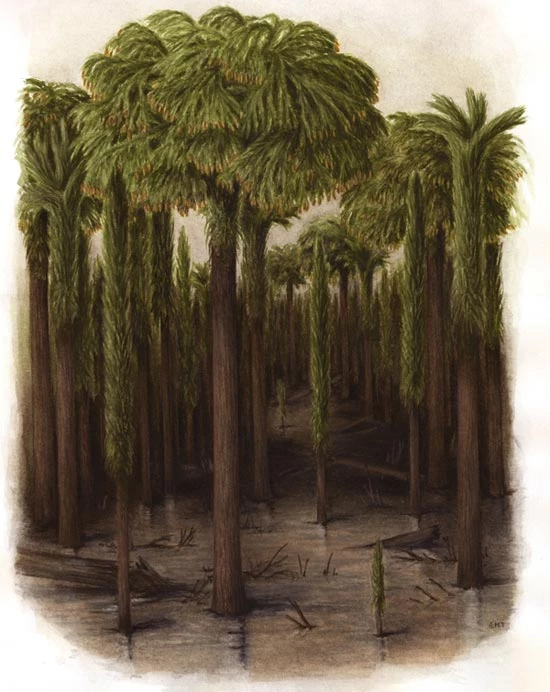
Lepidodendron
Lepidodendron
Main page
2106295

Lepidodendron

logo
Community Hub0 subscribers
Read side by side
from Wikipedia

Lepidodendron
Temporal range: Early Carboniferous–Late Permian
Life reconstruction
Scientific classification Edit this classification
Kingdom: Plantae
Clade: Embryophytes
Clade: Tracheophytes
Clade: Lycophytes
Class: Lycopodiopsida
Order: Lepidodendrales
Family: Lepidodendraceae
Genus: Lepidodendron
Sternberg, 1820
Species
  • L. aculeatum Sternberg 1820
  • L. batovii Chachlov 1948
  • L. obovatum Sternberg 1820
  • L. whitehillianum Anderson & Anderson 1986
Synonyms
  • Dimicheleodendron B.A.Thomas & C.J.Cleal

Lepidodendron, from Ancient Greek λεπίς (lepís), meaning "scale", and δένδρον (déndron), meaning "tree", is an extinct genus of primitive lycopodian vascular plants belonging to the order Lepidodendrales. It is well preserved and common in the fossil record. Like other Lepidodendrales, species of Lepidodendron grew as large-tree-like plants in wetland coal forest environments. They sometimes reached heights of 50 metres (160 feet),[1] and the trunks were often over 1 m (3 ft 3 in) in diameter. They are often known as "scale trees", due to their bark having been covered in diamond-shaped leaf-bases, from which leaves grew during earlier stages of growth. However, they are correctly defined as arborescent lycophytes. They thrived during the Carboniferous Period (358.9 to 298.9 million years ago), and persisted until the end of the Permian around 252 million years ago. Sometimes erroneously called "giant club mosses", the genus was actually more closely related to modern quillworts than to modern club mosses. In the form classification system used in paleobotany, Lepidodendron is both used for the whole plant as well as specifically the stems and leaves.

Description and biology

[edit]

Overview

[edit]
Lepidostrobus, the strobilus of Lepidodendron lycophytes
Reconstruction of Lepidodendron (second from left) compared to a juvenile scale tree (far left) and other Lepidodendrales, which from left to right include Lepidophloios, Synchysidendron, Diaphorodendron and Sigillaria.

Lepidodendron species were comparable in size to modern trees. The plants had tapering trunks as wide as 2 m (6.6 ft) at their base that rose to about 40 m (130 ft)[2] and even 50 m (160 ft),[1] arising from an underground system of horizontally spreading branches that were covered with many rootlets. Though the height of the lycopsids make the plants similar to modern trees, the constant dichotomy of branches created a habit that contrasts with that of modern trees. At the ends of branches were oval-shaped strobili called Lepidostrobus that had a similar shape to modern cones of a spruce or fir.[3]

Stem

[edit]
Leaf scars shown on a Lepidodendron. The "diamond shape" or scale impressions are common indicators of the leaf scars from Lepidodendron lycophytes.

The stem of the lycopsids had a unifacial vascular cambium, contrasting with the bifacial vascular cambium of modern trees. Though the bifacial cambium of modern trees produces both secondary phloem and xylem, the unifacial cambium of Lepidodendron lycopsid produced only secondary xylem. As the lycopods aged, the wood produced by the unifacial cambium decreased towards the top of the plant such that terminal twigs resembled young Lepidodendron stems. Compared to modern trees, the stems and branches of the lycopsids contained little wood with the majority of mature stems consisting of a massive cortical meristem. The nearly-uniform growth of this cortical tissue indicates no difference in growth during changing seasons, and the absence of dormant buds further indicates the lack of seasonality in Lepidodendron species.[4] The outermost cortex of oldest stems developed into the bark-like lycopodiopsid periderm.[5] The bark of the lycopsid was somewhat similar to that of Picea species, as leaf scars formed peg-like projections that stretched and tore as the bark stretched. To resist the bending force of wind, Lepidodendron depended on their outer bark rather than their vascular tissues, as compared to modern trees that rely mostly on their central mass of wood.[3]

Leaves

[edit]
Leaf of Lepidodendron

The leaves of the lycopsid were needle-like and were densely spiraled about young shoots, each possessing only a single vein. The leaves were similar to those of a fir in some species and similar to those of Pinus roxburghii in others, though in general the leaves of Lepidodendron species are indistinguishable from those of Sigillaria species. The decurrent leaves formed a cylindrical shell around branches. The leaves were only present on thin and young branches, indicating that, though the lycopsid were evergreen, they did not retain their needles for as long as modern conifers. The leaf-cushions were fusiform and elongated, growing at most to a length of 8 cm (3 in) and a width of 2 cm (34 in). The middle of leaf-cushions were smooth, where leaf scars were created when an abscission layer cut a leaf from its base. Each leaf scar was composed of a central circular or triangular scar and two lateral scars that were smaller and oval-shaped. This central scar marks where the main vascular bundle of the leaf connected to the vascular system of the stem. This xylem bundle was composed only of primary trachea.[citation needed] The two outer scars mark the forked branches of a strand of vascular tissue that passed from the cortex of the stem into the leaf. This forked strand is sometimes referred to as the "parichnos". Surrounding this strand were parenchyma cells and occasionally thick-walled elements. Surrounding both conducting tissues was a broad sheath of transfusion tracheids. Below the leaf scar the leaf-cushion tapered to a basal position. In this tapering area, circular impressions with fine pits were present. These impressions were continuous with the parichnos scars near the top of the tapering portion. This is because the impressions are formed by aerenchyma tissue that developed in closely with the parichnos. Above the leaf scar was a deep triangular impression known as the "ligular pit" for its similarities to the ligule of Isoetes. In some leaf-cushions a second depression was present above the ligular pit. Though its purpose is unclear, it has been suggested that the depression may mark the position of a sporangium. As the branch of a Lepidodendron lycopsid grew the leaf-cushion only grew to a certain extent, past which the leaf-cushion stretched. This stretching widened the groove that separated the leaf-cushions, creating a broad, flat channel.[3]

Underground structures

[edit]

The underground structures of Lepidodendron and similar lycopsid species known from the fossil record including Sigillaria are assigned to the form taxon, Stigmaria. The rootlets were dichotomously branched from the rhizomes similar to Isoetes. These rhizomorphic axes were shoot-like, and dichotomous branching of the rootlets structured the stigmarian systems. Rootlet scars can be seen from Stigmaria fossils where the root hairs used to be attached.[6] Hyphae are occasionally present in the tissues of Lepidodendron lycopsids, indicating the presence of mycorrhizal associations.[7]

Decay

[edit]
Lepidodendron sp. bark from the Estonian Museum of Natural History.

Different fossil genera have been described to name the various levels of decay in Lepidodendron bark fossils. The name Bergeria describes stems that have lost their epidermises, Aspidiaria is used when cushions have been removed by deep decay, and Knorria is used when the leaf cushions and the majority of cortical tissues has decayed, with a shallow "fluted" surface remaining. However, it has been suggested that these are more likely growth forms than preserved bark types, as entire fossilized trunks have been discovered with dissimilar forms; if decay is assumed to be constant throughout the trunk, then different forms indicate growth rather than levels of decay. It is likely that the trunk of Lepidodendron lycopsids were subject to the growth forms Knorria, Aspidiaria, and Bergeria progressing up the trunk, respectively.[8]

Growth and reproduction

[edit]
External image
image icon Painting of lepidodendralean trees at various stages of growth by Annette Townsend
Reconstruction of a juvenile Lepidodendron, showing the unbranched trunk with leaves

During the early stages of growth, Lepidodendron grew as single, unbranched trunk, with leaves growing out of the scale leaf bases (cushions). Towards the end of the lycopod growth, the leaves on the lower part of the trunk were shed, and in Lepidodendron, the upper part of the trunk dichotomously branched into a crown.[9] The rate of growth of arborescent lycophytes is disputed, some authors contended that they had a rapid life cycle, growing to their maximum size and dying in only 10 to 15 years, while other authors argue that these growth rates were overestimated.[9] Rather than reproduce with seeds, Lepidodendron lycopsids reproduced with spores. The spores were stored in sporangia situated on fertile stems that grew on or near the main trunk. The fertile stems grew together in cone-like structures that clustered at the tips of branches.[10]

Distribution

[edit]

The lack of growth rings and dormant buds indicates no seasonal growth patterns, and modern plants with similar characteristics tend to grow in tropical conditions. However, Lepidodendron species were distributed throughout subtropical regions. The lycopsid inhabited an extensive area compared to tropical flora of the same time period, with lycopods growing as far north as Spitsbergen and as far south as South America, in a latitudinal range of 120°.[4]

Extinction

[edit]

In Euramerica, Lepidodendron became extinct at the end of the Carboniferous,[11] as part of a broader pattern of ecological change, including the increasing dominance of seed plants in lowland wetland forests, and increasingly arid-adapted vegetation across western Pangea.[12] However, in the Cathaysia region comprising what is now China, wet tropical environmental conditions continued to prevail, with Lepidodendron (in its broad sense) only becoming extinct around the end of the Permian, around 252 million years ago, as a result of the extreme environmental disturbance caused by the Permian-Triassic extinction event.[11][13]

[edit]

See also

[edit]

References

[edit]

Further reading

[edit]
Revisions and contributorsEdit on WikipediaRead on Wikipedia
from Grokipedia
Lepidodendron was an extinct genus of primitive, vascular, arborescent lycopsid plants, related to modern clubmosses and quillworts, that dominated the swampy forests of the Carboniferous Period from approximately 359 to 299 million years ago.[1][2] These tree-like plants, often called "scale trees," grew to heights exceeding 30 meters (100 feet) with trunk diameters over 1 meter (3.3 feet), featuring tall, unbranched or sparsely branched trunks covered in diamond-shaped leaf scars from spirally arranged, narrow leaves.[1][2][3] Characterized by a pole-like growth form with limited secondary xylem and primary support from a thick periderm layer, Lepidodendron species had soft tissues comprising much of their structure, including a cortex with lacunae for gas exchange and parichnos strands aiding aeration in waterlogged soils.[3][4] They reproduced heterosporously via spores produced in cone-like strobili, with a short lifespan of 10–15 years and a monocarpic life history, meaning they fruited once near the end of their lives before dying.[1][2][4] Ecologically, they formed dense stands in tropical peat-forming wetlands, tolerating anaerobic conditions through extensive stigmarian root systems and possibly employing crassulacean acid metabolism (CAM)-like photosynthesis for adaptation to their shady, humid habitats.[1][3][4] Fossils of Lepidodendron, including stems, leaves (as Lepidophyllum), roots (Stigmaria), and reproductive structures (Lepidostrobus), are abundant in Carboniferous coal measures worldwide, often preserved as impressions or compressions that reveal their scale-like bark patterns.[2][3] These plants peaked in abundance during the Westphalian stage (roughly 318–307 million years ago), comprising up to 70% of the biomass in some coal swamps, but declined toward the end of the Pennsylvanian due to climatic drying and competition from seed plants, becoming fully extinct by the early Permian.[3][4]

Taxonomy and nomenclature

Classification

Lepidodendron is an extinct genus within the phylum Lycopodiophyta, class Lycopodiopsida, order Lepidodendrales, and family Lepidodendraceae, representing arborescent lycopsids that dominated Carboniferous swamp forests.[3][5] This placement situates it among primitive vascular plants characterized by microphyllous leaves, ligules, and heterospory, with the Lepidodendrales forming a key clade of tree-like forms in the lycophyte lineage.[6] The genus belongs to the isoetalean clade of lycopsids, which includes the modern order Isoetales with herbaceous quillworts such as Isoetes, though the exact phylogenetic relationships within this clade remain debated.[3][6] In contrast to the smaller, creeping modern lycopods like Selaginella (Selaginellales) and Lycopodium (Lycopodiales), Lepidodendron exhibits a derived arborescent habit with extensive secondary growth, highlighting the evolutionary divergence toward gigantism in Paleozoic lycophytes while sharing ancestral traits like strobilar reproduction and stigmarian roots.[3][6] Lepidodendron is distinguished from the related genus Sigillaria (also in Lepidodendrales) primarily by its leaf scar arrangement and branching pattern; Lepidodendron features diamond- or rhomboid-shaped leaf cushions with scars in a spiral phyllotaxy and frequent dichotomous branching, whereas Sigillaria has leaf scars aligned in vertical rows on hexagonal bases with more limited, often unbranched or sparsely forked trunks.[7][3] Over 60 species of Lepidodendron have been recognized across Carboniferous floras, based on variations in stem diameter, leaf cushion morphology, and epidermal features.[8] Notable examples include L. harcourtii, identified by its elongated, keeled leaf cushions and prominent parichnos pits on the scars, and L. nobilissimum, characterized by robust trunks exceeding 2 meters in diameter and large, scale-like leaf bases indicative of mature growth stages.[9][10]

Etymology and synonyms

The genus name Lepidodendron derives from the Ancient Greek words lepís (λεπίς), meaning "scale", and déndron (δένδρον), meaning "tree", a reference to the distinctive diamond-shaped, scale-like leaf scars that adorned the trunks and branches of these extinct plants.[2] The genus Lepidodendron was established by Kaspar Maria von Sternberg in 1820, with type species L. aculeatum. The species L. harcourtii was described in 1831 by Henry Witham in his work Observations on Fossil Vegetables, based on well-preserved petrified specimens from Carboniferous coal measures in Lancashire, England, marking the first detailed anatomical study of such fossils.[11][12] Early paleobotanists applied several synonyms to Lepidodendron fossils owing to the fragmented nature of the material and misinterpretations of detached parts as separate taxa; for instance, Knorria was coined for decorticated stems where the outer bark had been lost, exposing irregular ridges from underlying vascular tissues, later recognized as a preservational variant of Lepidodendron and related genera like Bothrodendron.[3] Taxonomic debates have persisted regarding species validity within the genus, often leading to synonymy due to variability in leaf scar shape, branching, and preservation states.[13]

Morphology

Stem

The stem of Lepidodendron exhibited a pseudomonopodial growth pattern, characterized by dichotomous branching that created the illusion of a single dominant axis through unequal division of apical meristems, allowing for the development of a tall, trunk-like structure before extensive branching occurred higher up.[14] This branching typically began after an initial unbranched juvenile phase, with dichotomies producing a crown of smaller branches at the apex.[15] The stem tapered from a broad base to a narrower apex, with diameters reaching up to 1 meter or more at the base in mature specimens, providing the structural foundation for trees that could exceed 30 meters in height.[2] Externally, the stem surface was marked by diamond-shaped leaf scars arranged in a helical pattern, formed after the deciduous leaves abscised and left behind cushion-like bases that expanded with secondary growth.[14] These scars, taller than wide, featured a central pit for the vascular bundle attachment and smaller lateral parichnos scars, contributing to the characteristic "scale tree" appearance.[15] Internally, the vascular system consisted of an exarch siphonostele surrounding a central parenchymatous pith, with the primary xylem showing polyarch protoxylem points and the stele embedded in a multilayered cortex.[14] Secondary growth occurred via a unifacial vascular cambium that produced secondary xylem inward in radial ranks of tracheids with uniseriate rays, but no secondary phloem outward, resulting in an eccentric vascular ring due to uneven cambial activity.[15] In the absence of true lignified wood like that in modern trees, mechanical support was primarily provided by a thick periderm developed from a cork cambium (phellogen), which generated phellem externally and phelloderm internally, forming a bark-like layer that thickened over time.[14]

Leaves

The leaves of Lepidodendron, known as microphylls, were characteristically linear to lanceolate in shape, tapering to a sharply pointed apex, and could reach lengths of up to 1 meter while being only a few millimeters wide.[14][16] These leaves featured a single central vein for vascular transport and possessed a ligule—a small, tongue-like structure located near the base—that likely aided in water regulation or protection.[17] They were arranged spirally along the stems in a helical pattern, attaching directly without petioles.[16][2] Lepidodendron leaves were deciduous, abscising at the base and leaving behind distinctive diamond-shaped leaf cushions or scars on the stem surface, which contributed to the plant's scaly appearance in fossils.[14][2] Leaf size and form varied by growth stage: juvenile plants bore longer, grass-like foliage up to 1 meter, while adult branches supported shorter, scale-like leaves that were more adpressed and compact.[14][16] This ontogenetic variation reflects adaptations to structural changes during the plant's development from unbranched saplings to branching trees.[18] Fossil evidence reveals key photosynthetic adaptations in Lepidodendron leaves, including a protective cuticle covering the epidermis and stomata primarily along the lower surface in longitudinal grooves for gas exchange.[16][2] Cuticle thickness was relatively thin on the leaf laminae compared to the basal cushions, facilitating CO₂ uptake, while stomatal densities ranged from 200–250 per mm² in L. aculeatum to 450 per mm² in L. dichotomum, supporting efficient photosynthesis in the humid Carboniferous environment. These features, preserved in compression and impression fossils, indicate that the leaves were the primary photosynthetic organs, with potential contributions from persistent leaf cushions post-abscission.[4]

Reproductive organs

Lepidodendron exhibited heterospory, producing microspores and megaspores in separate strobili borne terminally on distal branches within the crown of the tree.[3] These reproductive structures, classified under form genera such as Lepidostrobus for microsporangiate cones and Lepidocarpon for megasporangiate cones, were typically 30–50 cm long and 2–6 cm in diameter.[14] Microsporangia and megasporangia occurred on different plants, reflecting a dioecious-like condition in this extinct lycopsid.[4] The cone structure featured a central axis supporting helically arranged sporophylls, which were modified versions of the plant's foliage leaves, with upturned distal portions and a basal heel for attachment.[3] Each sporophyll bore a single sporangium on its adaxial surface, often partially enclosed by lateral laminae in megasporangiate forms.[14] A distinctive ligule, a small tongue-like projection, occupied a pit just distal to the sporangium, potentially aiding in moisture regulation or spore protection.[3] Microspores, dispersed under the genus Lycospora, measured 20–30 μm in diameter, possessed a trilete suture, and featured walls ornamented with fine spines or equatorial thickenings.[3] Megasporangia typically produced a single functional megaspore alongside aborted ones, with dispersed forms assigned to Cystosporites, reaching 700–1250 μm in size and characterized by thick walls of loosely woven sporopollenin strands, sometimes with spinose or tuberculate ornamentation.[14] While some related lepidodendrids, such as Lepidophloios, displayed seed-like features including integument-like sporophyll outgrowths enclosing megasporangia, Lepidodendron lacked true seeds and relied on free-sporing heterospory for reproduction.[4]

Root system

The root system of Lepidodendron, referred to as Stigmaria, comprises elongate rhizomorph axes that exhibit isotomous dichotomous branching and radial symmetry, serving as the primary subterranean support structures. These rhizomorphs arise adventitiously from the lower stem, where they attach via a basal rooting zone marked by helically arranged circular scars left by the detachment or abscission of rootlets. Each rhizomorph bears numerous determinate rootlets in a helical phyllotaxy, with attachment points visible as small, circular scars on the surface, facilitating extensive lateral spread. This configuration allowed for the formation of broad, mat-like networks that enhanced stability in soft substrates.[19] The rootlets themselves display a highly branched, strictly dichotomous pattern, dividing up to five times with a stepwise diameter reduction of approximately 25% per branch order, resulting in densities of up to 25,600 terminal rootlets per meter of rhizomorph length. These branching networks, combined with dense root hairs, created interwoven mats that could extend over 12 meters, interlocking with adjacent root systems to provide anchorage for trees reaching heights of 30 meters and basal diameters of 2 meters in waterlogged coal swamp environments. The anatomy features simple vascular strands in the rootlets, lacking secondary growth, which supported efficient nutrient and mineral uptake in anaerobic, swampy soils, while the rhizomorphs themselves developed secondary xylem for added structural reinforcement.[20][19] In comparison to modern lycopods, such as those in the genus Isoetes, the Stigmaria system shares similarities in dichotomous branching and helical rootlet arrangement but differs markedly in scale and complexity, enabling the support of arborescent forms far larger than any extant lycopod rhizomes, which typically anchor smaller, herbaceous plants. This adaptation underscores the evolutionary innovations that allowed Lepidodendron to thrive as a dominant component of Carboniferous wetlands.[19]

Growth and life cycle

Development stages

Lepidodendron was heterosporous, producing microspores and megaspores in separate strobili on the fertile branches. These spores germinated endosporically, with the gametophytes (prothalli) developing entirely within the spore wall; the female prothallus arose from the larger megaspore and bore archegonia, while the smaller male prothallus from the microspore produced antheridia containing multiflagellated sperm.[21][14] Fertilization occurred after cone disaggregation and release of the Lepidocarpon units into the swamp, where multiflagellated sperm from wind-dispersed male gametophytes swam through water to the exposed archegonia of the female prothallus. This process required a film of water for the sperm to swim to the archegonia, linking reproduction to the moist swamp environment.[22] The zygote developed into an embryo that exhibited early dichotomous division of the apical meristem, with one branch forming the basal rooting system (Stigmaria) and the other initiating the upright stem. This marked the transition from the dependent gametophyte phase to the independent sporophyte, beginning with a short, potentially creeping juvenile stage before shifting to vertical growth supported by rhizomorphs.[14][23] In the juvenile phase, the sporophyte consisted of an unbranched, columnar stem bearing small, grass-like leaves arranged spirally, with limited dichotomous branching at the apex. As it matured into the adult phase, branching became more extensive through repeated isotomous apical dichotomies and occasional anisotomous divisions, leading to increased structural complexity and formation of an umbrella-like crown; leaf size and cushion development also enlarged progressively.[23][24] Fossil evidence from permineralized axes and leaf scar patterns indicates determinate, monocarpic growth, with an estimated lifespan of 10 to 15 years based on the limited number of branching cycles and absence of extensive secondary vascular accumulation before reproduction and senescence.[4]

Size and form

Lepidodendron attained mature heights of up to 50 meters, with trunk diameters reaching 1 to 2 meters at the base before tapering upward to accommodate its arborescent form.[25] These dimensions were supported by a massive primary body with limited secondary xylem growth, enabling rapid vertical extension while maintaining structural integrity.[25] The crown featured dense branching from the upper trunk, where lateral branches formed a compact canopy through isotomous dichotomies, often positioned sparsely along the axis.[26] Lower branches exhibited self-pruning via abscission, resulting in caducous laterals that reduced drag and optimized light capture in the forest understory.[26] Size variations occurred among species and populations, with preserved specimens documenting trunks up to 34.5 meters in length, indicative of the taller forms within the genus.[27] Full mature height was typically achieved late in the ontogenetic development, following an initial phase of rapid elongation.[25] Biomechanical adaptations for such stature included the broadened basal trunk diameter, which lowered the center of gravity and enhanced resistance to gravitational and wind-induced stresses, complemented by an extensive rhizomatous root system for anchorage.[25] This configuration allowed Lepidodendron to dominate Carboniferous swamp forests despite its lightweight wood.[25]

Paleobiology and ecology

Habitat and distribution

Lepidodendron primarily flourished during the Late Carboniferous Period, particularly in the Pennsylvanian subperiod (approximately 323–299 million years ago), within the extensive coal swamps of Euramerica, spanning regions corresponding to modern-day North America and Europe. These arborescent lycopsids dominated the vegetation in lowland mires, where they formed vast forests that contributed substantially to peat accumulation and subsequent coal formation.[28] The paleoenvironment of Lepidodendron consisted of tropical wetlands with persistently high humidity and water-saturated soils, ideal for the development of peat-forming ecosystems. These habitats featured dense stands of Lepidodendron trees, often associated with understory ferns and tall sphenopsids like Calamites, creating a layered forest structure in supersaturated, anaerobic conditions that limited decay and preserved organic matter.[29] Such environments were refugia for moisture-dependent lycopsids, enabling their proliferation amid the equatorial rainy belt of the time. Fossil floras reveal that Lepidodendron exhibited a predominantly Euramerican distribution, where it could comprise up to 75% of the peat biomass in swamp communities, underscoring its ecological dominance. Rare occurrences in Gondwanan assemblages indicate a more restricted presence outside Euramerica, likely influenced by regional climatic variations.[3] The species thrived under warm, wet climatic regimes that sustained high precipitation and stable temperatures, fostering the expansive growth of these scale trees in mire-dominated landscapes.[28]

Reproduction and dispersal

Lepidodendron exhibited an alternation of generations typical of vascular plants, with a dominant, independent sporophyte phase representing the large, tree-like form and a reduced gametophyte phase. The sporophyte produced spores via meiosis in strobili borne on fertile branches, initiating the gametophyte generation. Gametophytes were small, endosporic structures developing within the spore walls, with male gametophytes arising from microspores and female from megaspores; these were likely subterranean or soil-embedded due to their reduced size and dependence on moist, swampy substrates for development.[14][22] Reproduction was heterosporous, involving lightweight microspores (e.g., genus Lycospora) dispersed primarily by wind from microsporangiate strobili, facilitating widespread propagation in Carboniferous swamp environments. Megaspores (e.g., genus Cystosporites), larger and fewer in number, were typically retained within megasporangiate strobili such as Lepidocarpon, where endosporic female gametophytes developed; these dispersal units could also float on water surfaces, extending viability in wetland settings. Fertilization occurred on the prothallial gametophytes, where multiflagellated, swimming sperm from antheridia required a film of water to reach archegonia on female prothalli, thus necessitating consistently moist conditions analogous to pollination in more advanced plants.[14][22][30] Fossil evidence from Pennsylvanian sediments reveals mass spore release events, as indicated by abundant Lycospora and associated megaspore assemblages in coal balls and palynological deposits, suggesting synchronized reproduction tied to seasonal or environmental cues in ancient coal forests. These dispersed spores enabled colonization of suitable habitats, with concentrations in sediments pointing to episodic, high-volume dispersal from mature strobili.[14][22]

Ecological role

Lepidodendron dominated the vast coal forests of the Carboniferous Period, forming extensive monospecific stands in tropical swamp ecosystems that covered large areas of Euramerica. These arborescent lycopsids, reaching heights of up to 50 meters, created dense canopies and understories that shaped the structure of these wetlands, with their shallow, horizontally spreading root systems—known as Stigmaria—forming interconnected mats across the substrate. This root architecture stabilized waterlogged soils against erosion from frequent flooding and seasonal water level fluctuations, enhancing sediment retention and fostering conditions for further plant colonization.[31][32] Additionally, the extensive root networks influenced local hydrology by impeding surface water flow, promoting the development of anoxic conditions that inhibited decay and supported peat formation.[33] The prolific growth and rapid turnover of Lepidodendron biomass played a central role in nutrient cycling and organic matter accumulation within these ecosystems. Upon death, the trees' fibrous tissues and shed leaves contributed substantially to peat buildup in the swamp floors, serving as the primary precursor to the thick coal seams that define Carboniferous strata. This process not only sequestered carbon but also created stratified layers of organic material that supported specialized microbial communities. Evidence from permineralized roots suggests Lepidodendron formed symbiotic associations with arbuscular mycorrhizal-like fungi, which likely enhanced phosphorus and nitrogen uptake in the nutrient-impoverished, acidic swamp soils, enabling the trees' dominance despite limited resource availability.[34][32][33] As key structural elements of the forest, Lepidodendron trees provided essential resources for contemporary fauna, particularly invertebrates. Their bark, leaves, and decaying wood offered food for detritivores like the giant myriapod Arthropleura, which consumed plant detritus including Lepidodendron remains, facilitating decomposition and nutrient recycling. The complex architecture of trunks, branches, and root mats also created microhabitats—such as crevices and leaf litter accumulations—that sheltered diverse arthropod communities, including early insects and millipedes, thereby supporting trophic interactions within the swamp food web.[35][36]

Fossil record and preservation

Discovery and sites

Fossils of Lepidodendron were first scientifically described in 1820 by Czech botanist Kaspar Maria von Sternberg, who named the genus based on impressions of scaly bark from Carboniferous coal deposits in Europe. During the 19th century, Lepidodendron remains gained recognition through exposures in coal mines across Europe and North America, particularly in the Lancashire coalfields of the United Kingdom, where miners and early geologists encountered abundant stem impressions in the Coal Measures.[37] In the United States, similar discoveries occurred in Illinois coal mines, with fossils noted from the mid-19th century onward in areas like the Mazon River valley.[38] Key fossil sites include the Joggins Fossil Cliffs in Nova Scotia, Canada, a UNESCO World Heritage site renowned for its upright, in situ lycopsid trees, including Lepidodendron specimens preserved in growth position within rhythmically bedded sediments.[39] There, geologist Sir William Dawson conducted pioneering studies in the 1850s, collaborating with Charles Lyell to excavate and describe fossil forests, revealing Lepidodendron trunks and associated roots that informed early understandings of Carboniferous vegetation.[39] The Mazon Creek locality in Illinois has yielded exceptionally preserved Lepidodendron stems and leaves within siderite concretions, with intensified collections following strip mining in the 1940s that exposed vast fossil-bearing shales.[38] In Europe, major Carboniferous basins such as those in the Czech Republic, Upper Silesia (Poland), and the Pennine region (UK) have produced numerous Lepidodendron fossils from coal seams and associated shales.[40] Recent efforts have highlighted in situ Lepidodendron stumps, such as those at Joggins, where ongoing excavations continue to uncover growth-position assemblages, and rediscoveries like a 34.5-meter-long trunk from a Bolton, Lancashire coal mine, originally documented in the 19th century but reanalyzed in 2009 for its exceptional length.[27] In 2024, exceptionally well-preserved Lepidodendron fossils, dating to approximately 300 million years ago, were discovered in the suburbs of Yangquan City, Shanxi Province, China, representing some of the best-preserved examples known.[41] Preservation at these sites often involves permineralization in coal balls or encasement in concretions, capturing fine anatomical details.[38]

Taphonomy and decay

Lepidodendron remains were primarily preserved through rapid burial in the anoxic, waterlogged environments of Carboniferous coal swamps, where low oxygen levels inhibited aerobic microbial activity and slowed organic decay.[42] This process often led to permineralization, particularly in coal balls—calcite-filled concretions that captured peat fabrics before coalification, preserving cellular details of stems, roots, and branches.[43] In contrast, compression fossils formed when plant material was buried under fine sediments like mud or sand, flattening tissues while retaining impressions of external features.[44] Differential preservation patterns reflect the varying durability of Lepidodendron tissues during transport and burial. Stems frequently occur as internal and external casts or molds, formed by sediment intrusion into hollowed cylinders after softer inner tissues decayed, with compression sometimes expanding apparent widths by up to 57%.[17] Leaves, being thinner and more delicate, typically preserved as impressions in surrounding sediments, capturing details like vein patterns before full degradation.[17] Roots, especially stigmarian systems, often remained in situ within paleosols or peat, their robust structure resisting displacement and allowing permineralization to record growth positions. Petrifaction of Lepidodendron involved mineral replacement, primarily by silica and calcite, which infiltrated organic matrices during early diagenesis. Silica replacement dominated in some volcanic-influenced settings, filling voids and preserving wood structure through opal and quartz precipitation, as seen in silicified trunks from the Colorado Rocky Mountains.[45] Calcite, common in coal ball permineralizations, replaced or filled cell lumina in anoxic peat, maintaining anatomical fidelity despite ongoing mineralization.[46] These processes were most effective in stable swamp substrates, such as those at the Joggins Fossil Cliffs, where rapid sedimentation entombed upright trees.[42] Biodegradation of Lepidodendron targeted lignin-poor or exposed tissues, with fungi and bacteria preferentially attacking softer, cellulose-rich inner bark and leaf bases under aerobic conditions near swamp edges.[42] Fungal hyphae, indicative of white-rot decay, penetrated lignified periderm in aerated peats, leading to poor preservation of Lepidodendron-rich layers through enhanced microbial decomposition. Bacterial activity further broke down non-lignified components during initial exposure, but anoxic burial limited this, favoring permineralization over complete mineralization.[17]

Extinction and significance

Causes of extinction

The extinction of Lepidodendron and other arborescent lycopsids occurred during the Late Carboniferous to Early Permian transition, approximately 299 Ma, as part of the broader Carboniferous rainforest collapse driven by global cooling and increasing aridity associated with intensified polar glaciation. This climatic shift led to greater seasonality and moisture limitations in tropical lowlands, reducing the expansive wetland habitats essential for these spore-producing plants. A key factor in their decline was competition from seed plants, such as pteridosperms (seed ferns) and early conifers, which were better adapted to drier, more seasonal conditions and originated in upland or extrabasinal environments before expanding into former swamp areas. These competitors possessed reproductive strategies, including seeds that resisted desiccation, allowing them to outcompete lycopsids in the contracting wet habitats. Habitat loss further exacerbated the extinction, as tectonic uplift and changing continental configurations diminished lowland swamp areas through fluctuating sea levels and reduced sediment accumulation in depositional basins. Arborescent lycopsids showed no survival into the Triassic Period, marking the complete extinction of this group and a shift to seed plant-dominated floras in the Permian.

Geological and economic importance

Lepidodendron and related arborescent lycopsids were dominant components of Carboniferous swamp forests, contributing significantly to the formation of vast coal deposits through the accumulation of their peat in wetland environments. These trees could comprise up to 75% of the peat biomass in some ecosystems, forming the organic basis for much of the world's coal reserves from the Pennsylvanian and Westphalian stages.[29] Their dense growth in tropical, waterlogged habitats led to the preservation of massive volumes of plant material under anoxic conditions, which later lithified into bituminous coal seams exploited today in regions like the Appalachian Basin and Europe.[47] As a common fossil in Upper Carboniferous strata, Lepidodendron serves as an indicator for Pennsylvanian biostratigraphic zones, aiding in the correlation of rock layers across continents. Various species of Lepidodendron define key floral zones in the Northern Hemisphere, helping geologists delineate the timing of depositional events in coal-bearing formations.[48] This utility extends to paleoenvironmental reconstruction, where the presence of Lepidodendron fossils marks humid, coastal plain settings characteristic of the period's equatorial belt. Isotopic analyses of Lepidodendron fossils provide insights into ancient atmospheric conditions and vegetation dynamics. Carbon and oxygen isotope ratios from preserved tissues indicate high photosynthetic productivity and transpiration rates, suggesting elevated CO₂ levels and a warm, wet climate that supported these giant lycopsids.[28] Such studies reveal how lycopsid-dominated forests influenced global carbon cycling and hydrologic patterns, with shifts in their abundance linked to broader climate fluctuations during the late Paleozoic. Beyond scientific research, Lepidodendron holds educational and cultural value in paleobotany, featured prominently in museum exhibits to illustrate plant evolution and Earth's coal-forming past. Casts and fossils of its scale-like bark are displayed in institutions like the Smithsonian, engaging visitors with reconstructions of Carboniferous landscapes and the origins of fossil fuels.[49] These displays underscore the tree's role in understanding biodiversity changes and resource formation, fostering public appreciation for paleontological heritage.

References

User Avatar
No comments yet.