


Community hub
Recent from talks
Contribute something
Nothing was collected or created yet.
Lycophyte
View on Wikipedia
| Lycophyte | |
|---|---|

| |
| Collage of modern lycophytes. Upper left: Lycopodium clavatum (Lycopodiales, Lycopodioideae) Lower left: Huperzia serrata (Lycopodiales, Huperzioideae) Top right: Isoetes japonica (Isoetales) Right centre: Selaginella tamariscina Lower right: Selaginella remotifolia Selaginellales | |
Scientific classification 
| |
| Kingdom: | Plantae |
| Clade: | Tracheophytes |
| Clade: | Lycophytes |
| Classes | |
| |
The lycophytes, when broadly circumscribed, are a group of vascular plants that include the clubmosses. They are sometimes placed in a division Lycopodiophyta or Lycophyta or in a subdivision Lycopodiophytina. They are one of the oldest lineages of extant (living) vascular plants; the group contains extinct plants that have been dated from the Silurian (ca. 425 million years ago).[2][3] Lycophytes were some of the dominating plant species of the Carboniferous period, and included the tree-like Lepidodendrales, some of which grew over 40 metres (130 ft) in height, although extant lycophytes are relatively small plants.[4]
The scientific names and the informal English names used for this group of plants are ambiguous. For example, "Lycopodiophyta" and the shorter "Lycophyta" as well as the informal "lycophyte" may be used to include the extinct zosterophylls or to exclude them.
Description
[edit]Lycophytes reproduce by spores and have alternation of generations in which (like other vascular plants) the sporophyte generation is dominant. Some lycophytes are homosporous while others are heterosporous.[5] When broadly circumscribed, the lycophytes represent a line of evolution distinct from that leading to all other vascular plants, the euphyllophytes, such as ferns, gymnosperms and flowering plants. They are defined by two synapomorphies: lateral rather than terminal sporangia (often kidney-shaped or reniform), and exarch protosteles, in which the protoxylem is outside the metaxylem rather than vice versa. The extinct zosterophylls have at most only flap-like extensions of the stem ("enations") rather than leaves, whereas extant lycophyte species have microphylls, leaves that have only a single vascular trace (vein), rather than the much more complex megaphylls of other vascular plants. The extinct genus Asteroxylon represents a transition between these two groups: it has a vascular trace leaving the central protostele, but this extends only to the base of the enation.[6] See § Evolution of microphylls.
Zosterophylls and extant lycophytes are all relatively small plants, but some extinct species, such as the Lepidodendrales, were tree-like, and formed extensive forests that dominated the landscape and contributed to the formation of coal.[6]
Taxonomy
[edit]Classification
[edit]In the broadest circumscription of the lycophytes, the group includes the extinct zosterophylls as well as the extant (living) lycophytes and their closest extinct relatives. The names and ranks used for this group vary considerably. Some sources use the names "Lycopodiophyta" or the shorter "Lycophyta" to include zosterophylls as well as extant lycophytes and their closest extinct relatives,[7] while others use these names to exclude zosterophylls.[8][6] The name "Lycopodiophytina" has also been used in the inclusive sense.[9][10] English names, such as "lycophyte", "lycopodiophyte" or "lycopod", are similarly ambiguous, and may refer to the broadly defined group or only to the extant lycophytes and their closest extinct relatives.
The consensus classification produced by the Pteridophyte Phylogeny Group classification in 2016 (PPG I) places all extant (living) lycophytes in the class Lycopodiopsida.[11] There are around 1,290 to 1,340 such species.[12][13][11] For more information on the classification of extant lycophytes, see Lycopodiopsida § Classification.
Phylogeny
[edit]A major cladistic study of land plants was published in 1997 by Kenrick and Crane.[1] In 2004, Crane et al. published some simplified cladograms, based on a number of figures in Kenrick and Crane (1997). Their cladogram for the lycophytes is reproduced below (with some branches collapsed into 'basal groups' to reduce the size of the diagram).[14]
| panlycophyte |
| |||||||||||||||||||||||||||
In this view, the "zosterophylls" comprise a paraphyletic group, ranging from forms like Hicklingia, which had bare stems,[15] to forms like Sawdonia and Nothia, whose stems are covered with unvascularized spines or enations.[16][17] The genus Renalia illustrates the problems in classifying early land plants. It has characteristics both of the non-lycophyte rhyniophytes – terminal rather than lateral sporangia – and of the zosterophylls – kidney-shaped sporangia opening along the distal margin.[18]
A rather different view is presented in a 2013 analysis by Hao and Xue. Their preferred cladogram shows the zosterophylls and associated genera basal to both the lycopodiopsids and the euphyllophytes, so that there is no clade corresponding to the broadly defined group of lycophytes used by other authors.[19]
|
"lycophytes" of other authors |
Some extinct orders of lycophytes fall into the same group as the extant orders. Different sources use varying numbers and names of the extinct orders. The following phylogram shows a likely relationship between some of the proposed Lycopodiopsida orders.[citation needed]
| Lycopodiopsida | |
Evolution of microphylls
[edit]
Within the broadly defined lycophyte group, species placed in the class Lycopodiopsida are distinguished from species placed in the Zosterophyllopsida by the possession of microphylls. Some zosterophylls, such as the Devonian Zosterophyllum myretonianum, had smooth stems (axes). Others, such as Sawdonia ornata, had flap-like extensions on the stems ("enations"), but without any vascular tissue. Asteroxylon, identified as an early lycopodiopsid, had vascular traces that extended to the base of the enations. Species in the genus Leclercqia had fully vascularized microphylls. These are considered to be stages in the evolution of microphylls.[20]
Gallery
[edit]-
 Lycopodites, an early lycopod-like fossil
 -
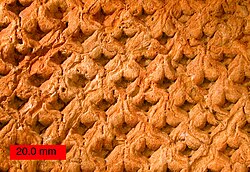
-
 Lycopod bark showing leaf scars, from the Middle Devonian of Wisconsin.
 -
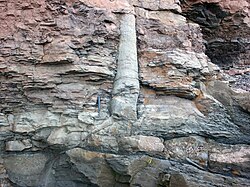
-
 Base of a fossil lycopsid showing connection with stigmarian roots.
 -
 Reconstruction of a Silurian Zosterophyllum
 -
 Reconstruction of Nothia aphylla
 -
 Reconstruction of Lepidodendron
 -
 Lycopod axis (branch) from the Middle Devonian of Wisconsin.
 -
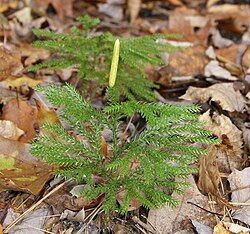 Lycopodium dendroideum, a modern member of the Lycopodiales
 -
 Isoetes melanospora, a modern member of the Isoetales
 -
 Restoration of Pleuromeia, an extinct Isoetales genus from the Early Triassic


.jpg)

References
[edit]- ^ a b Kenrick, Paul; Crane, Peter R. (1997). The Origin and Early Diversification of Land Plants: A Cladistic Study. Washington, D. C.: Smithsonian Institution Press. pp. 339–340. ISBN 978-1-56098-730-7.
- ^ Rickards, R.B. (2000). "The age of the earliest club mosses: the Silurian Baragwanathia flora in Victoria, Australia". Geological Magazine. 137 (2): 207–209. Bibcode:2000GeoM..137..207R. doi:10.1017/s0016756800003800. S2CID 131287538.
- ^ McElwain, Jenny C.; Willis, K. G.; Willis, Kathy; McElwain, J. C. (2002). The evolution of plants. Oxford [Oxfordshire]: Oxford University Press. ISBN 978-0-19-850065-0.
- ^ Ranker, T. A.; Hauler, C. H. (2008). Biology and evolution of ferns and lycophytes. Cambridge: Cambridge University Press.
- ^ Eichhorn, Evert, and Raven (2005). Biology of Plants, Seventh Edition. 381-388.
- ^ a b c Mauseth, James D. (2014). Botany : An introduction to Plant Biology (5th ed.). Burlington, MA: Jones & Bartlett Learning. ISBN 978-1-4496-6580-7.
- ^ Doweld, Alexander B. (2017). "(2499) Proposal to conserve the name Zosterophyllaceae against Sciadophytaceae (Fossil Lycopodiophyta: Zosterophyllopsida)". Taxon. 66 (1): 207–208. Bibcode:2017Taxon..66..207D. doi:10.12705/661.27.
- ^ Taylor, T.N.; Taylor, E.L. & Krings, M. (2009). Paleobotany : The Biology and Evolution of Fossil Plants (2nd ed.). Amsterdam; Boston: Academic Press. ISBN 978-0-12-373972-8.
- ^ Kenrick, Paul & Crane, Peter R. (1997a). The Origin and Early Diversification of Land Plants: A Cladistic Study. Washington, D.C.: Smithsonian Institution Press. ISBN 978-1-56098-730-7.
- ^ Kenrick, Paul & Crane, Peter R. (1997b). "The origin and early evolution of plants on land". Nature. 389 (6646): 33–39. Bibcode:1997Natur.389...33K. doi:10.1038/37918. S2CID 3866183.
- ^ a b PPG I (2016). "A community-derived classification for extant lycophytes and ferns". Journal of Systematics and Evolution. 54 (6): 563–603. Bibcode:2016JSyEv..54..563.. doi:10.1111/jse.12229. S2CID 39980610.
- ^ Callow, R.S. & Cook, Laurence Martin (1999). Genetic and evolutionary diversity: the sport of nature. Cheltenham: S. Thornes. p. 8. ISBN 978-0-7487-4336-0.
- ^ Christenhusz, M. J. M., M.J.M. & Byng, J.W. (2016). "The number of known plants species in the world and its annual increase". Phytotaxa. 261 (3): 201–217. Bibcode:2016Phytx.261..201C. doi:10.11646/phytotaxa.261.3.1.
- ^ Crane, P.R.; Herendeen, P. & Friis, E.M. (2004). "Fossils and plant phylogeny". American Journal of Botany. 91 (10): 1683–1699. Bibcode:2004AmJB...91.1683C. doi:10.3732/ajb.91.10.1683. PMID 21652317. S2CID 8493380.
- ^ Edwards, D. (1976). "The systematic position of Hicklingia edwardii Kidston and Lang". New Phytologist. 76 (1): 173–181. Bibcode:1976NewPh..76..173E. doi:10.1111/j.1469-8137.1976.tb01449.x.
- ^ Taylor, Taylor & Krings (2009), p. 253.
- ^ Kerp, H.; Hass, M.H. & Mosbrugger, V. (2001). "New Data on Nothia aphylla Lyon 1964 ex El-Saadawy et Lacey 1979, a Poorly Known Plant from the Lower Devonian Rhynie Chert". In Gensel, P.G. & Edwards, D. (eds.). Plants invade the Land : Evolutionary & Environmental Perspectives. New York: Columbia University Press. pp. 52–82. ISBN 978-0-231-11161-4.
- ^ Taylor, Taylor & Krings (2009), p. 250.
- ^ Hao, Shougang & Xue, Jinzhuang (2013). The early Devonian Posongchong flora of Yunnan: a contribution to an understanding of the evolution and early diversification of vascular plants. Beijing: Science Press. Fig. 6.8, p. 246. ISBN 978-7-03-036616-0.
- ^ Taylor, Taylor & Krings (2009), p. 267ff.
External links
[edit]

- Lycophytes
- Fossil Groves Archived 2009-03-12 at the Wayback Machine
- Paleo Plants (archived 15 January 2005)
Classification of Archaeplastida or Plantae s.l. | |||||||||||||||||||||||||||||||||||||||||||||||||||||||||||||||||||||||||||||||||||||||||||||||||||||||||||||
|---|---|---|---|---|---|---|---|---|---|---|---|---|---|---|---|---|---|---|---|---|---|---|---|---|---|---|---|---|---|---|---|---|---|---|---|---|---|---|---|---|---|---|---|---|---|---|---|---|---|---|---|---|---|---|---|---|---|---|---|---|---|---|---|---|---|---|---|---|---|---|---|---|---|---|---|---|---|---|---|---|---|---|---|---|---|---|---|---|---|---|---|---|---|---|---|---|---|---|---|---|---|---|---|---|---|---|---|---|---|
| |||||||||||||||||||||||||||||||||||||||||||||||||||||||||||||||||||||||||||||||||||||||||||||||||||||||||||||

Lycophyte
View on GrokipediaCharacteristics
Morphology and Anatomy
Lycophytes possess microphylls, which are small, scale-like leaves characterized by a single unbranched vein that lacks a leaf gap upon departure from the stem vascular system. These microphylls are thought to have originated as enations—vascularized outgrowths from the stem—distinguishing them from the more complex megaphylls of other vascular plants that feature multiple veins and associated leaf gaps.[8][9] The vascular anatomy of lycophytes typically includes an exarch protostele, where primary xylem maturation occurs from the outside toward the center, often forming a solid core without pith in smaller stems. Sporangia are laterally positioned, arising from the adaxial (upper) surface of fertile leaves or aggregated into terminal strobili. Stems exhibit dichotomous branching, either as prostrate rhizomes or upright forms, supported by simple vascular traces that supply microphylls and branches. Root systems are predominantly adventitious, emerging directly from stems or rhizomes rather than from a primary root axis. Many species, especially in Selaginellales and Isoëtales, bear ligules—small, tongue-like outgrowths on the adaxial surface of leaves near the base, thought to secrete mucilage for protection.[10][11][9][12] Modern lycophytes are generally small understory herbs, ranging from a few centimeters to about 50 cm in height, though some aquatic species can reach 1 m. In contrast, extinct lycophytes, such as those from the Carboniferous period, grew as arborescent trees up to 40 m tall, bearing densely packed scale-like microphylls. For example, clubmosses in the family Lycopodiaceae often feature creeping rhizomes with erect branches or fully upright stems clothed in spirally arranged microphylls. Quillworts in the family Isoetaceae, meanwhile, arise from short, corm-like bases that produce rosettes of rigid, quill-shaped leaves adapted to aquatic or semi-aquatic environments.[13][10][14]Reproduction and Life Cycle
Lycophytes exhibit an alternation of generations life cycle typical of vascular plants, featuring a dominant, independent diploid sporophyte phase that produces spores and a reduced haploid gametophyte phase—often photosynthetic in some homosporous species but non-photosynthetic in others—that produces gametes. The sporophyte is the prominent, long-lived stage, while the gametophyte is smaller and dependent on environmental conditions for survival. This pattern allows for genetic recombination through meiosis in the sporophyte and fertilization in the gametophyte, ensuring diversity in offspring.[15] Reproduction in lycophytes occurs via spores produced through meiosis in sporangia located on sporophylls, often aggregated into cone-like strobili for efficient dispersal by wind or water. Meiosis within the sporangia yields tetrads of haploid spores that are released upon dehiscence. Lycophytes display two reproductive strategies: homospory in the family Lycopodiaceae, where a single spore type is produced, leading to bisexual gametophytes capable of self-fertilization; and heterospory in Selaginellaceae and Isoetaceae, involving distinct megaspores (larger, fewer in number) that develop into female gametophytes and microspores (smaller, more numerous) that form male gametophytes, promoting outcrossing. In homosporous species like those in Lycopodiaceae, gametophytes are typically subterranean, non-photosynthetic, and reliant on mycorrhizal fungi for nutrient uptake, developing slowly underground over months to years. In contrast, heterosporous gametophytes in Selaginellaceae and Isoetaceae are endosporic, developing within the spore wall and retained on the parent sporophyte, with female gametophytes containing multiple eggs and male ones producing flagellated sperm; this endosporic development reduces exposure to desiccation.[9][16][17][18][19][20][21] Fertilization requires moist conditions, as multiflagellated sperm from antheridia swim to archegonia on the female gametophyte to unite with the egg, forming a diploid zygote that grows into a new sporophyte. The zygote embeds in the gametophyte tissue before emerging as an independent sporophyte. Life cycle duration varies widely: homosporous gametophytes may persist for up to 15 years before producing gametes, while heterosporous cycles can complete in months, influenced by habitat moisture and temperature.[22][23]Taxonomy
Classification
Lycophytes are classified within the division Lycopodiophyta (also known as Lycophyta), one of the four main groups of extant vascular plants, alongside ferns, gymnosperms, and angiosperms.[24] This division encompasses all living and extinct lycopod-like plants, characterized by microphylls and a basal position in vascular plant phylogeny. According to the Pteridophyte Phylogeny Group I (PPG I) classification of 2016, which remains the standard framework as of 2025, the primary extant group is the class Lycopodiopsida, which is subdivided into three monophyletic orders: Lycopodiales (clubmosses), Selaginellales (spikemosses), and Isoëtales (quillworts).[25] These orders reflect distinct evolutionary lineages within the class, with Lycopodiales being homosporous and the latter two heterosporous.[25] The order Lycopodiales includes a single family, Lycopodiaceae, which comprises approximately 16 genera and around 400 species, making it a significant but not dominant portion of lycophyte diversity.[25] Selaginellales consists of the family Selaginellaceae, with one genus (Selaginella) and about 700 species, while Isoëtales is represented by the family Isoetaceae, featuring one genus (Isoetes) and roughly 200-250 species.[25] In total, extant lycophytes number approximately 1,300-1,340 species across these three families.[1] Classification debates center on the inclusion of extinct groups, particularly the zosterophylls, which form a paraphyletic basal grade sister to the crown-group lycopsids (strict Lycopodiophyta) rather than being fully integrated into the division.[26] This distinction highlights the evolutionary transition from leafless, rhizomatous forms to modern lycophytes with microphylls. Historically, lycophytes were grouped with ferns under broader categories like Pteropsida due to shared sporangial traits, but molecular phylogenetics has firmly separated them as the sister lineage to all other vascular plants (euphyllophytes).[24] Terminology varies, with "Lycopsida" traditionally denoting the class or order of clubmosses, while "Lycophyta" refers to the broader division encompassing all lycophyte lineages.[18]Diversity and Distribution
Lycophytes comprise approximately 1,300 to 1,340 extant species worldwide, accounting for less than 1% of the total vascular plant diversity, which exceeds 369,000 species.[1][27] This modest representation belies their ecological significance as remnants of ancient lineages, with species richness concentrated in tropical regions where humidity and shaded understories favor their growth. For instance, the genus Selaginella alone accounts for around 700 species, predominantly distributed across the Americas and Asia.[28] Global distribution patterns of lycophytes are largely pantropical, with extensions into temperate zones, reflecting their preference for moist environments. Biodiversity hotspots occur in the Tropical Andes, Southeast Asia (including the Malaysian Archipelago), and parts of Africa, where elevated rainfall and topographic complexity support high species turnover.[29][30] In contrast, diversity is notably low in arid regions, such as deserts, due to their intolerance of water stress. Endemism levels are elevated in insular floras; for example, New Caledonia hosts a fern and lycophyte assemblage with about 38% endemic species, underscoring the archipelago's role as a refugium for relict taxa.[31] The genus Isoetes, with roughly 200-250 species, exemplifies widespread but species-poor distribution, occurring in freshwater habitats across all continents except Antarctica, often as scattered populations.[32] Phylogenetic analyses reveal lycophytes as the sister group to euphyllophytes in the vascular plant tree, representing a basal divergence that occurred over 400 million years ago. Within lycophytes, the family Selaginellaceae is the most speciose with approximately 700 species in a single genus (Selaginella), while Lycopodiaceae encompasses about 400 species across 16 genera and contributing significantly to overall diversity.[28] Contemporary threats, primarily habitat loss from deforestation and land conversion, disproportionately impact understory lycophyte populations in tropical hotspots, exacerbating declines in species richness. Recent discoveries, such as 12 new lycophyte and fern species described in China in 2023, highlight ongoing revelations in global vascular plant inventories, including lycophytes, amid these pressures.[33][34]Evolutionary History
Fossil Record
The fossil record of lycophytes extends back to the Silurian period, with the oldest known specimens dating to approximately 425 million years ago (Ma), represented by zosterophylls such as Zosterophyllum and related forms that exhibit early vascular tissue and simple branching patterns.[35] These early plants were small, herbaceous, and lacked true leaves, marking the initial colonization of land by vascular flora.[36] During the Devonian period (419–358 Ma), lycophytes diversified rapidly, with lycopsids like Drepanophycus appearing in the Early Devonian, featuring enations that foreshadowed microphylls and contributing to the expansion of terrestrial ecosystems. This diversification included both herbaceous and proto-arborescent forms, setting the stage for later dominance. The Carboniferous period (358–299 Ma) saw lycophytes reach their zenith, particularly through tree-like forms in the orders Lepidodendrales and Sigillariales, which formed vast coal forests across Euramerica and Gondwana.[4] Species such as Lepidodendron and Sigillaria grew to heights of up to 50 meters with trunks exceeding 2 meters in diameter, their remains accumulating in peat swamps that later formed major coal deposits essential to fossil fuels.[37] These arborescent lycophytes, with dichotomous branching and scale-like leaves, dominated wetlands and supported complex food webs, though their reproduction via spores limited long-term adaptability.[38] By the Permian period (299–252 Ma), lycophyte diversity declined sharply due to climatic shifts and competition, with most arborescent lineages extinct by the end; however, herbaceous forms persisted, as evidenced by the 2022 discovery of the megaspore Paxillitriletes permicus from the late Permian Xuanwei Formation in China, representing an early occurrence of this genus in the Cathaysian flora.[39] In the Mesozoic and Cenozoic eras, modern lineages like Isoetales and Selaginellales emerged, but the overall fossil record reveals far greater diversity in extinct groups, including the early arborescent Protolepidodendrales from the Devonian to Mississippian and the shrubby Pleuromeiales, such as Pleuromeia, which briefly dominated Early Triassic landscapes. Lycophyte fossils are exceptionally well-preserved in coal balls—calcareous permineralizations of peat that capture cellular details—and other permineralized deposits from Carboniferous swamps, allowing detailed anatomical studies.[40] Recent post-2020 reviews, such as that by Zavialova and Polevova (2025), have advanced understanding of spore structures, highlighting multilamellated zones in heterosporous lycopsid sporoderms as phylogenetically informative features across fossil and extant taxa.[41]Evolution of Key Features
Lycophytes represent the basal lineage of vascular plants, forming a sister group to the euphyllophytes (ferns and seed plants), with their divergence estimated at approximately 420 million years ago.[42] This phylogenetic position highlights lycophytes as a key clade for understanding early vascular plant evolution, retaining several ancestral traits such as simple vascular architecture and homospory in basal groups. Recent phylogenetic analyses (2025) confirm zosterophylls as a paraphyletic grade basal to crown lycophytes, with clades like Sawdoniaceae sister to the lycopsids.[43][42] The evolution of the vascular system in lycophytes was pivotal for terrestrial colonization, emerging around 425 million years ago as one of the first innovations in tracheophytes.[44] Basal lycophytes developed simple protosteles—solid cores of xylem without pith—providing efficient water and nutrient transport that supported upright growth and adaptation to subaerial environments.[44] This primitive stele structure, seen in early fossils, enabled lycophytes to exploit drier habitats compared to non-vascular bryophytes, marking a foundational step in plant diversification on land.[44] Microphylls, a defining synapomorphy of lycophytes, evolved from Silurian enations—vascularized outgrowths on stems—in zosterophylls such as Sawdonia, which featured spine-like extensions potentially aiding in photosynthesis or protection.[45] By the Devonian, these structures progressed to more complex forms in genera like Leclercqia, incorporating ligules (tongue-like projections) and a single vein trace that minimized vascular disruption to the stem.[45] This incremental development from enations to fully vascularized microphylls enhanced light capture and gas exchange, facilitating ecological expansion without the complex branching seen in euphyllophyte megaphylls.[45] Heterospory, the production of distinct microspores and megaspores, originated in the Devonian within the Protolepidodendrales, a group of early herbaceous lycophytes that remained homosporous at their base.[42] This innovation led to seed-like structures in later lineages, though not true seeds, by retaining megaspores within sporangia for endosporic development.[42] Adaptively, heterospory improved drought tolerance through larger, nutrient-rich female gametophytes that could better withstand desiccation during dispersal.[42] Recent genetic studies reveal unusual patterns in lycophyte genome evolution, including extraordinary preservation of gene collinearity—synteny among ~30% of genes—over 350 million years between species like Huperzia asiatica and Diphasiastrum complanatum.[1] Unlike seed plants, lycophytes exhibit slower rates of nucleotide substitution and chromosomal rearrangement, with independent whole-genome duplications (e.g., Lyco-α ~139 million years ago) showing conserved subgenomic synteny post-duplication.[1] A 2025 omics-based analysis further highlights adaptive genetic variation, such as RNA editing in Isoetes that modulates plastid gene expression for hydrophobicity and environmental stress response, underscoring lycophytes' conserved yet flexible genomic toolkit.[46]Ecology and Human Significance
Habitats and Ecological Roles
Lycophytes primarily inhabit moist, shaded environments, including the understory of forests where they grow as low-lying perennials, epiphytes on tree trunks and branches in humid rainforests, and aquatic forms in wetlands such as lakes and slow-moving rivers.[23] For instance, species in the genus Isoetes (quillworts) are often fully submerged or rooted in the sediments of oligotrophic lakes, tolerating low light and nutrient-poor conditions.[47] Their global distribution spans from tundra and alpine regions to tropical zones, with a preference for humid, shaded niches that maintain consistent moisture levels, though some like Selaginella lepidophylla exhibit remarkable desiccation tolerance in semi-arid rocky outcrops.[23] In ecosystems, lycophytes contribute to soil stabilization through extensive rhizome networks that bind substrates and prevent erosion, particularly in wetland margins and forested slopes.[49] They serve as indicators of wetland health owing to their sensitivity to pollution and acidification, with species like Isoetes echinospora declining in response to elevated metal concentrations and pH shifts in softwater lakes.[50] Additionally, many lycophytes form mycorrhizal associations with fungi, enhancing nutrient uptake—especially phosphorus and nitrogen—in nutrient-limited soils, which supports their persistence in oligotrophic habitats.[51][52] Ecological interactions of lycophytes include low herbivory rates attributed to chemical defenses such as alkaloids, which deter mammalian and insect herbivores by inducing toxicity or repellence. As slow-growing perennials, they play a role in carbon cycling by sequestering carbon in long-lived tissues and peat-forming wetlands, contributing to stable belowground storage over decades. Certain species demonstrate desiccation tolerance, enabling survival in fluctuating moisture regimes; for example, Selaginella njamnjamensis in West Africa exhibits adaptive physiological mechanisms that allow revival after prolonged drought.[53] Their dense mats further support biodiversity by creating microhabitats for invertebrates, such as springtails and mites, within the protective cover of foliage and rhizomes.[54] Globally, lycophyte abundance peaks in wet tropical regions, where humid conditions favor diverse understory and epiphytic forms, but they face heightened vulnerability to climate change through habitat drying and altered precipitation patterns that disrupt moisture-dependent niches.[23][55]Economic and Conservation Importance
Lycophytes have several economic applications, primarily as ornamental plants and in medicinal contexts. Species such as Lycopodium are harvested for use in holiday decorations like wreaths and garlands due to their evergreen appearance and branching structure.[18] In medicine, Huperzia serrata serves as a source of huperzine A, an alkaloid compound investigated for its potential to improve cognitive function in Alzheimer's disease by inhibiting acetylcholinesterase and protecting neurons.[56] Historically, extinct lycophyte forms, including tree-like lepidodendrids, contributed significantly to coal deposits during the Carboniferous period, powering industrial revolutions through fossil fuels derived from their biomass.[57] Ethnobotanical uses of lycophytes include traditional remedies, such as Selaginella species applied for wound healing and as poultices to treat injuries and inflammation.[58] Recent biotechnological interest focuses on lycophyte genomes for genetic studies; for instance, 2024 chromosomal assemblies of Huperzia asiatica and Diphasiastrum complanatum revealed preserved gene collinearity over 400 million years, aiding research into vascular plant development and polyploidy.[1] Many lycophyte species face threats from habitat loss due to deforestation and agriculture, as well as overharvesting for medicinal and ornamental trade, particularly Huperzia populations in Asia.[59] Globally, as of 2016, approximately 16% of pteridophyte and lycophyte species are threatened with extinction, with elevated conservation concern affecting 22%, according to IUCN assessments.[60] In 2025, a study highlighted the vulnerability of desiccation-tolerant vascular plants in West Africa, including the lycophyte Selaginella njamnjamensis from the family Selaginellaceae, to climate change and land-use shifts such as quarrying.[53] Conservation strategies emphasize establishing protected areas in biodiversity hotspots to safeguard endemic lycophytes, alongside promoting sustainable harvesting practices to curb overexploitation.[61] Restoration efforts include research on mycorrhizal inoculation to enhance seedling survival and nutrient uptake in degraded habitats, as demonstrated in studies of lycophyte-fungal symbioses.[62] Beyond direct uses, lycophytes serve as key models for understanding vascular plant evolution, with their simple anatomy and ancient lineages illuminating transitions like leaf development and heterospory.[42] They also act as indicators of ecosystem health, signaling disturbances in humid forests and wetlands where they thrive.[63]References
- https://www.[encyclopedia.com](/page/Encyclopedia.com)/science/encyclopedias-almanacs-transcripts-and-maps/lycophytes