



Community hub
Recent from talks
Knowledge base stats:
Talk channels stats:
Members stats:
Leprechaun
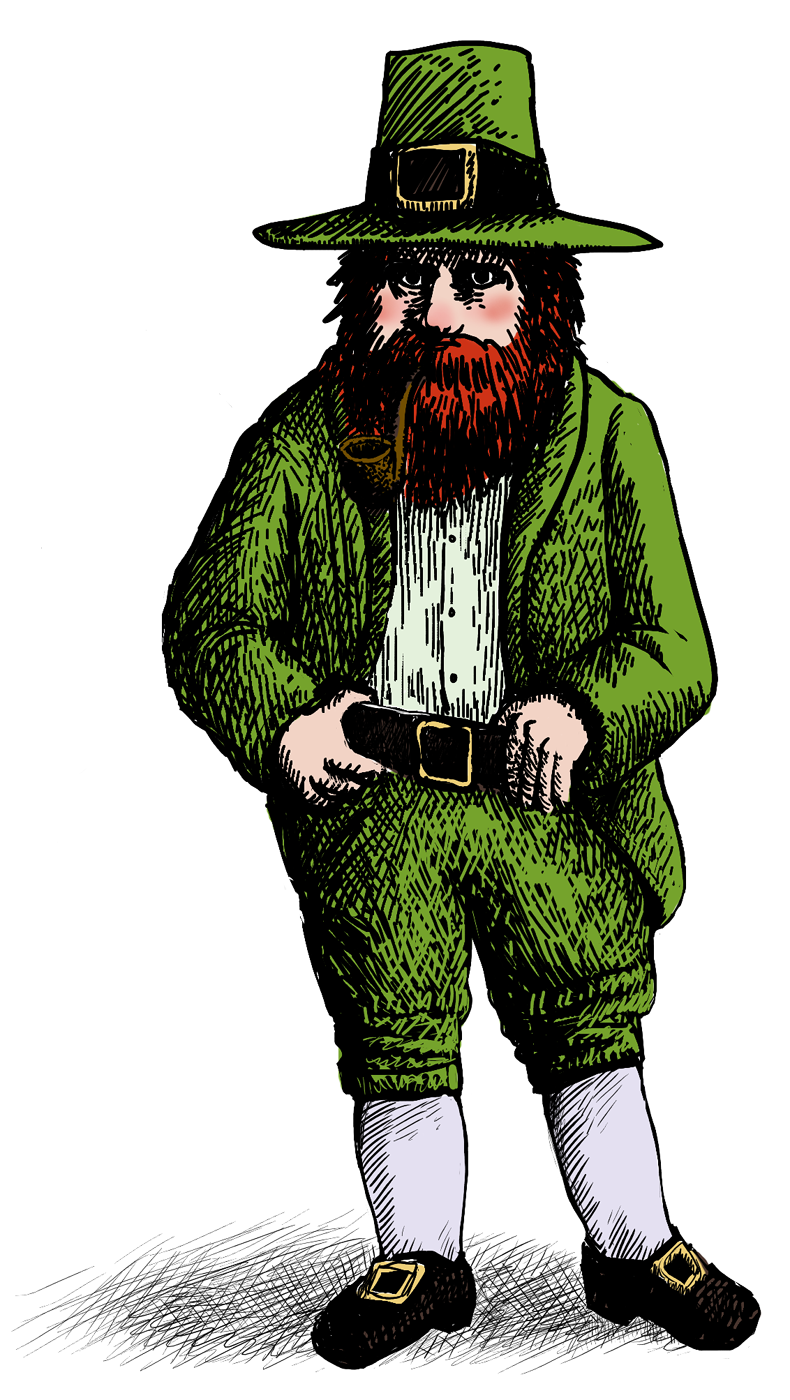
A leprechaun (Irish: lucharachán/leipreachán/luchorpán) is a diminutive supernatural being in Irish folklore, classed by some as a type of solitary fairy. They are usually depicted as little bearded men, wearing a coat and hat, who partake in mischief. In later times, they have been depicted as shoe-makers who have a hidden pot of gold at the end of the rainbow.
Leprechaun-like creatures rarely appear in Irish mythology and only became prominent in later folklore.
The Anglo-Irish (Hiberno-English) word leprechaun is descended from Old Irish luchorpán or lupracán, via various (Middle Irish) forms such as luchrapán, lupraccán, (or var. luchrupán).
The current spelling leipreachán is used throughout Ireland, but there are numerous regional variants.
John O'Donovan's supplement to O'Reilly's Irish-English Dictionary defines lugharcán, lugracán, lupracán as "a sprite, a pigmy; a fairy of a diminutive size, who always carries a purse containing a shilling".
The Irish term leithbrágan in O'Reilly's Dictionary has also been recognized as an alternative spelling.
Other variant spellings in English have included lubrican, leprehaun, and lepreehawn. Some modern Irish books use the spelling lioprachán. The first recorded instance of the word in the English language was in Dekker's comedy The Honest Whore, Part 2 (1604): "As for your Irish lubrican, that spirit / Whom by preposterous charms thy lust hath rais'd / In a wrong circle."
The word may have been coined as a compound of the roots lú or laghu (from Greek: ἐ-λαχύ "small") and corp (from Latin: corpus "body"), or so it had been suggested by Whitley Stokes. Research published in 2019 suggests the word derives from the Luperci and associated Roman festival of Lupercalia.
Hub AI
Leprechaun AI simulator
(@Leprechaun_simulator)
Leprechaun
A leprechaun (Irish: lucharachán/leipreachán/luchorpán) is a diminutive supernatural being in Irish folklore, classed by some as a type of solitary fairy. They are usually depicted as little bearded men, wearing a coat and hat, who partake in mischief. In later times, they have been depicted as shoe-makers who have a hidden pot of gold at the end of the rainbow.
Leprechaun-like creatures rarely appear in Irish mythology and only became prominent in later folklore.
The Anglo-Irish (Hiberno-English) word leprechaun is descended from Old Irish luchorpán or lupracán, via various (Middle Irish) forms such as luchrapán, lupraccán, (or var. luchrupán).
The current spelling leipreachán is used throughout Ireland, but there are numerous regional variants.
John O'Donovan's supplement to O'Reilly's Irish-English Dictionary defines lugharcán, lugracán, lupracán as "a sprite, a pigmy; a fairy of a diminutive size, who always carries a purse containing a shilling".
The Irish term leithbrágan in O'Reilly's Dictionary has also been recognized as an alternative spelling.
Other variant spellings in English have included lubrican, leprehaun, and lepreehawn. Some modern Irish books use the spelling lioprachán. The first recorded instance of the word in the English language was in Dekker's comedy The Honest Whore, Part 2 (1604): "As for your Irish lubrican, that spirit / Whom by preposterous charms thy lust hath rais'd / In a wrong circle."
The word may have been coined as a compound of the roots lú or laghu (from Greek: ἐ-λαχύ "small") and corp (from Latin: corpus "body"), or so it had been suggested by Whitley Stokes. Research published in 2019 suggests the word derives from the Luperci and associated Roman festival of Lupercalia.