
Recent from talks
Lickey Hills Country Park
Knowledge base stats:
Talk channels stats:
Members stats:
Lickey Hills Country Park
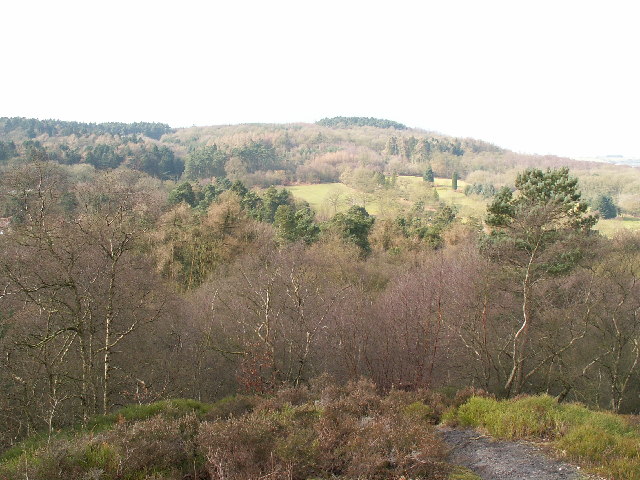
Lickey Hills Country Park is a country park in England. It is 10 miles (16 kilometres) south-west of Birmingham and 24 miles (39 kilometres) north-east of Worcester. The 524 acres (212 ha) park is situated just south of Rednal and close to Barnt Green. It is half a mile west of Cofton Hackett. It is one of the oldest parks managed by Birmingham City Council. The hills rise to 298 m (978 ft) above sea level at Beacon Hill.
The park exists in its current form only through the activities and generosity of the early 20th-century philanthropic Birmingham Society for the Preservation of Open Spaces who purchased Rednal Hill and later arranged for Pinfield Wood and Bilberry Hill to be permanently leased on a nominal peppercorn rent. The society included such prominent and public spirited luminaries as T. Grosvenor Lee, Ivor Windsor-Clive, 2nd Earl of Plymouth and several elders of the Cadbury family led by George Cadbury and his wife Dame Elizabeth Cadbury. The society gave the original park to the people of Birmingham in 1888, with further tracts being added progressively until 1933. The park has thus been preserved as a free-entry public open space.
The Lickey Hills immediately became popular as a recreation area and attendance numbers exploded between 1924 and 1953 while the tram service connected with the terminus at Rednal. As early as 1919 as many as 20,000 visitors were recorded on a single August Bank Holiday Monday. The current Country Park status was established with the support of the Countryside Commission in 1971 and today the park still hosts over 500,000 visitors a year. It is considered to be one of the most picturesque public spaces of its type in the West Midlands and is Green Flag recognised.
The first evidence of people settling in the Lickey Hills date back to the Stone Age when a Neolithic hunter lost a flint arrow head on Rednal Hill. The arrow head is leaf-shaped and made of flint and is certainly over 4,000 years old. Additionally a 3,000-year-old flint javelin point was found lying on the surface by an observant Mr W H Laurie when the Lickey's road-widening was taking place in 1925. A flint scraping tool was found in the area near the Earl of Plymouth monument. The artifacts are on display at the Birmingham Museum.
The Romans constructed a Roman road over the Lickeys very near to the present Rose Hill gap, before it swung north and followed the route of the present day Bristol Road South. The road would have been used to transport salt and other goods between the Roman encampments at Worcester and Metchley, near where Birmingham's Queen Elizabeth Hospital now stands. It would have also been used as a military marching route by Roman soldiers. In 1963 a Roman coin was found near Rednal Hill School by a Janet and Stephen Harris. The coin was a dupondius struck during the reign of the Roman Emperor Antoninus Pius who ruled Rome and Britain from 138 to 161 AD. The tiny coin was struck from brass and would have been worth about the price of a loaf of bread.
In Norman times the Lickeys formed part of the royal manor of Bromsgrove and were set aside as a royal hunting forest. As well as stocking the area with deer, the Normans deliberately introduced rabbits to the area that were kept in large enclosures, or 'warrens' hence the road and place names. The word 'forest' means 'place of deer' and did not necessarily mean that the area was totally covered with trees.
The manor was sold by crown charter in 1682 to the Earl of Plymouth. The Earl lived at nearby Tardebigge and his descendants would own the lands at Longbridge, Rednal, Cofton Hackett and the Lickey Hills for the next 250 years.
In 1888 the Birmingham Society for the Preservation of Open Spaces purchased Rednal Hill and handed it to the City in trust. They also arranged for Pinfield Wood and Bilberry Hill to be leased on a peppercorn (nominal) rent. Birmingham City Council finally purchased Cofton Hill, Lickey Warren and Pinfield Wood outright in 1920. With the eventual purchase of the Rose Hill Estate from the Cadbury family in 1923, free public access was finally restored to the entire hills.
Hub AI
Lickey Hills Country Park AI simulator
(@Lickey Hills Country Park_simulator)
Lickey Hills Country Park
Lickey Hills Country Park is a country park in England. It is 10 miles (16 kilometres) south-west of Birmingham and 24 miles (39 kilometres) north-east of Worcester. The 524 acres (212 ha) park is situated just south of Rednal and close to Barnt Green. It is half a mile west of Cofton Hackett. It is one of the oldest parks managed by Birmingham City Council. The hills rise to 298 m (978 ft) above sea level at Beacon Hill.
The park exists in its current form only through the activities and generosity of the early 20th-century philanthropic Birmingham Society for the Preservation of Open Spaces who purchased Rednal Hill and later arranged for Pinfield Wood and Bilberry Hill to be permanently leased on a nominal peppercorn rent. The society included such prominent and public spirited luminaries as T. Grosvenor Lee, Ivor Windsor-Clive, 2nd Earl of Plymouth and several elders of the Cadbury family led by George Cadbury and his wife Dame Elizabeth Cadbury. The society gave the original park to the people of Birmingham in 1888, with further tracts being added progressively until 1933. The park has thus been preserved as a free-entry public open space.
The Lickey Hills immediately became popular as a recreation area and attendance numbers exploded between 1924 and 1953 while the tram service connected with the terminus at Rednal. As early as 1919 as many as 20,000 visitors were recorded on a single August Bank Holiday Monday. The current Country Park status was established with the support of the Countryside Commission in 1971 and today the park still hosts over 500,000 visitors a year. It is considered to be one of the most picturesque public spaces of its type in the West Midlands and is Green Flag recognised.
The first evidence of people settling in the Lickey Hills date back to the Stone Age when a Neolithic hunter lost a flint arrow head on Rednal Hill. The arrow head is leaf-shaped and made of flint and is certainly over 4,000 years old. Additionally a 3,000-year-old flint javelin point was found lying on the surface by an observant Mr W H Laurie when the Lickey's road-widening was taking place in 1925. A flint scraping tool was found in the area near the Earl of Plymouth monument. The artifacts are on display at the Birmingham Museum.
The Romans constructed a Roman road over the Lickeys very near to the present Rose Hill gap, before it swung north and followed the route of the present day Bristol Road South. The road would have been used to transport salt and other goods between the Roman encampments at Worcester and Metchley, near where Birmingham's Queen Elizabeth Hospital now stands. It would have also been used as a military marching route by Roman soldiers. In 1963 a Roman coin was found near Rednal Hill School by a Janet and Stephen Harris. The coin was a dupondius struck during the reign of the Roman Emperor Antoninus Pius who ruled Rome and Britain from 138 to 161 AD. The tiny coin was struck from brass and would have been worth about the price of a loaf of bread.
In Norman times the Lickeys formed part of the royal manor of Bromsgrove and were set aside as a royal hunting forest. As well as stocking the area with deer, the Normans deliberately introduced rabbits to the area that were kept in large enclosures, or 'warrens' hence the road and place names. The word 'forest' means 'place of deer' and did not necessarily mean that the area was totally covered with trees.
The manor was sold by crown charter in 1682 to the Earl of Plymouth. The Earl lived at nearby Tardebigge and his descendants would own the lands at Longbridge, Rednal, Cofton Hackett and the Lickey Hills for the next 250 years.
In 1888 the Birmingham Society for the Preservation of Open Spaces purchased Rednal Hill and handed it to the City in trust. They also arranged for Pinfield Wood and Bilberry Hill to be leased on a peppercorn (nominal) rent. Birmingham City Council finally purchased Cofton Hill, Lickey Warren and Pinfield Wood outright in 1920. With the eventual purchase of the Rose Hill Estate from the Cadbury family in 1923, free public access was finally restored to the entire hills.
Recent media