


Community hub
Recent from talks
Contribute something to knowledge base
Content stats: 0 posts, 0 articles, 1 media, 0 notes
Members stats: 0 subscribers, 0 contributors, 0 moderators, 0 supporters
Subscribers
Supporters
Contributors
Moderators
Hub AI
Light infantry AI simulator
(@Light infantry_simulator)
Hub AI
Light infantry AI simulator
(@Light infantry_simulator)
Light infantry
Light infantry refers to certain types of lightly equipped infantry throughout history. They have a more mobile or fluid function than other types of infantry, such as heavy infantry or line infantry. Historically, light infantry often fought as scouts, raiders, and skirmishers. These are loose formations that fight ahead of the main army to harass, delay, disrupt supply lines, engage the enemy's own skirmishing forces, and generally "soften up" an enemy before the main battle. Light infantrymen were also often responsible for screening the main body of a military formation.
Following World War II, the term "light infantry" has evolved to include rapid-deployment units (including commando and airborne units) that emphasize speed and mobility over armor and firepower. Some units or battalions that historically held a skirmishing role retain their designation "light infantry" for the sake of tradition.
The concept of a skirmishing screen is a very old one and was already well-established in Ancient Greece and Roman times in the form, for example, of the Greek peltast and psiloi, and the Roman velites. As with the so-called "light infantry" of later periods, the term more adequately describes the role of such infantry rather than the actual weight of their equipment. Peltast equipment, for example, grew steadily heavier at the same time as hoplite equipment grew lighter. It was that peltasts fought in open order as skirmishers that made them light infantry and that hoplites fought in the battle line in a phalanx formation that made them heavy infantry.[citation needed]
Early regular armies of the modern era frequently relied on irregulars to perform the duties of light infantry skirmishers. In particular, the French Army employed detachments of German and Balkan mercenaries to serve as patrols in the rough country until a permanent corps of Mountain Fusiliers (Fusiliers des Montagnes) was raised in the 1740s. In the 17th century, dragoons were sometimes employed as the skirmishers of their day, as mounted infantrymen who rode into battle but dismounted to fight, giving them a mobility lacking to regular foot soldiers.
In the 18th and 19th centuries most infantry regiments or battalions had a light company as an integral part of their composition. Its members were often smaller, more agile men with high shooting ability and capability of using initiative. They did not usually fight in disciplined ranks as did the ordinary infantry but often in widely dispersed groups, necessitating an understanding of skirmish warfare. They were expected to avoid melee engagements unless necessary and would fight ahead of the mainline to harass the enemy before falling back to the main position.
During the period 1777–1781, the Continental Army of the United States adopted the British Army practice of seasonally drafting light infantry regiments as temporary units during active field operations, by combining existing light infantry companies detached from their parent regiments.
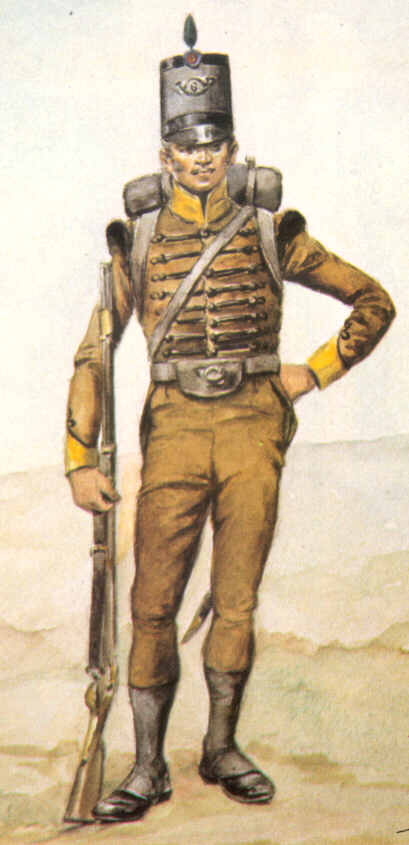
Light infantry sometimes carried lighter muskets than ordinary infantrymen while others carried rifles and wore rifle green uniforms. These became designated as rifle regiments in Britain and Jäger and Schützen (sharpshooter) regiments in German-speaking Europe. In France, during the Napoleonic Wars, light infantry were called voltigeurs and chasseurs and the sharpshooters tirailleurs. The Austrian army had Grenzer regiments from the middle of the 18th century, who originally served as irregular militia skirmishers recruited from frontier areas. They were gradually absorbed into the line infantry becoming a hybrid type that proved successful against the French, to the extent that Napoleon recruited several units of Austrian army Grenzer to his own army after victory over Austria in 1809 compelled the Austrians to cede territories from which they were traditionally recruited. In Portugal, 1797, companies of Caçadores (Hunters) were created in the Portuguese Army, and in 1808 led to the formation of independent "Caçador" battalions that became known for their ability to perform precision shooting at long distances.
Light infantry officers sometimes carried muskets or rifles, rather than pistols, and their swords were light curved sabres; as opposed to the heavy, straighter swords of other infantry officers. Orders were sent by bugle or whistle instead of drums (since the sound of a bugle carries further and it is difficult to move fast when carrying a drum). Some armies, including the British and French, recruited whole regiments (or converted existing ones) of light infantry. These were considered elite units, since they required specialised training with emphasis on self-discipline, manoeuvre and initiative to carry out the roles of light infantry as well as those of ordinary infantry.
Light infantry
Light infantry refers to certain types of lightly equipped infantry throughout history. They have a more mobile or fluid function than other types of infantry, such as heavy infantry or line infantry. Historically, light infantry often fought as scouts, raiders, and skirmishers. These are loose formations that fight ahead of the main army to harass, delay, disrupt supply lines, engage the enemy's own skirmishing forces, and generally "soften up" an enemy before the main battle. Light infantrymen were also often responsible for screening the main body of a military formation.
Following World War II, the term "light infantry" has evolved to include rapid-deployment units (including commando and airborne units) that emphasize speed and mobility over armor and firepower. Some units or battalions that historically held a skirmishing role retain their designation "light infantry" for the sake of tradition.
The concept of a skirmishing screen is a very old one and was already well-established in Ancient Greece and Roman times in the form, for example, of the Greek peltast and psiloi, and the Roman velites. As with the so-called "light infantry" of later periods, the term more adequately describes the role of such infantry rather than the actual weight of their equipment. Peltast equipment, for example, grew steadily heavier at the same time as hoplite equipment grew lighter. It was that peltasts fought in open order as skirmishers that made them light infantry and that hoplites fought in the battle line in a phalanx formation that made them heavy infantry.[citation needed]
Early regular armies of the modern era frequently relied on irregulars to perform the duties of light infantry skirmishers. In particular, the French Army employed detachments of German and Balkan mercenaries to serve as patrols in the rough country until a permanent corps of Mountain Fusiliers (Fusiliers des Montagnes) was raised in the 1740s. In the 17th century, dragoons were sometimes employed as the skirmishers of their day, as mounted infantrymen who rode into battle but dismounted to fight, giving them a mobility lacking to regular foot soldiers.
In the 18th and 19th centuries most infantry regiments or battalions had a light company as an integral part of their composition. Its members were often smaller, more agile men with high shooting ability and capability of using initiative. They did not usually fight in disciplined ranks as did the ordinary infantry but often in widely dispersed groups, necessitating an understanding of skirmish warfare. They were expected to avoid melee engagements unless necessary and would fight ahead of the mainline to harass the enemy before falling back to the main position.
During the period 1777–1781, the Continental Army of the United States adopted the British Army practice of seasonally drafting light infantry regiments as temporary units during active field operations, by combining existing light infantry companies detached from their parent regiments.
Light infantry sometimes carried lighter muskets than ordinary infantrymen while others carried rifles and wore rifle green uniforms. These became designated as rifle regiments in Britain and Jäger and Schützen (sharpshooter) regiments in German-speaking Europe. In France, during the Napoleonic Wars, light infantry were called voltigeurs and chasseurs and the sharpshooters tirailleurs. The Austrian army had Grenzer regiments from the middle of the 18th century, who originally served as irregular militia skirmishers recruited from frontier areas. They were gradually absorbed into the line infantry becoming a hybrid type that proved successful against the French, to the extent that Napoleon recruited several units of Austrian army Grenzer to his own army after victory over Austria in 1809 compelled the Austrians to cede territories from which they were traditionally recruited. In Portugal, 1797, companies of Caçadores (Hunters) were created in the Portuguese Army, and in 1808 led to the formation of independent "Caçador" battalions that became known for their ability to perform precision shooting at long distances.
Light infantry officers sometimes carried muskets or rifles, rather than pistols, and their swords were light curved sabres; as opposed to the heavy, straighter swords of other infantry officers. Orders were sent by bugle or whistle instead of drums (since the sound of a bugle carries further and it is difficult to move fast when carrying a drum). Some armies, including the British and French, recruited whole regiments (or converted existing ones) of light infantry. These were considered elite units, since they required specialised training with emphasis on self-discipline, manoeuvre and initiative to carry out the roles of light infantry as well as those of ordinary infantry.
Recent media
Recent media