Hubbry Logo
Limiting reagentLimiting reagentMain
Open search
Limiting reagent
Community hub
Limiting reagent
logo
8 pages, 0 posts
0 subscribers
Be the first to start a discussion here.
Limiting reagent
Limiting reagent
from Wikipedia
Equal masses of iron (Fe) and sulfur (S) react to form iron sulfide (FeS), but because of its higher atomic weight, iron is the limiting reagent and once all the iron is consumed some sulfur remains unreacted

The limiting reagent (or limiting reactant or limiting agent) in a chemical reaction is a reactant that is totally consumed when the chemical reaction is completed.[1][2] The amount of product formed is limited by this reagent, since the reaction cannot continue without it. If one or more other reagents are present in excess of the quantities required to react with the limiting reagent, they are described as excess reagents or excess reactants (sometimes abbreviated as "xs") or to be in abundance.[3]

The limiting reagent must be identified in order to calculate the percentage yield of a reaction since the theoretical yield is defined as the amount of product obtained when the limiting reagent reacts completely. Given the balanced chemical equation, which describes the reaction, there are several equivalent ways to identify the limiting reagent and evaluate the excess quantities of other reagents.

Method 1: Comparison of reactant amounts

[edit]

This method is most useful when there are only two reactants. One reactant (A) is chosen, and the balanced chemical equation is used to determine the amount of the other reactant (B) necessary to react with A. If the amount of B actually present exceeds the amount required, then B is in excess and A is the limiting reagent. If the amount of B present is less than required, then B is the limiting reagent.

Example for two reactants

[edit]

Consider the combustion of benzene, represented by the following chemical equation:

This means that 15 moles of molecular oxygen (O2) is required to react with 2 moles of benzene (C6H6)

The amount of oxygen required for other quantities of benzene can be calculated using cross-multiplication (the rule of three). For example, if 1.5 mol C6H6 is present, 11.25 mol O2 is required:

If in fact 18 mol O2 are present, there will be an excess of (18 - 11.25) = 6.75 mol of unreacted oxygen when all the benzene is consumed. Benzene is then the limiting reagent.

This conclusion can be verified by comparing the mole ratio of O2 and C6H6 required by the balanced equation with the mole ratio actually present:

  • required:
  • actual:

Since the actual ratio is larger than required, O2 is the reagent in excess, which confirms that benzene is the limiting reagent.

Method 2: Comparison of product amounts which can be formed from each reactant

[edit]

In this method the chemical equation is used to calculate the amount of one product which can be formed from each reactant in the amount present. The limiting reactant is the one which can form the smallest amount of the product considered. This method can be extended to any number of reactants more easily than the first method.

Example

[edit]

20.0 g of iron (III) oxide (Fe2O3) are reacted with 8.00 g aluminium (Al) in the following thermite reaction:

Since the reactant amounts are given in grams, they must be first converted into moles for comparison with the chemical equation, in order to determine how many moles of Fe can be produced from either reactant.

  • Moles of Fe which can be produced from reactant Fe2O3
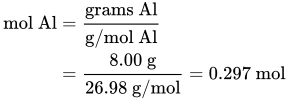
  • Moles of Fe which can be produced from reactant Al

There is enough Al to produce 0.297 mol Fe, but only enough Fe2O3 to produce 0.250 mol Fe. This means that the amount of Fe actually produced is limited by the Fe2O3 present, which is therefore the limiting reagent.

Shortcut

[edit]

It can be seen from the example above that the amount of product (Fe) formed from each reagent X (Fe2O3 or Al) is proportional to the quantity

This value is the extent of reaction required to deplete each reagent to zero. The reagent that decreases to zero moles with the lowest extent of reaction is the limiting reagent. The extent value can be multiplied by the stoichiometric coefficients of the other reagents and products to determine the amounts of each chemical once the reaction is complete.

See also

[edit]

References

[edit]
Revisions and contributorsEdit on WikipediaRead on Wikipedia
from Grokipedia
In chemistry, the limiting reagent, also known as the limiting reactant, is the reactant in a chemical reaction that is completely consumed first, thereby determining the maximum amount of product that can be formed and halting the reaction once depleted. The concept arises from the stoichiometric ratios in a balanced chemical equation, where the quantities of reactants dictate which one will be exhausted first based on their relative availability. Any reactant present in excess beyond what is required to react with the limiting reagent remains unconsumed after the reaction concludes, often referred to as the excess reagent. This distinction is crucial for understanding reaction efficiency, as the limiting reagent sets the theoretical yield—the maximum possible product under ideal conditions—while excess materials may lead to waste. For instance, in a simple analogy, assembling hot dogs with buns illustrates this: if there are more hot dogs than buns, the buns act as the limiting reagent, allowing only as many complete hot dogs as there are buns, leaving excess hot dogs unused. To identify the limiting reagent, chemists convert the given masses or volumes of reactants to moles using molar masses, then compare the mole ratios to the balanced equation's stoichiometry; the reactant yielding the smallest product amount is limiting. Alternatively, one can calculate the theoretical product mass from each reactant assuming complete reaction and select the lowest value to determine the limiting one. These calculations enable prediction of both product yields and leftover excess, which is vital in to optimize use and minimize costs. In practice, actual yields may fall short of theoretical due to side reactions or incomplete conversion, quantified by percent yield as (actual yield / theoretical yield) × 100%.

Fundamentals

Definition

In chemistry, the limiting reagent, also known as the limiting reactant, is the reactant in a chemical reaction that is completely consumed first, thereby determining the maximum amount of product that can be formed. This occurs because chemical reactions proceed according to fixed stoichiometric ratios, and the limiting reagent restricts the reaction's extent once it is depleted. Once the limiting reagent is exhausted, the reaction ceases, even if other reactants remain unconsumed. In contrast, excess reagents are the reactants that are present in quantities greater than required by the stoichiometry and are left over after the reaction completes. For a general balanced chemical equation represented as aA+bBa\mathrm{A} + b\mathrm{B} \rightarrow products, where aa and bb are the stoichiometric coefficients, the limiting reagent is identified as the reactant with the smallest ratio of its available moles to its stoichiometric coefficient.

Importance

Identifying the limiting reagent plays a crucial role in maximizing product yield during chemical reactions by determining the theoretical maximum amount of product that can be formed from the available reactants. In scenarios where reactants are not present in exact stoichiometric proportions, the limiting reagent is the one that gets completely consumed first, thereby dictating the extent of the reaction and preventing overestimation of output. This calculation ensures efficient utilization, as it allows chemists to predict and achieve the highest possible yield without unnecessary excess of materials. The also enhances overall reaction , particularly in scaling processes for or industrial applications, by minimizing of excess reactants and optimizing conditions to focus on the constraining component. For instance, recognizing the limiting reagent helps in adjusting reactant ratios to avoid leftover materials, which can reduce costs and environmental impact in large-scale productions. This approach is essential for sustainable , where precise control over inputs directly influences economic viability and process optimization. Furthermore, the limiting reagent ties into fundamental principles like and , illustrating how fixed stoichiometric ratios govern reaction outcomes and ensure that reactant masses balance with product masses. By adhering to these laws, the identification of the limiting reagent reinforces the predictability of chemical , showing that deviations from ideal proportions limit the reaction's progression in accordance with atomic and molecular constraints. The concept of the limiting reagent emerged in the 19th century, notably through the work of German chemist Justus von Liebig, who applied the idea of limiting factors—originally from his studies in agricultural chemistry—to chemical reactions, building on earlier stoichiometric principles.

Prerequisites

Stoichiometry Basics

Stoichiometry refers to the quantitative relationships between reactants and products in a chemical reaction, as determined by a balanced chemical equation. These relationships allow chemists to predict the amounts of substances involved in reactions based on their molecular proportions. Balancing chemical equations is essential to stoichiometry and involves adjusting coefficients to ensure the law of conservation of mass is upheld, meaning the total number of atoms of each element remains the same on both sides of the equation. The process typically follows these steps: first, write the unbalanced equation using correct chemical formulas for reactants and products; second, count the atoms of each element on both sides; third, adjust coefficients (never subscripts) starting with the most complex species, balancing one element at a time while rechecking others; and finally, verify the balance by recounting all atoms. For example, the unbalanced equation for water formation is H₂ + O₂ → H₂O; balancing yields 2H₂ + O₂ → 2H₂O, where two hydrogen molecules react with one oxygen molecule to produce two water molecules. From a balanced equation, stoichiometric ratios are derived directly from the coefficients, expressing the mole proportions of reactants and products. In the water formation example, the stoichiometric ratio of to is 2:1, indicating that two moles of react with one mole of oxygen. These ratios form the basis for converting between quantities of different substances in a reaction. Stoichiometric calculations standardize on moles as the unit of , enabling conversions from or to the proportional relationships defined by the .

Mole Concept

The mole, denoted by the symbol mol, is the SI unit for the amount of substance in chemistry, defined as the amount containing exactly 6.02214076 × 10^{23} elementary entities, such as atoms, molecules, ions, or other particles. This fixed number, known as Avogadro's constant (N_A), ensures a consistent scale for quantifying microscopic particles on a macroscopic level. Molar mass (M) is the mass of one mole of a substance, expressed in grams per mole (g/mol), and equals the numerical value of the substance's relative atomic or molecular mass. For elements, it is simply the atomic mass in grams per mole; for compounds, it is the sum of the atomic masses of all constituent atoms. For example, the molar mass of water (H_2O) is calculated as 2 × 1.008 + 15.999 = 18.015 g/mol. To relate measurable quantities to the mole scale, chemists use conversion factors. The number of moles (n) is determined from mass (m) by n = m / M, allowing grams to be converted to moles. Conversely, moles can be converted to the number of particles by multiplying by Avogadro's constant: number of particles = n × N_A. For ideal gases at standard temperature and pressure (STP, defined as 273.15 K and 100 kPa), one mole occupies a volume of 22.711 L, providing a direct volume-to-mole conversion. Moles are essential in chemical reactions because they enable direct comparison of reactant quantities based on stoichiometric ratios, independent of the substances' physical states, masses, or particle sizes, facilitating accurate predictions of reaction outcomes like limiting reagents.

Identification Methods

Reactant Comparison Method

The reactant comparison method, also known as the mole ratio or stoichiometric division approach, identifies the limiting reagent by normalizing the available quantities of each reactant relative to the balanced , allowing direct comparison to determine which reactant will be fully consumed first. This technique is particularly efficient for reactions involving multiple reactants, as it avoids pairwise calculations and instead uses a single comparative metric derived from . It relies on the principle that the reaction proceeds until the reactant that reaches depletion first halts the process, based on the mole ratios defined by the coefficients in the balanced equation. The process begins with writing and balancing for the reaction, ensuring that the stoichiometric coefficients accurately reflect the mole ratios of reactants and products. For aA+bBaA + bB \rightarrow products, the coefficients aa and bb represent the relative moles required for complete reaction. Next, convert the given quantities of each reactant—typically provided in masses, volumes, or other units—to moles using appropriate conversion factors, such as for solids or gases and molarity for solutions (as detailed in the mole concept). This yields the available moles nin_i for each reactant ii. To assess stoichiometric requirements, calculate the moles of each reactant needed relative to the others by using the coefficients; for instance, assuming reactant A is in excess, the required moles of B would be (nA/a)×b(n_A / a) \times b, where nAn_A is the available moles of A and a,ba, b are the coefficients. This step can be streamlined across all reactants by computing the ratio of available moles to the coefficient for each, effectively determining the maximum possible for each individually. Finally, compare the available moles to the required moles for each reactant, or equivalently, identify the limiting reagent as the one yielding the smallest value when available moles nin_i are divided by its stoichiometric νi\nu_i (taking the for reactants, which have negative coefficients in some notations). The for this identification is the minimum of ni/νin_i / |\nu_i| across all reactants, where the reactant corresponding to this minimum limits the reaction. This ratio represents the reaction's maximum progress in terms of "equivalent units," ensuring the limiting reagent is precisely the one with the least capacity to sustain the .

Product Yield Method

The product yield method provides an alternative approach to identifying the limiting reagent in a by determining the maximum amount of product that each reactant can theoretically produce, based on the balanced . This technique is particularly insightful when the primary interest lies in the quantity of product formed, as it directly ties reactant availability to output limitations. To apply this method, first balance the and convert the given amounts of each reactant to moles, using their respective molar masses. This establishes the stoichiometric foundation for subsequent calculations. Next, for each reactant, calculate the maximum moles of the desired product it can generate. This is done using the stoichiometric coefficients from the balanced equation, with the formula: moles of product=(moles of reactantνreactant)×νproduct\text{moles of product} = \left( \frac{\text{moles of reactant}}{\nu_{\text{reactant}}} \right) \times \nu_{\text{product}} where νreactant\nu_{\text{reactant}} and νproduct\nu_{\text{product}} represent the stoichiometric coefficients of the reactant and product, respectively. The reactant that results in the smallest amount of product moles is the limiting reagent, as it constrains the overall reaction extent and determines the theoretical maximum yield. Once the limiting reagent is identified, the theoretical yield of the product can be computed in mass units via: theoretical yield=(moles of limiting reagentνlimiting)×νproduct×Mproduct\text{theoretical yield} = \left( \frac{\text{moles of limiting reagent}}{\nu_{\text{limiting}}} \right) \times \nu_{\text{product}} \times M_{\text{product}} where MproductM_{\text{product}} is the of the product. This method offers the advantage of focusing on product-centric outcomes, making it valuable in scenarios where yield optimization is key, such as in synthetic chemistry. However, it typically involves more computational steps than direct reactant ratio comparisons, though it yields equivalent results.

Examples and Calculations

Basic Two-Reactant Example

Consider the balanced chemical equation for the combustion of hydrogen to form water: 2H2(g)+O2(g)2H2O(l)2\text{H}_2(g) + \text{O}_2(g) \rightarrow 2\text{H}_2\text{O}(l) This stoichiometry indicates that 2 moles of H₂ react with 1 mole of O₂ to produce 2 moles of H₂O. To identify the limiting reagent using the reactant comparison method, suppose 4 g of H₂ and 32 g of O₂ are provided. The molar mass of H₂ is 2 g/mol, so the moles of H₂ are 4÷2=24 \div 2 = 2 mol. The molar mass of O₂ is 32 g/mol, so the moles of O₂ are 32÷32=132 \div 32 = 1 mol. For complete reaction of the 2 mol of H₂, 1 mol of O₂ is required, which matches the available amount. Similarly, for the 1 mol of O₂, 2 mol of H₂ is required, which also matches. Thus, the reactants are in exact stoichiometric proportions, with no limiting reagent; both are fully consumed, yielding 2 mol (36 g) of H₂O. Now consider a case where the amounts are imbalanced, with 4 g (2 mol) of H₂ but only 16 g of O₂. The moles of O₂ are 16÷32=0.516 \div 32 = 0.5 mol. For complete reaction of the 0.5 mol of O₂, 1 mol of H₂ is required, but 2 mol of H₂ is available, making O₂ the limiting reagent. The excess H₂ remaining is 1 mol (2 g). The reaction produces 1 mol (18 g) of H₂O, based on twice the moles of the limiting O₂.

Shortcut for Product Yields

In the product yield method for identifying the , a streamlined approach calculates the maximum moles of product that each reactant can theoretically based on the balanced , allowing to determine the . Consider the of : 2H2+O22H2O2\mathrm{H_2} + \mathrm{O_2} \rightarrow 2\mathrm{H_2O}, with 4 g of H2\mathrm{H_2} (2 mol, since is 2 g/mol) and 16 g of O2\mathrm{O_2} (0.5 mol, since is 32 g/mol). To apply the shortcut, first divide the moles of each reactant by its stoichiometric coefficient in the balanced equation to find the "reaction equivalents," then multiply by the coefficient of the product (H2O\mathrm{H_2O}) to obtain the potential yield in moles. For H2\mathrm{H_2}: (2÷2)×2=2(2 \div 2) \times 2 = 2 mol H2O\mathrm{H_2O}. For O2\mathrm{O_2}: (0.5÷1)×2=1(0.5 \div 1) \times 2 = 1 mol H2O\mathrm{H_2O} . The reactant yielding the smallest amount of product—here, O2\mathrm{O_2} at 1 mol H2O\mathrm{H_2O} (equivalent to 18 g, using 18 g/mol)—is the limiting reagent, as it restricts the reaction to this scale. This division-first technique serves as an efficient shortcut, particularly when the primary interest is in product quantity rather than exhaustive reactant consumption checks, as it bypasses intermediate steps like pairwise comparisons between reactants. Verification against the reactant comparison method confirms consistency: both approaches identify O2\mathrm{O_2} as limiting and predict 1 mol (18 g) of H2O\mathrm{H_2O}, but the product yield shortcut proves faster for queries focused on output yields.

Applications

Industrial Uses

In the Haber-Bosch process for ammonia synthesis, the limiting reagent principle guides the optimization of reactant ratios to enhance efficiency in large-scale fertilizer production. The key reaction is N₂ + 3H₂ → 2NH₃, with industrial operations employing a stoichiometric 1:3 volume ratio of N₂ to H₂ to avoid excess gases that could increase operational pressures and costs. Hydrogen is often intentionally limited relative to potential inerts like argon from air-sourced nitrogen, helping maintain reactor conditions while achieving per-pass yields of approximately 15-20%; unreacted gases are recycled to reach overall conversions exceeding 98%. In petroleum , particularly (FCC), inform feedstock-to-catalyst ratios to maximize the breakdown of heavy into fuels like and diesel, minimizing unreacted residues that reduce efficiency. Optimal ratios, typically catalyst-to- around 5-6 by weight, ensure the feed acts as the limiting component, promoting selective cracking and suppressing over-cracking or coke formation on the catalyst. This approach enhances product yields and throughput, with FCC units converting up to 70-80% of gas feedstocks into valuable distillates. Pharmaceutical manufacturing relies on precise identification and dosing of limiting to produce active pharmaceutical ingredients (APIs) with high purity and consistent yields, aligning with regulatory requirements for impurity control. For instance, in multi-step syntheses, the limiting reactant—often an expensive intermediate—is dosed stoichiometrically to limit side and byproducts, ensuring API yields meet expected ranges and impurity levels stay below specified thresholds. The FDA's guidelines mandate documentation of reactant quantities, yield monitoring, and investigation of deviations to maintain and compliance, reducing the risk of batch failures. Overall, applying limiting reagent calculations in these industries enables precise reaction scaling, curbing excess material use and waste generation for substantial economic gains. In ammonia production, optimized stoichiometry helps minimize waste of high-cost inputs like hydrogen derived from natural gas. Similar efficiencies in refining and pharmaceuticals amplify profitability, with process improvements like the Boots-Hoechst-Celanese ibuprofen synthesis, which achieves approximately 80% atom economy compared to 40% in earlier processes, leading to reduced waste, lower solvent use, and significant cost savings.

Laboratory Practices

In laboratory settings, the limiting reagent is experimentally determined by accurately weighing or measuring the masses or volumes of reactants prior to the reaction, allowing the reaction to proceed to completion, and then quantifying any unreacted excess material through filtration, drying, or other isolation techniques. This process confirms which reactant was fully consumed first, as the limiting reagent will leave no measurable residue while the excess reactant remains. Precise mass measurements using analytical balances are essential, often targeting specific gram amounts (e.g., 0.09–0.11 g for one trial) to ensure stoichiometric comparisons align with theoretical expectations. Common techniques for handling limiting reagents in solution-based reactions include titration, where one reactant is gradually added to the other until the equivalence point is reached, indicating the limiting reagent has been fully neutralized. For instance, in the neutralization of hydrochloric acid (HCl) with sodium hydroxide (NaOH), a known volume of NaOH solution (e.g., 25 cm³ of 0.4 M) is placed in a conical flask with an indicator like methyl orange, and HCl is titrated from a burette until the color changes from yellow-orange to red, signaling completion. In reactions producing gases, such as magnesium (Mg) with HCl to generate hydrogen (H₂), gas collection via pressure sensors in a sealed flask measures the volume or pressure of evolved gas, with the plateau in pressure indicating the limiting reagent's depletion. These methods allow direct assessment of reactant consumption without relying solely on product yield calculations. Error sources in limiting reagent experiments often stem from impure reagents, which introduce extraneous substances that alter the effective stoichiometry, or side reactions that compete for reactants and reduce the expected product formation. For example, residual impurities like water in hydrated salts or contaminants in solutions can lead to inaccurate initial mass measurements, while unintended side reactions may consume additional reagent beyond the primary pathway. Mitigation involves using calculated excess of one reactant to drive complete conversion of the intended limiting reagent, verified through pre-reaction purity checks and post-reaction residue analysis, though this requires careful adjustment to minimize waste. Safety protocols emphasize identifying the limiting reagent in advance to prevent hazardous excesses, particularly in exothermic where uncontrolled buildup of reactive can lead to rapid heat release or pressure increases. Reactants like concentrated HCl or NaOH are handled in fume hoods with protective eyewear and gloves, and additions are regulated to keep the most reactive component as the limiting one, avoiding splattering or gas bursts. Spills are immediately neutralized and rinsed, and all apparatus is checked for leaks to maintain controlled conditions throughout the procedure.

References

Add your contribution
Related Hubs
User Avatar
No comments yet.