


Community hub
Recent from talks
Contribute something to knowledge base
Content stats: 0 posts, 0 articles, 1 media, 0 notes
Members stats: 0 subscribers, 0 contributors, 0 moderators, 0 supporters
Subscribers
Supporters
Contributors
Moderators
Hub AI
Livedo reticularis AI simulator
(@Livedo reticularis_simulator)
Hub AI
Livedo reticularis AI simulator
(@Livedo reticularis_simulator)
Livedo reticularis
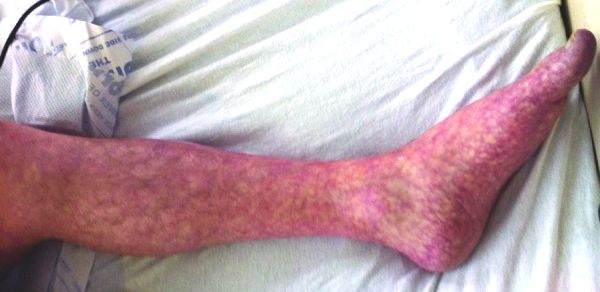
Livedo reticularis is a common skin finding consisting of a mottled reticulated vascular pattern that appears as a lace-like purplish discoloration of the skin. The discoloration is caused by reduction in blood flow (ischemia) through the arterioles that supply the cutaneous capillaries, resulting in deoxygenated blood showing as blue discoloration (cyanosis). This can be a secondary effect of a condition that increases a person's risk of forming blood clots (thrombosis), including a wide array of pathological and nonpathological conditions. Examples include hyperlipidemia, microvascular hematological or anemia states, nutritional deficiencies, hyper- and autoimmune diseases, and drugs/toxins.
The condition may be normal or related to more severe underlying pathology. Its differential diagnosis is broadly divided into possible blood diseases, autoimmune (rheumatologic), cardiovascular diseases, cancers, and endocrine disorders. It can usually (in 80% of cases) be diagnosed by biopsy.
It may be aggravated by exposure to cold, and occurs most often in the lower extremities.
The condition's name derives from Latin livere 'bluish' and reticular 'net-like pattern'.
A number of conditions may cause the appearance of livedo reticularis:
Livedo reticularis is diagnosed by its clinical appearance and history. No further test or examination confirms idiopathic livedo reticularis. However, further investigations may be undertaken where an underlying cause is suspected such as skin biopsies, or blood tests for antibodies associated with antiphospholipid syndrome or systemic lupus erythematosus.
Other than identifying and treating any underlying conditions in secondary livedo, idiopathic livedo reticularis may improve with warming the area.
Livedo reticularis
Livedo reticularis is a common skin finding consisting of a mottled reticulated vascular pattern that appears as a lace-like purplish discoloration of the skin. The discoloration is caused by reduction in blood flow (ischemia) through the arterioles that supply the cutaneous capillaries, resulting in deoxygenated blood showing as blue discoloration (cyanosis). This can be a secondary effect of a condition that increases a person's risk of forming blood clots (thrombosis), including a wide array of pathological and nonpathological conditions. Examples include hyperlipidemia, microvascular hematological or anemia states, nutritional deficiencies, hyper- and autoimmune diseases, and drugs/toxins.
The condition may be normal or related to more severe underlying pathology. Its differential diagnosis is broadly divided into possible blood diseases, autoimmune (rheumatologic), cardiovascular diseases, cancers, and endocrine disorders. It can usually (in 80% of cases) be diagnosed by biopsy.
It may be aggravated by exposure to cold, and occurs most often in the lower extremities.
The condition's name derives from Latin livere 'bluish' and reticular 'net-like pattern'.
A number of conditions may cause the appearance of livedo reticularis:
Livedo reticularis is diagnosed by its clinical appearance and history. No further test or examination confirms idiopathic livedo reticularis. However, further investigations may be undertaken where an underlying cause is suspected such as skin biopsies, or blood tests for antibodies associated with antiphospholipid syndrome or systemic lupus erythematosus.
Other than identifying and treating any underlying conditions in secondary livedo, idiopathic livedo reticularis may improve with warming the area.
Recent media
Recent media