Hubbry Logo
Local systemLocal systemMain
Open search
Local system
Community hub
Local system
logo
7 pages, 0 posts
0 subscribers
Be the first to start a discussion here.
Local system
Local system
from Wikipedia

In mathematics, a local system (or a system of local coefficients) on a topological space X is a tool from algebraic topology which interpolates between cohomology with coefficients in a fixed abelian group A, and general sheaf cohomology in which coefficients vary from point to point. Local coefficient systems were introduced by Norman Steenrod in 1943.[1]

Local systems are the building blocks of more general tools, such as constructible and perverse sheaves.

Definition

[edit]

Let X be a topological space. A local system (of abelian groups/modules...) on X is a locally constant sheaf (of abelian groups/of modules...) on X. In other words, a sheaf is a local system if every point has an open neighborhood such that the restricted sheaf is isomorphic to the sheafification of some constant presheaf. [clarification needed]

Equivalent definitions

[edit]

Path-connected spaces

[edit]

If X is path-connected,[clarification needed] a local system of abelian groups has the same stalk at every point. There is a bijective correspondence between local systems on X and group homomorphisms


and similarly for local systems of modules. The map giving the local system is called the monodromy representation of .

Proof of equivalence

Take local system and a loop at x. It's easy to show that any local system on is constant. For instance, is constant. This gives an isomorphism , i.e. between and itself. Conversely, given a homomorphism , consider the constant sheaf on the universal cover of X. The deck-transform-invariant sections of gives a local system on X. Similarly, the deck-transform-ρ-equivariant sections give another local system on X: for a small enough open set U, it is defined as

where is the universal covering.

This shows that (for X path-connected) a local system is precisely a sheaf whose pullback to the universal cover of X is a constant sheaf.

This correspondence can be upgraded to an equivalence of categories between the category of local systems of abelian groups on X and the category of abelian groups endowed with an action of (equivalently, -modules).[2]

Stronger definition on non-connected spaces

[edit]

A stronger nonequivalent definition that works for non-connected X is the following: a local system is a covariant functor

from the fundamental groupoid of to the category of modules over a commutative ring , where typically . This is equivalently the data of an assignment to every point a module along with a group representation such that the various are compatible with change of basepoint and the induced map on fundamental groups.

Examples

[edit]
  • Constant sheaves such as . This is a useful tool for computing cohomology since in good situations, there is an isomorphism between sheaf cohomology and singular cohomology:


  • Let . Since , there is an family of local systems on X corresponding to the maps :

  • Horizontal sections of vector bundles with a flat connection. If is a vector bundle with flat connection , then there is a local system given by For instance, take and , the trivial bundle. Sections of E are n-tuples of functions on X, so defines a flat connection on E, as does for any matrix of one-forms on X. The horizontal sections are then

    i.e., the solutions to the linear differential equation .

    If extends to a one-form on the above will also define a local system on , so will be trivial since . So to give an interesting example, choose one with a pole at 0:

    in which case for ,
  • An n-sheeted covering map is a local system with fibers given by the set . Similarly, a fibre bundle with discrete fibre is a local system, because each path lifts uniquely to a given lift of its basepoint. (The definition adjusts to include set-valued local systems in the obvious way).
  • A local system of k-vector spaces on X is equivalent to a k-linear representation of .
  • If X is a variety, local systems are the same thing as D-modules which are additionally coherent O_X-modules (see O modules).
  • If the connection is not flat (i.e. its curvature is nonzero), then parallel transport of a fibre F_x over x around a contractible loop based at x_0 may give a nontrivial automorphism of F_x, so locally constant sheaves can not necessarily be defined for non-flat connections.

Cohomology

[edit]

There are several ways to define the cohomology of a local system, called cohomology with local coefficients, which become equivalent under mild assumptions on X.

  • Given a locally constant sheaf of abelian groups on X, we have the sheaf cohomology groups with coefficients in .
  • Given a locally constant sheaf of abelian groups on X, let be the group of all functions f which map each singular n-simplex to a global section of the inverse-image sheaf . These groups can be made into a cochain complex with differentials constructed as in usual singular cohomology. Define to be the cohomology of this complex.
  • The group of singular n-chains on the universal cover of X has an action of by deck transformations. Explicitly, a deck transformation takes a singular n-simplex to . Then, given an abelian group L equipped with an action of , one can form a cochain complex from the groups of -equivariant homomorphisms as above. Define to be the cohomology of this complex.

If X is paracompact and locally contractible, then .[3] If is the local system corresponding to L, then there is an identification compatible with the differentials,[4] so .


Generalization

[edit]

Local systems have a mild generalization to constructible sheaves -- a constructible sheaf on a locally path connected topological space is a sheaf such that there exists a stratification of

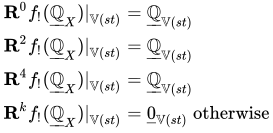
where is a local system. These are typically found by taking the cohomology of the derived pushforward for some continuous map . For example, if we look at the complex points of the morphism

then the fibers over

are the plane curve given by , but the fibers over are . If we take the derived pushforward then we get a constructible sheaf. Over we have the local systems

while over we have the local systems
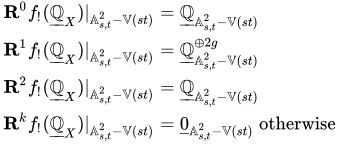
where is the genus of the plane curve (which is ).

Applications

[edit]

The cohomology with local coefficients in the module corresponding to the orientation covering can be used to formulate Poincaré duality for non-orientable manifolds: see Twisted Poincaré duality.

See also

[edit]

References

[edit]
[edit]
Revisions and contributorsEdit on WikipediaRead on Wikipedia
from Grokipedia
In mathematics, particularly in and sheaf theory, a local system on a topological space XX is defined as a sheaf F\mathcal{F} of abelian groups (or more generally, of modules or vector spaces over a ring) such that for every point xXx \in X, there exists a neighborhood UU of xx on which the restriction FU\mathcal{F}|_U is a constant sheaf. This structure allows the sheaf to vary in a controlled, "twisted" manner across XX, reflecting the while remaining constant locally. Local systems were introduced by Norman Steenrod in 1943 as a framework for defining homology with local coefficients, enabling the computation of topological invariants that account for non-trivial around loops in the space. Equivalently, a local system on XX corresponds to a representation of the fundamental groupoid of XX (or, when based at a point x0x_0, of the π1(X,x0)\pi_1(X, x_0)) into the of the stalk of the sheaf, providing a functorial link between algebraic representations and geometric data. This equivalence arises from the fact that the action along paths in XX determines the transition functions of the sheaf, and vice versa. Local systems play a central role in twisted cohomology theories, where cohomology groups with coefficients in a local system F\mathcal{F} capture invariants sensitive to the space's , generalizing ordinary sheaf cohomology. For instance, on simply connected spaces, every local system is constant, reducing to standard coefficients, but on spaces like the punctured plane C{0}\mathbb{C} \setminus \{0\}, non-trivial examples such as the square-root sheaf illustrate how local systems encode branching phenomena. They also relate to flat connections on vector bundles via the Riemann-Hilbert correspondence, bridging and .

Definition

Locally Constant Sheaves

In , a sheaf on a XX is a contravariant from the poset of open subsets of XX to the category of abelian groups (or modules over a ring RR) that satisfies two key axioms: the identity axiom, ensuring that a section uniquely determined locally is globally unique, and the gluing axiom, allowing compatible local sections over a cover to be glued into a global section over the union. This structure captures local data on XX that can be assembled compatibly, with the stalk Fx\mathcal{F}_x at a point xXx \in X defined as the direct limit of sections over neighborhoods of xx, representing the "germ" of sections at xx. A local system L\mathcal{L} on a XX is a sheaf of s (or RR-modules) that is locally constant, meaning that for every point xXx \in X, there exists an open neighborhood UU of xx such that the restriction LU\mathcal{L}|_U is isomorphic to the constant sheaf Lx\underline{\mathcal{L}_x} associated to its stalk Lx\mathcal{L}_x. The constant sheaf A\underline{A} for a fixed AA assigns to each VV the group Aπ0(V)A^{\pi_0(V)} of locally constant functions from the connected components of VV to AA, with restrictions preserving these components. This local constancy ensures that L\mathcal{L} varies "constantly" in small neighborhoods, making it suitable for defining coefficients in cohomology theories that account for topological twisting. The concept of local systems originated with Norman Steenrod's work on homology with local coefficients, where they served as a framework for handling varying coefficient groups over a space, predating the formal development of sheaf theory. In Steenrod's formulation, these systems allowed homology computations to incorporate local variations tied to the topology of the base space, such as in fiber bundles or covering spaces. A key property of local systems is that their stalks Lx\mathcal{L}_x are typically finite-dimensional vector spaces over a field kk (such as C\mathbb{C}), ensuring finite rank and enabling analytic or geometric interpretations. The transition functions between local trivializations on overlapping open sets UiUjU_i \cap U_j are constant on each connected component of the intersection, reflecting the sheaf's local constancy and guaranteeing compatibility across the space without introducing unnecessary variation. This structure distinguishes local systems from more general sheaves, like coherent sheaves in algebraic geometry, by emphasizing topological rather than analytic or algebraic constraints.

Monodromy Representation

A local system L\mathcal{L} on a pointed (X,x0)(X, x_0) is equivalently defined by a representation ρ:π1(X,x0)Aut(Lx0)\rho: \pi_1(X, x_0) \to \mathrm{Aut}(\mathcal{L}_{x_0}), where Lx0\mathcal{L}_{x_0} denotes the stalk () at the basepoint x0x_0 and Aut(Lx0)\mathrm{Aut}(\mathcal{L}_{x_0}) is the group of of this , typically a or module over a ring. This representation captures the parallel transport of sections along loops based at x0x_0, assigning to each class [γ]π1(X,x0)[\gamma] \in \pi_1(X, x_0) an ρ([γ])\rho([\gamma]) that describes how the fiber twists when transported around γ\gamma. The equivalence arises because the local system's structure sheaf allows consistent identification of fibers over contractible neighborhoods, enabling the global action of the on the base to define the entire sheaf. The monodromy action is explicitly given by ρ(γ)v\rho(\gamma) \cdot v for a loop γπ1(X,x0)\gamma \in \pi_1(X, x_0) and vLx0v \in \mathcal{L}_{x_0}, where ρ(γ)\rho(\gamma) is the induced by lifting γ\gamma to a path in the total of the associated étale and transporting vv along this lift. This action extends to the whole sheaf L\mathcal{L} by path lifting: for any path α:[0,1]X\alpha: [0,1] \to X with α(0)=x0\alpha(0) = x_0, parallel transport defines an isomorphism Lx0Lα(1)\mathcal{L}_{x_0} \to \mathcal{L}_{\alpha(1)} compatible with , ensuring that the representation ρ\rho reconstructs L\mathcal{L} as the sheaf of locally constant sections over XX. If two paths α,β\alpha, \beta are relative to endpoints, their induced isomorphisms coincide, making the well-defined up to . The local constancy of L\mathcal{L} implies that the representation ρ\rho is continuous when Aut(Lx0)\mathrm{Aut}(\mathcal{L}_{x_0}) is equipped with the discrete topology, as fibers over simply connected open sets are canonically identified without twisting, and the action only varies globally via the fundamental group. In this topology, every map from the discrete space π1(X,x0)\pi_1(X, x_0) is continuous, aligning the topological and algebraic structures seamlessly. This discreteness ensures that the sheaf is étale over XX, with the total space being a covering space modulo the group action. Unlike constant sheaves, where the representation ρ\rho is trivial (i.e., ρ(γ)=id\rho(\gamma) = \mathrm{id} for all γ\gamma), local systems permit non-trivial twisting, allowing the to vary systematically under the fundamental group's action and capturing phenomena like orientation reversals or more complex bundle structures. This distinction enables local systems to model local coefficients in homology and , generalizing constant coefficient theories to spaces with non-trivial topology.

Formulations and Spaces

Path-Connected Spaces

In the case of a path-connected topological space XX, the definition of a local system simplifies significantly compared to the general setting. Specifically, every local system on XX with fiber VV (a module over a commutative ring RR) is determined up to isomorphism by its monodromy representation ρ:π1(X,x0)\AutR(V)\rho: \pi_1(X, x_0) \to \Aut_R(V), where x0Xx_0 \in X is a basepoint and \AutR(V)\Aut_R(V) denotes the group of RR-linear automorphisms of VV. This representation arises from parallel transport along loops based at x0x_0, and it is independent of the choice of basepoint up to conjugation in \AutR(V)\Aut_R(V), due to the path-connectedness of XX allowing conjugation by paths between basepoints. A fundamental structural result is that the category of local systems on a path-connected XX is equivalent to the category of representations of the π1(X)\pi_1(X) on RR-modules. Under this equivalence, the sending a local system to its stalk (fiber) at a basepoint corresponds to the fiber functor on representations, which evaluates the module at the basepoint. This category equivalence holds because the action fully encodes the gluing data for the locally constant sheaf, and path-connectedness ensures a single representation suffices without additional compatibility conditions across components. Local systems also admit geometric interpretations in terms of fiber bundles and connections. For local systems of sets (i.e., R=ZR = \mathbb{Z} and VV a discrete set), they correspond precisely to fiber bundles over XX with discrete fibers, which are étale covers equipped with a transitive action of the deck transformation group on the fiber. In the vector space case (e.g., R=kR = k a field and VV a finite-dimensional kk-), local systems are equivalent to vector bundles over XX equipped with a flat connection, meaning a connection whose vanishes, ensuring local triviality via and compatibility with the representation. This flatness guarantees that the bundle is locally isomorphic to the trivial bundle X×VX \times V with the trivial connection.

Non-Path-Connected Spaces

In a general XX that is not path-connected, a local system L\mathcal{L} is defined componentwise on the path components of XX. Specifically, if {Xi}iI\{X_i\}_{i \in I} denotes the collection of path components of XX, then L\mathcal{L} consists of a local system Li\mathcal{L}_i on each XiX_i, with no required compatibility conditions between the different Li\mathcal{L}_i. This extends the notion from path-connected spaces, where a single monodromy representation of the suffices, to the disjoint union structure inherent in non-path-connected settings. More precisely, a local system on XX corresponds to a functor from the fundamental groupoid π1(X)\pi_1(X) of XX—whose objects are points of XX and morphisms are homotopy classes of paths—to the category of vector spaces (or modules over a ring), assigning to each path component an independent representation of its own . Since the fundamental groupoid has no morphisms between distinct path components, the local systems on different XiX_i are independent, allowing potentially different ranks or structures on each component. A key consequence of this componentwise definition is that the space of global sections decomposes as a product: Γ(X,L)=iIΓ(Xi,Li)\Gamma(X, \mathcal{L}) = \prod_{i \in I} \Gamma(X_i, \mathcal{L}_i). This reflects the disjoint nature of the path components, where sections on XX are precisely the tuples of sections restricted to each XiX_i.

Examples

Trivial and Constant Systems

The trivial local system on a XX with values in an AA is the constant sheaf A\underline{A} whose sections over any open set UXU \subseteq X consist of constant functions UAU \to A, equipped with the trivial monodromy representation ρ:π1(X,x0)\Aut(A)\rho: \pi_1(X, x_0) \to \Aut(A) that acts as the identity on AA. This sheaf is globally constant, meaning it is isomorphic to the product bundle X×AX \times A, and its stalks are canonically identified with AA at every point. A key property of the constant sheaf A\underline{A} is that its global sections over a connected UU are precisely the constant functions to AA, reflecting the absence of twisting by the . When AA is equipped with the , A\underline{A} coincides with the sheaf of locally constant functions UAU \to A, ensuring that local systems with discrete stalks capture untwisted coefficient systems in . For the case where AA is a VV over a field kk, the trivial local system has constant rank equal to dimkV\dim_k V across all points of XX, as the fiber over each point is isomorphic to VV. Local systems are defined to have discrete stalks, and those with finite stalks (e.g., when AA is a finite ) are inherently locally constant, providing the simplest examples without monodromic variation.

Non-Trivial Geometric Examples

One prominent non-trivial geometric example of a local system arises from the orientation sheaf on a non-orientable manifold such as the real projective plane RP2\mathbb{RP}^2. Here, the sheaf L\mathcal{L} has stalks isomorphic to Z\mathbb{Z} at each point, but the representation ρ:π1(RP2)Aut(Z)\rho: \pi_1(\mathbb{RP}^2) \to \mathrm{Aut}(\mathbb{Z}) is non-trivial, with π1(RP2)Z/2Z\pi_1(\mathbb{RP}^2) \cong \mathbb{Z}/2\mathbb{Z} acting via the sign homomorphism: the acts as multiplication by +1+1, while the generator (corresponding to an orientation-reversing loop) acts by multiplication by 1-1. This twisting reflects the global non-orientability of RP2\mathbb{RP}^2, where local orientations cannot be consistently glued, resulting in a locally constant sheaf that captures sign changes along certain paths. Another illustrative example is the local system on the punctured plane R2{0}\mathbb{R}^2 \setminus \{0\}, where the π1(R2{0})Z\pi_1(\mathbb{R}^2 \setminus \{0\}) \cong \mathbb{Z} is generated by a loop circling the origin once. A non-trivial representation ρ:Z{±1}GL(1,R)\rho: \mathbb{Z} \to \{\pm 1\} \subset \mathrm{GL}(1, \mathbb{R}) sends the generator to 1-1, inducing a Möbius-like twisting in the sheaf sections: parallel around the origin reverses the sign of vectors in the R\mathbb{R}-stalks. This construction demonstrates how the puncture introduces that prevents global triviality, even though the space is equivalent to the circle. Covering spaces provide a broad class of non-trivial local systems, particularly through the associated sheaves of sets. For an nn-sheeted connected covering p:YXp: Y \to X, the sheaf L\mathcal{L} has stalks of nn, and the action of π1(X,x0)\pi_1(X, x_0) on the p1(x0)p^{-1}(x_0) is transitive and free, corresponding to the deck transformation group isomorphic to the p(π1(Y,y0))p_*(\pi_1(Y, y_0)). More generally, vector bundles with flat connections yield local systems of vector spaces, where the representation ρ:π1(X)GL(V)\rho: \pi_1(X) \to \mathrm{GL}(V) encodes along loops. Local systems classify flat vector bundles up to : there is an between flat R\mathbb{R}-vector bundles on a manifold XX (equipped with a connection of vanishing ) and local systems of R\mathbb{R}-vector spaces on XX, via the representation that identifies isomorphisms between fibers.

Cohomology

Sheaf Cohomology

Sheaf cohomology with coefficients in a local system L\mathcal{L} on a XX is defined as the jj-th right of the global sections functor Γ(X,)\Gamma(X, -) applied to L\mathcal{L}, denoted Hj(X,L)H^j(X, \mathcal{L}). Local systems, being locally constant sheaves of abelian groups (or vector spaces), capture twisted coefficients arising from the fundamental groupoid of XX. These groups serve as primary invariants measuring the extent to which L\mathcal{L} fails to be acyclic globally. One standard method to compute Hj(X,L)H^j(X, \mathcal{L}) employs the Čech complex associated to an open cover U\mathcal{U} of XX where L\mathcal{L} is constant on the intersections Uα0αkU_{\alpha_0 \dots \alpha_k}, such as a good cover with simply connected finite intersections. In this case, Leray's theorem ensures that the Hˇj(U,L)\check{H}^j(\mathcal{U}, \mathcal{L}) is isomorphic to Hj(X,L)H^j(X, \mathcal{L}), obtained as the cohomology of the cochain complex of global sections over the nerves of the cover. Alternatively, for a more sheaf-theoretic approach, an injective resolution 0LI0I10 \to \mathcal{L} \to I^0 \to I^1 \to \cdots of L\mathcal{L} by injective sheaves (often flasque sheaves) yields Hj(X,L)Hj(Γ(X,I))H^j(X, \mathcal{L}) \cong H^j(\Gamma(X, I^\bullet)), the of the complex of global sections. On paracompact manifolds, resolutions by fine sheaves—such as those built from smooth functions using partitions of unity—simplify this, as fine sheaves are acyclic for Γ(X,)\Gamma(X, -), meaning Hj(X,F)=0H^j(X, F) = 0 for j>0j > 0 when FF is fine. Key properties include the exactness of the global sections functor on acyclic covers: if a cover U\mathcal{U} is such that Hk(Uα0αk,L)=0H^k(U_{\alpha_0 \dots \alpha_k}, \mathcal{L}) = 0 for k>0k > 0, then the higher direct images vanish, allowing the Čech complex to faithfully compute the s. For local systems of finite-dimensional vector spaces over a field on compact manifolds, the groups Hj(X,L)H^j(X, \mathcal{L}) are finite-dimensional, reflecting the bounded of the twisting by the . In the of sheaves Db(X)D^b(X), local systems appear as bounded complexes with concentrated in degree zero, enabling hypercohomology computations via spectral sequences without delving into full machinery. For instance, the orientation sheaf on non-orientable manifolds like the yields non-vanishing H1H^1 reflecting the sign ambiguity in local trivializations.

Singular Cohomology Equivalence

Singular cohomology with local coefficients in a local system ℒ on a XX, denoted H\sing(X;L)H^*_{\sing}(X; \mathcal{L}), is computed from the cohomology of the twisted singular cochain complex C(X;L)C^*(X; \mathcal{L}). This complex arises from the action of the fundamental groupoid of XX on the fibers of L\mathcal{L}, incorporating to account for the variation of coefficients along paths. One standard uses the universal cover X~\tilde{X} of a path-component of XX, where the cochain groups are Cn(X;L)=\HomZ[π1](Cn(X~),M)C^n(X; \mathcal{L}) = \Hom_{\mathbb{Z}[\pi_1]}(C_n(\tilde{X}), M), where MM is the Z[π1]\mathbb{Z}[\pi_1]-module given by the stalk of L\mathcal{L} at a basepoint with π1=π1(X)\pi_1 = \pi_1(X) acting via deck transformations on X~\tilde{X} and via the monodromy representation on MM. The differential δ:Cn(X;L)Cn+1(X;L)\delta: C^n(X; \mathcal{L}) \to C^{n+1}(X; \mathcal{L}) is induced by the singular boundary map on X~\tilde{X}, respecting the equivariant structure. In the simplicial formulation, cochains are functions ff assigning to each oriented singular nn-simplex σ:ΔnX\sigma: \Delta^n \to X an element f(σ)Lx0(σ)f(\sigma) \in \mathcal{L}_{x_0(\sigma)}, where x0(σ)x_0(\sigma) is the image of the starting vertex under σ\sigma, up to identification via . The coboundary operator is given by δf(σ)=i=0n+1(1)iγ(σ,i)f(σi),\delta f(\sigma) = \sum_{i=0}^{n+1} (-1)^i \cdot \gamma(\sigma, i) \cdot f(\sigma|_{\partial_i}), where γ(σ,i)\gamma(\sigma, i) denotes the induced by along the path in σ\sigma from the starting vertex of σ\sigma to that of the ii-th face σi\sigma|_{\partial_i}, ensuring consistency for non-constant paths. For constant local systems, this reduces to the untwisted singular coboundary. This twisting captures the non-trivial action of loops on coefficients, distinguishing local systems from constant ones. Under suitable topological assumptions on XX, sheaf cohomology with coefficients in L\mathcal{L} is isomorphic to this singular cohomology: for paracompact Hausdorff spaces XX that are locally contractible, there is a natural isomorphism Hj(X,L)H\singj(X;L)H^j(X, \mathcal{L}) \cong H^j_{\sing}(X; \mathcal{L}) for all j0j \geq 0. This equivalence extends to relative and pair versions (X,A)(X, A). The proof relies on the Leray theorem, which equates sheaf cohomology to over fine acyclic covers; on such spaces, with local coefficients matches singular cohomology via subdivision and homotopy invariance arguments, as the local contractibility ensures simplicial approximations align with sheaf resolutions. Milder conditions, such as semi-locally contractible and paracompact, suffice for the isomorphism when L\mathcal{L} is a sheaf of abelian groups. These assumptions ensure the necessary refinements of covers and acyclicity of nerves, bridging the intrinsic sheaf perspective with the combinatorial singular chains.

Generalizations

Constructible Sheaves

Constructible sheaves generalize local systems by allowing the sheaf to vary across a stratified decomposition of the space, while remaining locally constant within each stratum. Specifically, given a topological space XX and a stratification S={Si}iI\mathcal{S} = \{S_i\}_{i \in I} consisting of disjoint locally closed subsets whose union is XX, a sheaf F\mathcal{F} of vector spaces over a field kk on XX is constructible with respect to S\mathcal{S} if its restriction FSi\mathcal{F}|_{S_i} is a locally constant sheaf (i.e., a local system) on each stratum SiS_i, the stalks Fx\mathcal{F}_x are finite-dimensional kk-vector spaces for all xXx \in X. This framework extends the notion of local constancy from the entire space to piecewise-constant behavior adapted to the geometry of singularities or decompositions. Local systems fit naturally into this picture as a special case of constructible sheaves. A pure local system on XX, being locally constant across the whole space, corresponds to a constructible sheaf with respect to the trivial stratification S={X}\mathcal{S} = \{X\}, where the single is XX itself and no further is needed. This inclusion highlights how constructible sheaves capture more general coefficient systems that are constant on strata but may exhibit jumps or across boundaries, useful for studying spaces with non-trivial or singularities. A foundational result in the theory is the Beilinson-Bernstein-Deligne theorem, which establishes that the category of constructible sheaves on XX is an , and the bounded derived category of constructible sheaves, denoted Dcb(X,k)D^b_c(X, k), admits a t-structure whose heart is the abelian category of perverse sheaves. This t-structure is defined via conditions on the sheaves' supports relative to the dimension of strata, enabling powerful tools like Verdier duality and the six functor formalism for constructible objects. The theorem provides the categorical foundation for many applications in geometry and . As an illustrative example, skyscraper sheaves exemplify degenerate constructible sheaves. For a closed point xXx \in X, the skyscraper sheaf Fx\mathcal{F}_x with stalk kk at xx and zero elsewhere is constructible with respect to a stratification where {x}\{x\} is one stratum (on which it is locally constant) and X{x}X \setminus \{x\} is another (on which it vanishes). This construction demonstrates how constructible sheaves can model Dirac delta-like supports, essential for intersection cohomology and other singular theories.

Higher Local Systems

Higher local systems extend the classical notion of local systems to higher categorical frameworks, particularly within ∞-category theory. In this context, a higher local system on a XX is defined as a locally constant from XX to the ∞-category of (∞,n)-categories, or more precisely, as an object in the (n+1)-category (n+1)LocSysCatn(X;A)(n+1)\mathrm{LocSysCat}_n(X; \mathcal{A}) of n-categorical local systems valued in a presentably symmetric monoidal (∞,n)-category A\mathcal{A}. These structures can be interpreted as representations of the fundamental ∞- Π(X)\Pi_\infty(X) of XX into an (∞,1)-, generalizing the action of the fundamental groupoid on vector spaces in the classical case. Such representations are equipped with a flat ∞-connection, enabling along paths in higher dimensions. A key advancement in this area is the categorified monodromy equivalence, which describes higher local systems via higher monodromy data. For an (n+1)-connected space XX, higher local systems are equivalent to En+1E_{n+1}-modules over the (n+1)-fold based loop space Ωn+1X\Omega^{n+1}_* X, generalizing the classical monodromy representation as modules over the based loop space ΩX\Omega_* X. This equivalence extends Teleman's theory of topological actions on categories to (∞,n)-categories and connects invertible higher local systems over an n-connected XX to characters of the homotopy group πn(X)\pi_n(X). The framework links to stable homotopy theory when A\mathcal{A} is the ∞-category of spectra, yielding modules in stable settings, and to derived algebraic geometry through connections with étale cohomology and Brauer groups. Monodromy in higher dimensions is realized through parallel transport in ∞-bundles, where the structure group acts via EkE_k-algebra morphisms for k2k \geq 2. Examples in loop spaces, such as local systems on simply connected spaces as modules over the double loop space Ω2X\Omega^2_* X, highlight how these constructions encode higher homotopy information via iterated looping. This higher-dimensional perspective recovers classical local systems in dimension 1, where n=0 and the E1E_1-module structure reduces to ordinary representations of the fundamental group.

Applications

Manifold Duality

In manifold topology, local systems play a crucial role in extending classical duality theorems to incorporate twisted coefficients, allowing for the study of manifolds with non-trivial actions on coefficients. The twisted theorem provides an isomorphism between and homology groups equipped with a local system L\mathcal{L}. For a closed, orientable nn-manifold MM and a local system L\mathcal{L} of rank kk vector spaces over a field (or more generally, a Zπ1(M)\mathbb{Z}\pi_1(M)-module), the theorem states that Hj(M;L)Hnj(M;LorM)H^j(M; \mathcal{L}) \cong H_{n-j}(M; \mathcal{L}^\vee \otimes \mathrm{or}_M), where L\mathcal{L}^\vee is the dual local system and orM\mathrm{or}_M is the trivial orientation sheaf (isomorphic to the constant sheaf Z\underline{\mathbb{Z}} for orientable MM). This isomorphism is established via the cap product with the fundamental class [M]Hn(M;orM)[M] \in H_n(M; \mathrm{or}_M), yielding a map Hj(M;L)Hnj(M;LorM)H^j(M; \mathcal{L}) \to H_{n-j}(M; \mathcal{L}^\vee \otimes \mathrm{or}_M) that is an isomorphism under the given conditions. One proof proceeds by excising submanifolds and applying the Thom isomorphism theorem to their normal bundles: for a codimension-qq submanifold NMN \subset M, a tubular neighborhood UU of NN retracts to the zero section, and the Thom class in Hq(U,UN;L)H^q(U, U - N; \mathcal{L}) induces an isomorphism Hj(MN;L)Hj+q(M,MN;L)H^j(M - N; \mathcal{L}) \cong H^{j+q}(M, M - N; \mathcal{L}) via the restriction to the boundary of the tubular neighborhood, which extends globally to the duality map. For non-orientable manifolds, the theorem generalizes by replacing the constant orientation sheaf with the orientation local system orM=Zw\mathrm{or}_M = \mathbb{Z}_w, where wH1(M;Z/2)w \in H^1(M; \mathbb{Z}/2) is the first Stiefel-Whitney class, yielding Hj(M;L)Hnj(M;LZw)H^j(M; \mathcal{L}) \cong H_{n-j}(M; \mathcal{L}^\vee \otimes \mathbb{Z}_w), with the fundamental class now in Hn(M;Zw)H_n(M; \mathbb{Z}_w). A key application arises in computing twisted cohomology groups for non-orientable manifolds like the real projective space RPn\mathbb{RP}^n or the Klein bottle. For RP2\mathbb{RP}^2 with the orientation local system Zw\mathbb{Z}_w, the twisted cohomology is H0(RP2;Zw)Z/2H^0(\mathbb{RP}^2; \mathbb{Z}_w) \cong \mathbb{Z}/2, H1(RP2;Zw)=0H^1(\mathbb{RP}^2; \mathbb{Z}_w) = 0, and H2(RP2;Zw)ZH^2(\mathbb{RP}^2; \mathbb{Z}_w) \cong \mathbb{Z}, which duality relates to the homology groups via the isomorphism above. Similarly, for the Klein bottle KK, whose fundamental group is a,baba1b=1\langle a, b \mid aba^{-1}b = 1 \rangle, local systems classified by representations π1(K)GL(k,R)\pi_1(K) \to \mathrm{GL}(k, \mathbb{R}) allow computation of H1(K;L)H^1(K; \mathcal{L}) using duality to pair with H1(K;LZw)H_1(K; \mathcal{L}^\vee \otimes \mathbb{Z}_w), revealing non-trivial twists that vanish in the orientable double cover (the torus). To address open manifolds, where standard fails due to lack of compactness, compactly supported versions incorporate Borel-Moore homology: for an open orientable nn-manifold MM, Hcj(M;L)Hnj(M;LorM)H^j_c(M; \mathcal{L}) \cong H_{n-j}(M; \mathcal{L}^\vee \otimes \mathrm{or}_M), where HBMH_*^BM denotes homology with infinite chains allowed outside compact sets. This extends naturally to non-orientable cases using Zw\mathbb{Z}_w. In the sheaf-theoretic framework, Verdier duality provides the derived category formulation, asserting that for a smooth manifold MM of dimension nn, the dualizing complex is ωM\omega_M (the orientation sheaf shifted), yielding RHom(L,ωM)RHomc(L,k)RHom(\mathcal{L}, \omega_M ) \cong RHom_c(\mathcal{L}, \underline{k}) in the of sheaves, recovering twisted upon taking .

Geometric and Algebraic Connections

Local systems on smooth manifolds establish a profound connection to through flat connections. A local system of rank kk corresponds to a representation ρ:π1(M)GL(k,R)\rho: \pi_1(M) \to GL(k, \mathbb{R}), where π1(M)\pi_1(M) is the of the manifold MM. This representation defines , yielding a flat whose sections form the local system. By the Riemann-Hilbert correspondence, such flat bundles with integrable connections are equivalent to local systems, enabling the computation of with local coefficients as the of the associated flat bundle. In algebraic geometry, étale local systems over schemes generalize this framework, corresponding to continuous \ell-adic representations of the étale fundamental group π1eˊt(X,x)\pi_1^{\text{ét}}(X, \overline{x}) into GL(k,Q)GL(k, \mathbb{Q}_\ell). These \ell-adic sheaves play a pivotal role in the Langlands program, where they encode geometric analogs of Galois representations and relate to automorphic forms on varieties. For instance, on algebraic curves, étale local systems parametrize the input data for the geometric Langlands correspondence, linking cohomology of moduli stacks to representations of Langlands dual groups. Recent developments in the 2020s, including progress on the categorical geometric Langlands conjecture, have further illuminated these ties through categorical enhancements. Local systems also intersect with physics in , particularly Yang-Mills theories on manifolds, where they model the of flat connections in the bundle of algebra-valued forms. Wilson lines, defined as path-ordered exponentials Pexp(γA)\mathcal{P} \exp \left( \int_\gamma A \right) along paths γ\gamma, compute gauge-invariant observables representing the representation of π1(M)\pi_1(M) induced by the connection; for pure Yang-Mills, the of flat connections is precisely the character variety of local systems. This framework extends to topological quantum field theories (TQFTs), where local systems furnish the representation data for constructing extended TQFTs via higher categories, as in the Reshetikhin-Turaev for 3-manifolds. A cornerstone linking these geometric and algebraic aspects is Deligne's development of mixed Hodge structures on the cohomology of local systems over complex algebraic varieties. In his seminal work, Deligne equips the hypercohomology H(X,QL)\mathbb{H}^*(X, \mathbb{Q} \otimes \mathcal{L}) of a local system L\mathcal{L} with a mixed Hodge structure, compatible with the variation over the base and reflecting the transcendental nature of the periods. This structure unifies Betti, de Rham, and Hodge cohomologies for non-constant coefficients, facilitating comparisons between topological and analytic invariants on varieties.

References

Add your contribution
Related Hubs
User Avatar
No comments yet.