



Community hub
Recent from talks
Contribute something
Nothing was collected or created yet.
Log reduction
View on WikipediaLog reduction is a measure of how thoroughly a decontamination process reduces the concentration of a contaminant. It is defined as the common logarithm of the ratio of the levels of contamination before and after the process, so an increment of 1 corresponds to a reduction in concentration by a factor of 10. In general, an n-log reduction means that the concentration of remaining contaminants is only 10−n times that of the original. So for example, a 0-log reduction is no reduction at all, while a 1-log reduction corresponds to a reduction of 90 percent from the original concentration, and a 2-log reduction corresponds to a reduction of 99 percent from the original concentration.[1]
Mathematical definition
[edit]Let cb and ca be the numerical values of the concentrations of a given contaminant, respectively before and after treatment, following a defined process. It is irrelevant in what units these concentrations are given, provided that both use the same units.
Then an R-log reduction is achieved, where
- .

For the purpose of presentation, the value of R is rounded down to a desired precision, usually to a whole number.
- Example
Let the concentration of some contaminant be 580 ppm before and 0.725 ppm after treatment. Then

Rounded down, R is 2, so a 2-log reduction is achieved.
Conversely, an R-log reduction means that a reduction by a factor of 10R has been achieved.
Log reduction and percentage reduction
[edit]Reduction is often expressed as a percentage. The closer it is to 100%, the better. Letting cb and ca be as before, a reduction by P % is achieved, where
- [2]
- Example
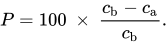
Let, as in the earlier example, the concentration of some contaminant be 580 ppm before and 0.725 ppm after treatment. Then

So this is (better than) a 99% reduction, but not yet quite a 99.9% reduction.
The following table summarizes the most common cases.
Log reduction Percentage 1-log reduction 90% 2-log reduction 99% 3-log reduction 99.9% 4-log reduction 99.99% 5-log reduction 99.999%
In general, if R is a whole number, an R-log reduction corresponds to a percentage reduction with R leading digits "9" in the percentage (provided that it is at least 10%).
See also
[edit]References
[edit]- ^ "Final Report of an NWRI Independent Advisory Panel: Recommended DPR General Guidelines and Operational Requirements for New Mexico" (PDF). National Water Research Institute. January 22, 2016. Retrieved December 7, 2018.
- ^ "Log and Percent Reductions in Microbiology and Antimicrobial Testing". Microchem Laboratory. December 16, 2015. Retrieved December 7, 2018.
Log reduction
View on GrokipediaMathematical Foundations
Definition
Log reduction is a mathematical measure that quantifies the proportional decrease in a quantity, such as the concentration of a substance or population, using the common logarithm (base 10).[5] It provides a scale for expressing reductions in orders of magnitude, which is particularly useful for large-scale decreases where linear or percentage measures become cumbersome.[6] The logarithm base 10 of a number , denoted , is the exponent to which 10 must be raised to yield ; for example, since .[7] A fundamental property of logarithms states that for positive and .[8] Log reduction leverages this property and is formally defined as , where is the initial quantity and is the final quantity after reduction (with ).[9] To illustrate, consider a 1-log reduction: . This equation implies , so , dividing the original quantity by 10.[6] More generally, an -log reduction corresponds to dividing by , as yields .[5] This roughly equates to a reduction; for instance, a 1-log reduction is approximately 90%.[5] The following table illustrates common log reduction values, showing the equivalent multiplicative factor and approximate percentage reduction:| Log Reduction | Multiplicative Factor | Approximate Percentage Reduction |
|---|---|---|
| 1 | 90% | |
| 2 | 99% | |
| 3 | 99.9% | |
| 4 | 99.99% | |
| 5 | 99.999% |
Logarithmic Properties Relevant to Reduction
One key property of logarithms that makes log reduction particularly useful is their additivity in logarithmic space. When a quantity undergoes successive multiplicative reductions, the total log reduction is the sum of the individual log reductions for each step. For instance, two consecutive 1-log reductions, each dividing the quantity by 10, result in a total 2-log reduction, equivalent to dividing by 100 overall.[10] This additivity arises from the fundamental property that the logarithm of a product equals the sum of the logarithms: . For a sequence of reductions from initial value to final value through intermediate values , the total log reduction is given by where each term represents the log reduction at step .[11] Logarithms also compress wide ranges of values into a more manageable scale, which is ideal for reductions spanning multiple orders of magnitude, such as from millions to units. This compression allows for straightforward visualization and comparison of exponential changes without dealing with extremely large or small numbers.[12] The base of the logarithm is typically 10 (common logarithm) in log reduction contexts for its alignment with decimal notation, facilitating intuitive interpretation—e.g., a 1-log reduction corresponds directly to a factor of 10. While natural logarithms (base ) are used in some analytical contexts for their mathematical convenience in calculus, base-10 remains standard for reductions due to its simplicity in practical reporting.[13][14]Comparisons with Other Measures
Relation to Percentage Reduction
Log reduction and percentage reduction are interconnected measures of microbial elimination, where a log reduction of corresponds to reducing the initial population to .[2] The percentage reduction is then derived as the proportion of the population eliminated, given by the formula where is the log reduction value.[2] This derivation stems from the definition of log reduction as the base-10 logarithm of the survival ratio . To illustrate, for a 1-log reduction (), the surviving fraction is , so . For a 2-log reduction (), , yielding . This pattern continues, with each additional log appending a "9" to the percentage for integer values. The following table compares common integer log reductions to their exact percentage equivalents and surviving fractions:| Log Reduction | Percentage Reduction | Surviving Fraction |
|---|---|---|
| 1 | 90.0% | 10.0% |
| 2 | 99.0% | 1.0% |
| 3 | 99.9% | 0.1% |
| 4 | 99.99% | 0.01% |
| 5 | 99.999% | 0.001% |
| 6 | 99.9999% | 0.0001% |