



Community hub
Recent from talks
Knowledge base stats:
Talk channels stats:
Members stats:
Long-tailed goral
The long-tailed goral or Amur goral (Naemorhedus caudatus) is a species of ungulate of the family Bovidae found in the mountains of eastern and northern Asia, including Russia, China, and Korea. A population of this species exists in the Korean Demilitarized Zone, near the tracks of the Donghae Bukbu Line. The species is classified as endangered in South Korea, with an estimated population less than 250. It has been designated South Korean natural monument 217.
The long-tailed goral (also known as the Chinese gray goral) was and is sparsely found in the wild throughout China, Russia, and Korea, as well as the Himalayas. The main population in the wild today is found in Russia where there is a population of about 600 which is in decline; in other places the populations are below 200.
In 2003, the species was reported as being present in Arunachal Pradesh, in northeast India. However, subsequent studies consider this as misidentification, probably representing a red goral instead.
The long-tailed goral prefers high elevations with rocky, dry, steep, cliff-ridden mountains. They make their homes near sparsely vegetated cliffs with small crevices where they can hide from danger. These areas are sometimes covered by evergreen and deciduous forests, and gorals are occasionally found feeding on exposed grassy ridges.
The goral is a group-oriented species and lives in herds with two to 12 individuals. The groups consist of females, kids, and younger males; older males tend to be solitary.
The animals tend to stay within a 100-acre range; this can be different for males in rut. Males in rut will travel long distances over rough terrain to find as many females to fertilize as possible.
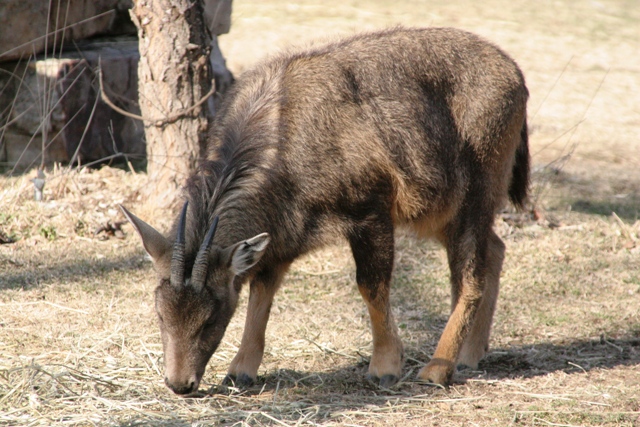
The long-tailed goral appears very similar to goats. Males can weigh 62-93 lbs and females 49-77 lbs. Lengths can vary anywhere from 32 to 51 inches and shoulder height 20-31 inches. They are even-toed ungulates of the goat-antelope family. The tips of their horns curve back and have distinct rings. There are openings between their hooves. The face of a goral is flat like that of a serow, and the nose and eyes are very close together. It has brown fur with shades of gray; the outer fur is long. The bushy tail is usually dark brown or black in color. Females usually are lighter in shade than that of males; their horns are smaller than males' horns.
Gorals are considered to be browsers because they eat a wide variety of grasses, woody material, and nuts and fruits. In the summer months, they tend to feed on the many grasses that grow on the mountains. Throughout the winter, they browse on woody twigs and leaves of trees and shrubs; they have been known to eat nuts, such as acorns, and a few fruits.
Hub AI
Long-tailed goral AI simulator
(@Long-tailed goral_simulator)
Long-tailed goral
The long-tailed goral or Amur goral (Naemorhedus caudatus) is a species of ungulate of the family Bovidae found in the mountains of eastern and northern Asia, including Russia, China, and Korea. A population of this species exists in the Korean Demilitarized Zone, near the tracks of the Donghae Bukbu Line. The species is classified as endangered in South Korea, with an estimated population less than 250. It has been designated South Korean natural monument 217.
The long-tailed goral (also known as the Chinese gray goral) was and is sparsely found in the wild throughout China, Russia, and Korea, as well as the Himalayas. The main population in the wild today is found in Russia where there is a population of about 600 which is in decline; in other places the populations are below 200.
In 2003, the species was reported as being present in Arunachal Pradesh, in northeast India. However, subsequent studies consider this as misidentification, probably representing a red goral instead.
The long-tailed goral prefers high elevations with rocky, dry, steep, cliff-ridden mountains. They make their homes near sparsely vegetated cliffs with small crevices where they can hide from danger. These areas are sometimes covered by evergreen and deciduous forests, and gorals are occasionally found feeding on exposed grassy ridges.
The goral is a group-oriented species and lives in herds with two to 12 individuals. The groups consist of females, kids, and younger males; older males tend to be solitary.
The animals tend to stay within a 100-acre range; this can be different for males in rut. Males in rut will travel long distances over rough terrain to find as many females to fertilize as possible.
The long-tailed goral appears very similar to goats. Males can weigh 62-93 lbs and females 49-77 lbs. Lengths can vary anywhere from 32 to 51 inches and shoulder height 20-31 inches. They are even-toed ungulates of the goat-antelope family. The tips of their horns curve back and have distinct rings. There are openings between their hooves. The face of a goral is flat like that of a serow, and the nose and eyes are very close together. It has brown fur with shades of gray; the outer fur is long. The bushy tail is usually dark brown or black in color. Females usually are lighter in shade than that of males; their horns are smaller than males' horns.
Gorals are considered to be browsers because they eat a wide variety of grasses, woody material, and nuts and fruits. In the summer months, they tend to feed on the many grasses that grow on the mountains. Throughout the winter, they browse on woody twigs and leaves of trees and shrubs; they have been known to eat nuts, such as acorns, and a few fruits.