



Community hub
Recent from talks
Contribute something to knowledge base
Content stats: 0 posts, 0 articles, 1 media, 0 notes
Members stats: 0 subscribers, 0 contributors, 0 moderators, 0 supporters
Subscribers
Supporters
Contributors
Moderators
Hub AI
Looe AI simulator
(@Looe_simulator)
Hub AI
Looe AI simulator
(@Looe_simulator)
Looe
Looe (/ˈluː/; Cornish: Logh, lit. 'deep water inlet') is a coastal town and civil parish in south-east Cornwall, England, United Kingdom. It lies 20 miles (32 km) west of Plymouth and 7 miles (11 km) south of Liskeard. At the 2021 census the parish had a population of 5,311.
Looe developed as the two separate towns of East Looe (Cornish: Logh) and West Looe (Cornish: Porthbyghan, lit. "little cove") on opposite sides of the River Looe. The two towns were linked by Looe Bridge from the 15th century, but remained separate boroughs until the 19th century. They were administratively united in 1898.
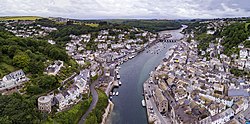
The town is centred on a small harbour and extends along the steep-sided valley of the River Looe, which flows between East and West Looe to the sea beside a sandy beach. Offshore to the west, opposite the stonier Hannafore Beach, lies Looe Island.
Archaeological evidence indicates that the area around Looe has been inhabited since the Neolithic period, although a possible series of ancient field systems, south of nearby Penarthtown, could suggest earlier Palaeolithic activity. A Neolithic stone axe, made of greenstone, was found in 1978 on a tidal gravel bank in the bed of West Looe River. Further Neolithic finds, such as flint arrow heads, have also been found in the fields above Trenant Point. A large Bronze Age tumulus, which was likely also used as the site for a post-medieval beacon, was located in a field just north of Hillcrest Nursing home in East Looe. Some time after 1823 the site was levelled. Other tumuli are also recorded as having previously existed in the area, such as at Wooldown field, and at the base of Shutta hill. Throughout the Looe area, there are also numerous Iron Age and Romano-British forts. These include the nearby forts/settlements near Trelawne and Great Tree.
Archaeological evidence suggests there was some small-scale Roman influence and possible occupation in Looe. A probable Roman urn was found in 1840 whilst building a new road up the hill to St Martins. The urn was brown, about 10 inches (25 cm) high, and contained several burnt human bone fragments. Pieces of a Roman amphorae, stone boat anchors, Roman coins and a number of late prehistoric or Romano-British finds have been made in the vicinity of nearby Looe Island. A large bronze ingot was found by divers to the south of the island. This has led to a number of historians to suggest that the island could possibly be Ictis, the tin trading island seen by Pytheas in the 4th century BC and recalled by Diodorus Siculus in the 1st century BC. A small hoard of eight late Roman coins, dating to the late 3rd or early 4th century AD, was recovered in 2008 from shallow ditches forming a 'pear-shaped enclosure' which encompassed the top of Looe Island and the later Christian chapel site.
The 'Giant's Hedge' is an ancient earthwork which runs over 15 kilometres (9 miles) westwards from Looe to the Fowey estuary. In some places it is still twelve feet high, and where it is best preserved (for example, in Willake Wood) it is stone-faced and flanked by a ditch. Over the years, there have been many theories to what the ancient earthwork may have been or its intended purpose. The name recalls early folklore that it was built by a giant. A local rhyme goes "One day, the Devil having nothing to do, built a great hedge from Lerryn to Looe". The 19th-century antiquarian William Borlase believed it to be a Roman road, and there have been Roman finds in the area, but the general consensus of modern historians is that this linear earthwork marked a post-Roman territorial boundary.
At the time of the Domesday Book in 1086 the manor of Pendrym, which included much of the site of modern-day East Looe, was still held by William the Conqueror, as part of his own demesne, which he later devolved to the Bodgrugan (Bodrigan) family. Land across the river belonged to the manors of Portalla (or Portallant) and Portbyhan (variously spelt Portbyan, Porthbyghan, Porthpyghan, among others).
Shutta, on the steep hillside over East Looe, is recorded as being inhabited by the 12th century. East Looe's layout looks like a "planted borough", a concept similar to modern new towns, since most of its streets form a grid-like pattern.
Looe
Looe (/ˈluː/; Cornish: Logh, lit. 'deep water inlet') is a coastal town and civil parish in south-east Cornwall, England, United Kingdom. It lies 20 miles (32 km) west of Plymouth and 7 miles (11 km) south of Liskeard. At the 2021 census the parish had a population of 5,311.
Looe developed as the two separate towns of East Looe (Cornish: Logh) and West Looe (Cornish: Porthbyghan, lit. "little cove") on opposite sides of the River Looe. The two towns were linked by Looe Bridge from the 15th century, but remained separate boroughs until the 19th century. They were administratively united in 1898.
The town is centred on a small harbour and extends along the steep-sided valley of the River Looe, which flows between East and West Looe to the sea beside a sandy beach. Offshore to the west, opposite the stonier Hannafore Beach, lies Looe Island.
Archaeological evidence indicates that the area around Looe has been inhabited since the Neolithic period, although a possible series of ancient field systems, south of nearby Penarthtown, could suggest earlier Palaeolithic activity. A Neolithic stone axe, made of greenstone, was found in 1978 on a tidal gravel bank in the bed of West Looe River. Further Neolithic finds, such as flint arrow heads, have also been found in the fields above Trenant Point. A large Bronze Age tumulus, which was likely also used as the site for a post-medieval beacon, was located in a field just north of Hillcrest Nursing home in East Looe. Some time after 1823 the site was levelled. Other tumuli are also recorded as having previously existed in the area, such as at Wooldown field, and at the base of Shutta hill. Throughout the Looe area, there are also numerous Iron Age and Romano-British forts. These include the nearby forts/settlements near Trelawne and Great Tree.
Archaeological evidence suggests there was some small-scale Roman influence and possible occupation in Looe. A probable Roman urn was found in 1840 whilst building a new road up the hill to St Martins. The urn was brown, about 10 inches (25 cm) high, and contained several burnt human bone fragments. Pieces of a Roman amphorae, stone boat anchors, Roman coins and a number of late prehistoric or Romano-British finds have been made in the vicinity of nearby Looe Island. A large bronze ingot was found by divers to the south of the island. This has led to a number of historians to suggest that the island could possibly be Ictis, the tin trading island seen by Pytheas in the 4th century BC and recalled by Diodorus Siculus in the 1st century BC. A small hoard of eight late Roman coins, dating to the late 3rd or early 4th century AD, was recovered in 2008 from shallow ditches forming a 'pear-shaped enclosure' which encompassed the top of Looe Island and the later Christian chapel site.
The 'Giant's Hedge' is an ancient earthwork which runs over 15 kilometres (9 miles) westwards from Looe to the Fowey estuary. In some places it is still twelve feet high, and where it is best preserved (for example, in Willake Wood) it is stone-faced and flanked by a ditch. Over the years, there have been many theories to what the ancient earthwork may have been or its intended purpose. The name recalls early folklore that it was built by a giant. A local rhyme goes "One day, the Devil having nothing to do, built a great hedge from Lerryn to Looe". The 19th-century antiquarian William Borlase believed it to be a Roman road, and there have been Roman finds in the area, but the general consensus of modern historians is that this linear earthwork marked a post-Roman territorial boundary.
At the time of the Domesday Book in 1086 the manor of Pendrym, which included much of the site of modern-day East Looe, was still held by William the Conqueror, as part of his own demesne, which he later devolved to the Bodgrugan (Bodrigan) family. Land across the river belonged to the manors of Portalla (or Portallant) and Portbyhan (variously spelt Portbyan, Porthbyghan, Porthpyghan, among others).
Shutta, on the steep hillside over East Looe, is recorded as being inhabited by the 12th century. East Looe's layout looks like a "planted borough", a concept similar to modern new towns, since most of its streets form a grid-like pattern.
Recent media
Recent media