Hubbry Logo
logo
Looe
Community hub

Looe

logo
0 subscribers
Read side by side
from Wikipedia

Looe (/ˈl/; Cornish: Logh,[2] lit.'deep water inlet') is a coastal town and civil parish in south-east Cornwall, England, United Kingdom. It lies 20 miles (32 km) west of Plymouth and 7 miles (11 km) south of Liskeard.[3] At the 2021 census the parish had a population of 5,311.

Key Information

Looe developed as the two separate towns of East Looe (Cornish: Logh[2]) and West Looe (Cornish: Porthbyghan,[2] lit. "little cove") on opposite sides of the River Looe. The two towns were linked by Looe Bridge from the 15th century, but remained separate boroughs until the 19th century. They were administratively united in 1898.

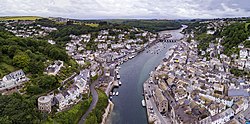
The town is centred on a small harbour and extends along the steep-sided valley of the River Looe, which flows between East and West Looe to the sea beside a sandy beach. Offshore to the west, opposite the stonier Hannafore Beach, lies Looe Island.

History

[edit]

Prehistory and foundation

[edit]

Archaeological evidence indicates that the area around Looe has been inhabited since the Neolithic period, although a possible series of ancient field systems, south of nearby Penarthtown, could suggest earlier Palaeolithic activity.[4] A Neolithic stone axe, made of greenstone, was found in 1978 on a tidal gravel bank in the bed of West Looe River.[5] Further Neolithic finds, such as flint arrow heads, have also been found in the fields above Trenant Point.[6] A large Bronze Age tumulus, which was likely also used as the site for a post-medieval beacon, was located in a field just north of Hillcrest Nursing home in East Looe. Some time after 1823 the site was levelled.[7] Other tumuli are also recorded as having previously existed in the area, such as at Wooldown field,[8] and at the base of Shutta hill.[9] Throughout the Looe area, there are also numerous Iron Age and Romano-British forts. These include the nearby forts/settlements near Trelawne and Great Tree.

Archaeological evidence suggests there was some small-scale Roman influence and possible occupation in Looe. A probable Roman urn was found in 1840 whilst building a new road up the hill to St Martins. The urn was brown, about 10 inches (25 cm) high, and contained several burnt human bone fragments.[10] Pieces of a Roman amphorae, stone boat anchors, Roman coins and a number of late prehistoric or Romano-British finds have been made in the vicinity of nearby Looe Island. A large bronze ingot was found by divers to the south of the island. This has led to a number of historians to suggest that the island could possibly be Ictis, the tin trading island seen by Pytheas in the 4th century BC and recalled by Diodorus Siculus in the 1st century BC. A small hoard of eight late Roman coins, dating to the late 3rd or early 4th century AD, was recovered in 2008 from shallow ditches forming a 'pear-shaped enclosure' which encompassed the top of Looe Island and the later Christian chapel site.

Image of part of the Giant's Hedge, taken near Lanreath

The 'Giant's Hedge' is an ancient earthwork which runs over 15 kilometres (9 miles) westwards from Looe to the Fowey estuary. In some places it is still twelve feet high, and where it is best preserved (for example, in Willake Wood) it is stone-faced and flanked by a ditch. Over the years, there have been many theories to what the ancient earthwork may have been or its intended purpose. The name recalls early folklore that it was built by a giant. A local rhyme goes "One day, the Devil having nothing to do, built a great hedge from Lerryn to Looe". The 19th-century antiquarian William Borlase believed it to be a Roman road, and there have been Roman finds in the area, but the general consensus of modern historians is that this linear earthwork marked a post-Roman territorial boundary.[11][12][13]

At the time of the Domesday Book in 1086 the manor of Pendrym, which included much of the site of modern-day East Looe, was still held by William the Conqueror, as part of his own demesne, which he later devolved to the Bodgrugan (Bodrigan) family. Land across the river belonged to the manors of Portalla (or Portallant) and Portbyhan (variously spelt Portbyan, Porthbyghan, Porthpyghan, among others).

Shutta, on the steep hillside over East Looe, is recorded as being inhabited by the 12th century.[14] East Looe's layout looks like a "planted borough", a concept similar to modern new towns, since most of its streets form a grid-like pattern.[15]

Low-lying parts of Looe continue to suffer frequent flooding when the tides are very high. For practical reasons, most fishermen's houses in ancient Looe, like elsewhere along the south coast, were constructed with their living quarters upstairs and a storage area at ground level below: for boats, tools and fishing tackle, etc; these are termed "fishermen's cellars".[16]

Early churches

[edit]

Some time before 1144, the Order of Saint Benedict occupied Looe Island, building a chapel there, and the monks established a rudimentary lighthouse service using beacons. Another chapel was founded on an opposite hillside just outside West Looe; both are now marked only by ruins.

The parish church of East Looe was at St Martin by Looe but there was a chapel of ease in the town. St Mary's Church, East Looe was dedicated in 1259 by Walter Bronscombe, Bishop of Exeter. The church was largely rebuilt in 1806 and again in 1882, with the oldest surviving part being the 15th-century tower. The church closed in the 1980s and the building has now been converted to residential use. On the centre of the bridge in medieval times stood the Chapel of St Anne, dedicated in 1436.[17]

St Nicholas' Church, West Looe

West Looe comprised part of the parish of Talland since the early Middle Ages, but a chapel of ease, St Nicholas' Church, West Looe was extant before 1330 when it is recorded as being further endowed and enlarged. After spells as a common hall and a schoolhouse, this building has reverted to its original ecclesiastical use, having been substantially restored in 1852, 1862 and 1915.[18]

Medieval era

[edit]
Sketchmap of the East and West Looe Rivers

The town was able to provide some 20 ships for the Siege of Calais in 1347.

An early wooden bridge over the Looe River was in place by 1411; but it burned down and was replaced by the first stone bridge, completed in 1436. This featured a chapel dedicated to St Anne in the middle. The current bridge, a seven-arched Victorian bridge, was opened in 1853. By that time Looe had become a major port, one of Cornwall's largest, exporting local tin, arsenic and granite, as well as hosting thriving fishing and boatbuilding industries.

In the Middle Ages and Tudor era, Looe was a busy port. The textile industry was also an important part of the town's economy, in addition to the traditional boatbuilding and fishing (particularly pilchards and crabs). Trade and transport to and from thriving Newfoundland also contributed to the town's success. The Old Guildhall in East Looe is believed to have dated from around 1450.[19]

17th century

[edit]

In June 1625, the fishing port of Looe was raided by Barbary pirates who streamed into the cobbled streets and forced their way into cottages and taverns. Much to their fury, they discovered that the villagers had been forewarned of their arrival and many had fled into the surrounding orchards and meadows to escape. The pirates still managed to seize eighty mariners and fishermen.[20] Those individuals were led away in chains to North Africa to be enslaved, and the town itself was torched.

Example of Elizabethan house in East Looe

19th century

[edit]

By the start of the 1800s, Looe's fortunes were in decline. The Napoleonic Wars had taken their toll on the country; in 1803, the town formed a volunteer company to man guns in defence against attack from the French. The blockade of 1808, which prevented the Looe fleet from reaching their pilchard-fishing areas, also put considerable financial strain on the community. In 1805, the old St. Mary's Chapel (apart from the tower) had to be demolished due to dilapidation, and in 1817, the town was badly damaged by heavy storms and flooding.

With the building of the Liskeard and Looe Union Canal linking Looe to Liskeard in 1828, and the development of booming copper mines in the Caradon area from 1837, Looe's fortunes began to revive. The Herodsfoot mine produced 13,470 tons of lead between 1848 and 1884 and more than 17 tons of silver between 1853 and 1884. The canal was used first to transport lime from Wales for use in Cornish farming, and later to carry copper and granite between the railhead at Liskeard (from where rail links reached to the Cheesewring on Bodmin Moor) and the port of Looe. In 1856 the large quay of East Looe was built to handle the demands of the shipping trade, and in 1860, with the canal unable to keep up with demand, a railway was built linking Looe to Moorswater near Liskeard, along the towpath of the canal, which was used less and less until, by 1910, traffic ceased entirely. The railway was later linked to Liskeard proper, and as the mining boom came to an end, it adapted to carry passengers in 1879.

In 1866, a lifeboat station had been established on East Looe Beach, and in 1877 a new town hall was built: the new Looe Guildhall.[21]

20th century and beyond

[edit]
The war memorial
Burgee of Looe Sailing Club, established in 1934

With the Victorian fashion for seaside holidays, Looe evolved as a tourist town, with nearby Talland Bay being dubbed "the playground of Plymouth". This trend continued throughout the 20th century; more and more hotels and tourist facilities were built in the town, and Looe grew and prospered, with peaks in fishing and boatbuilding following the First and Second World Wars.

New Zealand writer Katherine Mansfield stayed in Looe for spring and summer 1918, while recovering from tuberculosis.[22] She joined there her long-time friend the American painter Anne Estelle Rice, who famously painted her in red.[23] The Portrait of Katherine Mansfield made in Looe has been exhibited since 1946 in the Te Papa Tongarewa museum of New Zealand.

Looe and its surrounds are the filming location of BBC television crime drama Beyond Paradise, which first aired in 2023. It stands in for the fictional Devon town of Shipton Abbott.[24]

Looe today

[edit]
West Looe viewed across the river from East Looe

Looe remains a fishing town, and retained several fish dealers operating from the East Looe quayside until the advent of EU regulations.[citation needed] With its fleet of small fishing boats returning their catches to port daily, Looe has a reputation for procuring excellent fresh fish. The town is also a centre for shark fishing, and is home to the Shark Angling Club of Great Britain.[25]

View towards Looe, taken from near Looe Island

Nonetheless, Looe's main business today is tourism, with much of the town given over to hotels, guest houses and holiday homes, along with a large number of pubs, restaurants and beach equipment, ice cream and Cornish pasty vendors. Inland from Looe lie many camping and caravan sites, as well as the famous Woolly Monkey Sanctuary. Other local attractions include the beaches, sailing, fishing and diving, and spectacular coastal walks (especially via Talland to Polperro). South East Cornwall boasts several stately homes, including Antony House, Cotehele, Mount Edgcumbe and Lanhydrock House, as well as the Eden Project near St Austell which tourists can access by road.

Outside the busy summer months, the town remains a centre for shopping and entertainment for local villagers. Annually in late September, the town is the destination of choice for thousands of music lovers and top name performers for the Looe Music Festival, which takes place in temporary venues around the town, harbour and on East Looe beach.

There is a tradition of the townsfolk wearing fancy dress on New Year's Eve, when the streets are thronged with revellers in inventive outfits.[26] Looe has been on the list of the top ten places in the UK to celebrate New Year, and ranked third on the list for 2007–08. Looe is regenerating itself, like many other ports, to serve as a small cargo port. On the high ground north of East and West Looe there are many modern houses and a recreational area called 'the Downs'.

East Looe

[edit]
Looe RNLI Lifeboat Station

East Looe centres on its broad sandy beach, with the distinctive Banjo Pier designed by Joseph Thomas, a new lifeboat station and St Mary's Church. Stretching back from the church is a grid of narrow streets forming the main business area of the town, packed with many small shops, restaurants and pubs and the Old Guildhall, now a museum. Along the estuary lies the quay with its fish merchants. Towards Looe Bridge lies the Victorian Guildhall, and just north of the bridge the railway station. This is the terminus of the Looe Valley branch line to Liskeard, where it connects to the Great Western Main Line and services to London Paddington.

On the hilltop above East Looe lies Shutta, and beyond that the Sunrising housing estate and Looe Community Academy.[27] Along the cliffs to the east is Plaidy Beach, and further on the bay and village of Millendreath.

It is covered by the Looe East division of Cornwall Council.[28]

View down West Looe Hill, looking towards the harbour

West Looe

[edit]

West Looe spreads west from the bridge on the Polperro Road towards Sclerder, and along the river south of the bridge, with hotels, restaurants and boarding houses along the waterfront and houses climbing the perilous cliff above, towards a cluster of shops and businesses and the Church of St. Nicholas.

West Looe rises onto the Downs, a public recreation ground, well known for local dog walkers. Beyond this is West Looe cemetery, as well as Porthbythan Road, Goonwartha Road and Tregarrick.

Further south along the coast road is Hannafore Point, marking the edge of Looe Harbour, with to the west the wide, stony Hannafore Beach, facing across a narrow channel to Looe Island. Beyond lies the coastal path leading to Portnadler Bay, Talland and Porthallow, and then onward to Polperro. Two towers mark one end of a nautical measured mile, the other end is marked by two towers near Talland Bay.[29]

It is part of the Looe West, Lansallos and Lanteglos division of Cornwall Council.[28]

Governance

[edit]

There are two tiers of local government covering Looe, at parish (town) and unitary authority level: Looe Town Council and Cornwall Council. The town council is based at the Community Hub on the Millpool in West Looe, which forms part of the same building as the town's library.[30][31]

Administrative history

[edit]
Looe Guildhall in Fore Street: Built 1877 for the old borough of East Looe, subsequently served as headquarters of Looe Urban District Council 1898–1974

The Looe area historically straddled the ancient parishes of Talland west of the river, and St Martin (often called St Martin-by-Looe to distinguish it from other parishes of the same name) east of the river.[a] Both parishes formed part of the West Wivelshire hundred of Cornwall.[33]

West Looe's earliest known borough charter was issued by Richard, Earl of Cornwall. The charter is undated; it must date from after 1225 when Richard was made Earl of Cornwall, and appears to have been issued before 1257 when Richard also took on the title of King of the Romans.[34] East Looe gained the right to hold a market by 1189 and was taxed as a borough from 1306. It was granted its first charter in 1320 by Otto Bodrugan as lord of the manor.[35][36] The seal of East Looe was blazoned An antique one-mast vessel in it a man and boy against the side of the hulk three escutcheons each charges with three bends, with the legend "Si, comunetatis de Loo". The seal of West Looe was An armed man holding a bow in his right hand and an arrow in his left, with the legend "Por-tu-an vel Wys Westlo".[37]

West Looe was made a constituency for parliamentary elections in 1547 as the West Looe parliamentary borough. East Looe similarly became a constituency in 1571 as the East Looe parliamentary borough.[38] Both constituencies came to be viewed as rotten boroughs and were abolished by the Reform Act 1832. A government survey of boroughs in 1835 found that the borough corporations for both East Looe and West Looe had few functions left after the abolition of the constituencies; East Looe ran a few lower-tier courts, but in both cases the main function of the borough corporations prior to 1832 had come to be managing parliamentary elections.[34][36]

From the 17th century onwards, parishes were gradually given various civil functions under the poor laws, in addition to their original ecclesiastical functions. In some cases, the civil functions were exercised by subdivisions of the parish rather than the parish as a whole. Poor law functions were administered separately for the borough of West Looe and the rest of the parish of Talland, and likewise for the borough of East Looe and the rest of the parish of St Martin. In 1866 the legal definition of 'parish' was changed to be the areas used for administering the poor laws, and so West Looe and East Looe both became separate civil parishes.[33]

West Looe's borough corporation went into terminal decline after the abolition of the constituency in 1832. As the members of the corporation died or resigned they were not replaced, until eventually the corporation consisted of one man, Nathaniel Hearle. He then took the title of mayor until his death in 1869. With no one left on the corporation after his death, the corporation's remaining rights and property passed to the Duchy of Cornwall as lord of the manor.[39]

East Looe's borough corporation continued to operate until 1886, although some of the courts that it was entitled to hold under its charters were in practice discontinued, with their cases passing to the county courts.[40] East Looe was never reformed to become a municipal borough, which would have allowed it to take on more modern local government functions. Such unreformed boroughs were eventually abolished in 1886.[41]

When elected parish and district councils were established under the Local Government Act 1894, East Looe and West Looe were initially both given parish councils and included in the Liskeard Rural District. Shortly afterwards, it was decided to create a new urban district called Looe, covering both East Looe and West Looe, which came into effect in 1898.[42][43] Looe Urban District Council took over Looe Guildhall to serve as its headquarters. The urban district was enlarged in 1934 to take in areas from both the neighbouring parishes of Talland and St Martin, including the parish church and adjoining settlement of St Martin from the latter.[44]

Looe Urban District was abolished in 1974 under the Local Government Act 1972, when the area became part of the new Caradon district.[45][46] A successor parish called Looe was created at the same time covering the area of the abolished urban district, with its parish council taking the name Looe Town Council.[47]

Caradon was in turn abolished in 2009. Cornwall County Council then took on district-level functions, making it a unitary authority, and was renamed Cornwall Council.[48][49]

Cornish wrestling

[edit]

There have been Cornish wrestling tournaments, for prizes, held in Looe (both East Looe[50] and West Looe[51]) for centuries. Venues for tournaments have included: the field at Barbican Farm,[52] the field adjoining the Old Barbican,[53] Looe Beach[54] and West Looe Down.[55]

Twinning

[edit]

Looe is twinned with Quiberon (Breton: Kiberen) in Brittany, France.[56]

See also

[edit]

References

[edit]
[edit]
Revisions and contributorsEdit on WikipediaRead on Wikipedia
from Grokipedia
Looe is a small coastal town and civil parish in south-east Cornwall, England, serving as a historic fishing port where the River Looe meets the English Channel.[1] Divided into East Looe and West Looe by the river's estuary, the two parts are connected by a seven-arched stone bridge and together form a traditional Cornish seaside settlement with a population of 5,314 according to the 2021 census.[2][3] Located approximately 20 miles (32 km) west of Plymouth in a steep-sided valley, Looe spans coordinates 50°21′N 4°27′W and covers an area of about 6.79 km², with its economy centered on tourism and a diminishing but persistent fishing industry.[1][4][5] Historically, Looe developed as one of Cornwall's major ports from medieval times, thriving on the export of local resources such as tin, arsenic, and granite, alongside its role in fishing and trade.[6] The town's maritime legacy includes smuggling activities in the 18th and 19th centuries, evidenced by structures like the Smugglers Inn built in 1430 and restored with timbers from the Spanish Armada in 1595.[7] Key landmarks from this period include the 13th-century St Nicholas Church in West Looe, which once doubled as a guildhall and magistrate's court, and the Old Guildhall dating to around 1500, now housing a museum on local history.[7] Today, Looe's economy relies heavily on tourism, drawing visitors to its sandy beaches, rock pools, and the South West Coast Path, a 630-mile (1,014 km) national trail that passes through the town.[5][7] The active fishing fleet, comprising 47 vessels as of 2023, supports a fish market and charter trips, while the town hosts events like the Looe Sea Festival and serves as headquarters for the Shark Angling Club of Great Britain.[1][7][8] Nearby St George's Island (Looe Island), a nature reserve managed by Cornwall Wildlife Trust, adds to its appeal as a site for wildlife and historical monastic remains.[1]

Geography

Location and Topography

Looe is situated in southeast Cornwall, England, on the south coast facing the English Channel, approximately 20 miles (32 km) west of Plymouth and 7 miles (11 km) south of Liskeard.[9][10] The town occupies the mouth of the River Looe estuary, where the river meets the sea after draining from the southern slopes of Bodmin Moor through a catchment that rises to about 300 meters.[11] The topography of Looe is characterized by steep-sided river valleys and rolling hills that descend to the coastal plain, creating a dramatic setting for the town with its narrow, winding streets climbing the hillsides from the waterfront.[11] The River Looe estuary divides the settlement into East Looe and West Looe, two historic districts spanning both banks and connected by Looe Bridge, a seven-arched structure completed in 1853 to replace an earlier 15th-century crossing.[12] This division influences the town's layout, with East Looe featuring narrow lanes rising from the harbor, while West Looe extends along the quayside amid similar steep terrain.[13] As a compact fishing port, Looe centers around its sheltered harbor at the estuary's mouth, supporting a working fleet alongside recreational boating, with adjacent sandy beaches like East Looe Beach providing gentle slopes for access to the sea.[14] The urban area is hemmed in by the river and hills, transitioning outward to rural countryside that includes open moorland and elevated areas known as the Downs, offering panoramic views over the town and coast.[11][15]

Looe Island and Coastline

Looe Island, also known as St George's Island, is a small nature reserve situated approximately 1 mile offshore from the town of Looe in southeast Cornwall. Covering an area of 22 acres (9 hectares), the island is owned and managed by the Cornwall Wildlife Trust, which acquired it in 2004 following its donation by the previous private owners. The terrain rises to a highest point of about 47 meters above sea level, featuring a mix of grasslands, woodlands, and rocky outcrops that provide habitats for various wildlife, including a notable colony of grey seals that frequent the surrounding waters.[16][17][18] Archaeological remnants on the island include the ruins of St Michael's Chapel, part of the medieval Lammana Priory complex dating back to the 6th-century Celtic Christian period, with evidence of monastic activity from that time. These ruins, consisting of stone foundations and indentations, reflect the island's historical significance as a site of religious seclusion overlooking the mainland. The island remains largely uninhabited, accessible only by boat under controlled conditions to preserve its ecological integrity.[19] The surrounding coastline of Looe is defined by rugged rocky shores, extending westward to Hannafore Point, a prominent headland that offers panoramic views of the island and Looe Bay. This point features extensive rock pools and shingle beaches exposed at low tide, contributing to the area's dramatic coastal scenery. The River Looe estuary, which bisects the town into East and West Looe, plays a key role in shaping the local geography through its tidal regime, with spring tides regularly reaching high levels along the quaysides and exacerbating erosion on the estuary banks.[20][21] Geologically, Looe Island and the adjacent coastline are underlain by Upper Devonian slate formations, characteristic of the Looe Basin, with mudstone layers known locally as "shillet" forming the island's basal rock. These slates, part of the broader Devonian sedimentary sequences in southeast Cornwall, are interspersed with granite intrusions typical of the region's Hercynian orogeny, influencing the rugged cliff profiles and resistance to wave action along the shore.[22]

Climate and Environment

Weather Patterns

Looe features a temperate oceanic climate under the Köppen classification Cfb, marked by mild year-round temperatures and moderate precipitation without extreme seasonal swings. The average annual temperature is approximately 10.9°C, with summer highs typically reaching 18–20°C in July and August, and winter lows averaging 4–5°C in January and February. Annual rainfall totals around 1,000 mm, distributed relatively evenly across the months but with a tendency for higher volumes in winter.[23] Seasonal weather patterns in Looe are heavily influenced by the Gulf Stream, which moderates temperatures and contributes to milder winters compared to inland UK regions. Winters are wet and stormy, often featuring strong Atlantic winds and rainfall exceeding 100 mm per month, particularly from November to February, which can lead to coastal erosion and elevated river levels in the Looe River estuary. Summers, by contrast, are drier with averages around 50 mm monthly and comfortable conditions conducive to outdoor activities, though occasional showers persist. The coastal position further tempers temperature extremes by providing a maritime buffer against continental air masses.[24][23] Notable extreme weather events include the intense winter storms of 2013–2014, which brought record rainfall and tidal surges to Looe, resulting in significant flooding along the estuary and quay areas. These storms, part of a series affecting southwest England, caused water to breach defenses and inundate low-lying parts of the town, highlighting the vulnerability of Looe's coastal setting to Atlantic depressions. Such events underscore the region's exposure to powerful low-pressure systems during winter.[21][25]

Ecology and Conservation

Looe’s mild oceanic climate fosters a rich array of species across its coastal and estuarine environments.[26] The surrounding waters and Looe Island support significant marine biodiversity, including grey seals (Halichoerus grypus), which haul out and breed on the island's shores.[27] Seabird populations thrive there as well, with Looe Island hosting Cornwall's largest breeding colonies of cormorants (Phalacrocorax carbo), shags (Gulosus aristotelis), and oystercatchers (Haematopus ostralegus).[27] The Looe Estuary, a 4.1 km-long channel system, serves as a vital nursery and spawning ground for migratory fish such as salmon (Salmo salar), sea trout (Salmo trutta), and eels (Anguilla anguilla).[28][29] This area forms part of the Cornwall Area of Outstanding Natural Beauty, which safeguards its coastal habitats and biodiversity.[26] Conservation efforts in Looe emphasize habitat protection and sustainable management. Looe Island operates as a marine nature reserve under the stewardship of the Cornwall Wildlife Trust, where activities like guided visits and volunteer monitoring help preserve its seabird and seal populations while restricting access to minimize disturbance.[16] The nearby Whitsand and Looe Bay Marine Conservation Zone designates protection for nine key habitats, including seagrass beds and rocky reefs, and seven priority species such as undulate rays (Raja undulata) and tope sharks (Galeorhinus galeus), addressing threats from fishing and tourism-related pollution.[30] Local initiatives, coordinated by Cornwall Council and environmental groups, target coastal erosion through shoreline management plans and pollution mitigation via improved waste handling in fishing and tourist operations.[21] Environmental challenges in Looe are intensified by climate change, particularly rising sea levels projected to exceed 1 meter over the next century, exacerbating flood risks in this low-lying coastal town.[31] Looe, identified as the UK's most frequently flooded coastal community, has faced severe inundation events since the 2000 floods, including a tidal surge in September 2025, prompting the development of the Looe Flood Defence and Regeneration Scheme.[32] This ongoing project, with construction delayed as of November 2025, incorporates adaptive flood barriers, raised defenses, and nature-based solutions like wetland restoration to counter increased tidal surges and erosion, while ensuring minimal impact on estuarine ecosystems.[33][31]

History

Prehistoric and Roman Periods

Evidence of human activity in the Looe area dates back to the Neolithic period, with archaeological finds indicating early settlement and resource use along the coastal river valley. In 1978, a polished greenstone axe, measuring 104 mm by 37 mm by 22 mm, was discovered on a tidal gravel bank in the bed of the West Looe River, suggesting tool production or trade in the region during the New Stone Age.[34] Further Neolithic artifacts, such as flint tools, have been recovered nearby, pointing to sporadic occupation focused on hunting, gathering, and early agriculture in this estuarine environment. During the Bronze Age, burial practices are evidenced by tumuli on the surrounding hills, including the Hendersick Barrow near Looe, excavated in 2018 and dating to around 2000 BCE. This site revealed an intact urn containing cremated human remains, along with pottery, flint tools, and hammer stones, within a circular ditch-enclosed mound, highlighting ritual and funerary customs typical of southwest England.[35] Such barrows, often positioned on elevated terrain for visibility, reflect a landscape used for commemorative purposes amid growing metalworking communities reliant on local tin resources.[36] The Iron Age saw increased defensive activity, with hillforts constructed on prominent local features to protect against incursions and facilitate control over trade routes. Yearle's Fort, located in the West Looe valley, survives as an oval enclosure defined by a bank and hedge, likely dating to the late Iron Age and serving as a promontory fortification overlooking the river.[37] Nearby sites, such as Bury Camp at Laureath, feature multiple defensive banks, underscoring a pattern of fortified settlements in the area during the centuries before Roman arrival.[38] Roman influence in the Looe region appears limited to minor coastal interactions rather than established settlements, as indicated by artifacts suggesting trade or transient activity. Excavations on Looe Island in 2008 uncovered Romano-British pottery, including gabbroic and Black Burnished wares, in two ditches associated with an Iron Age/Romano-British enclosure, alongside a small hoard of eight late 3rd- to early 4th-century CE coins.[39] These finds imply possible use as a trading post or waypoint for maritime commerce along Cornwall's southwest coast, though no major villas or forts have been identified.[40] The name Looe reflects its early Celtic origins, deriving from the Cornish "Logh," meaning "deep water inlet," which describes the river's estuary and points to prehistoric awareness of the site's natural harbor for fishing and navigation.[41] This linguistic root, shared with West Looe as "Porthbyghan" (little cove), underscores continuous habitation by Celtic-speaking communities from the Iron Age onward.[42]

Medieval Development

During the early medieval period, Looe saw the establishment of key religious sites that supported community growth. A Benedictine cell, consisting of two monks, was founded on Looe Island (also known as St George's or Lammana Island) by Glastonbury Abbey in the 12th century, including a chapel dedicated to St Michael that became a pilgrimage center.[43] The Abbot of Glastonbury ordered the chapel's construction for this cell. On the mainland, St Mary's Church in East Looe was dedicated in 1259 as a chapel of ease to the parish church of St Martin by Looe, serving the growing settlement.[44] Similarly, St Nicholas' Church in West Looe was constructed in the 13th century on the quayside, dedicated to St Nicholas of Myra and reflecting the town's maritime orientation. Looe developed as two distinct boroughs, East and West, founded as planned settlements by rival manorial lords in the 12th century from the parishes of Talland and St Martin by Looe. East Looe received a charter from the Earls of Cornwall in 1325, granting borough status and privileges, while West Looe had an earlier borough recognition around 1201, with additional charters confirming rights by the mid-15th century.[45][46] These charters facilitated self-governance and economic activity, positioning the twin towns as important coastal communities. As a port, Looe gained market rights in the late 13th century, with East Looe granted a weekly market and annual fair in 1301 by Edward I, boosting local trade. The economy centered on maritime commerce, particularly the export of tin from Cornish mines, which brought prosperity to both boroughs through shipping to wider markets. Local industries, including textiles such as serge cloth, contributed to the trade network, though tin remained the dominant commodity.[45][46] A pivotal development occurred in the mid-15th century with the construction of Looe Bridge, begun in 1411 and completed in 1436, which physically linked East and West Looe across the River Looe and included a central chapel dedicated to St Anne. This stone structure, funded by indulgences and tolls, enhanced connectivity for travelers and merchants, unifying the boroughs and solidifying Looe's role as a regional port.[47]

Early Modern Era

In the early 17th century, Looe, like other coastal settlements in Cornwall, faced significant threats from Barbary corsairs operating from North Africa. In August 1625, these pirates raided nearby Mount's Bay, capturing approximately 60 men, women, and children from local communities and enslaving them, an event that disrupted fishing and trade along the southwest coast, including Looe.[48] The raids extended to ports such as Looe in 1626, where vessels were seized and coastal activities were curtailed due to fear of further attacks, severely impacting the local economy reliant on maritime pursuits.[49] Smuggling emerged as a prominent illicit activity in Looe during this period and intensified through the 17th and 18th centuries, with the town's coves and harbors serving as hideouts for contraband like brandy and tea, evading excise duties amid economic pressures from disrupted legitimate trade.[50] By the 18th and 19th centuries, Looe's economy underwent notable shifts as the pilchard fishing industry, once a cornerstone built on medieval port foundations, began to decline due to overfishing, changing migration patterns, and reduced European demand, leading fishermen to diversify into other catches or smuggling.[51] The textile trade, which had provided supplementary employment through wool processing and export, waned as competition from larger industrial centers grew, contributing to economic stagnation until infrastructure improvements. Brief mining booms in the surrounding Caradon Hill area during the mid-19th century, driven by copper and granite extraction, indirectly boosted Looe as an export hub, though these were short-lived due to exhausted lodes and market fluctuations.[51] To support this trade, the Liskeard and Looe Union Canal opened in 1828, facilitating the transport of lime, sand, and coal from Looe to inland farms and mines over its 6-mile length with 24 locks.[52] The arrival of the railway in 1860, via the Liskeard and Looe Railway connecting Moorswater to Looe's quayside, further enhanced connectivity for minerals and goods, replacing parts of the canal system and spurring population growth from around 1,941 in 1801 to approximately 3,997 by 1851, reflecting influxes from mining and trade opportunities.[53][41] In response to frequent shipwrecks along the hazardous coastline, the Royal National Lifeboat Institution established a lifeboat station in Looe in 1866, following the loss of local boatmen attempting rescues, with the first boat, Oxfordshire, stationed to aid mariners in the area.[54]

Modern History

In the early 20th century, Looe attracted notable visitors, including the writer Katherine Mansfield, who stayed at the Headland Hotel in 1918 during her recovery from illness, finding inspiration in the town's coastal scenery.[55] During World War II, the town played a defensive role with the construction of the Looe coastal battery, an emergency installation as part of Southern Command's fortifications to protect against potential invasion.[56] The 19th-century railway connection continued to enable easier access, supporting Looe's transition from fishing and trade toward tourism as the primary economic driver by the interwar period. Following World War II, Looe experienced a pronounced shift to tourism, with the construction of additional hotels and facilities capitalizing on its beaches and scenery, building on pre-war trends to foster steady growth.[6] The town's population expanded during the century, reaching over 5,000 residents by the late 20th century, driven by this influx of visitors and related development.[57] The COVID-19 pandemic (2020-2022) severely impacted Looe's tourism sector, leading to business closures and economic challenges, though recovery was aided by national support schemes and a rebound in visitors by 2023.[58] In the 21st century, Looe has gained visibility as a filming location for the BBC series Beyond Paradise, with much of the production set in the town since 2023, portraying the fictional Shipton Abbott and boosting local interest.[59] The town contributed to economic recovery from the 2008 recession through sustained tourism, which helped stabilize the local economy amid national downturns.[60] The 2021 census recorded Looe's population at 5,314, reflecting ongoing stability.[3] More recently, following severe storms in 2020, Looe implemented enhanced flood defenses, including proposals for a tidal barrier and breakwater extensions to mitigate rising sea levels and frequent inundations.[32] Sustainable fishing initiatives have also advanced, with local fleets participating in tuna tagging and pollack monitoring programs to promote marine conservation.[61] As of November 2025, Looe has experienced no major disruptive events beyond routine weather and local developments.

Demographics

Population Statistics

Looe's population has experienced notable growth since the early 19th century, rising from around 1,500 residents in 1801 to 5,314 as recorded in the 2021 United Kingdom census.[3] This expansion reflects broader demographic shifts in Cornwall, driven by industrialization and later tourism development. The 2021 census data indicates slight growth from 5,280 in the 2011 census, influenced by migration patterns and housing constraints in the region.[3] The town's population density stands at approximately 780 people per square kilometre, based on the civil parish area of 6.79 km² encompassing both urban and surrounding zones.[3] Distribution is relatively balanced, with roughly half the residents in East Looe and the other half in West Looe, divided by the River Looe. This even split underscores the integrated yet historically distinct character of the two sides of the town. Projections for Cornwall suggest the area's population will remain relatively stable through the 2030s, with a gradual aging trend as the proportion of residents over 65 increases due to lower birth rates and net out-migration of younger people.[62] Tourism seasonality plays a role in this dynamic, temporarily boosting the effective population during summer months but not significantly altering long-term resident figures. These trends align with broader Cornwall projections from the Office for National Statistics, emphasizing the need for targeted housing and services planning. In 2021, the civil parish had a slight female majority, with 51.3% women and 48.7% men.[3]

Social Composition

Looe's population exhibits a notably aged structure, with 34% of residents aged 65 and over according to the 2021 Census, surpassing the national average of 18.6% in England and Wales.[3][63] This elevated proportion is largely attributed to the influx of retirees drawn to the town's coastal appeal and tranquil lifestyle. The median age stands at 48 years, reflecting a demographic skewed toward older adults compared to the national median of 40 years. In terms of ethnicity and cultural identity, Looe remains predominantly White British, comprising over 95% of the population as per the 2021 Census data. This homogeneity aligns with broader trends in rural Cornwall, where non-White ethnic groups represent less than 5%. A small but growing Cornish identity movement persists among residents, with 48,553 people across England and Wales identifying as Cornish in the same census, including a notable portion in Cornwall emphasizing local heritage and autonomy.[64] Education levels are moderate, with about 30% of adults holding higher education qualifications, slightly below the national average but indicative of a community valuing practical skills alongside formal learning. The community in Looe is characterized by its family-oriented nature, fostering close-knit social ties amid the town's seasonal rhythms influenced by tourism. Overall deprivation levels are low, with Looe ranking favorably within Cornwall's Index of Multiple Deprivation, scoring better than many urban areas on metrics like health, education, and housing access. This contributes to a stable social fabric, where intergenerational support and local engagement play key roles in daily life. In 2021, there were 2,426 households in the civil parish, with 28% being one-person households, often among older residents.[3]

Economy

Traditional Industries

Looe's economy has long been anchored in fishing, a practice dating back to pre-medieval times when the port served as a hub for local catches. By the medieval period, Looe supported fleets targeting pilchards, a staple of the Cornish seafood trade, alongside emerging crab and lobster fisheries that utilized simple pots and lines. These activities formed the backbone of the town's livelihood, with fishermen operating from the sheltered harbors of East and West Looe.[65][6] The 19th century marked the peak of Looe's fishing industry, particularly for pilchards, as the port became one of Cornwall's major exporters with a thriving fleet that contributed to the regional total of over 200 vessels in East Cornwall by 1889. Crab and lobster potting also expanded during this era, supporting a seasonal economy tied to coastal migrations. However, the arrival of the railway in the 1860s began to alter trade patterns, contributing to a gradual decline in traditional pilchard seining. Today, the fleet has contracted to approximately 47 vessels, many focused on sustainable crab and lobster catches that echo the town's enduring shellfishing heritage.[66][67][65] Beyond fishing, Looe played a key role in nearby mining operations, exporting copper ore from the Caradon Hill mines—discovered in 1837—along with tin, lead, and arsenic through its harbor. The Liskeard and Looe Union Canal, opened in 1828, facilitated the transport of lime from Welsh imports to local kilns, where it was processed for agricultural use and construction, bolstering the town's industrial output. Shipbuilding complemented these trades, with local yards constructing luggers and schooners for fishing and trade until the early 1900s, when larger vessels from external ports reduced demand.[6][51][68] The legacy of these industries persists through historical institutions like the 15th-century Old Guildhall, originally tied to fishermen's and merchants' guilds that regulated trades and resolved disputes. Seasonal crabbing remains a vital economic thread, with potters landing catches that sustain local processors and markets, preserving Looe's maritime identity amid evolving regulations.[69][70]

Tourism and Modern Economy

Tourism serves as the cornerstone of Looe's contemporary economy, generating approximately £47.8 million in annual visitor expenditure and directly supporting more than 1,100 jobs in the town.[31] This sector is highly seasonal, with peak activity during summer months driven by the town's coastal appeal, beaches, and local festivals, leading to a concentration of employment in hospitality and related services that accounts for a substantial portion of local livelihoods.[60] Complementary to tourism, the ongoing fishing industry provides seasonal synergies, such as fresh seafood offerings for visitors. Beyond traditional hospitality, Looe's economy has diversified into retail, light manufacturing, and an emerging remote work sector, particularly accelerated by post-COVID shifts toward flexible employment.[71] Initiatives like the Looe Business and Learning Hub promote skills development and startup support to foster these areas, aiming to reduce over-reliance on seasonal tourism and create year-round opportunities.[72] Tourism's overall contribution remains vital, bolstering the local GDP through sustained visitor spend amid broader Cornish trends of £2 billion annually across the county.[73] Looe faces economic challenges including a 10-12% drop in regional visitor numbers in 2024 due to weather and cost-of-living pressures, prompting adaptations for post-2020 recovery.[74] Sustainability efforts are intensifying, with 2025 initiatives such as the Kernowfornia Festival emphasizing eco-friendly practices and the Visit Looe platform promoting responsible tourism to mitigate environmental impacts while enhancing long-term viability.[75][76] These measures, including regenerative pledges by local accommodations, support a balanced approach to economic resilience.[77]

Local Government

Administration

Looe consists of two historically distinct settlements, East Looe and West Looe, each functioning as separate municipal boroughs with their own governance structures until the late 19th century. The Municipal Corporations Act 1835 reformed these ancient boroughs by establishing elected councils comprising a mayor, aldermen, and councillors, replacing the previous self-perpetuating systems while preserving their separation.[41][78] Each borough maintained its own mayor, a tradition reflecting Looe's divided heritage along the River Looe. The two boroughs merged administratively in 1898 with the formation of the Looe Urban District Council, which unified governance over the entire town.[41][6] Following the Local Government Act 1972, Looe became a civil parish, with the Looe Urban District Council abolished and its functions transferred to the new Caradon District Council and Cornwall County Council. In 2009, Cornwall Council was established as a unitary authority, assuming all local government responsibilities for Looe, including education, highways, and social services. Looe Town Council now serves as the parish-level authority, comprising 15 elected or co-opted councillors representing two wards: East Looe and West Looe. The council elects a mayor annually from among its members to chair meetings and represent the community.[79][80] The Looe Town Council focuses on hyper-local services, including commenting on planning applications submitted to Cornwall Council, maintaining community facilities such as the town hall, library, and allotments, and organizing public amenities like parks and public toilets. It also supports community events and environmental initiatives within its remit. The council's annual budget is approximately £500,000, primarily funded through a precept on the council tax collected by Cornwall Council, with expenditures covering administration, facilities management, and grounds maintenance.[80][81]

Twinning and International Relations

Looe has maintained a formal twinning partnership with Quiberon, a coastal town in Brittany, France, since 1976.[82] This arrangement fosters cultural and community exchanges between the two fishing towns, which share similarities in their maritime heritage and seaside environments.[83] For many years following the initial agreement, successful exchanges occurred, including visits that promoted mutual understanding and friendship.[83] In recent efforts to revive the partnership ahead of its 50th anniversary in 2026, a delegation from Quiberon visited Looe at their own expense, signaling renewed commitment to the relationship.[82] These initiatives emphasize opportunities for joint activities, such as sports exchanges in football, tennis, pétanque, bowls, golf, sailing, rowing, diving, and sea swimming, coordinated through Looe Town Council.[82]

Culture and Events

Cornish Wrestling and Sports

Cornish wrestling, known in Cornish as Omdowl Kernewek, is a traditional jacketed style of folk wrestling that originated in Cornwall and emphasizes throws and holds while maintaining an upright posture.[84] This Celtic martial art has deep historical roots, with evidence of its practice dating to at least the early 14th century through church carvings depicting wrestling scenes, and it evolved into organized tournaments by the 18th and 19th centuries across the region.[85] In the Looe area, tournaments continue this legacy, drawing local competitors and spectators to celebrate the sport's enduring appeal.[86] Beyond wrestling, Looe supports a vibrant array of local sports that leverage its coastal setting and community spirit. Looe Town FC, a longstanding amateur club, competes in the St Piran League Premier Division East (as of 2025), having joined the East Cornwall League in 2016 and earning promotion through consistent performance in regional fixtures.[87][88] Sailing regattas are a highlight, organized by Looe Sailing Club, which hosts national championships like the Fireball Nationals and local races in Looe Bay, accommodating various dinghy classes amid the town's sheltered harbor.[89] The biennial Looe Lugger Regatta revives historic fishing boat traditions, featuring traditional two-masted luggers racing in the bay to honor Looe's maritime heritage.[90] Additionally, coastal path walking along the South West Coast Path offers athletic pursuits, with popular routes like the 5.4-mile Looe to Polperro trail combining strenuous hikes, elevation gains, and scenic clifftop views for fitness enthusiasts.[91] These activities hold significant cultural value in Looe, reinforcing Cornish identity through physical traditions that connect residents to their Celtic past. Cornish wrestling, in particular, serves as a symbol of regional pride, embedded in local culture as a marker of Cornish distinctiveness and community gatherings since the 19th century.[92] Events like regattas and path walks further tie athleticism to Looe's seafaring and rural heritage, fostering social bonds and preserving customs amid modern life.[93]

Festivals and Traditions

Looe hosts the annual Looe Music Festival, a three-day event held in September on East Looe Beach, featuring live performances by local and international artists across multiple stages. Originally launched in 2011 as Making Waves, the festival has evolved into the Looe Weekender, emphasizing community-driven music with free entry to encourage broad participation. A new addition is the Kernowfornia Festival, first held September 26–28, 2025, as a three-day event on East Looe Beach with live music from local and international artists.[94][95] The Looe Food and Drink Festival, typically taking place in September on East Looe Quayside (though the 2025 event was cancelled due to adverse weather), celebrates the town's fishing heritage through seafood tastings, chef demonstrations, and local produce stalls. This event highlights Looe's renowned crab and lobster catches, drawing visitors to sample fresh Cornish specialties.[96][97] New Year's Eve in Looe features two spectacular fireworks displays launched from the Banjo Pier over the harbor, with a family-friendly show at 6 p.m. and a midnight spectacle to mark the year's end. This tradition transforms the harbor into a vibrant gathering spot, reflecting the community's festive spirit.[98] In late November, the Christmas Lights Switch-On event includes a Lantern Parade starting from Millpool, processing through town to the seafront amid carols and fireworks, illuminating Looe's streets and bridge with festive decorations. Organized by the Looe Town Council, this gathering fosters local involvement and signals the holiday season's arrival.[99][100] These events play a key role in community cohesion, with high resident turnout enhancing Looe's cultural vibrancy and attracting tourists to its harborside setting.

Landmarks and Attractions

East Looe Highlights

East Looe Beach is a gently sloping sandy stretch backed by a promenade, ideal for watersports such as stand-up paddleboarding (SUP) and kayaking, with equipment hire available on-site for visitors seeking gentle sea activities away from stronger currents.[101] Adjacent to the beach, the Banjo Pier, constructed in 1897 and designed by Cornish engineer Joseph Thomas to combat harbor silting through its distinctive circular "banjo" shape, serves as a popular spot for anglers targeting species like bass and pollock, while offering panoramic views of the coastline and Looe Harbour.[102][70] Key historical sites in East Looe include the Smugglers Inn, a Grade II listed building dating to 1430 that was restored in 1595 using timbers from the Spanish Armada, reflecting the town's smuggling past with its atmospheric interior and proximity to the harbor.[7] The Old Guildhall Museum, a Grade II listed structure originally dating to the 16th century and later remodeled, which now houses exhibits on local governance, smuggling, and maritime heritage within its preserved medieval cells and courtrooms.[103] Nearby, the tower of St Mary's Church, dating from the 15th century and retained as a navigational aid during later rebuilds, stands as a prominent landmark overlooking the town and estuary.[104] Fore Street in East Looe buzzes with modern amenities, featuring seafood restaurants like The Fish Market, which sources fresh catches directly from the adjacent quay for dishes emphasizing local shellfish and fish.[105] The street also hosts art galleries such as Whistlefish, showcasing contemporary Cornish artwork and prints in a historic setting.[106] These establishments contribute to the area's vibrant cultural and culinary scene, connected to West Looe via the 19th-century seven-arched bridge spanning the River Looe.[107]

West Looe Features

West Looe, the quieter counterpart to its eastern neighbor across the River Looe, features a waterfront centered on West Looe Quay, a historic harbor area where visitors can observe fishing boats and pleasure craft and participate in boating activities such as kayak launches from the nearby slipway on Quay Road.[108][109] The quay serves as a departure point for various water-based excursions, including glass-bottom boat trips that explore the local marine environment.[110] Adjacent to the quay, Hannafore Beach offers a shingle and rocky shoreline ideal for exploration, particularly at low tide when rock pools reveal marine life and sandy stretches appear.[111] The beach provides panoramic views of Looe Island (also known as St George's Island), a protected nature reserve visible offshore, enhancing its appeal for leisurely strolls along the seafront promenade lined with benches.[112][113] Recreational facilities in West Looe include The Downs, a public green space on Downs Road that accommodates sports like football, with open fields equipped with goalposts suitable for informal games and community activities.[114] Nearby, St Nicholas' Church, a Grade II*-listed structure dating to the 13th or 14th century, stands as a key historical site on the quayside, originally built by the D'Aubigny family and dedicated to St Nicholas, the patron saint of sailors.[115][116] The church has endured varied uses over centuries, including as a guildhall during the Commonwealth period, before restoration as a place of worship.[117] Unique to West Looe's charm are its smugglers' cottages, such as the Grade II-listed Smugglers Cottage, which reflect the area's 18th- and 19th-century smuggling heritage tied to the town's coastal location and hidden coves.[118] These quaint, historic dwellings, often available as holiday rentals, contribute to the atmospheric appeal for tourists interested in Looe's maritime past. Complementing this, local ice cream production plays a role in the visitor economy, with family-run operations like Treleavens, which began in Looe and uses fresh local milk to craft artisan flavors sold at beachside kiosks and shops.[119][120] Similarly, Gibson's Cornish Ice Cream supplies treats to nearby outlets, supporting the influx of holidaymakers seeking traditional Cornish desserts.[121]

Other Notable Sites

The Old Guildhall Museum and Gaol in Looe houses exhibits on local history, including Victorian-era artifacts related to fishing, smuggling, and town development, with displays of photographs, records, and interactive elements covering the 19th century's social and economic life.[122] Located in a 15th-century building, it provides insights into Looe's Victorian industrial and maritime heritage through curated collections that highlight the period's shipbuilding and trade activities.[123] Nearby, the Wild Futures Monkey Sanctuary, situated between Looe and Seaton on the south Cornish coast, serves as a rescue and rehabilitation center for primates, established in 1964 to provide lifelong care for woolly monkeys and capuchins saved from the pet trade and labs.[124] The sanctuary spans wooded hillside enclosures emphasizing conservation efforts for endangered species, though it has been closed to visitors since 2025 due to financial challenges while continuing its primate welfare work.[125] Looe Bridge, a Grade II listed structure spanning the East Looe River, features seven arches over the water and was constructed in 1853 to replace a hazardous medieval bridge, facilitating connectivity between the town's divided sections while carrying the A387 road.[12] Its granite construction and lamp standards contribute to the town's historic infrastructure, supporting pedestrian and vehicular traffic across the estuary.[126] The ruins of Polvellan Tidal Mill, located at the Old Mill site in West Looe, date to 1621 when it was first built to grind corn using tidal power from four waterwheels, with operations continuing into the 19th century for bone meal production before abandonment.[127] The remnants include traces of the mill structure beside a shrunken pool that once covered 13 acres, enclosed by a high wall, illustrating early industrial reliance on tidal energy in the region.[127] Peripheral attractions include the Polperro Model Village, approximately four miles southwest of Looe, which presents a 1:50 scale replica of the neighboring fishing village, complete with animated scenes of Cornish myths, legends, and a model railway operational for over 60 years.[128] Complementing this, sections of the South West Coast Path near Looe offer rugged coastal walks, such as the route from Looe to Polperro, traversing cliffs, beaches, and the wooded West Looe River estuary for panoramic views of the shoreline.[91]

Transport

Road Access

Looe is primarily accessed by road via the A387, which serves as the main arterial route connecting the town to Plymouth in the east and Liskeard in the north. Travelers from Plymouth typically join the A387 after exiting the A38 dual carriageway at Trerulefoot, following a approximately 13-mile stretch that winds through rural landscapes before entering Looe. From Liskeard, the A387 provides a direct 7-mile link southward, passing through Looe Valley. [129][130] The narrow lanes characteristic of the A387 and surrounding roads pose significant challenges for traffic, particularly during peak tourist seasons when congestion builds in the approach to Looe. These lanes, often lacking wide verges or passing places, can lead to delays from oncoming vehicles or maintenance works, such as the frequent closures for landslide repairs on sections like Polperro Road. Parking in the town center exacerbates these issues, with limited on-street spaces and high demand leading to overflow into paid facilities like the Millpool Car Park, which offers nearly 1,000 spaces but has faced criticism for rising charges that deter visitors. [131][132][133] Supporting infrastructure includes the B3253, which links the A38 near Saltash to Looe before merging into the A387 toward Polperro, providing an alternative entry for traffic from the northeast. Along the coast, multi-use cycle paths form part of the Looe Valley Trails network, offering safer routes for cyclists parallel to the A387 in sections and extending toward coastal areas like Talland Bay for scenic, low-traffic travel. [130][134][135] In the 2020s, developments have focused on enhancing sustainability and connectivity, including the installation of electric vehicle (EV) charging points in key car parks such as Millpool, supported by Cornwall Council's broader initiative to add up to 2,000 public chargers county-wide starting in 2025. Improvements to bus links have also integrated electric vehicles into south-east Cornwall routes, bolstering road-based public access to Looe from nearby towns like Liskeard and Plymouth. These efforts build on earlier transport precursors, such as the 19th-century Looe Navigation canal, which facilitated goods movement before road dominance. [136][137][138]

Rail and Public Transport

The Looe Valley Line provides the primary rail connection to Looe, operating as an 8.75-mile branch from Liskeard on the Cornish Main Line. Passenger services on the line commenced on 11 September 1879, following its initial opening as a mineral railway in 1860. Today, the line is managed by Great Western Railway (GWR) and features diesel multiple unit trains that traverse a scenic route along the East Looe River valley, offering views of woodlands, wildlife, and the estuary. Services run approximately every 1-2 hours on weekdays, with 13 trains per day from Monday to Friday, including additional departures during peak commuting periods; frequency reduces to about every 2-3 hours on weekends and is suspended on Sundays after 26 October 2025.[139][140] While regular operations are diesel-powered, the line occasionally hosts heritage excursions, including steam-hauled specials that evoke its Victorian origins, though these are not part of the standard timetable and depend on preserved railway groups. The service supports tourism and local travel, with connections at Liskeard to mainline routes toward Plymouth and beyond, facilitating multi-modal journeys that integrate with bus options for broader regional access.[53] Public bus services in Looe are operated primarily by Go Cornwall Bus, with route 10 providing connections approximately every 1.5-2 hours to Plymouth via Liskeard, taking about 1 hour 20 minutes and serving as a key link for commuters and visitors. Additional routes extend to nearby coastal villages such as Polperro, offering frequent summer services that align with tourist demand, though 2025 timetables reflect revised operations without extra peak-season journeys due to prior usage patterns. Seasonal tourist shuttles operate intermittently to support events and attractions, enhancing accessibility without reliance on private vehicles.[141][142] Looe promotes walking and cycling as preferred modes for intra-town movement, given its compact layout across East and West Looe, connected by a seven-arched bridge and pedestrian-friendly paths along the waterfront and cliffs. There is no local airport, with the nearest being Cornwall Airport Newquay, approximately 30 miles away, requiring onward bus or taxi transfers. Private ferry operators, such as Looe Sea Safari, provide boat trips to Looe Island from the harbor, typically lasting 2 hours for exploration of the nature reserve, weather permitting and bookable in advance.[143][144][145]

Notable People

Literary and Artistic Figures

Katherine Mansfield, the acclaimed New Zealand short story writer, spent part of the spring and summer of 1918 in Looe, Cornwall, seeking recovery from tuberculosis alongside her friend, the American painter Anne Estelle Rice.[146] During this period, Rice painted a notable portrait of Mansfield in Looe, capturing her in a red frock amid the town's coastal setting, which highlighted Mansfield's fragile health and creative spirit at the time.[55] Although primarily known for works inspired by her New Zealand childhood and European travels, Mansfield's letters from Looe describe the town's cloudy summer days and sea air, reflecting her observations of the local environment during her recuperation.[147] Looe natives include the 17th-century physician and chemist John Mayow, who contributed to early understanding of gases through studies on respiration and combustion, and actress Anna Palk (1940–1990), known for roles in films like Jason and the Argonauts (1963). Looe has long attracted artists drawn to its rugged coastline and fishing heritage, fostering a tradition of local painters who capture the town's essence. Contemporary artists such as John Dyer and Joanne Short, based in Cornwall, frequently depict Looe in their vibrant watercolors and oils, emphasizing the harbor, bridges, and estuary views that define the landscape.[148] Their works, exhibited in local galleries like the John Dyer Gallery, contribute to Looe's artistic scene by blending impressionistic styles with the town's maritime character. Sculptors with ties to Looe also enrich the area's cultural output, often incorporating coastal themes into their practice. Richard Vasey, who began his career as a fisherman in Looe before transitioning to sculpture, creates bronze works inspired by marine life and the sea, displayed in prominent Cornish galleries such as Red Rag.[149] Similarly, the Ebenezer Gallery in nearby Polperro features contemporary sculptures alongside paintings, showcasing pieces that evoke the town's tidal rhythms and natural forms.[150] The cultural legacy of these figures is evident in Looe's vibrant literary and artistic events, including the annual Looe Festival of Words, which celebrates reading, writing, and storytelling through workshops, talks, and book fairs.[151] This festival, held in October, draws inspiration from Looe's history of hosting creative visitors like Mansfield, promoting the town's role as a haven for artistic reflection amid its scenic backdrop.[152]

Local and Contemporary Residents

Looe's sports community features dedicated figures in football and sailing, reflecting the town's ties to traditional coastal activities. Paul Boxall, serving as both manager and chairman of Looe Town Football Club, orchestrated a remarkable turnaround, guiding the team to promotion in the 2024-2025 season through strategic decisions that transformed the squad's performance. Local sailors actively participate in regional regattas organized by the Looe Sailing Club, including the biennial Looe Lugger Classics, where traditional vessels compete in races celebrating Cornwall's fishing heritage.[153][154][90] In business and community leadership, Looe's fishing sector has produced entrepreneurs who sustain the town's economy amid industry challenges. Sam Chapman, a fish merchant based in Looe, has built a venture focused on promoting the port's renowned day-fresh catch, supporting local fishermen through direct sales and market expansion. Similarly, Bill Hocking, at 87 years old in 2017, was Britain's oldest working fisherman, continuing to operate a 15-foot boat laying lobster pots off the Cornish coast, embodying the resilience of Looe's inshore fleet. On the town council, Stephen Remington was elected mayor in May 2025, advocating for resident input on local issues such as infrastructure and community surveys.[155][156][157] Contemporary conservation efforts highlight activists protecting Looe's marine and island ecosystems. Claire Lewis and Jon Ross serve as wardens of Looe Island Nature Reserve, managing the 22-acre site since 2004 to restore biodiversity, including habitats for seals, seabirds, and wildflowers, transforming it into a thriving wildlife haven through hands-on habitat management and public education. The Looe Marine Conservation Group, a volunteer-led initiative, organizes rock-pooling events, estuary explorations, and seal-spotting trips to raise awareness and foster protection of the surrounding coastal waters. These efforts tie into Looe's fishing traditions by promoting sustainable practices that balance industry needs with environmental health.[158][159]

References

User Avatar
No comments yet.