



Community hub
Recent from talks
Contribute something
Nothing was collected or created yet.
Loop invariant
View on WikipediaIn computer science, a loop invariant is a property of a program loop that is true before (and after) each iteration. It is a logical assertion, sometimes checked with a code assertion. Knowing its invariant(s) is essential in understanding the effect of a loop.
In formal program verification, particularly the Floyd-Hoare approach, loop invariants are expressed by formal predicate logic and used to prove properties of loops and by extension algorithms that employ loops (usually correctness properties). The loop invariants will be true on entry into a loop and following each iteration, so that on exit from the loop both the loop invariants and the loop termination condition can be guaranteed.
From a programming methodology viewpoint, the loop invariant can be viewed as a more abstract specification of the loop, which characterizes the deeper purpose of the loop beyond the details of this implementation. A survey article[1] covers fundamental algorithms from many areas of computer science (searching, sorting, optimization, arithmetic etc.), characterizing each of them from the viewpoint of its invariant.
Because of the similarity of loops and recursive programs, proving partial correctness of loops with invariants is very similar to proving the correctness of recursive programs via induction. In fact, the loop invariant is often the same as the inductive hypothesis to be proved for a recursive program equivalent to a given loop.
Informal example
[edit]The following C subroutine max() returns the maximum value in its argument array a[], provided its length n is at least 1.
Comments are provided at lines 3, 6, 9, 11, and 13. Each comment makes an assertion about the values of one or more variables at that stage of the function.
The highlighted assertions within the loop body, at the beginning and end of the loop (lines 6 and 11), are exactly the same. They thus describe an invariant property of the loop.
When line 13 is reached, this invariant still holds, and it is known that the loop condition i!=n from line 5 has become false. Both properties together imply that m equals the maximum value in a[0...n-1], that is, that the correct value is returned from line 14.
int max(int n, const int a[]) {
    int m = a[0];
    // m equals the maximum value in a[0...0]
    int i = 1;
    while (i != n) {
        // m equals the maximum value in a[0...i-1]
        if (m < a[i])
            m = a[i];
        // m equals the maximum value in a[0...i]
        ++i;
        // m equals the maximum value in a[0...i-1]
    }
    // m equals the maximum value in a[0...i-1], and i==n
    return m;
}
Following a defensive programming paradigm, the loop condition i!=n in line 5 should better be modified to i<n, in order to avoid endless looping for illegitimate negative values of n. While this change in code intuitively shouldn't make a difference, the reasoning leading to its correctness becomes somewhat more complicated, since then only i>=n is known in line 13. In order to obtain that also i<=n holds, that condition has to be included into the loop invariant. It is easy to see that i<=n, too, is an invariant of the loop, since i<n in line 6 can be obtained from the (modified) loop condition in line 5, and hence i<=n holds in line 11 after i has been incremented in line 10. However, when loop invariants have to be manually provided for formal program verification, such intuitively too obvious properties like i<=n are often overlooked.
Floyd–Hoare logic
[edit]In Floyd–Hoare logic,[2][3] the partial correctness of a while loop is governed by the following rule of inference:
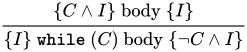
This means:
- If some property I is preserved by the code —more precisely, if I holds after the execution of whenever both C and I held beforehand— (upper line) then
- C and I are guaranteed to be false and true, respectively, after the execution of the whole loop , provided I was true before the loop (lower line).


In other words: The rule above is a deductive step that has as its premise the Hoare triple . This triple is actually a relation on machine states. It holds whenever starting from a state in which the boolean expression is true and successfully executing some code called , the machine ends up in a state in which I is true. If this relation can be proven, the rule then allows us to conclude that successful execution of the program will lead from a state in which I is true to a state in which holds. The boolean formula I in this rule is called a loop invariant.



With some variations in the notation used, and with the premise that the loop halts, this rule is also known as the Invariant Relation Theorem.[4][5] As one 1970s textbook presents it in a way meant to be accessible to student programmers:[4]
Let the notation P { seq } Q mean that if P is true before the sequence of statements seq run, then Q is true after it. Then the invariant relation theorem holds that
P & c { seq } P- implies
P { DO WHILE (c); seq END; } P & ¬c
Example
[edit]The following example illustrates how this rule works. Consider the program
while (x < 10)
    x := x+1;
One can then prove the following Hoare triple:

The condition C of the while loop is . A useful loop invariant I has to be guessed; it will turn out that is appropriate. Under these assumptions it is possible to prove the following Hoare triple:



While this triple can be derived formally from the rules of Floyd-Hoare logic governing assignment, it is also intuitively justified: Computation starts in a state where is true, which means simply that is true. The computation adds 1 to x, which means that is still true (for integer x).

Under this premise, the rule for while loops permits the following conclusion:

However, the post-condition (x is less than or equal to 10, but it is not less than 10) is logically equivalent to , which is what we wanted to show.


The property is another invariant of the example loop, and the trivial property is another one. Applying the above inference rule to the former invariant yields . Applying it to invariant yields , which is slightly more expressive.




Programming language support
[edit]Eiffel
[edit]The Eiffel programming language provides native support for loop invariants.[6] A loop invariant is expressed with the same syntax used for a class invariant. In the sample below, the loop invariant expression x <= 10 must be true following the loop initialization, and after each execution of the loop body; this is checked at runtime.
    from
        x := 0
    invariant
        x <= 10
    until
        x > 10
    loop
        x := x + 1
    end
Whiley
[edit]The Whiley programming language also provides first-class support for loop invariants.[7] Loop invariants are expressed using one or more where clauses, as the following illustrates:
function max(int[] items) -> (int r)
// Requires at least one element to compute max
requires |items| > 0
// (1) Result is not smaller than any element
ensures all { i in 0..|items| | items[i] <= r }
// (2) Result matches at least one element
ensures some { i in 0..|items| | items[i] == r }:
    //
    nat i = 1
    int m = items[0]
    //
    while i < |items|
    // (1) No item seen so far is larger than m
    where all { k in 0..i | items[k] <= m }
    // (2) One or more items seen so far matches m
    where some { k in 0..i | items[k] == m }:
        if items[i] > m:
            m = items[i]
        i = i + 1
    //
    return m
The max() function determines the largest element in an integer array. For this to be defined, the array must contain at least one element. The postconditions of max() require that the returned value is: (1) not smaller than any element; and, (2) that it matches at least one element. The loop invariant is defined inductively through two where clauses, each of which corresponds to a clause in the postcondition. The fundamental difference is that each clause of the loop invariant identifies the result as being correct up to the current element i, whilst the postconditions identify the result as being correct for all elements.
Use of loop invariants
[edit]A loop invariant can serve one of the following purposes:
- purely documentary
- to be checked within the code, e.g. by an assertion call
- to be verified based on the Floyd–Hoare approach
For 1., a natural language comment (like // m equals the maximum value in a[0...i-1] in the above example) is sufficient.
For 2., programming language support is required, such as the C library assert.h, or the above-shown invariant clause in Eiffel. Often, run-time checking can be switched on (for debugging runs) and off (for production runs) by a compiler or a runtime option.[citation needed]
For 3., some tools exist to support mathematical proofs, usually based on the above-shown Floyd–Hoare rule, that a given loop code in fact satisfies a given (set of) loop invariant(s).
The technique of abstract interpretation can be used to detect loop invariant of given code automatically. However, this approach is limited to very simple invariants (such as 0<=i && i<=n && i%2==0).
Distinction from loop-invariant code
[edit]Loop-invariant code consists of statements or expressions that can be moved outside a loop body without affecting the program semantics. Such transformations, called loop-invariant code motion, are performed by some compilers to optimize programs. A loop-invariant code example (in the C programming language) is
for (int i=0; i<n; ++i) {
    x = y+z;
    a[i] = 6*i + x*x;
}
where the calculations x = y+z and x*x can be moved before the loop, resulting in an equivalent, but faster, program:
x = y+z;
t1 = x*x;
for (int i=0; i<n; ++i) {
    a[i] = 6*i + t1;
}
In contrast, e.g. the property 0<=i && i<=n is a loop invariant for both the original and the optimized program, but is not part of the code, hence it doesn't make sense to speak of "moving it out of the loop".
Loop-invariant code may induce a corresponding loop-invariant property.[clarification needed] For the above example, the easiest way to see it is to consider a program where the loop invariant code is computed both before and within the loop:
x1 = y+z;
t1 = x1*x1;
for (int i=0; i<n; ++i) {
    x2 = y+z;
    a[i] = 6*i + t1;
}
A loop-invariant property of this code is (x1==x2 && t1==x2*x2) || i==0, indicating that the values computed before the loop agree with those computed within (except before the first iteration).
See also
[edit]References
[edit]- ^ Furia, Carlo A.; Meyer, Bertrand; Velder, Sergey (2014-01-13), "Loop invariants: Analysis, classification, and examples", ACM Computing Surveys, 46 (3): 1–51, arXiv:1211.4470, doi:10.1145/2506375
- ^ Robert W. Floyd (1967). "Assigning Meanings to Programs" (PDF). In J.T. Schwartz (ed.). Proceedings of Symposia in Applied Mathematics. Mathematical Aspects of Computer Science. Vol. 19. Providence, RI: American Mathematical Society. pp. 19–32.
- ^ Hoare, C. A. R. (October 1969). "An axiomatic basis for computer programming" (PDF). Communications of the ACM. 12 (10): 576–580. doi:10.1145/363235.363259. S2CID 207726175. Archived from the original (PDF) on 2016-03-04.
- ^ a b Conway, Richard; Gries, David (1973). An Introduction to Programming: A Structured Approach using PL/1 and PL/C. Cambridge, Massachusetts: Winthrop. pp. 198–200.
- ^ Huang, J. C. (2009). Software Error Detection through Testing and Analysis. Hoboken, New Jersey: John Wiley & Sons. pp. 156–157.
- ^ Meyer, Bertrand, Eiffel: The Language, Prentice Hall, 1991, pp. 129–131.
- ^ Pearce, David J.; Groves, Lindsay (2015). "Designing a Verifying Compiler: Lessons Learned from Developing Whiley". Science of Computer Programming. 113: 191–220. doi:10.1016/j.scico.2015.09.006.
Further reading
[edit]- Thomas H. Cormen, Charles E. Leiserson, Ronald L. Rivest, and Clifford Stein. Introduction to Algorithms, Second Edition. MIT Press and McGraw-Hill, 2001. ISBN 0-262-03293-7. Pages 17–19, section 2.1: Insertion sort.
- David Gries. "A note on a standard strategy for developing loop invariants and loops." Science of Computer Programming, vol 2, pp. 207–214. 1984.
- Michael D. Ernst, Jake Cockrell, William G. Griswold, David Notkin. "Dynamically Discovering Likely Program Invariants to Support Program Evolution." International Conference on Software Engineering, pp. 213–224. 1999.
- Robert Paige. "Programming with Invariants." IEEE Software, 3(1):56–69. January 1986.
- Yanhong A. Liu, Scott D. Stoller, and Tim Teitelbaum. Strengthening Invariants for Efficient Computation. Science of Computer Programming, 41(2):139–172. October 2001.
- Michael Huth, Mark Ryan. "Logic in Computer Science.", Second Edition.
Loop invariant
View on GrokipediaFundamentals
Definition
A loop invariant is a logical assertion or property concerning the variables within a loop that holds true immediately before the loop begins, at the start of each subsequent iteration, and after the loop terminates.[6] This predicate serves as an inductive invariant on the program state, remaining valid throughout the loop's execution provided the loop body preserves it when the exit condition is false.[6] In algorithm analysis, loop invariants play a crucial role in establishing the partial correctness of loops, meaning that if the loop terminates, the desired postcondition is satisfied assuming the precondition holds.[6] By maintaining this invariant across iterations, it enables rigorous verification that the loop's behavior aligns with the overall program's specifications.[7] Within structured programming, loop invariants bridge the precondition of the loop and its postcondition, facilitating the decomposition of program correctness proofs into manageable parts akin to Hoare triples.[6] The concept of loop invariants was first introduced by Robert W. Floyd in 1967 as a tool for program verification through assertions placed along paths of control flow.[7]Historical Context
The concept of loop invariants was first introduced by Robert W. Floyd in his seminal 1967 paper, where he proposed using logical assertions to assign meanings to programs within the framework of axiomatic semantics, enabling formal verification of program correctness through inductive reasoning on loop behaviors.[8] This idea was significantly expanded by C. A. R. Hoare in 1969, who developed Hoare logic as an axiomatic system for reasoning about programs, explicitly formalizing loop invariants to establish partial correctness by ensuring that the invariant holds before and after each loop iteration.[9] In the 1970s, loop invariants played a key role in the structured programming movement, influencing efforts to eliminate unstructured control flows like goto statements by emphasizing verifiable loop structures and assertions, as discussed in works by Edsger W. Dijkstra and Donald E. Knuth, which integrated invariants into broader formal methods for program design and proof. A major milestone came in 1976 with Dijkstra's adoption of loop invariants in his predicate transformer calculus outlined in A Discipline of Programming, providing a systematic approach to deriving programs from specifications while ensuring invariant preservation. By the 2000s, loop invariants saw modern extensions in automated theorem proving, with techniques for invariant generation via constraint solving and abstraction enabling scalable verification of complex loops in tools like those based on predicate abstraction.[10] Post-2015 developments further advanced their use in model checking for concurrent systems. More recently, as of 2023, techniques leveraging large language models for inductive loop invariant synthesis have emerged, aiding automated verification of complex programs.[11]Properties
Initialization
The initialization property of a loop invariant requires that the invariant holds true immediately prior to the execution of the loop's first iteration. This ensures the program enters the loop in a state that satisfies the invariant condition, serving as the starting point for subsequent verifications of correctness. In practice, the invariant is often derived directly from the loop's precondition, with any necessary variable assignments performed beforehand to establish this truth.[9] Formally, for a loop construct of the form while B do S—where B is the loop condition and S is the loop body—the invariant I must satisfy the implication that the precondition pre entails I, denoted as {pre} ⇒ I. This relationship guarantees the invariant's validity at loop entry, independent of the number of iterations that follow.[9] The importance of this property cannot be overstated, as it establishes a valid baseline state that allows the invariant to be preserved across iterations, ultimately contributing to the loop's overall correctness. Without proper initialization, the loop risks beginning in an inconsistent state, which may propagate errors through early iterations and lead to undefined behavior or incorrect outcomes. Common pitfalls include overlooking the precondition's implications or inadequately setting initial variable values, both of which undermine the invariant from the outset.Maintenance
The maintenance property of a loop invariant requires that, after each execution of the loop body, the invariant remains true, provided it held true prior to the execution and the loop condition continues to hold.[9] This preservation ensures the loop's reliability across multiple iterations by guaranteeing that the invariant's assertion about the program's state is upheld throughout the execution.[6] Formally, the requirement is expressed in Hoare logic as the assertion , where is the invariant, is the loop condition, and is the loop body; this states that if and are true before executing , then is true afterward.[9] This rule forms the basis for the while-loop axiom in Hoare logic, enabling the inference that holds upon loop termination when combined with the negation of .[9] In inductive reasoning, the maintenance property treats the loop as a series of repeated applications of the body , where each iteration preserves the invariant, allowing the proof of overall loop correctness to proceed by induction on the number of iterations.[9] This approach mirrors mathematical induction, with the invariant serving as the inductive hypothesis that is strengthened step by step.[6] Challenges in ensuring maintenance arise particularly with side effects, such as updates to arrays or other mutable structures, which can alter program states in ways that complicate preservation unless the invariant explicitly accounts for changes (e.g., through "aging" clauses that track partial progress).[6] Similarly, complex data structures like linked lists or trees introduce difficulties, as invariants must precisely capture relationships such as acyclicity or ordering while handling pointer manipulations or traversals that risk violating the property.[6]Termination
In the context of loop invariants, the termination property addresses the guarantees provided upon exit from the loop. When the loop condition evaluates to false, signaling the end of iteration, the invariant holds true alongside the negation of the condition . This conjunction must logically imply the desired postcondition of the overall program segment, thereby completing the proof of the loop's behavioral correctness assuming it terminates.[12] Formally, this is captured in Hoare logic's while rule for partial correctness: if (where is the loop body), then while do , and further . This ensures that the postcondition is achieved upon exit. For total correctness, which guarantees both correct behavior and halting, the invariant must be paired with a separate termination argument, such as a loop variant—a quantity that decreases strictly in each iteration over a well-founded domain (e.g., the natural numbers)—to prove the loop executes finitely many times.[12][13] Standard loop invariants in Hoare logic establish partial correctness, verifying the postcondition under the assumption of termination, but do not inherently prove the loop halts; dedicated termination proofs are required to address potential non-termination. Loop variants provide this supplementary evidence by demonstrating progress toward exit. A practical benefit of crafting strong invariants—those tightly linked to the postcondition—is their ability to expose termination issues early, as they highlight whether the loop makes sufficient progress to reach the exit condition.[12][14][6]Examples
Informal Example
A straightforward illustration of a loop invariant appears in a C program designed to find the maximum value in a non-empty array of integers.[15] Consider the following code snippet, which initializes the maximum to the first element and iterates through the rest of the array:#include <stdio.h>
int main() {
int arr[] = {3, 1, 4, 1, 5, 9, 2};
int n = sizeof(arr) / sizeof(arr[0]);
if (n == 0) {
// Handle empty array case, e.g., return error or undefined
printf("Array is empty\n");
return 1;
}
int max_val = arr[0];
for (int i = 1; i < n; i++) {
if (arr[i] > max_val) {
max_val = arr[i];
}
}
printf("Maximum value: %d\n", max_val);
return 0;
}
#include <stdio.h>

int main() {
    int arr[] = {3, 1, 4, 1, 5, 9, 2};
    int n = sizeof(arr) / sizeof(arr[0]);
    if (n == 0) {
        // Handle empty array case, e.g., return error or undefined
        printf("Array is empty\n");
        return 1;
    }
    int max_val = arr[0];
    for (int i = 1; i < n; i++) {
        if (arr[i] > max_val) {
            max_val = arr[i];
        }
    }
    printf("Maximum value: %d\n", max_val);
    return 0;
}
if statement), max_val holds the maximum value among the elements arr[0] through arr[i-1].[16] This property provides an intuitive way to track the algorithm's progress without delving into formal verification.
To see how the invariant holds step by step, examine the execution with the array {3, 1, 4, 1, 5, 9, 2} (where n=7). Before the loop starts, i=1 and max_val=3, which is the maximum of the subarray arr[0..0] (just the first element), satisfying the invariant. In the first iteration (i=1), arr[1]=1 is compared to max_val=3; since 1 < 3, max_val remains 3, now the maximum of arr[0..1]. In the third iteration (i=3), arr[3]=1 < 4 (updated from previous), so no change, maintaining the invariant for arr[0..3]. By the fifth iteration (i=5), arr[5]=9 > current max_val=5, updating it to 9, which becomes the maximum of arr[0..5]. After the final iteration (i=6), the loop exits with i=n, and max_val=9 is the maximum of the entire array arr[0..6], as the invariant implies upon termination.
For defensive programming, the code checks if the array is empty (n==0) before the loop, avoiding undefined behavior or incorrect results in such cases; otherwise, initializing max_val to a sentinel value like the minimum integer could handle empty arrays by setting the maximum to that sentinel post-loop.[17] This adjustment ensures robustness, as an empty array has no maximum, and the program signals an error accordingly.
This informal example relies on intuitive walkthroughs of the code's execution to demonstrate the invariant's role in ensuring correctness, aiding beginners by building conceptual understanding without relying on axioms or formal logic.[15] It shares conceptual similarities with Hoare-style proofs, which are explored more rigorously in the formal example section.
Formal Example
A formal example of a loop invariant in the context of Hoare logic demonstrates how to verify partial correctness of a program loop using a precondition, an invariant, and a postcondition. Consider a simple program that initializes variables such that (with and ), then executes the loop: The loop invariant is .[9][18] To verify partial correctness using Hoare logic, three conditions must hold: initialization, maintenance, and termination implication. Initialization: The invariant holds before the loop begins. Given the precondition , it follows that , so is true.[9] Maintenance: The loop body preserves the invariant. Assume holds and the loop condition is true. After executing followed by , the new values satisfy , so holds after the body.[9][18] Termination implication: Upon loop exit, the condition is false, so . Combined with the invariant , we have and . Assuming (preserved by the body since initial and decrements only while implicitly via the loop progress), it follows that and , satisfying the postcondition . This establishes partial correctness: if the loop terminates, the postcondition holds.[9][18]Theoretical Foundations
Floyd–Hoare Logic
Floyd–Hoare logic provides an axiomatic framework for reasoning about program correctness, particularly through the use of logical assertions to verify the behavior of imperative programs. In this approach, program semantics are defined via triples of the form {P} S {Q}, where P is a precondition (an assertion true before executing statement S), S is the program statement, and Q is a postcondition (an assertion true after S terminates). This notation, introduced by C. A. R. Hoare, enables deductive proofs of program properties by composing rules for basic constructs like assignments, conditionals, and loops.[1] The foundational ideas trace back to Robert W. Floyd's 1967 work, which proposed assigning meanings to programs using assertions placed at points in flowcharts to establish predicates that hold along execution paths, laying the groundwork for formal verification of loops via invariants. Hoare built upon this in 1969 by formalizing the triple notation and providing a complete set of axioms and inference rules for partial correctness, focusing on ensuring that if a program starts in a state satisfying P and terminates, it ends in a state satisfying Q—without guaranteeing termination itself.[19][1] Central to handling loops in this logic is the loop rule, which relies on an invariant I: if {I ∧ B} S {I} holds (where B is the loop condition and S the loop body), then {I} while B do S {I ∧ ¬B} follows, allowing inductive reasoning about the loop's effect by showing the invariant preserved across iterations and implying the postcondition upon exit. This rule supports partial correctness proofs for loops, as the invariant captures a property maintained throughout execution if the loop terminates.[1] For total correctness, which requires both behavioral correctness and guaranteed termination, the logic extends partial correctness by incorporating loop variants—typically a non-negative integer expression that strictly decreases with each iteration while remaining bounded below. Invariants alone suffice for partial correctness, but combining them with variants proves termination, ensuring the loop cannot run indefinitely.[13]Role in Proving Correctness
Loop invariants play a central role in establishing the correctness of iterative programs through an inductive proof structure. This approach mirrors mathematical induction and involves verifying three key steps for a loop with precondition P, body S, condition B, and postcondition Q: first, initialization, confirming that I (the invariant) holds upon entry under P; second, maintenance, showing that if I and B hold before an iteration, then I holds after executing S; and third, termination, demonstrating that when the loop exits (I ∧ ¬B), Q follows. This framework ensures partial correctness: if the loop terminates, the postcondition is satisfied.[1] In broader program verification, loop invariants integrate seamlessly with procedure-level preconditions and postconditions, enabling modular proofs that chain across components. By treating the loop's postcondition (derived from I ∧ ¬B) as the precondition for subsequent code and vice versa for preceding segments, invariants facilitate compositional reasoning, where the correctness of the whole program emerges from verified parts without re-proving interactions. This chaining supports scalable analysis in structured programming environments.[20] For programs with nested loops, invariants compose hierarchically to manage complexity. The invariant of an inner loop contributes to the outer loop's invariant, often by abstracting the inner loop's effect as a refined postcondition that preserves the outer invariant. This layered structure allows verification to proceed inward-outward, ensuring each nesting level upholds the overall program's properties without conflating scopes.[6] A key limitation of loop invariants is their focus on partial correctness; they verify outcomes assuming termination but do not prove the loop halts. To address total correctness, invariants must pair with a decreasing variant—a non-negative quantity that strictly decreases each iteration and reaches zero at exit, such as a counter bounded by input size—ruling out infinite loops. Without this, non-termination remains possible even with a valid invariant.[1] This inductive use of invariants extends into modern calculi, notably Dijkstra's weakest precondition framework, where invariants help compute the precise initial states ensuring postconditions via backward propagation through loop bodies. Here, the invariant approximates the weakest liberal precondition of the loop, refining proofs for complex control flows while maintaining rigor.[21]Programming Language Support
Eiffel
Eiffel, conceived in 1985 by Bertrand Meyer as part of the Design by Contract methodology, provides built-in support for loop invariants directly in its loop syntax to facilitate the specification and verification of loop correctness.[22] The language's loop construct, introduced from the outset, includes an optionalinvariant clause that expresses a boolean assertion holding true just after the loop's initialization and preserved by each iteration of the body, before the exit condition is evaluated.[23] This feature integrates seamlessly with Eiffel's object-oriented design principles, allowing developers to embed formal correctness properties within the code itself.
The basic syntax for a from-until loop (the standard form since Eiffel's early versions) is from initialization invariant assertion until condition loop body end, where the assertion can reference loop-local variables and class attributes.[23] For instance, a simple traversal loop might be written as:
from
    i := low
invariant
    min <= i <= max + 1
until
    i > max
loop
    -- Process a[i]
    i := i + 1
end
from
    i := low
invariant
    min <= i <= max + 1
until
    i > max
loop
    -- Process a[i]
    i := i + 1
end
i remains within the intended bounds throughout the loop's execution.[23]
During compilation, loop invariants are treated as assertions and checked at runtime only if assertion monitoring is enabled (via options like -all in the EiffelStudio compiler), triggering a Loop invariant violated exception if falsified to aid debugging.[24] This runtime verification supports Design by Contract by enforcing that loops adhere to their specified behavior, promoting reliable software construction without compromising performance in production builds where assertions are disabled.[24]
A classic example is the binary search algorithm on a sorted array t of size n seeking value x, where the invariant captures the search subspace properties:
from
    i := 1
    j := n + 1
    Result := 0
invariant
    1 <= i and i <= j and j <= n + 1;
    0 <= Result and Result <= n;
    across 1 |..| (i - 1) as k all t[k.item] < x end;
    across j |..| n as k all t[k.item] > x end;
    (Result > 0) implies t[Result] = x
until
    i >= j or Result > 0
loop
    m := i + (j - i) // 2
    if t[m] < x then
        i := m + 1
    elseif t[m] > x then
        j := m
    else
        Result := m
    end
end
from
    i := 1
    j := n + 1
    Result := 0
invariant
    1 <= i and i <= j and j <= n + 1;
    0 <= Result and Result <= n;
    across 1 |..| (i - 1) as k all t[k.item] < x end;
    across j |..| n as k all t[k.item] > x end;
    (Result > 0) implies t[Result] = x
until
    i >= j or Result > 0
loop
    m := i + (j - i) // 2
    if t[m] < x then
        i := m + 1
    elseif t[m] > x then
        j := m
    else
        Result := m
    end
end
x is in the subarray from i to j-1 if anywhere, all elements before i are less than x, all after j-1 are greater, and Result holds a valid index if set.[25] By specifying such invariants, Eiffel enables design-time enforcement of loop semantics, enhancing code reliability, maintainability, and refactoring safety through automated checks during development.[24]
Whiley
Whiley is a verification-oriented programming language developed by David J. Pearce starting in 2009, emphasizing static checking of program correctness through integrated formal methods. One of its core features is mandatory support for loop invariants in while loops, which are declared usingwhere clauses to specify properties that must hold true at the beginning of each iteration and upon loop exit (when the condition becomes false).[26] These invariants are expressed as boolean expressions and can be combined via logical conjunction if multiple where clauses are provided.[26]
The syntax for a while loop in Whiley follows the form while <condition> where <invariant> : <body>, where the invariant aids in proving loop correctness without runtime evaluation.[27] For instance, invariants are required in loops to ensure bounds checking and prevent errors like array overflows. The language's verifying compiler, including tools such as the Whiley File Checker, statically verifies these invariants using automated theorem proving and constraint solving, ensuring they hold across all possible executions and eliminating the need for runtime checks.[26] This verification process integrates invariants into the type system, enabling flow-sensitive typing that adapts to loop state changes.[26]
A representative example is a method to sum elements in an array while maintaining an invariant on the index:
int sum([int] xs) -> (int r)
requires all { i in 0 .. |xs| | xs[i] >= 0 }:
    int i = 0
    int total = 0
    while i < |xs|
        where i >= 0:
        total = total + xs[i]
        i = i + 1
    return total
int sum([int] xs) -> (int r)
requires all { i in 0 .. |xs| | xs[i] >= 0 }:
    int i = 0
    int total = 0
    while i < |xs|
        where i >= 0:
        total = total + xs[i]
        i = i + 1
    return total
i >= 0 ensures the index remains non-negative throughout the loop, which the verifier confirms holds on entry (since i = 0) and is preserved by the body (i = i + 1). This prevents potential underflow errors and contributes to proving the method's postcondition that the returned sum equals the array total.[28][27]
A key unique aspect of Whiley's approach is the absence of runtime overhead for invariants, as they are fully resolved during compilation via exhaustive static analysis rather than dynamic assertion testing. This design positions Whiley as particularly suitable for safety-critical applications, where verification guarantees correctness without performance penalties.[26]
Dafny
Dafny is a verification-oriented programming language developed by Microsoft Research since 2009, designed for writing and verifying functionally correct programs. It provides built-in support for loop invariants using theinvariant keyword within while loops, enabling static verification of loop correctness alongside preconditions, postconditions, and termination metrics.[29]
The syntax for a while loop in Dafny is while condition invariant assertion decrease variant { body }, where the invariant is a boolean expression that must hold before the loop, after each iteration, and on exit. The optional decrease clause specifies a variant (e.g., a non-negative integer that decreases) to prove termination. Dafny's verifier uses automated theorem proving (via Z3 SMT solver) to check that the invariant is maintained and implies the postcondition upon exit, integrating seamlessly with the language's type system for ghost variables and specifications.[30]
For example, a simple array sum function might use:
method Sum(xs: [array](/page/Array)<int>) returns (r: int)
    ensures r == SumOf(xs);
{
    var i := 0;
    var total := 0;
    while i < xs.Length
        invariant 0 <= i <= xs.Length;
        invariant total == SumOf(xs[0..i]);
        decrease xs.Length - i;
    {
        total := total + xs[i];
        i := i + 1;
    }
    r := total;
}
method Sum(xs: [array](/page/Array)<int>) returns (r: int)
    ensures r == SumOf(xs);
{
    var i := 0;
    var total := 0;
    while i < xs.Length
        invariant 0 <= i <= xs.Length;
        invariant total == SumOf(xs[0..i]);
        decrease xs.Length - i;
    {
        total := total + xs[i];
        i := i + 1;
    }
    r := total;
}
i, and the decrease clause guarantees termination. Dafny verifies these properties statically, making it ideal for safety-critical software like OS kernels or cryptographic code, with no runtime overhead for verified code.[30]
Applications
Documentation and Design
Loop invariants play a crucial role in documentation by serving as explanatory comments that outline the persistent conditions of a loop, thereby clarifying its intended behavior for developers and reviewers. In pseudocode or annotation systems like Javadoc, these invariants can be expressed as inline remarks, such as noting that "the sum of elements from the start to the current index remains constant after each iteration," which helps convey the algorithm's logic without delving into implementation details.[31][32] As a design aid, loop invariants enable refinement of loop constructs during the development phase by allowing verification of their feasibility before coding begins. Developers can derive an appropriate invariant from the postcondition and initial state, ensuring it can be established at the loop's outset and maintained through each iteration while supporting progress toward completion; this systematic approach, often starting with the weakest suitable predicate, streamlines the creation of robust loops.[33] Incorporating loop invariants into design and documentation yields significant benefits, including improved code readability through explicit articulation of key assumptions, enhanced team collaboration by reducing ambiguity in shared codebases, and simplified maintenance by preserving insights into the loop's unchanging properties. These advantages promote long-term software quality without relying on runtime mechanisms.[31][34] Effective practices for employing loop invariants emphasize beginning with natural language descriptions to capture conceptual intent, such as "all processed elements are correctly partitioned," before formalizing them into logical expressions for precision. Invariants should be revisited and updated during refactoring to reflect modifications in loop behavior, ensuring their ongoing utility in design documentation.[33][34]Runtime Checking
Runtime checking of loop invariants involves dynamically evaluating these properties during program execution to detect violations that could indicate bugs or incorrect behavior. In languages supporting built-in contract mechanisms, such as Eiffel, loop invariants are checked automatically when assertion monitoring is enabled via compile-time flags; the checks occur after loop initialization and following each iteration of the loop body to ensure the invariant holds throughout execution.[23] Similarly, in Java, developers can insertassert statements at the end of the loop body to verify invariants post-iteration, with these assertions enabled or disabled at runtime using command-line flags like -ea.[35]
This approach offers significant advantages in software development, particularly for catching subtle errors early during testing and debugging phases, where invariants serve as sentinels for maintaining consistency in complex data structures like graphs or trees that evolve across iterations.[36] By providing immediate feedback on invariant breaches, runtime checks facilitate quicker diagnosis and correction of issues that might otherwise propagate and cause failures in later program stages.[37]
However, runtime evaluation imposes a non-trivial performance overhead due to the repeated computation and testing of potentially expensive predicates within tight loops, which can slow execution by factors depending on invariant complexity and frequency of checks.[36] To mitigate this, such mechanisms are conventionally disabled in production environments— for instance, Java's assert statements are off by default, and Eiffel's monitoring can be toggled off post-development—prioritizing efficiency over redundant verification in deployed software.[35]
Since 2015, advancements have enhanced runtime checking integration with development tools; for example, the E-ACSL plug-in for Frama-C generates efficient runtime monitors for C programs annotated with ACSL specifications, including loop invariants.[38]
Formal Verification
Formal verification leverages loop invariants to mathematically prove the correctness of programs, particularly those containing loops, by establishing properties that hold throughout execution. This approach, rooted in deductive verification, enables exhaustive analysis without runtime execution, contrasting with testing methods. Developers annotate source code with loop invariants—assertions that remain true before the loop, after each iteration, and upon termination—alongside preconditions and postconditions. These annotations are then translated into logical verification conditions, which are checked by automated theorem provers or satisfiability modulo theories (SMT) solvers such as Z3. The solver determines whether the conditions are satisfiable under the program's semantics, confirming that the invariants preserve program properties like absence of errors or adherence to specifications.[39][40] Key tools for this process include Dafny, developed by Microsoft since 2010, which integrates loop invariants directly into its verification-aware language. In Dafny, invariants are specified inwhile loops to prove functional correctness, with Z3 discharging the resulting obligations to ensure termination and safety. SPARK, an extension of Ada for high-assurance software, uses GNATprove to verify invariants, automatically generating frame conditions for arrays and records while requiring manual invariants for complex loops to prove initialization, preservation, and post-loop effects. CBMC, a bounded model checker for C and C++, handles loops primarily through unrolling but incorporates invariants in k-induction modes to prove unbounded properties, reducing verification to SMT queries solvable by Z3 or similar.[29][41][42]
The benefits of this verification are pronounced in safety-critical domains, providing machine-checked guarantees against failures. In aerospace, SPARK has verified autonomous systems like a Mars rover's safety monitor, proving loop behaviors to eliminate errors in remote-control modes. For blockchain smart contracts, tools like those for Move and Solidity use invariants to ensure loop termination and asset preservation, mitigating vulnerabilities in decentralized finance applications. These proofs enable certification compliance, such as DO-178C for avionics, by exhaustively covering infinite execution paths.[43][44][45]
Recent developments in the 2020s integrate AI to assist invariant synthesis, addressing the challenge of manual annotation. The Lean theorem prover, enhanced by projects like LeanDojo and LeanCopilot, employs large language models for real-time proof suggestions and invariant generation in formal verification pipelines. Similarly, LLM-based rankers evaluate and refine auto-generated invariants for tools like Dafny, improving automation for complex loops in autonomous systems. These advancements fill gaps in verifying modern applications, such as adaptive control in self-driving vehicles, by combining neural synthesis with symbolic provers.[46][47][48]
Related Concepts
Distinction from Loop-Invariant Code
Loop-invariant code refers to computations or expressions within a loop body whose values remain constant across all iterations, allowing them to be relocated outside the loop to improve execution efficiency without altering program semantics.[49] This optimization, known as loop-invariant code motion (LICM), targets side-effect-free operations such as arithmetic expressions where operands are either constants or variables defined outside the loop.[49] For instance, in a loop that iterates a fixed number of times, calculating the loop bound or a constant offset once before the loop avoids redundant evaluations.[50] In contrast, a loop invariant in program verification is a semantic property or logical assertion about program variables that holds true immediately before the loop begins, after each iteration, and upon termination, serving as a foundation for proving overall program correctness.[1] While loop-invariant code focuses on syntactic restructuring for performance—identifying hoistable expressions based on data-flow analysis—the logical loop invariant emphasizes behavioral guarantees, such as maintaining a partial sum in a summation algorithm, which is neither constant nor movable in the same way.[1] This distinction arises because verification invariants capture abstract relations (true or false) that evolve predictably with loop progress, whereas invariant code targets unchanging computations detectable through control-flow and reaching definitions analysis.[49] Consider a C example illustrating this difference:int n = 10;
int sum = 0;
for (int i = 0; i < n; i++) {
int offset = n - 5; // Loop-invariant code: constant value, hoistable for optimization
sum += i; // Maintains invariant: sum equals partial sum of 0 to i-1 before addition
}
int n = 10;
int sum = 0;
for (int i = 0; i < n; i++) {
    int offset = n - 5;  // Loop-invariant code: constant value, hoistable for optimization
    sum += i;            // Maintains invariant: sum equals partial sum of 0 to i-1 before addition
}
offset is loop-invariant code, as its value does not depend on i and can be computed once outside the loop by a compiler pass like LICM in LLVM, reducing overhead.[51] Conversely, the property "sum is the sum of integers from 0 to i-1" is a logical loop invariant used in verification to ensure the final sum equals the total (0 to n-1), but it cannot be "hoisted" as code since it changes per iteration.[1]
The terms are often confused due to the shared "invariant" nomenclature, yet one pertains to formal verification methodologies for correctness (as in Hoare logic), while the other is a compiler optimization technique applied in tools like LLVM to eliminate redundancy.[51] This overlap in terminology can mislead when discussing loop analysis, but clarifying the semantic (verification) versus syntactic (optimization) natures resolves the ambiguity.[49]