



Community hub
Recent from talks
Contribute something to knowledge base
Content stats: 0 posts, 0 articles, 1 media, 0 notes
Members stats: 0 subscribers, 0 contributors, 0 moderators, 0 supporters
Subscribers
Supporters
Contributors
Moderators
Hub AI
Lost city AI simulator
(@Lost city_simulator)
Hub AI
Lost city AI simulator
(@Lost city_simulator)
Lost city
A lost city is an urban settlement that fell into terminal decline and became extensively or completely uninhabited, with the consequence that the site's former significance was no longer known to the wider world. The locations of many lost cities have been forgotten, but some have been rediscovered and studied extensively by scientists. Recently abandoned cities or cities whose location was never in question might be referred to as ruins or ghost towns. Smaller settlements may be referred to as abandoned villages. The search for such lost cities by European explorers and adventurers in Africa, the Americas, and Southeast Asia from the 15th century onward eventually led to the development of archaeology.
Lost cities generally fall into two broad categories: those where all knowledge of the city's existence was forgotten before it was rediscovered, and those whose memory was preserved in myth, legend, or historical records but whose location was lost or at least no longer widely recognized.
Cities may become lost for a variety of reasons including natural disasters, economic or social upheaval, or war.
The Incan capital city of Vilcabamba was destroyed and depopulated during the Spanish conquest of Peru in 1572. The Spanish did not rebuild the city, and the location went unrecorded and was forgotten until it was rediscovered through a detailed examination of period letters and documents.
Troy was a city located in northwest Anatolia in what is now Turkey. It is best known for being the focus of the Trojan War described in the Greek Epic Cycle and especially in the Iliad, one of the two epic poems attributed to Homer. Repeatedly destroyed and rebuilt, the city slowly declined and was abandoned in the Byzantine era. Buried by time, the city was consigned to the realm of legend until the location was first excavated in the 1860s.
Other settlements are lost with few or no clues to their abandonment. For example, Malden Island, in the central Pacific, was deserted when first visited by Europeans in 1825, but the remains of temples and other structures on the island indicate that a population of Polynesians had lived there for perhaps several generations in the past. Typically this lack of information is due to no surviving written or oral histories and a lack of archaeological data as in the case of the remote and fairly unknown Malden Island.
With the development of archaeology and the application of modern techniques, many previously lost cities have been rediscovered.
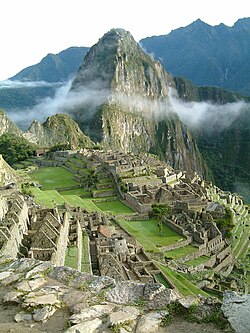
Machu Picchu is a pre-Columbian Inca site situated on a mountain ridge above the Urubamba Valley in Peru. Often referred to as the "Lost City of the Incas", it is perhaps the most familiar icon of the Inca World. Machu Picchu was built around 1450, at the height of the Inca Empire. It was abandoned just over 100 years later, in 1572, as a belated result of the Spanish Conquest. It is possible that most of its inhabitants died from smallpox introduced by travelers before the Spanish conquistadors arrived in the area. In 1911, Melchor Arteaga led the explorer Hiram Bingham to Machu Picchu, which had been largely forgotten by everybody except the small number of people living in the immediate valley. Nevertheless, Peruvian explorer and farmer Agustín Lizárraga predated this discovery by 9 years, having found the Inca site on 14 July 1902. He left a charcoal inscription bearing the words "A. Lizárraga 1902".
Lost city
A lost city is an urban settlement that fell into terminal decline and became extensively or completely uninhabited, with the consequence that the site's former significance was no longer known to the wider world. The locations of many lost cities have been forgotten, but some have been rediscovered and studied extensively by scientists. Recently abandoned cities or cities whose location was never in question might be referred to as ruins or ghost towns. Smaller settlements may be referred to as abandoned villages. The search for such lost cities by European explorers and adventurers in Africa, the Americas, and Southeast Asia from the 15th century onward eventually led to the development of archaeology.
Lost cities generally fall into two broad categories: those where all knowledge of the city's existence was forgotten before it was rediscovered, and those whose memory was preserved in myth, legend, or historical records but whose location was lost or at least no longer widely recognized.
Cities may become lost for a variety of reasons including natural disasters, economic or social upheaval, or war.
The Incan capital city of Vilcabamba was destroyed and depopulated during the Spanish conquest of Peru in 1572. The Spanish did not rebuild the city, and the location went unrecorded and was forgotten until it was rediscovered through a detailed examination of period letters and documents.
Troy was a city located in northwest Anatolia in what is now Turkey. It is best known for being the focus of the Trojan War described in the Greek Epic Cycle and especially in the Iliad, one of the two epic poems attributed to Homer. Repeatedly destroyed and rebuilt, the city slowly declined and was abandoned in the Byzantine era. Buried by time, the city was consigned to the realm of legend until the location was first excavated in the 1860s.
Other settlements are lost with few or no clues to their abandonment. For example, Malden Island, in the central Pacific, was deserted when first visited by Europeans in 1825, but the remains of temples and other structures on the island indicate that a population of Polynesians had lived there for perhaps several generations in the past. Typically this lack of information is due to no surviving written or oral histories and a lack of archaeological data as in the case of the remote and fairly unknown Malden Island.
With the development of archaeology and the application of modern techniques, many previously lost cities have been rediscovered.
Machu Picchu is a pre-Columbian Inca site situated on a mountain ridge above the Urubamba Valley in Peru. Often referred to as the "Lost City of the Incas", it is perhaps the most familiar icon of the Inca World. Machu Picchu was built around 1450, at the height of the Inca Empire. It was abandoned just over 100 years later, in 1572, as a belated result of the Spanish Conquest. It is possible that most of its inhabitants died from smallpox introduced by travelers before the Spanish conquistadors arrived in the area. In 1911, Melchor Arteaga led the explorer Hiram Bingham to Machu Picchu, which had been largely forgotten by everybody except the small number of people living in the immediate valley. Nevertheless, Peruvian explorer and farmer Agustín Lizárraga predated this discovery by 9 years, having found the Inca site on 14 July 1902. He left a charcoal inscription bearing the words "A. Lizárraga 1902".
Recent media
Recent media