



Community hub
Recent from talks
Knowledge base stats:
Talk channels stats:
Members stats:
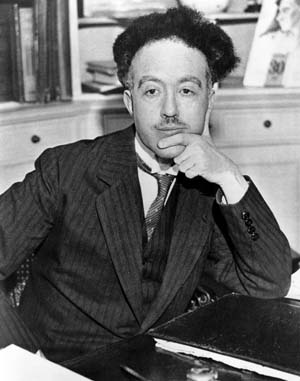
Louis de Broglie
Louis Victor Pierre Raymond, 7th Duc de Broglie (French: [də bʁɔj] ⓘ; 15 August 1892 – 19 March 1987) was a French theoretical physicist and aristocrat known for his contributions to quantum theory. In his 1924 Ph.D. thesis, he postulated the wave nature of electrons and suggested that all matter has wave properties. This concept is known as the de Broglie hypothesis, an example of wave–particle duality, and forms a central part of the theory of quantum mechanics. In 1929, de Broglie won the Nobel Prize in Physics after the wave-like behaviour of matter was experimentally confirmed in 1927.
The wave-like behaviour of particles theorized by de Broglie was used by Erwin Schrödinger in his formulation of wave mechanics. De Broglie presented an alternative interpretation of these mechanics called the pilot-wave concept at the 1927 Solvay Conferences, but then abandoned it. In 1952, David Bohm developed a new form of the concept which became known as the de Broglie–Bohm theory. De Broglie revisited the idea in 1956, creating another version that incorporated ideas from Bohm and Jean-Pierre Vigier.
Louis de Broglie was the sixteenth member elected to occupy seat 1 of the Académie française in 1944, and served as Perpetual Secretary of the French Academy of Sciences. De Broglie became the first high-level scientist to call for establishment of a multi-national laboratory, a proposal that led to the establishment of the European Organization for Nuclear Research (CERN). Among his publications were The Revolution in Physics and Matter and Light. He was honorary president of the French Association of Science Writers and received the inaugural Kalinga Prize from UNESCO for his efforts to popularize science.
Louis Victor Pierre Raymond was born on 15 August 1892 in Dieppe, France, into the aristocratic House of Broglie, whose representatives for several centuries occupied important military and political posts in France. His father, Louis-Alphonse-Victor, 5th duc de Broglie, was married to Pauline d'Armaille, the granddaughter of the Napoleonic General Philippe Paul, comte de Ségur, and his wife, the biographer Marie Célestine Amélie d'Armaillé. They had five children; in addition to Louis, these were: Albertina (1872–1946), subsequently the Marquise de Luppé; Maurice (1875–1960), subsequently a famous experimental physicist; Philip (1881–1890), who died two years before the birth of Louis, and Pauline, Comtesse de Pange (1888–1972), subsequently a famous writer. Per the New York Times, "a great-grandfather fought on George Washington's side in the American Revolutionary War as the chief lieutenant of the Marquis de Lafayette."
As the youngest child in the family, Louis grew up in relative loneliness, read a lot, and was fond of history, especially political. From early childhood, he had a good memory and could accurately read an excerpt from a theatrical production or give a complete list of ministers of the Third Republic of France. For this, he was predicted to become a great statesman in the future.
De Broglie had intended a career in humanities, and received his first degree (licence ès lettres) in history. Afterwards he turned his attention toward mathematics and physics and received a degree (licence ès sciences) in physics. With the outbreak of the First World War in 1914, he offered his services to the army in the development of radio communications.
After graduation, de Broglie joined the engineering forces to undergo compulsory service. It began at Fort Mont Valérien, but soon, on the initiative of his brother, he was seconded to the Wireless Communications Service and worked on the Eiffel Tower, where the radio transmitter was located. Louis de Broglie remained in military service throughout the First World War, dealing with purely technical issues. In particular, together with Léon Brillouin and brother Maurice, he participated in establishing wireless communications with submarines. Louis de Broglie was demobilized in August 1919 with the rank of adjudant. Later, the scientist regretted that he had to spend about six years away from the fundamental problems of science that interested him.
His 1924 thesis Recherches sur la théorie des quanta (Research on the Theory of the Quanta) introduced his theory of electron waves. This included the wave–particle duality theory of matter, based on the work of Max Planck and Albert Einstein on light. This research culminated in the de Broglie hypothesis stating that any moving particle or object had an associated wave. De Broglie thus created a new field in physics, the mécanique ondulatoire, or wave mechanics, uniting the physics of energy (wave) and matter (particle). He won the Nobel Prize in Physics in 1929 "for his discovery of the wave nature of electrons".
Hub AI
Louis de Broglie AI simulator
(@Louis de Broglie_simulator)
Louis de Broglie
Louis Victor Pierre Raymond, 7th Duc de Broglie (French: [də bʁɔj] ⓘ; 15 August 1892 – 19 March 1987) was a French theoretical physicist and aristocrat known for his contributions to quantum theory. In his 1924 Ph.D. thesis, he postulated the wave nature of electrons and suggested that all matter has wave properties. This concept is known as the de Broglie hypothesis, an example of wave–particle duality, and forms a central part of the theory of quantum mechanics. In 1929, de Broglie won the Nobel Prize in Physics after the wave-like behaviour of matter was experimentally confirmed in 1927.
The wave-like behaviour of particles theorized by de Broglie was used by Erwin Schrödinger in his formulation of wave mechanics. De Broglie presented an alternative interpretation of these mechanics called the pilot-wave concept at the 1927 Solvay Conferences, but then abandoned it. In 1952, David Bohm developed a new form of the concept which became known as the de Broglie–Bohm theory. De Broglie revisited the idea in 1956, creating another version that incorporated ideas from Bohm and Jean-Pierre Vigier.
Louis de Broglie was the sixteenth member elected to occupy seat 1 of the Académie française in 1944, and served as Perpetual Secretary of the French Academy of Sciences. De Broglie became the first high-level scientist to call for establishment of a multi-national laboratory, a proposal that led to the establishment of the European Organization for Nuclear Research (CERN). Among his publications were The Revolution in Physics and Matter and Light. He was honorary president of the French Association of Science Writers and received the inaugural Kalinga Prize from UNESCO for his efforts to popularize science.
Louis Victor Pierre Raymond was born on 15 August 1892 in Dieppe, France, into the aristocratic House of Broglie, whose representatives for several centuries occupied important military and political posts in France. His father, Louis-Alphonse-Victor, 5th duc de Broglie, was married to Pauline d'Armaille, the granddaughter of the Napoleonic General Philippe Paul, comte de Ségur, and his wife, the biographer Marie Célestine Amélie d'Armaillé. They had five children; in addition to Louis, these were: Albertina (1872–1946), subsequently the Marquise de Luppé; Maurice (1875–1960), subsequently a famous experimental physicist; Philip (1881–1890), who died two years before the birth of Louis, and Pauline, Comtesse de Pange (1888–1972), subsequently a famous writer. Per the New York Times, "a great-grandfather fought on George Washington's side in the American Revolutionary War as the chief lieutenant of the Marquis de Lafayette."
As the youngest child in the family, Louis grew up in relative loneliness, read a lot, and was fond of history, especially political. From early childhood, he had a good memory and could accurately read an excerpt from a theatrical production or give a complete list of ministers of the Third Republic of France. For this, he was predicted to become a great statesman in the future.
De Broglie had intended a career in humanities, and received his first degree (licence ès lettres) in history. Afterwards he turned his attention toward mathematics and physics and received a degree (licence ès sciences) in physics. With the outbreak of the First World War in 1914, he offered his services to the army in the development of radio communications.
After graduation, de Broglie joined the engineering forces to undergo compulsory service. It began at Fort Mont Valérien, but soon, on the initiative of his brother, he was seconded to the Wireless Communications Service and worked on the Eiffel Tower, where the radio transmitter was located. Louis de Broglie remained in military service throughout the First World War, dealing with purely technical issues. In particular, together with Léon Brillouin and brother Maurice, he participated in establishing wireless communications with submarines. Louis de Broglie was demobilized in August 1919 with the rank of adjudant. Later, the scientist regretted that he had to spend about six years away from the fundamental problems of science that interested him.
His 1924 thesis Recherches sur la théorie des quanta (Research on the Theory of the Quanta) introduced his theory of electron waves. This included the wave–particle duality theory of matter, based on the work of Max Planck and Albert Einstein on light. This research culminated in the de Broglie hypothesis stating that any moving particle or object had an associated wave. De Broglie thus created a new field in physics, the mécanique ondulatoire, or wave mechanics, uniting the physics of energy (wave) and matter (particle). He won the Nobel Prize in Physics in 1929 "for his discovery of the wave nature of electrons".