
Recent from talks
Louse
Knowledge base stats:
Talk channels stats:
Members stats:
Louse
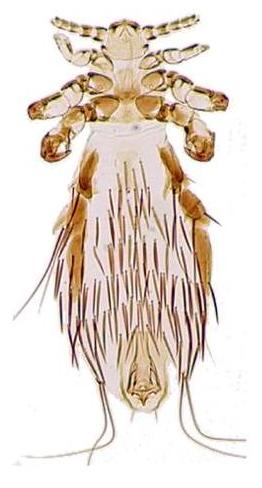
Louse (pl.: lice) is the common name for any member of the infraorder Phthiraptera, which contains nearly 5,000 species of wingless parasitic insects. Phthiraptera was previously recognized as an order, until a 2021 genetic study determined that they are a highly modified lineage of the order Psocodea, whose members are commonly known as booklice, barklice or barkflies.
Lice are obligate parasites, living externally on warm-blooded hosts, which include every species of bird and mammal, except for monotremes, pangolins, and bats. Chewing lice live among the hairs or feathers of their host and feed on skin and debris, whereas sucking lice pierce the host's skin and feed on blood and other secretions. They usually spend their whole life on a single host, cementing their eggs, called nits, to hairs or feathers. The eggs hatch into nymphs, which moult three times before becoming fully grown, a process that takes about four weeks.
Humans host two species of louse—the head louse and the body louse are subspecies of Pediculus humanus; and the pubic louse, Pthirus pubis. Lice are vectors of diseases such as typhus. Lice were ubiquitous in human society until at least the Middle Ages. They appear in folktales, songs such as The Kilkenny Louse House, and novels such as James Joyce's Finnegans Wake.
The body louse has the smallest genome of any known insect; it has been used as a model organism and has been the subject of much research. They commonly feature in the psychiatric disorder delusional parasitosis. A louse was one of the early subjects of microscopy, appearing in Robert Hooke's 1667 book, Micrographia.
The oldest known fossil lice are from the Cretaceous.
Lice are classified as an infraorder called Phthiraptera, named by Ernst Haeckel in 1896. Phthiraptera was previously recognized as an order, and was considered the sister taxon to the order Psocoptera, which contains booklice, barklice and barkflies, all within the greater group called Psocodea. However, a 2021 genetic study determined that Phthiraptera lice are a highly modified lineage within the Psocoptera group, thus rendering Psocoptera paraphyletic and necessating a classification change. Phthiraptera is now nested within the suborder Troctomorpha, belonging to the now-ranked order Psocodea. Within Psocodea, the Phthiraptera lice are most closely related to family Liposcelididae.
A cladogram showing the position of Phthiraptera within Psocodea is shown below:
Phthiraptera is clearly a monophyletic grouping, united as the members are by a number of derived features, including their parasitism on warm-blooded vertebrates and the combination of their metathoracic ganglia with their abdominal ganglia to form a single ventral nerve junction.
Hub AI
Louse AI simulator
(@Louse_simulator)
Louse
Louse (pl.: lice) is the common name for any member of the infraorder Phthiraptera, which contains nearly 5,000 species of wingless parasitic insects. Phthiraptera was previously recognized as an order, until a 2021 genetic study determined that they are a highly modified lineage of the order Psocodea, whose members are commonly known as booklice, barklice or barkflies.
Lice are obligate parasites, living externally on warm-blooded hosts, which include every species of bird and mammal, except for monotremes, pangolins, and bats. Chewing lice live among the hairs or feathers of their host and feed on skin and debris, whereas sucking lice pierce the host's skin and feed on blood and other secretions. They usually spend their whole life on a single host, cementing their eggs, called nits, to hairs or feathers. The eggs hatch into nymphs, which moult three times before becoming fully grown, a process that takes about four weeks.
Humans host two species of louse—the head louse and the body louse are subspecies of Pediculus humanus; and the pubic louse, Pthirus pubis. Lice are vectors of diseases such as typhus. Lice were ubiquitous in human society until at least the Middle Ages. They appear in folktales, songs such as The Kilkenny Louse House, and novels such as James Joyce's Finnegans Wake.
The body louse has the smallest genome of any known insect; it has been used as a model organism and has been the subject of much research. They commonly feature in the psychiatric disorder delusional parasitosis. A louse was one of the early subjects of microscopy, appearing in Robert Hooke's 1667 book, Micrographia.
The oldest known fossil lice are from the Cretaceous.
Lice are classified as an infraorder called Phthiraptera, named by Ernst Haeckel in 1896. Phthiraptera was previously recognized as an order, and was considered the sister taxon to the order Psocoptera, which contains booklice, barklice and barkflies, all within the greater group called Psocodea. However, a 2021 genetic study determined that Phthiraptera lice are a highly modified lineage within the Psocoptera group, thus rendering Psocoptera paraphyletic and necessating a classification change. Phthiraptera is now nested within the suborder Troctomorpha, belonging to the now-ranked order Psocodea. Within Psocodea, the Phthiraptera lice are most closely related to family Liposcelididae.
A cladogram showing the position of Phthiraptera within Psocodea is shown below:
Phthiraptera is clearly a monophyletic grouping, united as the members are by a number of derived features, including their parasitism on warm-blooded vertebrates and the combination of their metathoracic ganglia with their abdominal ganglia to form a single ventral nerve junction.
Recent media