
Recent from talks
Low-frequency radio range
Knowledge base stats:
Talk channels stats:
Members stats:
Low-frequency radio range
The low-frequency radio range, also known as the four-course radio range, LF/MF four-course radio range, A-N radio range, Adcock radio range, or commonly "the range", was the main navigation system used by aircraft for instrument flying in the 1930s and 1940s, until the advent of the VHF omnidirectional range (VOR), beginning in the late 1940s. It was used for en route navigation as well as instrument approaches and holds.
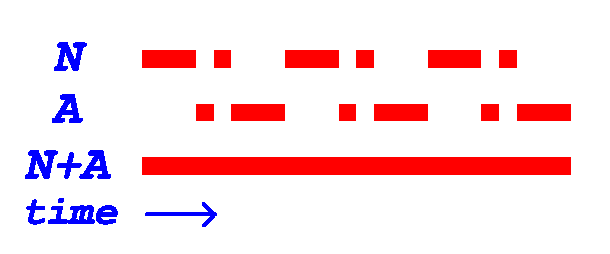
Based on a network of radio towers which transmitted directional radio signals, the radio range defined specific airways in the sky. Pilots navigated using low-frequency radio by listening to a stream of automated "A" and "N" Morse codes. For example, they would turn or slip the aircraft to the right when hearing an "N" stream ("dah-dit, dah-dit, ..."), to the left when hearing an "A" stream ("di-dah, di-dah, ..."), and fly straight ahead when these sounds merged to create a constant tone indicating the airplane was directly tracking the beam.
As the VOR system was phased in around the world, low-frequency radio range was gradually phased out, mostly disappearing by the 1970s. There are no remaining operational facilities today. At its maximum deployment, there were over 400 stations exclusively using low-frequency radio range in the Continental U.S. alone.
After World War I, aviation began to expand its role into the civilian arena, starting with airmail flights. It soon became apparent that for reliable mail delivery, as well as the passenger flights which were soon to follow, a solution was required for navigation at night and in poor visibility. In the U.S., a network of lighted beacons, similar to maritime lighthouses, was constructed for the airmail pilots. But the beacons were useful mostly at night and in good weather, while in poor visibility conditions they could not be seen. Scientists and engineers realized that a radio based navigation solution would allow pilots to "see" under all flight conditions, and decided a network of directional radio beams was needed.
On September 24, 1929, then-Lieutenant (later General) James H. "Jimmy" Doolittle, U.S. Army, demonstrated the first "blind" flight, performed exclusively by reference to instruments and without outside visibility, and proved that instrument flying was feasible. Doolittle used newly developed gyroscopic instruments—attitude indicator and gyrocompass—to help him maintain his aircraft's attitude and heading, and a specially designed directional radio system to navigate to and from the airport. Doolittle's experimental equipment was purpose-built for his demonstration flights; for instrument flying to become practical, the technology had to be reliable, mass-produced and widely deployed, both on the ground and in the aircraft fleet.
There were two technological approaches for both the ground and air radio navigation components, which were being evaluated during the late 1920s and early 1930s.
On the ground, to obtain directional radio beams with a well-defined navigable course, crossed loop antennas were used initially. The Ford Motor Company developed the first commercially workable application of a loop-based, low-frequency radio range. They installed it at their Dearborn and Chicago fields in 1926 and filed the patent for it in 1928. Earlier concepts for the system were developed in Germany in 1906 which were later experimented with by the US Bureau of Standards and Army Signal Corps in the early 1920s. The technology was quickly adopted by the U.S. Commerce Department, who set up a demonstration range on June 30, 1928, and the first series of stations entered service later that year. But the loop antenna design generated excessive horizontally polarized skywaves that could interfere with the signals, especially at night. By 1932, the Adcock antenna array eliminated this problem by only having vertical antennae and it became the preferred solution. The U.S. Commerce Department's Aeronautics Branch referred to the Adcock solution as the "T-L Antenna" (for "Transmission Line") and did not initially mention Adcock's name.
In the air, there were also two competing designs, originating from groups of different backgrounds and needs. The Army Signal Corps, representing military aviators, preferred a solution based on a stream of audio navigation signals, constantly fed into the pilots' ears via a headset. Civilian pilots on the other hand, who were mostly airmail pilots flying cross-country to deliver the mail, felt the audio signals would be annoying and difficult to use over long flights, and preferred a visual solution, with an indicator in the instrument panel.
Hub AI
Low-frequency radio range AI simulator
(@Low-frequency radio range_simulator)
Low-frequency radio range
The low-frequency radio range, also known as the four-course radio range, LF/MF four-course radio range, A-N radio range, Adcock radio range, or commonly "the range", was the main navigation system used by aircraft for instrument flying in the 1930s and 1940s, until the advent of the VHF omnidirectional range (VOR), beginning in the late 1940s. It was used for en route navigation as well as instrument approaches and holds.
Based on a network of radio towers which transmitted directional radio signals, the radio range defined specific airways in the sky. Pilots navigated using low-frequency radio by listening to a stream of automated "A" and "N" Morse codes. For example, they would turn or slip the aircraft to the right when hearing an "N" stream ("dah-dit, dah-dit, ..."), to the left when hearing an "A" stream ("di-dah, di-dah, ..."), and fly straight ahead when these sounds merged to create a constant tone indicating the airplane was directly tracking the beam.
As the VOR system was phased in around the world, low-frequency radio range was gradually phased out, mostly disappearing by the 1970s. There are no remaining operational facilities today. At its maximum deployment, there were over 400 stations exclusively using low-frequency radio range in the Continental U.S. alone.
After World War I, aviation began to expand its role into the civilian arena, starting with airmail flights. It soon became apparent that for reliable mail delivery, as well as the passenger flights which were soon to follow, a solution was required for navigation at night and in poor visibility. In the U.S., a network of lighted beacons, similar to maritime lighthouses, was constructed for the airmail pilots. But the beacons were useful mostly at night and in good weather, while in poor visibility conditions they could not be seen. Scientists and engineers realized that a radio based navigation solution would allow pilots to "see" under all flight conditions, and decided a network of directional radio beams was needed.
On September 24, 1929, then-Lieutenant (later General) James H. "Jimmy" Doolittle, U.S. Army, demonstrated the first "blind" flight, performed exclusively by reference to instruments and without outside visibility, and proved that instrument flying was feasible. Doolittle used newly developed gyroscopic instruments—attitude indicator and gyrocompass—to help him maintain his aircraft's attitude and heading, and a specially designed directional radio system to navigate to and from the airport. Doolittle's experimental equipment was purpose-built for his demonstration flights; for instrument flying to become practical, the technology had to be reliable, mass-produced and widely deployed, both on the ground and in the aircraft fleet.
There were two technological approaches for both the ground and air radio navigation components, which were being evaluated during the late 1920s and early 1930s.
On the ground, to obtain directional radio beams with a well-defined navigable course, crossed loop antennas were used initially. The Ford Motor Company developed the first commercially workable application of a loop-based, low-frequency radio range. They installed it at their Dearborn and Chicago fields in 1926 and filed the patent for it in 1928. Earlier concepts for the system were developed in Germany in 1906 which were later experimented with by the US Bureau of Standards and Army Signal Corps in the early 1920s. The technology was quickly adopted by the U.S. Commerce Department, who set up a demonstration range on June 30, 1928, and the first series of stations entered service later that year. But the loop antenna design generated excessive horizontally polarized skywaves that could interfere with the signals, especially at night. By 1932, the Adcock antenna array eliminated this problem by only having vertical antennae and it became the preferred solution. The U.S. Commerce Department's Aeronautics Branch referred to the Adcock solution as the "T-L Antenna" (for "Transmission Line") and did not initially mention Adcock's name.
In the air, there were also two competing designs, originating from groups of different backgrounds and needs. The Army Signal Corps, representing military aviators, preferred a solution based on a stream of audio navigation signals, constantly fed into the pilots' ears via a headset. Civilian pilots on the other hand, who were mostly airmail pilots flying cross-country to deliver the mail, felt the audio signals would be annoying and difficult to use over long flights, and preferred a visual solution, with an indicator in the instrument panel.
Recent media