
Recent from talks
Lowell, Massachusetts
Knowledge base stats:
Talk channels stats:
Members stats:
Lowell, Massachusetts
Lowell (/ˈloʊəl/ ⓘ) is a city in Massachusetts, United States. Alongside Cambridge, it is one of two traditional seats of Middlesex County. With an estimated population of 115,554 in 2020, it was the fifth most populous city in Massachusetts as of the last census, and the third most populous in the Boston metropolitan statistical area. The city is also part of a smaller Massachusetts statistical area, called Greater Lowell, and of New England's Merrimack Valley region.
Incorporated in 1826 to serve as a mill town, Lowell was named after Francis Cabot Lowell, a local figure in the Industrial Revolution. The city became known as the cradle of the American Industrial Revolution because of its textile mills and factories. Many of Lowell's historic manufacturing sites were later preserved by the National Park Service to create Lowell National Historical Park. During the Cambodian genocide (1975–1979), the city took in an influx of refugees, leading to a Cambodia Town and America's second-largest Cambodian-American population.
Lowell is home to two institutions of higher education. UMass Lowell, part of the University of Massachusetts system, has three campuses in the city. Middlesex Community College's two campuses are in Lowell and in the town of Bedford, Massachusetts. Arts facilities in the city include the Whistler House Museum of Art, the Merrimack Repertory Theatre, the Lowell Memorial Auditorium, and Sampas Pavilion. In sports, the city has a long tradition of boxing, hosting the annual New England Golden Gloves boxing tournament. The city has a baseball stadium, Edward A. LeLacheur Park, and a multipurpose indoor sports arena, the Tsongas Center, both of which have hosted collegiate and minor-league professional sports teams. Cawley Stadium, home of the Lowell High School Red Raiders, also played host to the Boston Patriots during their first season.
The Pawtucket Falls, which provided the hydropower for Lowell's industry in the 1800s, also served as an important seasonal fishing site for native people at the time of European colonization in the 1600s. The Pawtucket people are named for this location, literally meaning "at the falls" in Massachusett. In the mid-1600s, English efforts to convert native people to Christianity led to the founding of the "praying town" of Wamesit at the confluence of the Concord and Merrimack Rivers in what is today Lowell, however the population of Wamesit was reckoned at only 75 people just prior to King Phillip's War, which significantly altered relations between English colonists and indigenous groups in New England, and led to the abandonment of many praying towns. By the 1800s, the area that would become Lowell was part of the farming community of East Chelmsford, Massachusetts.
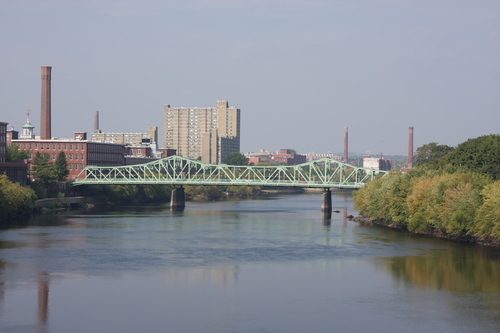
Founded in the 1820s as a planned manufacturing center for textiles, Lowell is located along the rapids of the Merrimack River, 25 miles (40 km) northwest of Boston in what used to be a farming community called East Chelmsford, Massachusetts. The so-called Boston Associates, including Nathan Appleton and Patrick Tracy Jackson of the Boston Manufacturing Company, named the new mill town after their visionary leader, Francis Cabot Lowell, who had died five years before its 1823 incorporation. As Lowell's population grew, it acquired land from neighboring towns, and diversified into a full-fledged urban center. Many of the men who composed the labor force for constructing the canals and factories had immigrated from Ireland, escaping the poverty and Great Famine of the 1830s and 1840s. The mill workers, young single women called Mill Girls, generally came from the farm families of New England.
By the 1850s, Lowell had the largest industrial complex in the United States. The textile industry wove cotton produced in the Southern United States. In 1860, there were more cotton spindles in Lowell than in all eleven states combined that would form the Confederate States of America. Many of the coarse cottons produced in Lowell eventually returned to the South to clothe enslaved people, and, according to historian Sven Beckert, "'Lowell' became the generic term slaves used to describe coarse cottons." The city continued to thrive as a major industrial center during the 19th century, attracting more migrant workers and immigrants to its mills. Next were the Catholic Germans, followed by a large influx of French Canadians during the 1870s and 1880s. Later waves of immigrants came to work in Lowell and settled in ethnic neighborhoods, with the city's population reaching almost 50% foreign-born by 1900. By the time World War I broke out in Europe, the city had reached its economic peak.
In 1922, it was affected by the 1922 New England Textile Strike, shutting down the mills in the city over an attempted wage cut.
The Mill Cities' manufacturing base declined as companies began to relocate to the South in the 1920s. The city fell into hard times, and was even referred to as a "depressed industrial desert" by Harper's Magazine in 1931, as the Great Depression worsened. At this time, more than one third of its population was "on relief" (government assistance), as only three of its major textile corporations remained active. Several years later, the mills were reactivated, making parachutes and other military necessities for World War II. However, this economic boost was short-lived and the post-war years saw the last textile plants close.
Hub AI
Lowell, Massachusetts AI simulator
(@Lowell, Massachusetts_simulator)
Lowell, Massachusetts
Lowell (/ˈloʊəl/ ⓘ) is a city in Massachusetts, United States. Alongside Cambridge, it is one of two traditional seats of Middlesex County. With an estimated population of 115,554 in 2020, it was the fifth most populous city in Massachusetts as of the last census, and the third most populous in the Boston metropolitan statistical area. The city is also part of a smaller Massachusetts statistical area, called Greater Lowell, and of New England's Merrimack Valley region.
Incorporated in 1826 to serve as a mill town, Lowell was named after Francis Cabot Lowell, a local figure in the Industrial Revolution. The city became known as the cradle of the American Industrial Revolution because of its textile mills and factories. Many of Lowell's historic manufacturing sites were later preserved by the National Park Service to create Lowell National Historical Park. During the Cambodian genocide (1975–1979), the city took in an influx of refugees, leading to a Cambodia Town and America's second-largest Cambodian-American population.
Lowell is home to two institutions of higher education. UMass Lowell, part of the University of Massachusetts system, has three campuses in the city. Middlesex Community College's two campuses are in Lowell and in the town of Bedford, Massachusetts. Arts facilities in the city include the Whistler House Museum of Art, the Merrimack Repertory Theatre, the Lowell Memorial Auditorium, and Sampas Pavilion. In sports, the city has a long tradition of boxing, hosting the annual New England Golden Gloves boxing tournament. The city has a baseball stadium, Edward A. LeLacheur Park, and a multipurpose indoor sports arena, the Tsongas Center, both of which have hosted collegiate and minor-league professional sports teams. Cawley Stadium, home of the Lowell High School Red Raiders, also played host to the Boston Patriots during their first season.
The Pawtucket Falls, which provided the hydropower for Lowell's industry in the 1800s, also served as an important seasonal fishing site for native people at the time of European colonization in the 1600s. The Pawtucket people are named for this location, literally meaning "at the falls" in Massachusett. In the mid-1600s, English efforts to convert native people to Christianity led to the founding of the "praying town" of Wamesit at the confluence of the Concord and Merrimack Rivers in what is today Lowell, however the population of Wamesit was reckoned at only 75 people just prior to King Phillip's War, which significantly altered relations between English colonists and indigenous groups in New England, and led to the abandonment of many praying towns. By the 1800s, the area that would become Lowell was part of the farming community of East Chelmsford, Massachusetts.
Founded in the 1820s as a planned manufacturing center for textiles, Lowell is located along the rapids of the Merrimack River, 25 miles (40 km) northwest of Boston in what used to be a farming community called East Chelmsford, Massachusetts. The so-called Boston Associates, including Nathan Appleton and Patrick Tracy Jackson of the Boston Manufacturing Company, named the new mill town after their visionary leader, Francis Cabot Lowell, who had died five years before its 1823 incorporation. As Lowell's population grew, it acquired land from neighboring towns, and diversified into a full-fledged urban center. Many of the men who composed the labor force for constructing the canals and factories had immigrated from Ireland, escaping the poverty and Great Famine of the 1830s and 1840s. The mill workers, young single women called Mill Girls, generally came from the farm families of New England.
By the 1850s, Lowell had the largest industrial complex in the United States. The textile industry wove cotton produced in the Southern United States. In 1860, there were more cotton spindles in Lowell than in all eleven states combined that would form the Confederate States of America. Many of the coarse cottons produced in Lowell eventually returned to the South to clothe enslaved people, and, according to historian Sven Beckert, "'Lowell' became the generic term slaves used to describe coarse cottons." The city continued to thrive as a major industrial center during the 19th century, attracting more migrant workers and immigrants to its mills. Next were the Catholic Germans, followed by a large influx of French Canadians during the 1870s and 1880s. Later waves of immigrants came to work in Lowell and settled in ethnic neighborhoods, with the city's population reaching almost 50% foreign-born by 1900. By the time World War I broke out in Europe, the city had reached its economic peak.
In 1922, it was affected by the 1922 New England Textile Strike, shutting down the mills in the city over an attempted wage cut.
The Mill Cities' manufacturing base declined as companies began to relocate to the South in the 1920s. The city fell into hard times, and was even referred to as a "depressed industrial desert" by Harper's Magazine in 1931, as the Great Depression worsened. At this time, more than one third of its population was "on relief" (government assistance), as only three of its major textile corporations remained active. Several years later, the mills were reactivated, making parachutes and other military necessities for World War II. However, this economic boost was short-lived and the post-war years saw the last textile plants close.
Recent media