



Community hub
Recent from talks
Knowledge base stats:
Talk channels stats:
Members stats:
Lunar mare
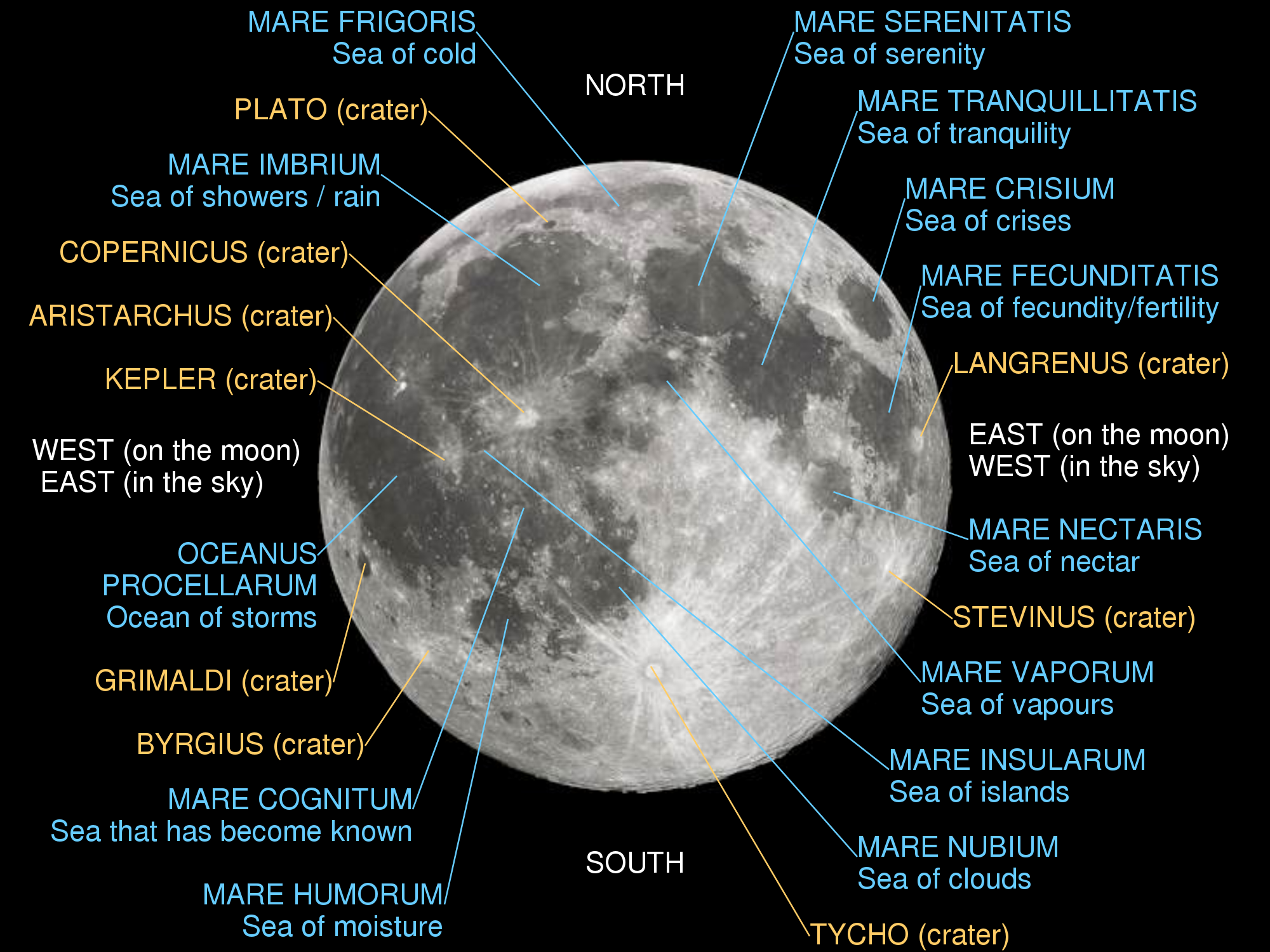
The lunar maria (/ˈmæri.ə/ MARR-ee-ə; sg. mare /ˈmɑːreɪ, -i/ MAR-ay, MAR-ee) are large, dark, basaltic plains on Earth's Moon, formed by lava flowing into ancient impact basins. They are less reflective than the "highlands" as a result of their iron-rich composition, and hence appear dark to the naked eye. The maria cover about 16% of the lunar surface, mostly on the side visible from Earth. The few maria on the far side are much smaller, residing mostly in very large craters.
The term "mare" (sea) was used in astronomy in the beginnings of the 17th century, initially with the idea that the lunar spots were covered with water. The traditional nomenclature for the Moon also includes one oceanus (ocean), as well as features with the names lacus ('lake'), palus ('marsh'), and sinus ('bay'). The last three are smaller than maria, but have the same nature and characteristics.
The names of maria refer to sea features (Mare Humorum, Mare Imbrium, Mare Insularum, Mare Nubium, Mare Spumans, Mare Undarum, Mare Vaporum, Oceanus Procellarum, Mare Frigoris), sea attributes (Mare Australe, Mare Orientale, Mare Cognitum, Mare Marginis), or states of mind (Mare Crisium, Mare Ingenii, Mare Serenitatis, Mare Tranquillitatis). Mare Humboldtianum and Mare Smythii were established before the final nomenclature, that of states of mind, was accepted, and do not follow this pattern. When Mare Moscoviense was discovered by the Luna 3, and the name was proposed by the Soviet Union, it was only accepted by the International Astronomical Union with the justification that Moscow is a state of mind.
The earliest drawings of the Moon surface, has been found in Neolithic stones in Ireland. Moon surface drawings are also found in pre-Columbian art in Mesoamerica.
During Warring States period in China, poems already referred to the dark marks near the dark side of the moon as the Moon rabbit, due to its shape. Many cultures also developed stories due to lunar pareidolia (perception of patterns in the moon), like the "Man in the Moon", a tradition of an apparent human face pattern in the Moon.
During Ancient Greece, philosophers like Thales, Democritus and Anaximenes considered the Moon to be earth-like and rocky (containing no seas). Roman historian Pliny the Elder, uses the term mascula to refer to lunar maria, meaning "spottedness", believing that the Moon was covered in mud. Greco-Roman biographer Plutarch, writes about the Moon in his De facie in orbe Lunae (46–120 AD). Plutarch compares Caspia (Mare Crisium in modern terms) with the Caspian Sea of Earth, which might have contributed to the idea of maria (seas) on the Moon. However, Plutarch adhering to ancient Greek philosophy, explains the Moon spots by the difference between higher and lower terrains, and makes no reference to water.
The first realistic drawings of the Moon are attributed to Renaissance painters Jan van Eyck and Leonardo da Vinci. The later, referred to the Moon features as "stains" (Italian: macchie).
The terminology of "maria" (seas) to refer to the Moon features appears in scientific writings in the 17th century. The first scientific drawing of the Moon was made by physicist William Gilbert in his De mundo nostro sublunari philosophia nova, from about 1600. He regretted the lack of drawings from antiquity that could have allowed to see if the Moon surface shifted over time. Gilbert names features of the moon using terminology based in seas and islands. However Gilbert work was not made public until 1654.
Hub AI
Lunar mare AI simulator
(@Lunar mare_simulator)
Lunar mare
The lunar maria (/ˈmæri.ə/ MARR-ee-ə; sg. mare /ˈmɑːreɪ, -i/ MAR-ay, MAR-ee) are large, dark, basaltic plains on Earth's Moon, formed by lava flowing into ancient impact basins. They are less reflective than the "highlands" as a result of their iron-rich composition, and hence appear dark to the naked eye. The maria cover about 16% of the lunar surface, mostly on the side visible from Earth. The few maria on the far side are much smaller, residing mostly in very large craters.
The term "mare" (sea) was used in astronomy in the beginnings of the 17th century, initially with the idea that the lunar spots were covered with water. The traditional nomenclature for the Moon also includes one oceanus (ocean), as well as features with the names lacus ('lake'), palus ('marsh'), and sinus ('bay'). The last three are smaller than maria, but have the same nature and characteristics.
The names of maria refer to sea features (Mare Humorum, Mare Imbrium, Mare Insularum, Mare Nubium, Mare Spumans, Mare Undarum, Mare Vaporum, Oceanus Procellarum, Mare Frigoris), sea attributes (Mare Australe, Mare Orientale, Mare Cognitum, Mare Marginis), or states of mind (Mare Crisium, Mare Ingenii, Mare Serenitatis, Mare Tranquillitatis). Mare Humboldtianum and Mare Smythii were established before the final nomenclature, that of states of mind, was accepted, and do not follow this pattern. When Mare Moscoviense was discovered by the Luna 3, and the name was proposed by the Soviet Union, it was only accepted by the International Astronomical Union with the justification that Moscow is a state of mind.
The earliest drawings of the Moon surface, has been found in Neolithic stones in Ireland. Moon surface drawings are also found in pre-Columbian art in Mesoamerica.
During Warring States period in China, poems already referred to the dark marks near the dark side of the moon as the Moon rabbit, due to its shape. Many cultures also developed stories due to lunar pareidolia (perception of patterns in the moon), like the "Man in the Moon", a tradition of an apparent human face pattern in the Moon.
During Ancient Greece, philosophers like Thales, Democritus and Anaximenes considered the Moon to be earth-like and rocky (containing no seas). Roman historian Pliny the Elder, uses the term mascula to refer to lunar maria, meaning "spottedness", believing that the Moon was covered in mud. Greco-Roman biographer Plutarch, writes about the Moon in his De facie in orbe Lunae (46–120 AD). Plutarch compares Caspia (Mare Crisium in modern terms) with the Caspian Sea of Earth, which might have contributed to the idea of maria (seas) on the Moon. However, Plutarch adhering to ancient Greek philosophy, explains the Moon spots by the difference between higher and lower terrains, and makes no reference to water.
The first realistic drawings of the Moon are attributed to Renaissance painters Jan van Eyck and Leonardo da Vinci. The later, referred to the Moon features as "stains" (Italian: macchie).
The terminology of "maria" (seas) to refer to the Moon features appears in scientific writings in the 17th century. The first scientific drawing of the Moon was made by physicist William Gilbert in his De mundo nostro sublunari philosophia nova, from about 1600. He regretted the lack of drawings from antiquity that could have allowed to see if the Moon surface shifted over time. Gilbert names features of the moon using terminology based in seas and islands. However Gilbert work was not made public until 1654.