Hubbry Logo
LysebotnLysebotnMain
Open search
Lysebotn
Community hub
Lysebotn
logo
8 pages, 0 posts
0 subscribers
Be the first to start a discussion here.
Lysebotn
Lysebotn
from Wikipedia

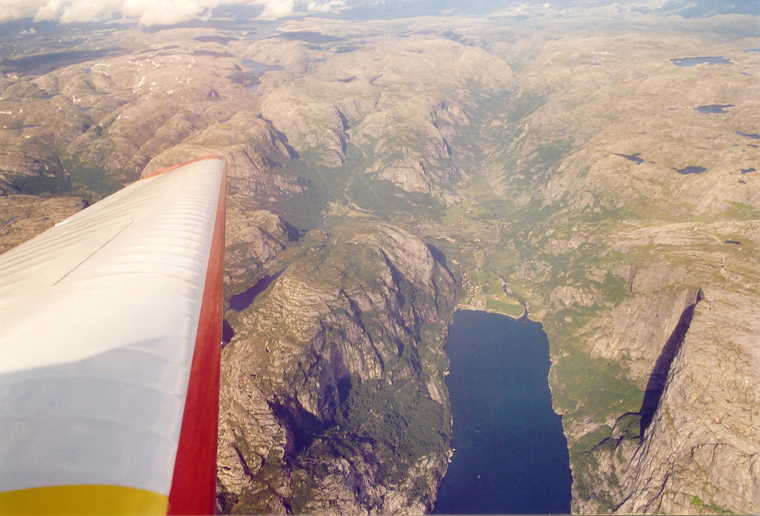
Lysebotn is a village in Sandnes municipality in Rogaland county, Norway. The village is located at the eastern end of the Lysefjorden in a very isolated valley that is only accessible by a seasonal road or by boat. The name itself means the "bottom [end] of the Lysefjorden". It's a destination for over 100,000 tourists annually, and it is an access point for the Kjerag mountain, a popular Base Jumping spot. There are cruises and an express boat to Lysebotn from Skagenkaien in the city of Stavanger, Lauvvik in Sandnes, and the village of Forsand. All of which pass beneath the famous Preikestolen cliff on the way to Lysebotn. Lyse Chapel, built in 1961, is found at Lysebotn. Lysebotn at one time had its own school, but that is now closed.[3]

Key Information

Economy

[edit]

Lysebotn is largely populated by workers at the nearby Lysebotn Hydroelectric Power Station and Tjodan Hydroelectric Power Station, both of which are built inside the surrounding mountains. At the Lysefjord plant, the water falls 620 metres (2,030 ft) to the turbines, producing up to 210,000 kilowatts (280,000 hp) of electricity. At Tjodan, the water falls 896 metres (2,940 ft) to yield an output of 110,000 kilowatts (150,000 hp). The two power plants provide electricity for more than 100,000 people.

Lysebotn today has its own campground, bed & breakfast, and tourist cabins. Guided kayak tours and other activity offerings are available during the summer. There are also trailheads near Lysebotn for access to the Lyseheiane back-country, and a huge flume for Lyse Power nearby, that generates hydroelectricity.

Transportation

[edit]

The only way in to Lysebotn is by boat or by the spectacular Lysebotnvegen (Lysebotn road), officially known as Lyseveien (Bokmål) and Lysevegen (Nynorsk), which connects it to the nearby municipality of Sirdal in Agder county. The 29-kilometre (18 mi) long road rises over 900 metres (3,000 ft) up a very steep cliff, going through 27 hairpin turns, including one hairpin turn inside a 1,103-metre (3,619 ft) long tunnel that goes inside the mountain. The road was opened in 1984 and it is open only in the summer, when it is ice free and safe. The road has its highest point at 932 metres (3,058 ft) above sea level. At the top of the turns is Øygardstølen which has a parking lot, food service, and a service building for hiking trips to the nearby Kjerag mountain, Kjeragbolten boulder, and Kjeragfossen waterfall.

Lysebotn seen from Øygardstøl (full view)

Climate

[edit]
Climate data for Lysebotn (345 m, Precipitation 1895-, extremes 2012-)
Month Jan Feb Mar Apr May Jun Jul Aug Sep Oct Nov Dec Year
Record high °C (°F) 13.6
(56.5)
13.1
(55.6)
15.5
(59.9)
20.6
(69.1)
31.1
(88.0)
30.2
(86.4)
34.2
(93.6)
30.3
(86.5)
28.6
(83.5)
19.2
(66.6)
17.2
(63.0)
12.9
(55.2)
34.2
(93.6)
Daily mean °C (°F) 2.1
(35.8)
1.7
(35.1)
3.2
(37.8)
7.2
(45.0)
10.6
(51.1)
13.5
(56.3)
15.6
(60.1)
15.7
(60.3)
12.6
(54.7)
8.5
(47.3)
5.5
(41.9)
2.6
(36.7)
8.2
(46.8)
Record low °C (°F) −10.1
(13.8)
−11.7
(10.9)
−10.4
(13.3)
−3.2
(26.2)
−0.6
(30.9)
3.8
(38.8)
6.4
(43.5)
5.9
(42.6)
2.3
(36.1)
−3.0
(26.6)
−6.8
(19.8)
−10.2
(13.6)
−11.7
(10.9)
Average precipitation mm (inches) 266
(10.5)
228
(9.0)
184
(7.2)
108
(4.3)
94
(3.7)
102
(4.0)
123
(4.8)
164
(6.5)
198
(7.8)
237
(9.3)
250
(9.8)
286
(11.3)
2,240
(88.2)
Source: [4]

References

[edit]
[edit]
Revisions and contributorsEdit on WikipediaRead on Wikipedia
from Grokipedia
Lysebotn is a remote village in municipality, county, southwestern , situated at the eastern terminus of the 42-kilometer-long , surrounded by steep granite cliffs rising up to 1,000 meters. With a population of approximately 16 residents as of 2023, it functions primarily as a hub for hydroelectric power production and outdoor , serving as the gateway to popular hiking trails leading to like the boulder and the nearby (Pulpit Rock). The village's development is closely tied to Norway's post-World War II expansion, with the original Lysebotn I hydroelectric , which became operational in 1953, utilizing a 620-meter head to generate from the watershed. In 2018, the more efficient Lysebotn II facility replaced it, boasting a capacity of 370 MW and an annual production of 1,500 GWh—enough to power about 75,000 households—through advanced underground infrastructure including 11 kilometers of tunnels and two 185 MW Francis turbines. The s employ a small , contributing to the local alongside seasonal that attracts over 120,000 visitors annually for fjord cruises, hiking, and . Historically, Lysebotn has evidence of habitation dating back approximately 9,500 years, with burial mounds from the (circa 400–550 CE) and roots as a 16th-century agricultural settlement; traditional farms such as Lysegården, Aukland, and Tangen persist amid the modern landscape. Prior to the , access was limited to boats along the fjord or overland trade paths like the Skinnvegen to , but the construction of the dramatic Lysevegen road in 1984—with 27 hairpin turns climbing 932 vertical meters—transformed connectivity, originally built to service the projects. Today, the village features amenities like the Lyse Chapel (built 1961) and a small harbor, emphasizing in the Global Geopark-recognized Ryfylke region while preserving its isolation and natural beauty.

Geography

Location

Lysebotn is a village in municipality in county, , located at the eastern end of the 42-kilometer-long Lysefjorden. The village lies in an isolated valley setting within the Ryfylke district of , surrounded by steep cliffs that rise up to 1,000 meters above the fjord. This positioning makes Lysebotn a key access point to the inner reaches of Lysefjorden. The precise coordinates of Lysebotn are 59°03′19″N 06°39′07″E, with the village situated at an elevation of 8 meters above . In terms of proximity to nearby towns, Lysebotn is approximately 40 kilometers east of Forsand and 50 kilometers northeast of .

Landscape and geology

Lysebotn is situated at the eastern head of Lysefjorden, where steep cliffs rise dramatically from a narrow , creating a secluded and rugged terrain that enhances its isolation. These cliffs, composed of light-colored , form sheer walls exceeding 1,000 meters in height and contribute to the fjord's characteristic sparkling appearance under sunlight. The surrounding landscape features a classic profile, a hallmark of glacial sculpting, with the valley floor narrowing at Lysebotn to emphasize the fjord's terminal position. The geological formation of this area stems primarily from glacial erosion during the last Ice Age, known as the , which deepened pre-existing river valleys into the steep-sided fjord system observed today. Initially carved by fluvial processes through an ancient plain, the valley was further modified by advancing glaciers, such as the Lysebreen, which excavated the trough-shaped bottom and deposited side-moraine ridges along the flanks. This erosional history is evidenced by cosmogenic dating studies in the Lysefjorden region, confirming deglaciation patterns from the Late Glacial period around 15,000–11,000 years ago. The broader terrain around Lysebotn is part of the Ryfylkeheiane plateau, a high mountain massif in the Ryfylke region with elevations generally between 1,000 and 1,100 meters above , including prominent peaks like at 1,084 meters. Lysefjorden itself reaches a maximum depth of 422 meters, starting shallow at 13 meters near its mouth and plunging deeper inland, which underscores the 's threshold type morphology shaped by and sediment infill. Local includes numerous small streams cascading down the cliffs into the fjord, supplemented by the Lyseelva (Lyse River), which originates in the nearby mountains and flows westward through the valley toward Lysebotn.

History

Early settlement

Archaeological evidence from the region indicates human presence dating back to the , where early hunter-gatherers utilized the area's abundant resources from waters and forests for sustenance. In the nearby Forsandmoen site, excavations have uncovered extensive and Early settlements spanning from approximately 1400 BC to AD 700, including over 248 house structures that suggest organized communities engaged in mixed subsistence activities. Additionally, burial mounds from the (c. 400–550 AD) have been identified specifically in the area, pointing to continued habitation during the late . During the medieval period, prior to the in 1349, small-scale settlements were scattered along the , with inhabitants relying on , —particularly —and emerging and . The served as a vital transportation route connecting coastal areas to inland regions like and Sirdal, facilitating trade and seasonal movement. Farms such as Håheller, with documented history from 1580 but archaeological traces of earlier use, along with traditional farms like Lysegården, Aukland, and Tangen, exemplify the transition to more established agricultural practices in the post-medieval era, though the valley's steep terrain limited large-scale farming. By the , the Lysebotn area's population remained sparse due to its extreme isolation, accessible primarily by , supporting mainly seasonal and fishing communities in places like Neverdalen and Høllesli. These small holdings, such as the Neverdalen farm occupied from the early 1800s until the early 1900s, sustained limited families through fjord-based livelihoods. Lysebotn formed part of Ryfylke's traditional coastal-inland communities, rich in local .

Modern development

The development of hydroelectric power in Lysebotn began in earnest after , with the construction of the Power Station commencing in 1947 and opening in 1953, which dramatically altered the village's landscape and demographics. This project, managed by A/S Lyse, brought a significant influx of temporary workers to the area, swelling the local population from just 63 residents in 1946 to over 1,000 by the early 1950s, as the initiative required substantial labor for tunneling, dam construction, and related infrastructure. The energy projects not only established Lysebotn's economic reliance on power generation but also prompted the creation of supporting community facilities to accommodate the growing workforce. In response to the expanding community needs, Lyse Kraft constructed essential amenities, including the first permanent religious site, Lyse Chapel, which was built in 1961 and dedicated that year. This wooden long church, designed by architects Gustav Helland and Endre Årreberg, seated 150 people and served as a vital spiritual and social hub for the small, isolated settlement amid the industrial boom. Similarly, a local school was established during this period to educate the children of workers, reflecting the temporary surge in family presence tied to the hydropower endeavors. As the initial construction phases concluded and reduced the need for on-site labor, Lysebotn experienced a sharp in the latter half of the , leading to the closure of the local school in the early due to dwindling enrollment from out-migration. This depopulation transformed the village from a bustling industrial outpost back into a quieter enclave, though the laid by the energy projects endured. Following the 1980s, Lysebotn saw renewed vitality through the expansion of facilities, capitalizing on its stunning setting and proximity to hiking destinations like . This growth included the establishment of campgrounds, such as those at Kjerag Lysebotn Camping, which provided tent sites, caravan spaces, and basic amenities to attract summer visitors seeking outdoor adventures. These developments helped diversify the village's role beyond power production, fostering a modest seasonal centered on nature-based .

Demographics

Population statistics

Lysebotn is defined as a statistical village (grend) by Statistics Norway, encompassing an area of 0.168 square kilometers. As of 2022, the village had a of 16 residents, rendering it one of 's smallest statistical areas. This reflects ongoing depopulation attributed to the area's extreme isolation. By January 2024, the had declined to 9 residents. The resulting is approximately 95 inhabitants per square kilometer (using 2022 figures). Recent trends underscore challenges in sustaining amid seasonal tourism influences.

Community composition

The community of Lysebotn consists predominantly of Norwegian nationals, reflecting the broader demographic patterns of rural . This small permanent resident base maintains strong cultural connections to the Ryfylke region's traditions, including the use of the dialect, which is actively promoted through local organizations like Rogaland Mållag. Historical practices such as fjord-based rowing for transport and trade along ancient paths like Skinnvegen underscore these ties to Ryfylke's heritage of agriculture and craftsmanship. The resident composition features a mix of long-term locals and seasonal workers tied to the hydroelectric power operations and sector. Permanent households often include families linked to the legacy of development, though the number of such families has dwindled following the closure of the local school, which prompted special remote learning arrangements and contributed to youth outmigration. This has resulted in an age distribution skewed toward older residents, with fewer young families due to the challenges of isolation and limited educational . A notable transient element bolsters the community's dynamism, particularly during summer months when seasonal workers from power plant maintenance and upgrades join the mix, alongside hikers and base jumpers accessing trails like . These visitors, numbering in the tens of thousands annually, interact with locals through tourism services, temporarily expanding the social fabric beyond the core permanent population of a few dozen.

Economy

Hydroelectric power

The hydroelectric infrastructure in Lysebotn forms the cornerstone of the local energy production system, primarily through two major facilities that harness the region's abundant precipitation and topography. The Lysebotn Hydroelectric Power Station, originally constructed in 1953 with an installed capacity of 210 MW, was a pioneering underground facility that utilized from nearby reservoirs to generate via high-head turbines. This station was upgraded and replaced by the modern Lysebotn II plant, commissioned in 2018, which boasts a higher capacity of 370 MW while maintaining the same sources, including the Strandvatn lake and surrounding catchments covering 316 square kilometers. The upgrade increased annual output to approximately 1.5 TWh, achieved through more efficient Francis turbines operating under heads ranging from 618 to 686 meters, without requiring new dams or diversions. Complementing this is the Tjodan Hydroelectric Power Station, an underground facility with an installed capacity of 110 MW that became operational in as part of the broader Lyse energy network. It draws water from multiple rivers and lakes in the upper watershed, channeling it through extensive tunnels to produce an average annual output of 310 GWh via two units. Both stations are integrated into the Lyse system, which emphasizes flexible generation to balance grid demands, and are primarily owned and operated by Lyse Produksjon AS in partnership with Hydro Energi AS. Together, their combined production exceeds 1.8 TWh annually, sufficient to power more than 100,000 households in a typical year. These facilities incorporate design features that minimize surface disruption, with powerhouses and penstocks largely buried within the mountain to reduce visual and ecological footprints. While the initial reservoir developments in the mid-20th century involved flooding of valleys to create storage capacity, ongoing operations have limited additional environmental effects, as no new watercourses are impacted and sediment management is integrated into the tunnel systems. The road access to Lysebotn, including the steep Lysevegen with its 27 hairpin turns, was constructed primarily to facilitate materials transport during these hydroelectric developments.

Tourism and services

Lysebotn serves as a key hub for in the region, offering accommodations and activities that capitalize on the area's dramatic natural scenery. The village attracts over 120,000 visitors annually, drawn primarily by its position at the fjord's head and proximity to iconic sites. Seasonal peaks in summer, supported by facilities that cater to outdoor enthusiasts and day-trippers. Accommodation options include a campground and cabin rentals at Lysebotn Camping Resort, which features a large site for tents, motorhomes, and caravans, along with six cabins accommodating two to five people each. Additional comprises bed & breakfast rooms—14 doubles and 16 singles—and the Lysefjorden Turisthytte, a tourist lodge with high standards open from May to October. These facilities collectively support up to 200 visitors during peak seasons, providing access to communal kitchens, showers, and areas. Local firms operate tours and guided excursions, emphasizing the pristine waters and cliffs of during summer months. Offerings include half-day safaris for small groups and multi-day paddling adventures, often starting from Lysebotn's quay. Boat-based excursions provide narrated tours of the fjord's geological features, enhancing visitor experiences without strenuous effort. Retail services are limited but tourism-oriented, with the Lysebotn Landhandel & serving as a central spot by the dock. This seasonal outlet, open from mid-May to mid-September, stocks essential groceries, local products, souvenirs, ice cream, and beverages, aligning with summer visitor influxes. A nearby Coop supermarket supplements daily needs, operating daily except Sundays and holidays. The at Lysefjorden Turisthytte offers meals using local ingredients, further tying services to demands. Tourism supplements the dominant energy sector in Lysebotn, generating seasonal revenue for the municipality through visitor spending on lodging, activities, and provisions. In 2023, the broader area saw around 635,000 tourists, contributing to regional economic diversification beyond . Ferry access from and Lauvvik boosts these numbers, facilitating easy day visits.

Transportation

Road access

The primary overland route to Lysebotn is the Lysevegen road, also known as Lysebotnvegen, a 29 km scenic mountain road that connects the village northward to Sirdal in county, providing access from the interior of and counties, . This route features 27 hairpin turns, particularly in its dramatic descent from the mountain plateau to the fjord, offering stunning views of the surrounding peaks and Lysefjorden. The road ascends approximately 900 meters in elevation from the fjord level at Lysebotn to the plateau, with steep gradients averaging 9.4% and reaching up to 16% in sections, making it a challenging yet iconic drive. Constructed primarily between 1980 and as a works road to facilitate access during the building of the nearby Tjodan hydroelectric , it was officially opened to the public in to also support tourism development in the region. As part of County Road FV500, Lysevegen is maintained by county and is seasonally closed from November to late May due to heavy snow accumulation, ensuring safety during harsh winter conditions. Prior to the road's completion, boat transport along Lysefjorden served as the main means of access to Lysebotn.

Water transport

Water transport has historically been essential for accessing Lysebotn, located at the eastern end of the isolated Lysefjorden. Prior to the opening of the in , boats served as the sole regular means of communication, transporting all supplies, residents, and visitors to and from the village. Today, passenger ferries provide a scenic alternative to , with services operating year-round but increasing in frequency during the seasonal period from April to October to accommodate higher tourist demand. These ferries connect Lysebotn to points including (via connecting bus or car to intermediate ports), Lauvvik, and Forsand, allowing travelers to bypass the challenging mountain roads. The routes traverse the 42-kilometer-long Lysefjorden, passing close to iconic geological features such as the cliff, offering views from below during the journey. The primary operator is Kolumbus, which runs both fast passenger boats like the MS Rygerfjord and car ferries such as the MF Sveio along the . The fast ferry accommodates up to 92 passengers and 10 bicycles, while the car ferry carries 146 passengers along with vehicles and goods. Travel times vary by route and vessel: approximately 1 hour 10 minutes from Forsand to Lysebotn, and 1 to 2 hours from Lauvvik to Lysebotn depending on stops at intermediate quays like Flørli and Songesand. Tourist companies, including Go Fjords and Rødne Fjord Cruise, offer guided fjord cruises from into the , providing views of attractions like , with vessels typically accommodating 100 to 200 passengers. Pre-booking is recommended, especially in peak season, as services can fill quickly.

Climate

Climate classification

Lysebotn's climate is classified as an (Cfb) under the Köppen-Geiger system, characterized by mild temperatures throughout the year and significant precipitation influenced by its position on the western coast of . This classification applies to much of county, where Lysebotn is located, due to the region's exposure to maritime air masses. The warming effect of the , an extension of the , plays a key role in moderating temperatures, preventing the severe cold typical of higher latitudes at similar elevations. Winters in Lysebotn are mild, with average temperatures rarely dropping below freezing for extended periods, thanks to the thermal moderation provided by the surrounding Lysebotn waters, which act as a reservoir absorbing and releasing warmth. Frost occurrences are infrequent, particularly at lower elevations near the , allowing for relatively stable conditions compared to inland or northern areas. Summers remain cool and predominantly wet, with frequent and rainfall contributing to lush vegetation but limiting extreme . Seasonal patterns in Lysebotn feature pronounced variations in daylight and activity, with the high tourist season occurring from to August, when longer daylight hours—up to 18 hours—facilitate outdoor pursuits like . Relative to the broader region, Lysebotn experiences slightly higher due to , where moist westerly winds are forced upward by the steep surrounding mountains, enhancing rainfall at the fjord's head. This results in annual totals of approximately 2,240 mm, exceeding the county's coastal averages of approximately 1,200–1,500 mm.

Weather data

Lysebotn experiences an average annual of 8.2°C (based on the 1991–2020 normals), derived from observations at a nearby weather station situated at 345 m elevation. Annual in the area amounts to 2,240 mm (1991–2020 normals), with the highest amounts occurring during autumn months, and roughly 200 days per year featuring rainfall. Typical temperature extremes include winter lows averaging around -5°C and summer highs reaching up to 25°C (1991–2020 normals). These figures reflect the local microclimate, which the Norwegian Meteorological Institute attributes to variations influenced by the valley's fjord setting and oceanic proximity.

Attractions and recreation

Hiking trails

Lysebotn serves as a primary gateway for accessing the renowned Kjeragbolten trail, a challenging out-and-back route that begins from the parking area at Øygardstøl, approximately 10 kilometers from the village. The trail spans about 11 kilometers round trip, featuring an elevation gain of around 800 meters and typically taking 6 to 10 hours to complete, depending on fitness level and weather conditions. Hikers navigate steep sections supported by chains, rocky terrain, and constructed stairways, culminating at —a massive boulder dramatically wedged in a mountain crevasse 984 meters above the , offering vertigo-inducing views. From the plateau, the area provides access points for , one of the world's premier sites for the due to its sheer cliffs overlooking the . Participants must meet stringent experience requirements, such as a minimum number of prior jumps, and adhere to guidelines set by local organizations to ensure safety, though formal permits are not typically required for individual jumps beyond registration and equipment checks. In contrast, the Lyseheiane trails offer more accessible options for hikers seeking less demanding excursions across the expansive heathland plateau above Lysebotn. These paths, often starting along the Lyseveien mountain road, meander through open, moor-like landscapes with gentle undulations, making them ideal for day hikes of varying lengths that reward with panoramic vistas of the surrounding fjords and mountains. Safety is paramount on all trails from Lysebotn, given the steep and exposed terrain, rapid weather shifts, and potential for slippery conditions after rain; hikers should carry proper gear, including sturdy boots, gloves for chains, sufficient water and food, and inform others of their plans. The route alone attracts over 60,000 visitors annually, underscoring the need for caution amid high traffic during peak summer months.

Local sites

Lyse Chapel (Lyse kapell), constructed in 1961, is a modest wooden in the traditional long church style located in the village of Lysebotn. It serves as a central community gathering point for religious services, events, and local functions in this remote settlement. Along the shore in Lysebotn, several scenic viewpoints provide opportunities for and relaxation, offering panoramic vistas of the dramatic with its sheer granite cliffs rising over 1,000 meters and serene waters. These spots highlight the natural beauty of the area, where visitors can observe the interplay of light on the and surrounding mountains during different times of day. Preikestolen, one of Norway's most iconic natural landmarks, lies nearby and is accessible via ferry from Lysebotn to Forsand, from where the trailhead at Preikestolhytta is a short distance away. The hike to its flat, 604-meter-high plateau spans 8 kilometers round trip, rewarding visitors with breathtaking overlooks of the . The industrial heritage of Lysebotn centers on the Lysebotn hydroelectric power stations, construction of the original Lysebotn I of which began in 1947 and was commissioned in 1953, later replaced by the more efficient Lysebotn II in 2018 featuring over 11 kilometers of tunnels. Viewing platforms along the local roads and shore allow non-technical appreciation of this engineering feat, showcasing the integration of infrastructure with the fjord landscape.

References

Add your contribution
Related Hubs
User Avatar
No comments yet.