Hubbry Logo
MAN KAT1MAN KAT1Main
Open search
MAN KAT1
Community hub
MAN KAT1
logo
8 pages, 0 posts
0 subscribers
Be the first to start a discussion here.
MAN KAT1
MAN KAT1
from Wikipedia

The MAN Category 1 is a family of high-mobility off-road trucks developed by MAN SE for the German army. Production continued through an evolution of the design with the final iteration (SX) in production until early 2019.[1]

Key Information

History

[edit]

In the late 1950s and early 1960s the West German Technical Office for Armament and Military Purchases drew up requirements for a new range (or second generation) of vehicles for the army. Covering all weight classes and mobility levels, the Bundeswehrʼs second-generation requirement originally called for 62,000 vehicles (of all classes including cars and buses) including four-tonne 4×4, seven-tonne 6×6, and 10-tonne 8×8 trucks; 4×4 and 6×6 armoured amphibious load carriers; and an 8×8 amphibious reconnaissance vehicle.[2]

To meet development and production demands, a joint venture led by MAN and including Klöckner-Humboldt-Deutz (KHD), Rheinstahl-Henschel, Krupp (which later dropped out), and Büssing (acquired by MAN in 1971) was set up. The first prototype vehicles were shown at the end of the 1960s, and a further two prototype series were developed before the first genuine pre-production vehicles were designed and built. Along the development trail it became clear that the highly technical vehicles would simply not be affordable as originally specified, so many of the more ambitious 'wish list' features were dropped. The total number to procure was also cut down to 18,000. In 1972, the amphibious specification and the requirement for the vehicles to be powered by an air-cooled multifuel engine were dropped. In 1975, the four-tonne rating was uprated to five-tonne while stretching that model’s bed, along with increasing the wheelbase from 4.3 to 4.5 m.[2]

In December 1975, MAN was awarded a contract to build 8,385 4×4, 6×6, and 8×8 Category 1 vehicles at a cost of DM 1.4 million; this production total was further reduced to 7,925 in 1979. The umbrella corporation to make these trucks was now Rheinmetall MAN Military Vehicles (RMMV).[2]

The 8×8 version was the first Category 1 model to enter production and started to be delivered in 1976. A 6×6 tipper and the 4×4 cargo truck followed in 1977. Deliveries of the 6×6 cargo truck began in January 1979; the final units were supplied in 1981. By 1983, 8,617 vehicles of all Category 1 configurations had been delivered to the West German armed forces, and while exact totals are unknown, the Bundeswehr did receive a total of seven 5,000 kg 4×4 variants, 14 variants of the 7,000 kg 6×6, and nine 8×8 10,000 kg variants. The complete range of Category 1 vehicles were produced at MAN’s Watenstedt plant in Germany.[2]

Category I vehicles underwent a complete overhaul in the mid-1990s to extend their service life by another ten years, and replacement has only recently begun in earnest. Some ex-military MAN Category 1 vehicles have been released on the second-hand market in Germany.[3]

Production figures

[edit]
Year Production figures 5t 4x4 7 t 6x6 10t 8x8 14.240 20.280 27365 (US) 27365
1977 3078 479 183 2416 0 0 0 0
1978 3242 1899 614 729 0 0 0 0
1979 2403 487 1435 481 0 0 0 0
1980 897 682 205 0 10 0 0 0
1981 884 50 267 279 0 267 21 0
1982 662 4 140 11 203 246 56 2
1983 403 0 60 3 52 108 123 57
1984 402 0 0 0 14 125 124 139
1985 135 0 0 0 53 22 59 1
1986 163 0 0 0 12 7 140 4
Sum [4] 12269 3601 2904 3919 344 775 523 203

Description

[edit]
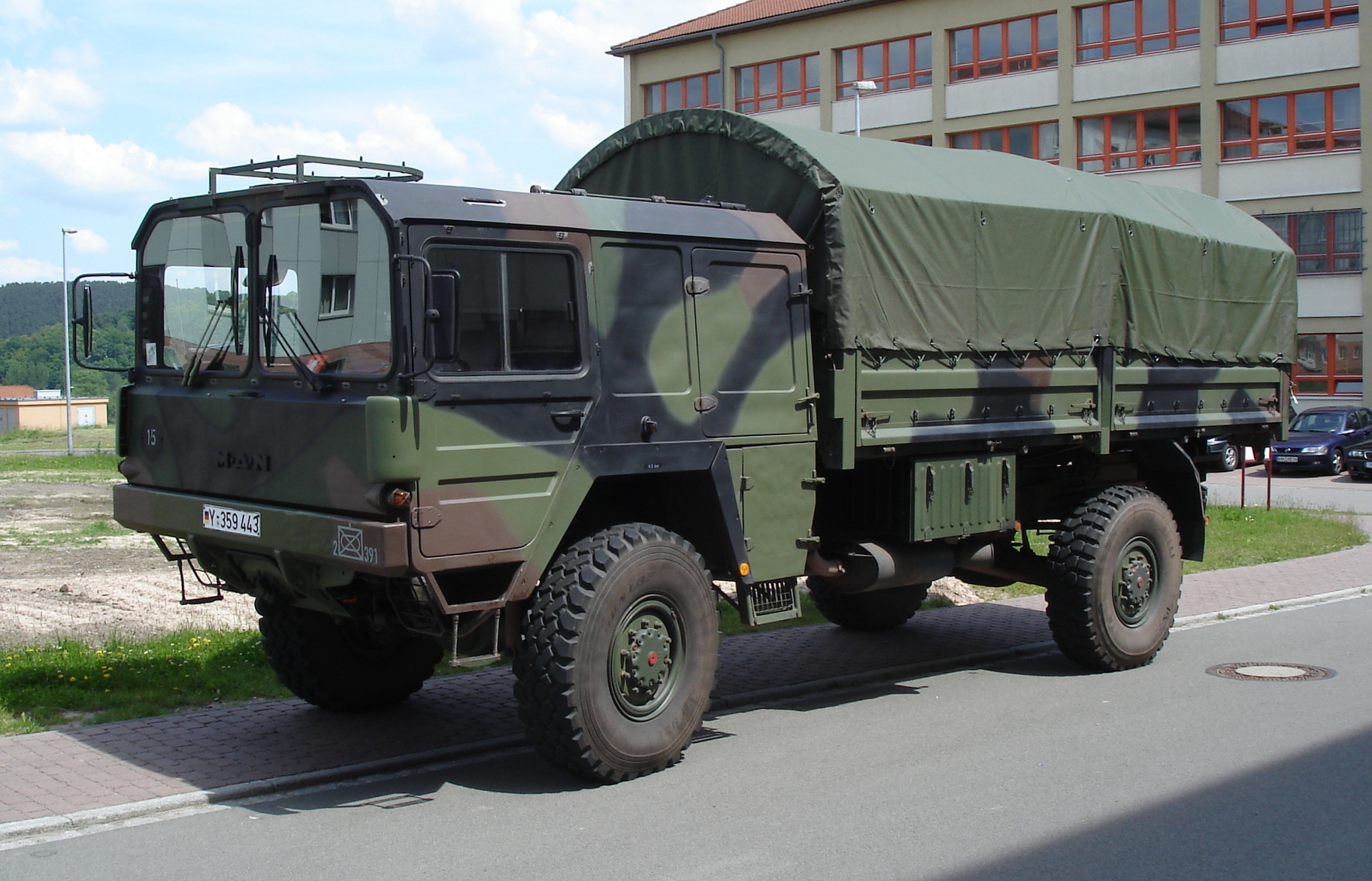
A MAN 7t mil gl MSA truck of the Bundeswehr

Introduced as the mil gl (for "militarisiert geländegängig" - military, cross country mobile), the MAN Category 1 series was used by all branches of the Bundeswehr. Militarisation includes a fully separate blackout lights circuit, a military instrument layout with blackout option, an emergency stop switch to cut electrical power, a roof hatch with machine gun mount, and rifle brackets.[2]

All Category 1 (and follow-on series) share a modular design. They have a torsionally rigid box-section chassis frame with rigid hub-reduction axles sprung by coil springs and shock-absorbers. The engine is mounted inside the forward-control cab, which is separated into a driver and engine compartment by a firewall. The engine is located to the rear of the driver compartment instead of beneath it to keep the overall height below 2.9 m and make the trucks rail-mobile on standard flatcars. The characteristic, cut-away corners of the otherwise box-shaped cab serve to keep dimensions within the railway loading gauge. The cab of early production examples does not tilt forward for maintenance because these vehicles were still based on the amphibious prototypes. The tilting cab was only introduced in the mid-80s.[2]

The KHD air-cooled diesel engine drives all axles via a torque converter, semi-automatic transmission and a transfer case, these components forming a single unit. The follow-on A1 series employed a far greater number of off-the-shelf standard truck components. For the extraterritorial deployment of the Bundeswehr, some vehicles were fitted with an additional modular armour (modulare Schutzausstattung, MSA) to increase crew protection.[2][1]

Category 2 (US military)

[edit]

The United States Army and the United States Air Force operated four derivations of the KAT 1 8x8, these known as Category 2 trucks and designated M1001, M1002, M1013 and M1014 by the US military.[5] Category 2 trucks were developed at the request of, and in close co-operation with, the US armed forces.

  • Truck Tractor w/Crane, 10-ton, 8X8 M1001 (NSN 2320-12-191-5422)
  • Truck Tractor w/Crane, 10-ton, 8X8, M1002 (NSN 2320-12-191-5423)
  • Truck Tractor w/Crane, 10-ton, 8X8, M1013 (NSN 2320-12-191-5424)
  • Truck Tractor w/o Crane, 10-ton, 8X8, M1014 (NSN 2320-12-191-5425)

The M1001 was used by the US Army as the prime mover for the Pershing II nuclear missile. The tractor was configured with a fifth wheel to tow the erector launcher, an Atlas Maschinen GmbH 8-ton crane for handling missile components and a 30 kW generator to power the erector launcher. The M1002 was configured as a recovery vehicle with a Rotzler recovery unit, earth spades, Atlas Maschinen GmbH AK4300 M5 crane, and carriers for two erector launcher spare tires.

The M1013 was used by the US Air Force as the prime mover for the Gryphon Ground Launched Cruise Missile (GLCM). The tractor was configured with a fifth wheel to tow the launcher, a 2-ton material handling crane and a self-recovery winch. The M1014 was also configured as a prime mover and had a tire carrier for a launcher spare tire.

By the end of 1986, 534 Category 2 trucks had been delivered to the US, with 157 delivered to France, and 42 to Canada.[1]

Category 3

[edit]

In a parallel development to the category 1, the so-called Category 3 trucks were developed. These are similar to the Category I vehicles, but are fitted with a cab from the MAN civilian truck range, modified for military use. A total of 1,594 Category 3 trucks were delivered to Algeria (280), Ireland, Oman (95), Peru (165), Singapore (104), Venezuela (405), and others including some commercial users.[1]

Category 1 A1 and 1 A1.1

[edit]

In April 1985 MAN presented the first of the revised Category I A1 models to the German Federal Office for Military Technology and Procurement (BWB) and to the Test Centre 41 facility. It was planned that there would be 35 test vehicles of all configurations, including an extra wide 8×8 version for the Patriot and Roland systems. Production of the new category vehicles began in 1987. The Category I A1 generation was a development of the Category I with improved performance on- and off-road owing to higher power output engines and an improved design of chassis and cab. Category 1 A1 included a new (as a direct replacement for the earlier Kat 1 10,000 kg) 15,000 kg 8×8 weight class.

From 1988, the Bundeswehr ordered 1,100 Cat 1A1 models. Category 1 A1 models developed from 1988 carry the Category 1 A1.1 designation. Category 1 A1 models used some commercial components from MAN's F90 range of heavy commercial trucks introduced in 1986, while the later Category 1A1.1 models were developed between 1988 and 1991 and were based on components from MAN’s F2000 range of heavy commercial trucks introduced in 1992.

From 1993 the Bundeswehr ordered about 500 MAN Category 1 A1.1 trucks. The MAN designation of SX range became prevalent for the Category 1 A1.1 in the early 1990s and was applied to final derivations of the category 1 product, these remaining in production as SX44 and SX45 until early 2019.[1]

A range of high performance airfield crash tenders were produced on the Cat 1 A1 extra-wide (2.9 m) chassis, and continued to be produced on the successor SX range 2.9 m wide chassis.[1]

[edit]

Bundeswehr replacement

[edit]

On 6 July 2017 Rheinmetall MAN Military Vehicles announced it had entered a framework agreement with the German Bundeswehr to supply 2271 MAN HX2 trucks under the Bundeswehr’s Unprotected Transport Vehicle (UTF) programme. UTF will replace the older Category 1 trucks. The contract award has a potential value of around EUR 900 million. An initial order for 558 trucks to an amount of around EUR 240 million was placed, including special tools and training support. Delivery was to take place during the 2018-2021 timeframe.[6] RMMV announced on 12 June 2019 that the Bundeswehr had placed an order with the company for a second batch of unprotected transport vehicles. The order called for 252 trucks (161 5-tonne and 91 15-tonne) and was valued at EUR 92 million. The 252 vehicles ordered were delivered during 2019 and deliveries followed those of the original 558 trucks ordered at contract signing, the delivery timeline for these expedited. A further 60 trucks were ordered in November 2019, and the most recent order to date was announced in December 2019. This order calls for 1,000 trucks and is valued at EUR 382 million after taxes. Of the latest order, 675 trucks are 5,000 kg payload and the remaining 325 are 15,000 kg payload. Production of this latest order commenced in January 2020, with delivery to be complete by the end of the year.

References

[edit]
Revisions and contributorsEdit on WikipediaRead on Wikipedia
from Grokipedia
The MAN KAT1 is a family of high-mobility off-road tactical trucks developed by the German manufacturer for military use, primarily serving the as versatile utility vehicles capable of transporting heavy loads across challenging terrains. Entering service with the West German Army in 1976, the KAT1 series was designed to provide reliable in tactical environments, with production from 1976 to 1981 yielding around 9,110 units and emphasizing durability and all-wheel-drive configurations to match the pace of armored units. The lineup includes 4×4, 6×6, and 8×8 variants, allowing adaptability for roles such as cargo transport, personnel carrying, and specialized equipment mounting, with the 8×8 model being the first produced for maximum payload and traction. Technical specifications highlight the KAT1's robust , featuring air-cooled Deutz V8 diesel engines—such as the F8L413F (12,675 cc, 256 hp) in the 4×4 variant or a turbocharged and intercooled version (320 hp) in the 6×6 and 8×8 variants—paired with manual ZF transmissions (6-speed) and permanent all-wheel drive with differential locks. capacities range from 5 tons (GVW 14,300 kg) in 4×4 models to 10 tons (GVW approximately 24,000 kg) in 8×8 configurations, with dimensions for the 8×8 variant measuring approximately 10.1 m long, 2.5 m wide, and 2.96 m high, offering a ground clearance of 0.41 m and top speeds of 80–90 km/h. Notable for its , options, and suspension, the KAT1 excelled in extreme off-road conditions, influencing subsequent designs like the MAN SX series while seeing limited exports and civilian conversions for expedition use post-military service.

Development and Production

Origins and Requirements

In 1962, the German identified the need for a new generation of high-mobility off-road to replace aging vehicles and support modern battlefield operations, envisioning a "pure " capable of following tracked armor across diverse terrains. This initiative stemmed from demands for robust logistics support, leading to the development of the KAT1 (Kategorie 1) family as a tactical series focused on transporting personnel, materials, , , and specialized equipment. The original requirements emphasized a modular family of vehicles in 4x4, 6x6, and configurations, with payload capacities of 5,000 kg, 7,000 kg, and 10,000 kg respectively, designed for extreme off-road performance and reliability in military applications. The tender process involved collaboration among major German manufacturers, including MAN, Magirus-Deutz, and , reflecting a unique industry effort during the to meet specifications for advanced tactical logistics. MAN emerged as the selected developer, with the program culminating in an initial order for 8,000 units placed by the in 1975, followed by procurement starting in 1977.

Manufacturing and Contracts

In December 1975, MAN was awarded a contract by the for the production of 8,385 KAT1 vehicles across 4×4, 6×6, and 8×8 configurations. Overall production totaled approximately 9,110 vehicles between 1976 and 1981. occurred primarily at MAN's and plants in , where assembly lines were optimized for high-volume output while adhering to rigorous military standards for durability and . Components, including early air-cooled diesel engines, were integrated from suppliers such as Klöckner-Humboldt-Deutz (KHD). A mid-1990s overhaul program extended the of existing KAT1 vehicles by up to ten years through comprehensive refurbishments. This effort facilitated a smooth transition to the successor series, whose production continued at similar facilities until early 2019.

Design and Technical Specifications

Chassis and Mobility Features

The MAN KAT1 employs a modular featuring a torsionally rigid box-section frame, allowing for adaptable configurations across its 4x4, 6x6, and variants while maintaining structural integrity under heavy loads and rough conditions. This frame supports rigid hub-reduction axles with suspension on all wheels, utilizing shock absorbers to provide long-travel articulation for superior off-road handling. Enhancing its tactical mobility, the KAT1 incorporates a (CTIS) that enables on-the-fly adjustments to pressure, optimizing traction and ride quality across diverse terrains such as , , or pavement. The vehicle's dimensions vary by configuration, with chassis lengths ranging from approximately 7.2 m for 4x4 models to 9.2 m for 8x8 variants, a consistent width of 2.5 m, and a ground clearance of about 0.4 m to navigate obstacles effectively. It demonstrates robust water-crossing capability with a fording depth of up to 1.2 m without preparation, and can climb slopes of 60% while traversing side slopes of up to 40%. For recovery operations, many KAT1 units are fitted with a front-mounted offering capacities of 5 to 8 tons, depending on the variant and mission requirements. The design prioritizes air-transportability, with 4x4 and 6x6 models compatible for sling-loading or internal carriage in C-130 Hercules aircraft, and all variants suitable for the larger C-160 Transall. Additionally, it features an overpressure system that maintains positive internal pressure via filtered air intake to protect occupants from chemical, biological, and radiological threats.

Engine and Performance

The MAN KAT1 series featured evolving configurations to meet requirements for reliability in diverse environments, centered on air-cooled Deutz V8 s. Early production models utilized a KHD Deutz F8L413F V8 air-cooled , producing 192 kW (260 hp) at 2,300 rpm with a maximum of approximately 760 Nm at 1,500 rpm. This air-cooled design provided excellent cold-weather starting capabilities, down to -35°C with inlet heating. Later models upgraded to the Deutz BF8L513C V8 air-cooled , offering power outputs up to 235 kW (320 hp) with turbocharging, and peak reaching up to 1,100 Nm at 1,200 rpm for enhanced low-end pulling power. The transmission system consisted of an 8-speed manual ZF gearbox with an integrated off-road reduction gear, enabling versatile operation across terrains. On-road top speeds reached 85-95 km/h, while off-road low-gear speeds were limited to 5-7 km/h for maximum traction and control. Fuel systems included diesel tanks with capacities of 400-600 liters, depending on the configuration, supporting an operational range of 600-800 km under typical loads. These specifications ensured sustained performance during extended missions, with optimized through direct injection and turbocharging. Reliability was a core design principle, with the engineered for annual service intervals up to 10,000 km in extreme conditions, including dust, mud, and temperatures from -50°C to +50°C. focused on modular components for quick field repairs, such as accessible filters and belts, minimizing downtime; the air-cooled engines required less frequent coolant checks. Overall, the system demonstrated high endurance, with documented service lives exceeding 500,000 km under use.

Variants

Category 1 (4x4)

The Category 1 (4x4) variant of the MAN KAT1 serves as the lightest configuration in the family, tailored for reconnaissance and light logistics duties, including roles as command vehicles and ambulances. Equipped with a 4x4 drive system, it offers a payload capacity of 5,000 kg and a gross vehicle weight rating of 14,300 kg, enabling it to support diverse superstructures such as cargo beds and radio mounts. Key dimensions include a length of approximately 8 m, width of 2.5 m, height of 2.86 m, and a wheelbase of 4.5 m, contributing to a curb weight of 8,500 kg that balances load-carrying potential with maneuverability. The chassis supports integration with towing hitches suitable for light artillery pieces up to 3 tons, enhancing its utility in forward support operations. Powered by a Deutz air-cooled V8 diesel engine (type F8L413) delivering 256 hp, the vehicle maintains compatibility with the family's general engine architecture for reliable performance across terrains. Production of the Category 1 spanned to , with an estimated 4,000 units built primarily for the , emphasizing its role in agile, low-volume transport needs. Its compact design excels in urban and trail environments, providing superior off-road mobility compared to heavier siblings, while achieving of around 25 L/100 km in demanding conditions.

Category 2 (6x6)

The Category 2 (6x6) variant of the MAN KAT1 represents the medium-duty configuration within the family, optimized for balanced mobility and load-carrying in off-road environments. This 6x6 setup provides enhanced traction over the lighter 4x4 model through three axles, with all wheels driven via planetary hubs, enabling it to handle demanding terrains while supporting a of approximately 7,000 kg. Powered by a Deutz air-cooled V8 (type BF8L513) delivering 320 hp, it serves primarily in roles such as general cargo transport, fuel tanker operations, and specialized transporter duties, where its robust accommodates modular bodies like tipper beds or towing setups. In dimensions, the 6x6 model typically features a of around 4 meters between the front and first rear , with an additional short span to the second rear for stability, resulting in an overall of about 8 meters for standard configurations. Curb weight varies by body type but is generally in the range of 11,000–12,000 kg for equipped versions, allowing for effective distribution without exceeding operational limits. Optional includes a front-mounted for self-recovery and a hydraulic crane capable of lifting up to 5 tons, enhancing its utility in field logistics and recovery tasks. This variant was integral to the initial production runs for the starting in the mid-1970s, forming a core component of the German military's high-mobility fleet alongside the 4x4 and categories. Such adaptations ensured compatibility with joint forces while retaining the core off-road capabilities derived from the base chassis design.

Category 3 (8x8)

The Category 3 () variant of the MAN KAT1 represents the heaviest configuration in the series, optimized for demanding tasks in rugged environments. This all-wheel-drive features an layout capable of carrying a standard of 10,000 kg, with gross rated at 24,000 kg. Designed primarily for the , it excels in transporting bulky equipment, ammunition, and construction materials over challenging terrain, distinguishing it from lighter variants by its superior load-bearing ability. Powered by a Deutz air-cooled V8 (type BF8L513C) delivering 360 hp, the design emphasizes reliability in military . Key to its mobility are the multi-axle dimensions and advanced steering system, including a wheelbase of 4.3 m between the first and second axles, plus 1.32 m extensions to the third and fourth axles, resulting in an overall length typically ranging from 9.8 to 10.5 m. The curb weight stands at approximately 14,000 kg, providing stability for off-road operations with a ground clearance exceeding 0.4 m and spring suspension on all axles. Power-assisted steering on the front axles, combined with optional configurations for the rear axles, enhances maneuverability despite the vehicle's size, allowing tight turning radii in confined or uneven areas. These features enable the truck to navigate forests, mud, and inclines while fully loaded, prioritizing reliability in military logistics. In practical applications, the model serves as a heavy , capable of semi-trailers with loads up to 30 tons for long-haul supply convoys across unprepared routes. Recovery vehicle subvariants incorporate a 20-ton hydraulic crane and system, facilitating the extraction of disabled armored vehicles or bridging equipment in forward areas. It emphasizes a cross-country speed of up to 50 km/h even under full , which underscores its role in sustaining rapid mechanized operations. For international applications, particularly with the military, the was adapted under designations like M1001, M1002, M1013, and M1014, with hundreds of units delivered between 1981 and 1986 to support NATO-aligned operations in . These -specific versions incorporated modifications to meet MIL-STD requirements, including standardized electrical connectors for with American systems, and were employed by the Army for missile transport as well as by the for towing units.

Upgrades and Subvariants

A1 and A1.1 Models

The A1 upgrade, introduced in with production starting in 1988, served as a mid-life enhancement to the MAN KAT1 series across its variants, focusing on improved components for greater reliability and expanded load-carrying capacity. This iteration incorporated upgraded engines, including water-cooled options with power outputs ranging from 235 kW (≈315 hp) in lighter configurations to higher ratings in heavier models, replacing earlier air-cooled Deutz units in many setups to boost performance and thermal management. Notable improvements included increasing the payload capacity to 15,000 kg for Category 3 () models (from 10,000 kg original), with minor gains such as up to 5,500 kg for Category 1 (4x4). Approximately 1,100 A1 units were produced for the (), emphasizing incremental improvements over the base design without a full redesign. The A1.1 subvariant, developed between 1988 and 1991 with orders starting in 1993, built on these advancements by incorporating components from MAN's commercial F2000 series to enhance maintainability and integrate modern features. Key updates included digital diagnostic systems for faster fault detection and reinforced frames to improve structural integrity under heavy off-road use. Production of the A1.1 extended into the late 1990s, with approximately 500 units supplied to the , featuring ergonomic cabin modifications like expanded stowage and optional removable roofs for better operator comfort. A mid-1990s overhaul program retrofitted numerous original KAT1 trucks with A1-level components, including enhanced anti-lock braking systems and updated water-cooled engines, to extend operational life into the and address wear from prolonged service. These upgrades prioritized reliability in extreme conditions, with reinforced braking for safer load handling and cabin redesigns for improved human-machine interface. In total, approximately 1,600 units across the A1 and A1.1 lines were produced, with additional retrofits benefiting the fleet and solidifying their role in German military logistics.

SX Iteration

The SX iteration, developed in the 1990s under designations like S2000 and formally launched in 2000, emerged as a modernized continuation of the series, incorporating a modular cab derived from the KAT1 design but extended by 290 mm in depth for enhanced operator space and over 600 liters of integrated stowage. This evolution emphasized improved cross-country performance through a robust boxed-section and optional crew protection features, with production spanning until early 2019 when the line was phased out in favor of the HX series. The series bridged the KAT1's legacy by integrating components from MAN's contemporary F2000 commercial lineup, ensuring sustained high-mobility logistics capabilities for applications. Key enhancements in the SX focused on and structural refinements, including more efficient D2066 10.5L engines (440 hp, compatible with emissions standards) offering better fuel economy compared to prior KAT1 variants, paired with ZF automatic transmissions. The 6x6 configuration (SX44) achieved a gross rating of approximately 25,000-30,000 kg depending on setup, enabling greater handling (14-16 tons) in demanding terrains while maintaining air-transportability by C-130 . Configurations preserved the KAT1's 4x4, 6x6, and 8x8 options but expanded to include protected variants, such as Level 3 ballistic- and mine-resistant cabs on models for high-threat environments, with a designed 30-year . Over 5,000 SX units were manufactured globally (exports to more than 13 countries), supporting roles from cargo transport to specialized recovery. The SX's transitional role was evident in export contracts, such as those awarded to the in the for and vehicles like the MAN SX 2000-based well-drilling units, which bolstered before the shift to the HX series. These developments built on A1-series upgrades for reliability but introduced broader modular adaptability across the lineup.

Operational History

Use by the Bundeswehr

The MAN KAT1 trucks entered service in 1977, forming the core of the German Army's high-mobility logistics fleet during the era. Stationed primarily in , they were designed for rapid mobilization to support NATO's forward defense posture against potential incursions, transporting personnel, ammunition, fuel, materials, and equipment shelters over rough terrain to keep pace with frontline units. Their air-cooled Deutz V8 engines and all-wheel-drive configurations enabled reliable integration with armored formations, including and main battle tanks as well as like the M109, ensuring sustained operational tempo in defensive scenarios. In the 1980s, the KAT1 provided critical support during major exercises such as REFORGER (Return of Forces to ), where thousands of vehicles simulated the reinforcement of European fronts by hauling supplies across simulated combat zones to test alliance interoperability and rapid deployment capabilities. Following , the trucks transitioned to post-Cold War roles. From the mid-1990s onward, the KAT1 supported peacekeeping efforts in the as part of 's IFOR (1995–1996) and SFOR (1996–2004) missions in , serving as base transport vehicles for troop movements, equipment delivery, and convoys amid post-conflict stabilization operations. In the , during the ISAF mission in , KAT1 trucks facilitated at forward operating bases like those in the north, enduring harsh desert conditions for resupply runs despite evolving threats. To address (IED) risks in these asymmetric environments, the introduced modular armor kits (modulare Schutzausstattung, MSA) on select units, enhancing cab protection against blasts and small-arms fire while maintaining mobility. Over decades of service, individual KAT1 vehicles have logged operational distances exceeding 1 million kilometers, underscoring their durability in diverse theaters.

International Users and Exports

The MAN KAT1 saw significant exports to various international militaries, primarily allies during the era, serving in logistics, transport, and specialized roles. The and Air Force adopted several variants of the 6x6 and 8x8 configurations, designated as M1001, M1002, M1013, and M1014, primarily for towing and transporting the ballistic missile in . Belgium acquired the MAN KAT1 in the 1980s for NATO commitments, with units integrated into its logistics fleet for high-mobility operations. The Belgian Army utilized these trucks in various configurations, including 4x4 and 6x6 models, before surplus vehicles entered the civilian market. employed Category 3 (8x8) variants for engineering tasks, enhancing its tactical mobility in joint NATO exercises. Other notable users include , which fielded units across its armed forces prior to adopting successor models; , where the 4x4 configuration served in recovery and transport roles; , which used 6x6 trucks in its defense inventory before donating some to starting in May 2022; and the , which incorporated SX-upgraded versions for continued service. Non-NATO operators encompassed (Category 3 units acquired in the 1980s), , , , and , with adaptations such as the U.S. M1001 highlighting the truck's versatility for missile transport. Post-2000 exports were limited due to the emergence of advanced successors like the MAN SX and RMMV HX series, resulting in deliveries to several countries overall.

Replacement and Legacy

Phase-Out in German Service

In 2017, the German initiated the phase-out of the MAN KAT1 truck fleet through the Unprotected Transport Vehicle (UTF) program, awarding a €900 million for 2,271 HX2 trucks to replace the aging Category 1 vehicles. The initial order under this agreement covered 558 vehicles at €240 million, with subsequent call-offs expanding deliveries to include 5-tonne and 15-tonne payload variants. This replacement addressed the KAT1's obsolescence, as the oldest units dated to 1976 and had exceeded 40 years of service in many cases, limiting their suitability for contemporary operations. Deliveries of the HX2 trucks commenced in 2018, with the first batch meeting accelerated production targets ahead of the planned 90 vehicles for that year. By late 2019, additional orders had been placed, including 1,000 more HX trucks worth €382 million, ensuring a steady transition as KAT1 units were withdrawn from front-line duties. To date, approximately 7,000 HX-series vehicles have been delivered to the as of August 2025. The HX2's superiority stems from its modern design, featuring upgradable protection kits that allow transformation from unprotected to armored configurations without significant payload loss, alongside enhanced digitization for integrated command and logistics systems. These improvements provide greater versatility and operational resilience compared to the KAT1, including higher up to 680 HP and compatibility with advanced mission equipment. As HX2 integration progressed, older KAT1 trucks underwent overhauls for interim use before disposal, with many excess units auctioned off through channels post-service . The full phase-out of the KAT1 from service is projected to complete between 2025 and 2030, aligning with ongoing HX deliveries. This timeline supports the Bundeswehr's modernization goals, retiring the KAT1 from primary logistics roles while retaining select units for secondary applications until HX2 stocks fully cover requirements.

Current Status and Civilian Use

As of 2025, the phase-out of the MAN KAT1 from active service is ongoing, with over 3,000 units still reported in service as of 2024, while the German military transitions to modern logistic vehicles such as the (RMMV) UTF family under multi-year contracts valued at hundreds of millions of euros. An order for approximately 1,400 unarmored tactical vehicles (UTVs) in 4x4 and configurations, valued at around €770 million and scheduled for delivery by the end of 2025, underscores this replacement effort as part of broader modernization initiatives. While exact reserve figures remain undisclosed, surplus units from have entered secondary markets, supporting ongoing international use. In export contexts, the MAN KAT1 remains operational with several foreign militaries, including the , where variants like the MAN 4610/4620/4640/4530 serve as standard utility trucks for and towing roles. These vehicles continue to provide reliable off-road capability in NATO-aligned forces, with no confirmed phase-out timelines beyond German service as of late 2025. Civilian applications have surged in popularity, particularly for expedition and overland travel conversions, where the KAT1's robust 4x4, 6x6, and 8x8 support custom camper builds capable of extreme . Enthusiast projects often involve integrating living quarters, solar systems, and storage for long-duration adventures, as seen in restorations of models documented by overland communities. Additionally, demilitarized units have been repurposed as fire trucks, leveraging the vehicle's high payload and all-wheel-drive for rugged emergency response in forestry and industrial settings. Preservation efforts focus on maintaining historical examples through enthusiast networks and specialized forums, where owners share restoration techniques for air-cooled Deutz engines and ZF transmissions common to early KAT1 . Aftermarket parts remain accessible via MAN dealerships in and third-party suppliers specializing in , ensuring longevity for non-military owners despite the cessation of new production in the 1990s. On the used market from 2020 to 2025, standard MAN KAT1 trucks typically sell for €20,000 to €50,000 in , depending on condition, mileage, and configuration, with converted expedition models commanding premiums up to €180,000. This affordability, combined with compatibility for upgrades from later MAN HX-series components, sustains interest among collectors and adventurers.

References

Add your contribution
Related Hubs
User Avatar
No comments yet.