Hubbry Logo
MAX232MAX232Main
Open search
MAX232
Community hub
MAX232
logo
8 pages, 0 posts
0 subscribers
Be the first to start a discussion here.
MAX232
MAX232
from Wikipedia

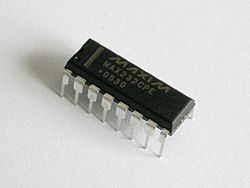
MAX232 chip in DIP-16 package
The die of a MAX232
MAX232 pinout: Red: power, Yellow: charge pump capacitors,
Blue: outputs, Green: inputs,
Pins 9–12: TTL/CMOS I/O voltages

The MAX232 is an integrated circuit by Maxim Integrated Products, now a subsidiary of Analog Devices, that converts signals from a TIA-232 (RS-232) serial port to signals suitable for use in TTL-compatible digital logic circuits. The MAX232 is a dual transmitter / dual receiver that typically is used to convert the RX, TX, CTS, RTS signals.[1]

The drivers provide TIA-232 voltage level outputs (about ±7.5 volts) from a single 5-volt supply by on-chip charge pumps and external capacitors. This makes it useful for implementing TIA-232 in devices that otherwise do not need any other voltages. The receivers translates the TIA-232 input voltages (up to ±25 volts, though MAX232 supports up to ±30 volts) down to standard 5 volt TTL levels.[1] These receivers have a typical threshold of 1.3 volts and a typical hysteresis of 0.5 volts.[1]

The MAX232 replaced an older pair of chips MC1488 and MC1489 that performed similar RS-232 translation. The MC1488 quad transmitter chip required 12 volt and −12 volt power,[2] and MC1489 quad receiver chip required 5 volt power.[3] The main disadvantages of this older solution was the ±12 volt power requirement, only supported 5 volt digital logic, and two chips instead of one.

History

[edit]

The MAX232 was proposed by Charlie Allen and designed by Dave Bingham.[4][5][6] Maxim Integrated Products announced the MAX232 no later than 1986.[1]

Versions

[edit]

The later MAX232A is backward compatible with the original MAX232 but may operate at higher baud rates and can use smaller external capacitors – 0.1 μF in place of the 1.0 μF capacitors used with the original device.[7] The newer MAX3232 and MAX3232E are also backwards compatible, but operates at a broader voltage range, from 3 to 5.5 V.[8][9]

Pin-to-pin compatible versions from other manufacturers are ICL232, SP232, ST232, ADM232 and HIN232. Texas Instruments makes compatible chips, using MAX232 as the part number.

Voltage levels

[edit]

The MAX232 translates a TTL logic 0 input to between +3 and +15 V, and changes TTL logic 1 input to between −3 and −15 V, and vice versa for converting from TIA-232 to TTL. (The TIA-232 uses opposite voltages for data and control lines, see RS-232 voltage levels.)

TIA-232 line type and logic level TIA-232 voltage TTL voltage to/from MAX232
Data transmission (Rx/Tx) logic 0 +3 V to +15 V 0 V
Data transmission (Rx/Tx) logic 1 −3 V to −15 V 5 V
Control signals (RTS/CTS/DTR/DSR) logic 0 −3 V to −15 V 5 V
Control signals (RTS/CTS/DTR/DSR) logic 1 +3 V to +15 V 0 V

Applications

[edit]
TIA-232 to TTL converters that use MAX232

The MAX232(A) has two receivers that convert from RS-232 to TTL voltage levels, and two drivers that convert from TTL logic to RS-232 voltage levels. As a result, only two out of all RS-232 signals can be converted in each direction. Typically, the first driver/receiver pair of the MAX232 is used for TX and RX signals, and the second one for CTS and RTS signals.

There are not enough drivers/receivers in the MAX232 to also connect the DTR, DSR, and DCD signals. Usually, these signals can be omitted when, for example, communicating with a PC's serial interface, or when special cables render them unnecessary. If the DTE requires these signals, a second MAX232 or some other IC from the MAX232 family can be used.

Derivatives

[edit]

The MAX232 family was subsequently extended by Maxim to versions with four transmitters (the MAX234) and a version with four receivers and four transmitters (the MAX248), as well as several other combinations of receivers and transmitters. A notable addition is the MAX316x which is able to be electrically reconfigured between differential 5 V (RS-422 and RS-485) and single-ended RS-232 albeit at reduced voltage.

References

[edit]
Revisions and contributorsEdit on WikipediaRead on Wikipedia
from Grokipedia
The MAX232 is a dual-channel line driver and receiver designed for converting TTL or logic levels to and from RS-232-compatible voltage levels, enabling interfaces compliant with EIA/TIA-232E and V.28/V.24 standards. It operates from a single +5V (±10% tolerance) and features an integrated circuit that generates the necessary ±10V bipolar voltages internally, eliminating the need for external bipolar power supplies, using an integrated that requires only four external capacitors. Introduced in the late by (now part of ), the MAX232 was pioneering as the first RS-232 transceiver to support single-supply operation through this technology, which doubled and inverted the input voltage to meet RS-232 requirements. This innovation significantly simplified for early personal computers, modems, and peripherals by reducing board space, power consumption, and component count compared to previous designs requiring ±12V or ±15V supplies. The device supports rates up to 200 kbps while driving capacitive loads as high as 2500 pF, and it includes two drivers and two receivers in a compact 16-pin package available in DIP, SO, and other formats. Operating over a range of 0°C to +70°C (with extended options to -55°C to +125°C), it has been widely adopted in applications such as multidrop networks, portable diagnostic equipment, and interface translation between logic levels and serial ports. Key enhancements in the MAX232 family include variants with shutdown modes for ultra-low power (as low as 5 µW) and integrated capacitors to further minimize external parts, making it a foundational component in legacy systems despite the shift toward USB and other modern interfaces. Its enduring legacy lies in democratizing connectivity for battery-powered and space-constrained devices, influencing subsequent generations of transceivers like the MAX3232 series.

Background

RS-232 Standard

The standard, formally designated as TIA/EIA-232-F, is an interface specification for asynchronous serial data transmission between (DTE), such as computers or terminals, and (DCE), such as modems. It establishes protocols for point-to-point communication over distances up to 50 feet, emphasizing electrical signaling, timing, and connector interfaces to ensure . Originating in 1960 from the Electronic Industries Association (EIA), the standard was initially developed to connect teletypewriters and early computers with modems, addressing the need for reliable data exchange in . Subsequent revisions, including RS-232-C in 1969 and the current TIA/EIA-232-F in 1997, refined its specifications without breaking , adapting it for broader use in data processing systems. Key electrical requirements include driver output signal levels of +5 V to +15 V for logic 0 (space) and -5 V to -15 V for logic 1 (mark), with receivers recognizing levels above +3 V or below -3 V to provide a 2 V noise margin. The standard also defines a common-mode voltage range of -7 V to +7 V for receivers to tolerate ground potential differences between connected devices. Typical data rates reach up to 20 kbit/s under standard conditions, using unshielded twisted-pair cabling with a maximum capacitance of 2500 pF. Connector types specified include the 25-pin D-subminiature DB-25 for full implementations and the reduced 9-pin DB-9 for common PC applications. These bipolar voltage levels, ranging from -15 V to +15 V, are incompatible with low-voltage digital logic environments like TTL (0 V to 5 V) or CMOS (0 V to 3.3 V), creating the need for voltage level converters to interface RS-232 with modern microcontrollers.

Role of Level Converters

The RS-232 standard specifies voltage levels of +5 V to +15 V for logic 0 (space) and -5 V to -15 V for logic 1 (mark), which are incompatible with the 0 V to 5 V signaling used in TTL and CMOS logic families commonly found in microcontrollers and digital circuits. This mismatch can lead to communication failures, signal misinterpretation, or even permanent damage to sensitive TTL/CMOS components when directly interfacing with RS-232 devices, as the negative voltages exceed the tolerance of low-voltage logic. To bridge this gap, level converters translate between TTL/CMOS and voltage domains, with two primary types: discrete transistor-based circuits and integrated solutions such as the MAX232. Discrete approaches typically employ individual transistors, resistors, and diodes to shift and invert signals, often requiring manual design for both positive and negative voltage generation. In contrast, integrated converters like the MAX232 consolidate drivers, receivers, and voltage generation into a single chip, supporting bidirectional communication. Integrated level converters offer significant advantages over discrete implementations, including simplified by operating from a single 5 V supply and incorporating on-chip charge pumps to generate the necessary bipolar voltages without external power rails. They also reduce overall component count, board space, and assembly complexity, making them ideal for embedded systems and portable devices. Prior to the advent of such integrated circuits in the late , RS- interfacing posed substantial challenges, particularly the need for separate positive and negative power supplies (typically ±12 V) to drive the required voltage swings, which increased system cost, size, and power consumption while complicating integration with single-supply TTL-based designs.

Operation

Charge Pump Mechanism

The MAX232 integrates a switched-capacitor to generate the bipolar voltage rails required for communication from a single +5V supply, eliminating the need for external voltage regulators. This circuit relies on four external 1µF to store and transfer charge efficiently. The comprises a for the positive rail and an inverter for the negative rail, driven by an internal oscillator. The functions in two alternating phases: during the charging phase, the flying (associated with pins C1+ and C1-) is connected across the +5V supply and ground, charging to VCC. In the transfer phase, switches reconfigure the flying in series with the supply, delivering charge to the positive reservoir and producing an output voltage of approximately V+ ≈ 2 × VCC - 2Vdiode, where VCC = 5V and Vdiode accounts for voltage drops across internal switching (typically 0.7V each), yielding typical outputs of +8.5V to +9V. The inverter operates in a complementary two-phase cycle using another flying (associated with pins C2+ and C2-). It first charges the flying to the positive rail voltage, then switches its to ground, transferring charge to the negative to generate V- ≈ -(2 × VCC - 2Vdiode), resulting in typical -8.5V to -9V outputs. These phases repeat continuously, with the oscillator ensuring synchronized switching between the doubler and inverter cycles to maintain stable rails. Efficiency is achieved through the capacitive nature of the design, which minimizes power loss during charge transfer, though some dissipation occurs due to switching and drops. The overall supply current remains low at up to 8mA under light load conditions.

Driver and Receiver Functions

The MAX232 features two independent drivers that convert TTL-compatible input signals to voltage levels. When the TTL input is high (typically 2V to 5V), the driver outputs a negative voltage corresponding to the RS-232 mark state (logic 1, ranging from -3V to -15V per the standard, with the device achieving a minimum of -5V). Conversely, a TTL low input (0V to 0.8V) produces a positive voltage for the RS-232 space state (logic 0, +3V to +15V, minimum +5V). These drivers are inverting in terms of signal polarity but preserve logical states, and they incorporate control limited to less than 30V/μs to ensure clean transitions and minimize . The two receivers in the MAX232 convert RS-232 input signals back to TTL-compatible outputs. The receiver input threshold is typically ±1.3V, with a hysteresis of 0.5V to prevent oscillations near the transition point, and it supports inputs up to ±30V for robust protection against overvoltages without requiring external diodes. A positive RS-232 input (space, logic 0) results in a TTL low output (0V), while a negative input (mark, logic 1) yields a TTL high output (5V), making the receivers non-inverting in logical terms. This design ensures compatibility with standard TTL/CMOS logic levels. The drivers support data rates up to 120 kbit/s while maintaining compliant RS-232 output levels, and the receivers support data rates up to at least 120 kbit/s. Internal logic includes inverting functionality for the drivers to match polarity requirements, with receivers providing direct TTL outputs; some variants feature an enable (EN) pin for shutdown mode to reduce power consumption. is enhanced by integrated protection circuits, eliminating the need for external components like diodes, and the charge pump supplies the necessary voltages for operation (as detailed in the Charge Pump Mechanism section).

Hardware Implementation

Pinout Description

The MAX232 is housed in a 16-pin (DIP) or small-outline (SOIC) package, with identical pin functions across both formats. The pinout supports dual drivers and receivers, along with the internal circuitry required for voltage level conversion from a single +5V supply. The following table details the standard pin assignments and their functions:
PinNameFunction
1C1+Positive terminal for external C1 in the
2V+Positive voltage output (+7V to +10V) from the
3C1-Negative terminal for external C1 in the
4C2+Positive terminal for external C2 in the
5C2-Negative terminal for external C2 in the
6V-Negative voltage output (-7V to -10V) from the
7T2OUTOutput for Transmitter 2 ( voltage level)
8R2INInput for Receiver 2 ( voltage level)
9R2OUTOutput for Receiver 2 (TTL/CMOS logic level)
10T2INInput for Transmitter 2 (TTL/CMOS logic level)
11T1INInput for Transmitter 1 (TTL/CMOS logic level)
12R1OUTOutput for Receiver 1 (TTL/CMOS logic level)
13R1INInput for Receiver 1 ( voltage level)
14T1OUTOutput for Transmitter 1 ( voltage level)
15GNDGround connection
16VCCPositive supply voltage input (+5V)
Pins are logically grouped by function: charge pump related pins (1, 2, 3, 4, 5, 6) handle voltage generation; pins (10, 11, 7, 14; 7 T2OUT, 14 T1OUT) manage TTL-to-RS-232 transmission; receiver pins (8, 9, 13, 12) handle RS-232-to-TTL reception; and power pins (15, 16) provide grounding and supply. In applications using only a single /receiver channel, unused inputs can be left unconnected to avoid floating states and ensure stable operation, while outputs can typically be left unconnected. The GND pin (15) must always be connected to system ground for proper referencing.

External Components and Circuitry

The MAX232 requires only four external capacitors to support its internal , which generates the ±9V to ±12V levels needed for signaling from a single +5V supply. These capacitors must be polarized if using electrolytic or types, with values of 1 µF for the standard MAX232 (rated at 16V or higher) to ensure reliable voltage doubling and inversion. The MAX232A variant, an improved version with lower power consumption, uses smaller 0.1 µF capacitors while maintaining compatibility and performance. In the typical circuit, the capacitors connect as follows: C1 (1 µF) between pin 1 (C1+, positive terminal) and pin 3 (C1-, negative terminal) for the stage; C2 (1 µF) between pin 4 (C2+, positive) and pin 5 (C2-, negative) for the inverter stage; C3 (1 µF) between pin 2 (V+) and pin 15 (GND), with the positive terminal at V+ to store the positive supply; and C4 (1 µF) between pin 6 (V-) and pin 15 (GND), with the positive terminal at ground to store the negative supply. The +5V supply connects to pin 16 (VCC), and ground to pin 15 (GND). Non-polarized capacitors can substitute if rated appropriately, but polarized ones must observe the indicated polarity to prevent damage. Optionally, a 1 µF should be placed between VCC (pin 16) and GND (pin 15), as close as possible to the IC, to filter power-supply noise and stabilize operation. For applications requiring additional ESD protection beyond the device's built-in ±2 kV rating, low-value series resistors (e.g., 22 Ω) can be inserted on the transmit and receive lines, though this is not essential for standard use. Effective PCB layout is crucial for performance; the traces to the capacitors (C1–C4) should be kept short (under 1 cm) and wide to minimize parasitic and resistance, reducing ripple on the generated voltages and preventing signal . Ground planes under the IC and capacitors further aid in noise suppression.

Specifications

Electrical Characteristics

The MAX232 operates from a single +5V supply, with an operating voltage range of 4.5V to 5.5V, enabling compatibility with standard TTL logic systems without requiring dual power rails. Key output voltage levels for the drivers conform to standards, providing a minimum swing of ±5V into a 3kΩ load, typically reaching ±8V, while using the recommended 1µF external capacitors to achieve ±5V minimum to ±7V under loaded conditions. Receiver outputs deliver a high level of at least 3.5V (VOH min at -1mA) and a low level of no more than 0.4V (VOL max at 3.2mA), ensuring reliable interfacing with TTL/ logic. Driver inputs accept TTL-compatible levels, with a maximum low input voltage (VIL) of 0.8V and a minimum high input voltage (VIH) of 2V. For receivers, the input thresholds are designed to switch around ±3V to meet EIA/TIA-232E specifications, with input protection up to ±30V. Supply current consumption is typically 8mA quiescent with no load, increasing to up to 15mA under loaded conditions or during transmission. Timing parameters support reliable operation at data rates up to 200 kbps, with driver transition times under 1µs ( minimum 6V/µs) and receiver delay typically 500ns. The device is rated for commercial operating temperatures from 0°C to 70°C, with industrial grade options from -40°C to 85°C and extended options to -55°C to 125°C; ESD protection is rated at 2000V using the .

Package Variants

The MAX232 integrated circuit is available in several 16-pin package variants, each suited to different integration needs in electronic designs. The primary options include the plastic (PDIP), narrow small-outline integrated circuit (NSOIC), and shrink small-outline package (SSOP), allowing compatibility with through-hole and surface-mount assembly processes. The 16-pin PDIP measures approximately 19.3 mm in length and 0.3 inches (7.62 mm) in width, with a lead pitch of 0.1 inches (2.54 mm), facilitating easy prototyping on breadboards and standard PCB sockets. In contrast, the NSOIC variant offers a compact of about 10 mm by 4 mm, with a finer lead pitch of 0.65 mm, ideal for space-constrained applications requiring . The SSOP provides an even denser layout, though specific dimensions align closely with NSOIC standards for high-density boards. These variations enable designers to select based on board real estate and manufacturing methods, with PDIP favoring reliability in low-volume or educational setups while surface-mount options like NSOIC and SSOP support automated assembly and . Thermal management is a key consideration across packages, with a maximum of 150°C to prevent degradation. For the PDIP, the junction-to-ambient thermal resistance is approximately 100°C/W, necessitating adequate airflow or heatsinking in high-power environments to maintain safe operating temperatures. NSOIC and SSOP exhibit similar thermal profiles but benefit from better heat dissipation on multilayer PCBs due to their smaller size and direct board contact. Lead-free, RoHS-compliant versions of the MAX232 in all primary packages became widely available in the mid-2000s, aligning with global environmental regulations and enhancing for modern lead-free processes. These compliant variants maintain full pin compatibility with earlier models, easing transitions in legacy designs.

History and Evolution

Development and Release

The MAX232 was invented by Products, a startup founded in , as one of its early breakthrough products that exemplified innovative analog integration. The device was proposed by Charlie Allen, who envisioned combining interface functions with on-chip power generation, and designed by Dave Bingham, who implemented the integration of a circuit directly with the drivers and receivers to generate the necessary ±10 V levels from a single +5 V supply, thereby eliminating the need for external bipolar power supplies. This approach addressed a key pain point in implementations, which previously required separate voltage converters and multiple components. The MAX232 was publicly announced in July 1986. Development of the MAX232 began in 1986, with design work led by Bingham building on focus on mixed-signal ICs. First engineering samples became available later that year, followed by full commercial release in February 1988. The IC quickly gained traction as a response to the expanding use of personal computers and peripherals in the late , where serial ports demanded reliable, low-power interfacing without complex external circuitry; it represented a pivotal shift toward compact, single-supply analog-digital mixed ICs suitable for embedded and PC applications. Early adoption was swift, with the MAX232 featured in hobbyist publications such as the June issue of Radio-Electronics, which highlighted its use in simple circuits for interfacing. By 1990, it had established itself as an industry standard for single-supply transceivers, widely incorporated into industrial equipment, computer peripherals, and development boards due to its reliability and ease of integration.

Versions and Derivatives

The MAX232 has seen several versions that refined its design for improved efficiency and integration. The MAX232A, introduced in the , supports smaller 0.1 µF external capacitors compared to the original's 1.0 µF requirement, enabling more compact circuit layouts and reduced costs while maintaining +5V operation and 200 kbps data rates. Similarly, the MAX232D variant also utilizes 0.1 µF capacitors for analogous space-saving benefits, with emphasis on compatibility in surface-mount applications. Derivatives in the MAX220–MAX249 family expanded functionality by varying channel configurations. The MAX234 provides four transmitters without receivers, suitable for unidirectional applications, operating at +5V with 1.0 µF capacitors and up to 120 kbps. The MAX235 integrates capacitors internally, eliminating external components for five drivers and five receivers, and supports +5V ±5% supply with 120 kbps rates. The MAX202 enhances ESD protection and reduces power consumption to as low as 5 µW in shutdown mode, using 0.1 µF capacitors at +5V and guaranteeing 64 kbps (up to 120 kbps). Later derivatives like the MAX3232 addressed evolving power constraints, operating from 3.0V to 5.5V supplies with two drivers and two receivers, achieving up to 250 kbps data rates and 1 µA shutdown current using 0.1 µF . These improvements stem from drivers such as minimized sizes for board space efficiency, support for 3V logic in portable devices, and increased speeds up to 1 Mbps in advanced family members to meet higher-bandwidth needs. Originally developed and released by in 1988, the MAX232 was second-sourced by starting around 1989 for broader availability, and production transitioned to following its 2021 acquisition of Maxim. While the original MAX232 remains in production for legacy support, it has been largely superseded in new designs by these lower-voltage and more efficient derivatives.

Applications

Common Uses

The MAX232 is primarily used to interface microcontrollers such as the 8051 and PIC families with personal computers via serial ports, enabling tasks like , firmware programming, and data transfer in embedded systems. This level-shifting capability allows TTL/ logic signals from the microcontroller's UART to be converted to compliant voltages, facilitating reliable communication without additional power supplies. In industrial applications, the MAX232 connects peripheral devices like sensors, GPS modules, and barcode readers to central control systems, supporting data acquisition and automation in environments requiring robust serial interfaces. For instance, it enables GPS receivers outputting NMEA data over RS-232 to integrate with microcontroller-based controllers for location tracking in logistics or navigation systems. Similarly, barcode scanners in manufacturing setups use the MAX232 to transmit decoded data to supervisory computers or PLCs, ensuring compatibility with legacy RS-232 protocols. The device provides legacy support in systems such as modems, terminals, and scientific instrumentation that adhere to standards, where it maintains compatibility for ongoing maintenance or upgrades without overhauling communication infrastructure. Its role in these applications stems from the need for voltage conversion to meet EIA/TIA-232E specifications in established equipment. A key advantage of the MAX232 in battery-powered devices is its operation from a single +5V supply, which simplifies design and reduces power consumption to around 8mA typical, making it suitable for portable diagnostics and hand-held equipment. This feature has contributed to its widespread adoption as a standard component in early RS-232 shields, where it provides serial connectivity for prototyping and hobbyist projects.

Integration Examples

One common integration scenario involves establishing a basic serial link between a unit (MCU) and a PC, enabling data exchange such as debugging output or command control. In this setup, the MCU's transmit pin (TX) connects to the MAX232's T1IN (pin 11), while the receiver output R1OUT (pin 12) links to the MCU's receive pin (RX); the T1OUT (pin 14) and R1IN (pin 13) then interface with the PC's port via a DB-9 connector, with ground shared between devices. External capacitors rated at 1.0 µF (for C1 through C4, polarized electrolytic or non-polarized ceramic) are connected as per the configuration: C1 between pins 1 and 3, C2 between pins 4 and 5, and so on, powered by a single +5V supply to generate the required ±9V to ±12V levels. rate matching is essential, typically set to 9600 bps in both the MCU (e.g., via UART configuration registers) and PC terminal software, supporting reliable half-duplex communication up to 200 kbps over short cables without hardware adjustments. For full-duplex operation or hardware flow control, the MAX232's dual driver-receiver pairs can be utilized to handle simultaneous bidirectional data flow or control signals, such as in bidirectional sensor logging or systems. The first channel follows the basic setup (T1IN to MCU TX, R1OUT to MCU RX, T1OUT to PC RX, R1IN to PC TX), while the second channel is typically used for flow control: T2IN (pin 10) connects to MCU GPIO for RTS assertion, T2OUT (pin 7) to PC CTS; PC RTS connects to R2IN (pin 8), and R2OUT (pin 9) to MCU GPIO for CTS detection. The same 1.0 µF capacitors are shared across the . This configuration maintains the 9600 bps rate or higher (up to 200 kbps) through software UART settings, ensuring compatibility with legacy PC ports while avoiding the need for additional hardware flow control lines in simpler designs. Troubleshooting MAX232 integrations often centers on power supply and component issues that disrupt voltage generation. A frequent problem is reversed capacitor polarity in the charge pump (if using electrolytic types), leading to no voltage swing on the driver outputs (T1OUT, T2OUT) as V+ (pin 2) and V- (pin 6) fail to reach ±5V minimum; receiver outputs (R1OUT, R2OUT) remain unaffected by the charge pump—verifying polarity with a and using non-polarized alternatives resolves this. Insufficient decoupling, such as omitting a 0.1 µF ceramic capacitor from VCC (pin 16) to ground, can introduce noise causing erratic levels or intermittent communication; adding this bypass near the IC mitigates supply ripple. Always measure V+ and V- to confirm they reach at least ±5V minimum, typically ±9V to ±10V (unloaded), as cable capacitance exceeding 2500 pF at higher rates may degrade performance. While modern designs may favor USB-to-serial adapters for plug-and-play connectivity and higher speeds, the MAX232 remains suitable for low-cost implementations requiring legacy compatibility, such as industrial equipment or battery-powered devices where single +5V operation simplifies powering without USB enumeration overhead. It excels in scenarios needing robust noise immunity over longer cables (up to 50 feet) due to its ±5V minimum signaling, unlike USB's sensitivity to grounding issues, though USB is preferred for new portable systems to avoid DB-9 connectors. For isolated applications, MAX232 can interface with optocouplers on the MCU side to enhance in noisy environments. Software configuration plays a key role in seamless integration, particularly baud rate setup, which is handled entirely in the MCU's UART module (e.g., setting prescaler and mode for 9600 bps at 16 MHz clock) without altering the MAX232 hardware, allowing flexible adaptation to PC-side tools like HyperTerminal or . This approach ensures parity, stop bits (typically 8N1), and flow control match the standard, minimizing errors in data transmission.

References

Add your contribution
Related Hubs
User Avatar
No comments yet.