Hubbry Logo
Maharashtra State Road Transport CorporationMaharashtra State Road Transport CorporationMain
Open search
Maharashtra State Road Transport Corporation
Community hub
Maharashtra State Road Transport Corporation
logo
7 pages, 0 posts
0 subscribers
Be the first to start a discussion here.
Maharashtra State Road Transport Corporation
from Wikipedia

The Maharashtra State Road Transport Corporation abbreviated as (MSRTC, or simply ST),[7] is the state-run bus service of Maharashtra, India, which serves routes to towns and cities within Maharashtra as well as to its adjoining states. It also offers a facility for online booking of tickets for all buses.[8] Recently from 21 May 2020, the Corporation started goods transportation, private bus body building, and private vehicle tyre remoulding.[9] In the future, the Corporation plans to start petrol pumps for private vehicles all over the Maharashtra.[10]

Key Information

History

[edit]

The Maharashtra State Road Transport Corporation was established by the State Government of Maharashtra as per the provision in Section 3 of RTC Act 1950. The MSRTC operates its services by the approved scheme of road transport published vide Notification MVA 3173/30303-XIIA dated 29 November 1973 in the official gazette. The area covered by the scheme is the entire area of the state of Maharashtra. The undertaking is operating stage and contract carriage services in the entire area of the state of Maharashtra except S.T. undertaking defined under Section 68 A (b) of M. V. Act and other exceptions published in the scheme. The first bus was flagged off from Pune to Ahmednagar in 1948.[11][12]

In the 1920s, various entrepreneurs started operations in the public transport sector. Till the Motor Vehicle Act came into being in 1939, there were no regulations monitoring their activities which resulted in arbitrary competition and unregulated fares. The implementation of the Act rectified matters to some extent. The individual operators were asked to form a union on defined routes in a particular area. This also proved to be beneficial for travellers as some sort of schedule set in; with a time table, designated pick-up points, conductors, and fixed ticket prices. This was the state of affairs till 1948, when the then Bombay State Government, with the late Morarji Desai as the home minister, started its own state road transport service, called State Transport Bombay. And, with this, the first blue and silver-topped bus took off from Pune to Ahmednagar.[11][12]

There were 10 makes of buses in use then – Chevrolet, Ford Motor Company, Bedford Vehicles, Seddon Atkinson, Studebaker, Morris Commercial, Albion Motors, Ashok Leyland, Commer and Fiat. In the early 1950s, two luxury coaches were also introduced with Morris Commercial Chassis. These were called Neelkamal and Giriyarohini and used to ply on the Pune-Mahabaleshwar route. They had two by two seats, curtains, interior decoration, a clock, and green tinted windows.[11][12]

In 1950, a Road Transport Corporation Act was passed by the Central Government which delegated powers to states to form their individual road transport corporations with the Central Government contributing one-third of the capital. The Bombay State Road Transport Corporation (BSRTC) thus came into being, later changing its name to MSRTC with the re-organization of the state.[11][12]

The ST started with 30 Bedford buses having wooden bodies, coir seats. The fare charged on the Pune-Nagar route was nine paisa. With time, the S.T. buses underwent many changes, including increasing the seating capacity from the original 30 to 45 to the present 54, introduction of all-steel bodies to replace wooden bodies to make them stronger and cushion seats for more comfort. Later, in 1960, aluminium bodies were introduced as steel corrodes, especially in coastal areas, and the colour code also changed to red from the blue and silver. A partial night service was launched in 1968; the overnight service about a decade later and the semi-luxury class came into being during the 1982 Asian Games.[11][12]

The S.T. buses are also used for transportation of the postal mail, distribution of medicines, newspapers and even tiffins sent by people from rural areas to their relatives in cities. They also are used to transport agricultural goods to cities.[12]

Fleet

[edit]
Bus Type No.of Bus
Ordinary Bus 13000
City Bus 100
Semi Luxury(Hirakani) 450
Midi Bus 30
Shivneri-Ashwamedh(volvo & Scania) 110
Shivshahi AC Seater 1070
Ordinary Sleeper Seater 200
Non AC Sleeper 100
Shivai Electric 50
Shivneri- Electric 30

MSRTC is operating a fleet of approximately 15,512 buses that ferry 8.7 million passengers daily.[11]

MSRTC Premium buses

The Ordinary, Parivartan, Asiad and City Buses are built at MSRTC's in-house workshops at Pune city, Aurangabad, and Nagpur on Ashok Leyland and TATA chassis. These workshops produce as many as 20,000 buses per year on average. The corporation has nine tyre retreading plants along with 32 divisional workshops.[13] The Shivneri air-conditioned bus service consists of Volvo 9400R and Scania Metrolink buses.[14] The Shivshahi buses are air-conditioned luxury buses which are operated by MSRTC and some private contractors.[15]

In 2018, MSRTC added approximately a 1,000 special non-AC Vithai buses, which were introduced to ferry passengers to the pilgrim town of Pandharpur in Solapur district. They have a seating capacity of 45 seats and a similar design to that of 'Parivartan' buses.[16]

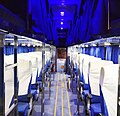
In 2019, the MSRTC introduced new non-air-conditioned buses with beds and recliner chairs specially designed for long overnight routes. Extra facilities like reading lamp, night lamp, charging point, fan and two huge storage compartments have also been provided.[17]

MSRTC’s first electric bus 'Shivai' that plies from Pune to Ahmednagar was flagged from Pune in presence of the then Deputy Chief Minister Ajit Pawar and the then state Transport Minister Anil Parab on 1 June 2022. MSRTC would get 50 electric buses in July 2022 which will be deployed from Pune to four cities — Nashik, Solapur, Kolhapur and Sambhajinagar.

In 2024 MSRTC gave contract to Ashok Leyland for procurement of 2000 non A/c ordinary buses(Lalpari). MSRTC plans to induct 300 buses per month in the fleet from March 2025.

Passengers will be able to know the live location of ST buses through a new mobile app developed by ST Corporation [1] Archived 11 January 2025 at the Wayback Machine

Services

[edit]

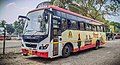
Ashwamedh

Ashwamedh bus

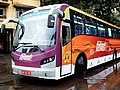
Shivneri

E-Shivneri (electric)

Shivai (electric)

Shivshahi AC

Non AC Sleeper Seater

Hirkani ( asiad or semi luxury)

City Bus

Ordinary Express ( Vithai or MS Bus )

Ordinary ( school bus or Kumbhamela bus)

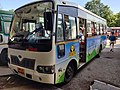
Midi Bus ( Yashwanti or Bhimashankar bus )

List of Bus Depots, Bus Stands & Traffic Controll Cells

[edit]
-Divisions-
Mumbai Pune Nashik Ch. Sambhajinagar Amaravati Nagpur
Palghar Kolhapur Jalgaon Beed Akola Bhandara
Thane Sangli Dhule Nanded Buldhana Chandrapur
Raigad Satara Ahilyanagar Parbhani Yavatmal Wardha
Ratnagiri Solapur Jalna
Sindhudurg Dharashiv
Latur

NathJal

[edit]

On Monday, November 2, 2020, MSRTC has launched 'Nathjal' with a focus to provide low-cost and pure potable water to the commuters.[18] The bottled water will be available at the bus stations for INR 10 and 15, and a private company based out of Pune has been selected for bottled water supply. The new initiative was inaugurated by Transport Minister and President of ST Corporation Adv. Anil Parab.


The corporation plans to sell the drinking water at every bus stand of the corporation. Talking about the same, he said, "The bottled water of other companies cannot be sold on ST stands. The MSRTC has taken the responsibility of making quality water available to the passengers at affordable rates." Over the decades, Maharashtra has seen a great tradition of Warkari sector, whereby the Guru is called 'Nath'. Sharing more, Minister Parab said that the official bottled drinking water being named 'Nathjal' is a moment of honour for Maharashtra.

Which aims to increase its revenue. 

2021–22 strike

[edit]

During the COVID-19 lockdown in India which started in March 2020, MSTRC was unable to process salaries of employees for many months. Salaries of nearly 90,000 employees were held up for 3–4 months, leading to few employees committing suicides finding it difficult to meet their needs. Employees put in various demands in front of the then Maharashtra government; like pay hike, remunerations for losses and also to consider merger of MSTRC with state government by which benefits of state government would get extended to the employees of MSTRC. With failure to reach any conclusion on demands; over 92,600 employees of MSTRC went on strike from 27 October 2021.[19][20][21]

[edit]

References

[edit]
[edit]
Revisions and contributorsEdit on WikipediaRead on Wikipedia
from Grokipedia
The Maharashtra State Road Transport Corporation (MSRTC) is a state government-owned entity established under the Road Transport Corporations Act, 1950, to provide public bus services across Maharashtra, India, encompassing intra-state routes, interstate connections to neighboring regions, and specialized services like luxury coaches and rural feeders. Formed in 1960 through the merger of operations from the former Bombay State Road Transport Corporation with segments from Madhya Pradesh and Hyderabad state undertakings following Maharashtra's creation, it operates as the state's principal road passenger transport provider in the public sector. With a fleet averaging approximately 15,800 buses as of fiscal year 2024-25, managed from 598 depots and bus stands employing over 86,000 personnel, MSRTC facilitates connectivity for millions of daily passengers, spanning urban hubs like Mumbai and Pune to remote rural areas, though its aging infrastructure and slow modernization have drawn criticism. MSRTC's defining characteristics include a diverse array of bus types, from ordinary non-AC services to premium AC sleepers like Shivneri and Ashwamedh, catering to varying passenger needs and promoting accessibility in a state where road transport dominates due to terrain and population density. Notable achievements encompass maintaining India's largest state-run bus fleet by operational scale, enabling economic integration of underserved regions through subsidized fares and extensive route coverage exceeding traditional rail networks in reach. However, persistent controversies highlight financial distress, with accumulated losses surpassing ₹10,300 crore by FY 2023-24, stemming from high operational costs, competition with unregulated private operators, procurement irregularities, and strikes disrupting services, underscoring challenges in sustaining public monopoly amid market pressures. Recent initiatives, including plans to induct 3,500 new buses in 2025 and scrap obsolete vehicles, aim to address fleet deficiencies and enhance reliability, yet implementation lags reveal systemic inefficiencies in state enterprise management.

History

Establishment and Early Operations (1950s–1970s)

The Maharashtra State Road Transport Corporation (MSRTC) originated from state-led nationalization of road passenger services in the former Bombay Presidency, with the inaugural government bus service launching on the Pune-Ahmednagar route on June 1, 1948, marking the onset of organized public transport to supplant unreliable private operators. The Road Transport Corporations Act, 1950, provided the legal framework for incorporating state-level entities to integrate disparate private fleets, district services, and ad hoc operations into a monopolistic structure focused on route rationalization, fare uniformity, and service reliability amid post-independence infrastructure deficits. Initially operating as the Bombay State Road Transport Corporation, it managed 81 routes with a fleet of 120 buses and capital investment of Rs. 17.77 lakhs by late 1948, prioritizing connectivity in underserved rural areas where private competition had led to inconsistent coverage and exploitative pricing. Following Maharashtra's formation on May 1, 1960, the corporation transitioned to MSRTC, absorbing operations within the state's boundaries and excluding Gujarat's share, thus establishing a unified entity under state control to address fragmented transport in a linguistically reorganized territory. Early fleet composition included diverse models such as Chevrolet, Bedford, Leyland, and Fiat buses, totaling around 10 vehicles initially, with expansions emphasizing durability for Maharashtra's varied terrain from coastal plains to the Western Ghats. By the early 1950s, MSRTC introduced limited luxury coaches like Neelkamal and Giriarohini on Morris Commercial chassis for premium inter-city routes, signaling initial efforts to differentiate services while core operations targeted mass rural-urban linkages to Mumbai, Pune, and Nagpur. Through the 1960s and 1970s, MSRTC's monopoly enabled systematic route extensions into remote villages, fostering economic integration by enabling agricultural produce transport and labor mobility without the inefficiencies of private duplication or under-servicing. This phase saw fleet augmentation to support growing demand, though exact volumes reflected broader state transport trends where road passenger services expanded to counter rail limitations in peripheral regions. The corporation's state-backed model ensured subsidized access for low-income rural populations, causally linking improved connectivity to localized market access, albeit constrained by mechanical reliability issues and fuel dependencies of the era's vehicles.

Expansion and Peak Performance (1980s–2000s)

During the 1980s, the Maharashtra State Road Transport Corporation (MSRTC) significantly expanded its operations to meet rising demand from urbanization and rural connectivity, growing its fleet from an average of 10,028 buses in 1981–82 to around 14,500 by 1983. This scaling supported an increase in route coverage, reaching approximately 80,000 kilometers by 1989–90, which facilitated essential links between rural agricultural areas and urban markets, enabling efficient transport of produce such as cotton and sugarcane from regions like Vidarbha and Marathwada. Express services, mandated for routes exceeding 192 kilometers since 1959 but augmented in frequency during this period, played a key role in handling longer-haul traffic, contributing to annual passenger-kilometers of about 9.5 billion by 1989–90. Into the 1990s and early 2000s, fleet strength continued to rise to over 17,000 buses by 1997, approaching 15,000 by the decade's end and sustaining daily carriage of 5–7 million passengers through dense rural-urban networks. Depot infrastructure expanded alongside, with the corporation organized into 15 operating divisions by the late 20th century, enhancing maintenance and service reliability across Maharashtra's diverse terrain. This peak era saw MSRTC achieve high vehicle utilization, with buses averaging substantial daily kilometers, bolstering economic activity by providing affordable access that supported agricultural output transport and commuter flows to industrial hubs like Mumbai and Pune. Despite robust demand, bureaucratic constraints emerged, including state-mandated fare controls under the Motor Vehicles Act that kept rates below operational costs to fulfill social objectives, fostering dependency on government subsidies and gradual productivity declines noted in analyses of state transport undertakings during the 2000s. These rigidities limited revenue generation even as passenger volumes peaked, highlighting early tensions between service expansion and financial sustainability in a subsidized public model.

Recent Developments and Crises (2010s–Present)

In May 2020, amid sharp passenger revenue declines triggered by COVID-19 lockdowns, MSRTC launched goods transportation services using converted surplus buses and dedicated trucks, initially hauling commodities like mangoes from Ratnagiri to Mumbai. This pivot generated ₹56 crore in its debut year through 1,150 vehicles moving over 700,000 tons of freight, with cumulative earnings reaching ₹101.93 crore by September 2022 despite ongoing pandemic constraints. To further diversify, the corporation entered private bus body building and tyre remoulding operations, leveraging existing workshops for ancillary revenue amid stalled core passenger services. The 2020–2022 lockdowns decimated ridership, enforcing near-total operational halts and delaying recovery even as cases subsided, with revenue rebound hampered by inflexible state-mandated routes and staffing unlike nimbler private intercity operators that pivoted faster to essential services. MSRTC's exposure revealed entrenched vulnerabilities, including dependency on subsidized fares and underutilized aging assets, which amplified losses beyond mere external disruptions. Fleet renewal efforts advanced in July 2024 with orders for 2,475 diesel buses, primarily Ashok Leyland Viking models, expanding operations from roughly 16,000 to 18,500 vehicles to address demand surges and breakdown rates. A June 2025 white paper documented accumulated losses ballooning 124% to ₹10,324 crore by FY24 from ₹4,603 crore in FY19, tying the spike to lockdown-induced halts but underscoring causal factors like obsolete buses, persistent loss-making routes, and inadequate fleet turnover—issues predating the pandemic and signaling operational rigidities unmitigated by diversification alone.

Organizational Structure

Administrative Divisions and Governance

The Maharashtra State Road Transport Corporation (MSRTC) operates under the oversight of the Government of Maharashtra's Transport Department, with its Board of Directors constituted in accordance with the Road Transport Corporations Act, 1950. The board comprises one Chairman—often a state minister or political appointee, such as Pratap Sarnaik appointed in April 2025—a Vice-Chairman and Managing Director (VCMD) who serves as the chief executive officer, and up to 17 other directors, including government nominees from state and potentially central levels. This structure ensures direct ministerial influence on strategic decisions, including fleet procurement and route approvals, though it has been critiqued for introducing political delays in operational reforms. Administratively, MSRTC is organized into six regional divisions—Mumbai, Pune, Nashik, Chhatrapati Sambhajinagar, Nagpur, and Amravati—established or restructured as of mid-2025 to enhance decentralized planning while maintaining central oversight. Each region is headed by a regional manager who reports to the VCMD at the central office in Mumbai, supervising multiple sub-divisions such as Thane, Palghar, and Raigad under Mumbai. These regions collectively manage around 252 depots statewide, coordinating traffic control cells for route scheduling and compliance. Decision-making follows a hierarchical model where regional managers handle local depot operations and minor adjustments, but major policies—like fare revisions or infrastructure investments—require board approval and state cabinet concurrence, reflecting the state-owned enterprise's emphasis on accountability to elected officials over market-driven agility. This framework, while providing uniform standards across Maharashtra's diverse geography, has empirically contributed to slower responses to fiscal pressures, as evidenced by prolonged negotiations on loss-making routes.

Workforce Composition and Management

The Maharashtra State Road Transport Corporation (MSRTC) maintains a workforce of approximately 102,000 employees, including drivers, conductors, administrative personnel, and maintenance staff, supporting operations across its extensive network. This figure reflects a slight reduction from prior peaks exceeding 100,000, amid efforts to address fiscal pressures, though the ratio of staff to buses—historically over 5 employees per vehicle—indicates persistent overstaffing relative to operational scale. High personnel numbers directly inflate costs, with staff expenses forming the largest component of total outlays, surpassing fuel and maintenance in budget allocations. Salary expenditures for FY 2024-25 are budgeted at Rs 5,315.72 crore, representing over 40% of projected total costs and underscoring how workforce remuneration drives the corporation's structural deficits. These costs stem from wage structures aligned with state government scales, frequently revised upward through union pressures, which prioritize pay parity over efficiency metrics. For instance, bus drivers on key routes like Mumbai-Pune typically earn take-home pay of approximately ₹22,000–₹32,000 per month at MSRTC, with higher figures up to ₹50,000 for experienced drivers or those operating premium services such as Volvo buses; private operators often provide ₹25,000–₹35,000 or more, influenced by trip incentives, overtime, and bus type. Overstaffing exacerbates this, as surplus personnel dilute per-employee productivity, with MSRTC's staff-to-output ratios lagging those of private bus operators who achieve higher load factors and revenue per vehicle through leaner staffing. Trade unions, numbering around 11 major affiliates, dominate labor negotiations, leveraging collective leverage to secure hikes often synchronized with electoral or seasonal demands, such as pre-festival concessions. In September 2024, for example, unions extracted a Rs 6,500 monthly basic pay increase retroactive to April 2020 following agitation, illustrating how political responsiveness overrides fiscal sustainability in bargaining outcomes. Management contends with resultant absenteeism and motivational shortfalls, as rigid hierarchies and union vetoes hinder performance incentives, perpetuating productivity gaps evident in MSRTC's lower operational efficiency compared to privatized competitors. This dynamic sustains a cycle where labor costs, untethered from revenue growth, amplify accumulated losses exceeding Rs 10,000 crore.

Fleet and Infrastructure

Bus Fleet Composition and Modernization

The Maharashtra State Road Transport Corporation (MSRTC) operates a fleet of approximately 15,560 buses as of the 2024-25 fiscal year, comprising primarily ordinary non-air-conditioned express buses suited for short- and medium-haul rural and inter-city routes, alongside smaller proportions of semi-luxurious models such as Hirkani (2+2 seating with push-back recliners) and Asiad (non-AC semi-luxury with enhanced seating), and premium air-conditioned variants including Shivneri (AC recliner coaches) and Shivshahi (AC seater-sleeper combinations). Ordinary buses form the bulk of the composition, optimized for high-volume passenger loads but prone to higher wear from intensive usage on varied terrain. The fleet's average age exceeds eight years for a significant portion, with many vehicles accumulating over 6.7 kilometers, contributing to elevated breakdown rates and maintenance downtime that averages higher than in younger private-sector fleets, where operators typically retire buses earlier to minimize disruptions. This ageing profile results in productivity losses, as older buses require extended repair intervals—often 20-30% more than new inductees—exacerbating service unreliability amid rising passenger demand. Modernization initiatives prioritize capacity expansion through diesel bus acquisitions, including work orders for 2,475 new ordinary and semi-luxury diesel models issued in July 2024 from manufacturers like Ashok Leyland, aiming to elevate the fleet toward 18,500 vehicles by addressing shortages from pandemic-era retirements. Further, MSRTC plans to induct 3,500 additional buses in 2025, comprising 2,200 purchases and 1,300 leases, focusing on reliable diesel powertrains to reduce on-road failures. Electric vehicle adoption remains constrained, with only pilot deployments like the Shivai e-bus model despite ambitions for 5,150 e-buses in rural operations; high upfront costs, sparse charging infrastructure (e.g., limited to select depots like Swargate with planned 50 points), and unproven scalability in Maharashtra's rural grid deter widespread rollout, prioritizing diesel for immediate reliability over long-term emissions goals.

Depots, Stands, and Maintenance Facilities

The Maharashtra State Road Transport Corporation (MSRTC) operates 247 depots statewide, strategically positioned at tahsil headquarters to support operations in rural areas and ensure connectivity to urban centers. These depots handle basic servicing, , and for thousands of buses, with a higher concentration in rural talukas compared to urban hubs, reflecting the corporation's emphasis on extensive intra-state coverage. Major bus stands are located in key cities including , Sambhajinagar (formerly ), , and , serving as hubs for high-volume passenger traffic and inter-depot coordination. Additionally, 585 bus stations function as terminal points, with traffic control centers embedded in select stands for real-time route monitoring and scheduling oversight. Maintenance facilities comprise 32 divisional workshops for intermediate repairs and scheduled overhauls, alongside three central workshops in Pune (Dapodi), Nagpur, and Aurangabad equipped for heavy-duty reconditioning, assembly repairs, and bus body fabrication. At the depot level, vehicles undergo daily inspections, decadely checks, and quarterly docking to address wear and prevent downtime, supported by nine tyre retreading plants distributed across divisions. These facilities aim to sustain fleet reliability, though depot capacities vary, with urban sites accommodating larger parking and repair bays than rural counterparts. Infrastructure challenges persist, including dilapidated depot surfaces, inadequate sanitation, and aging repair infrastructure in locations such as Thane and Swargate (Pune), which have led to passenger complaints and heightened breakdown risks from deferred upkeep. Rural depots often face resource constraints for timely repairs, exacerbating connectivity gaps during peak seasons, while urban stands grapple with overcrowding and poor amenities. Recent government initiatives seek to address these through land monetization at 150+ sites and upgrades to select depots, aiming for enhanced capacities and modern standards.

Services and Operations

Core Passenger Transport Services

The Maharashtra State Road Transport Corporation (MSRTC) operates core passenger services through an extensive network of bus routes spanning urban shuttles, district expresses, and long-haul intercity connections, primarily within Maharashtra and select interstate links. Ordinary buses dominate short-distance and rural linkages, providing basic non-AC seating for high-volume local travel, while express variants skip minor halts to reduce journey times on regional corridors. Long-distance services, often featuring semi-luxury or AC recliner configurations, target overnight and premium intercity demand, such as Mumbai-Pune Shivneri runs or routes to neighboring states. These categories collectively enable connectivity across diverse terrains, from congested metros to remote villages, with schedules calibrated for peak commuter flows. Daily operations ferry around 6.7 million passengers via approximately 18,449 buses, covering lakhs of kilometers and emphasizing route density in passenger-heavy districts like Pune and Mumbai. Rural routes, which form a substantial portion of the network, receive fare subsidies—such as minimum postal reimbursements of Rs 25 per route monthly—to maintain viability despite low yields per kilometer, prioritizing penetration over profitability. Express and long-distance fares incorporate distance-based slabs with automated revision formulas, though irregular hikes, like the 14.95% increase effective January 2025, reflect cost-recovery pressures amid subsidized baselines. Ridership metrics highlight coverage scale but reveal strain points: routine daily loads approach capacity limits, with surges like the October 2025 Diwali period seeing Pune division buses handle 2.5 lakh passengers over three days across 6,000+ trips, yielding Rs 6 crore—up Rs 2.1 crore from prior year—yet prompting overload beyond designed occupancy. Such peaks underscore efficacious geographic reach, as evidenced by sustained 60+ lakh daily averages pre-pandemic, but expose punctuality erosion from volume-induced boarding delays and route congestion, independent of external traffic variables. Empirical data from operational logs indicate that high-density routes maintain adherence to schedules only under sub-peak loads, with overloads correlating to 10-20% time variances per segment. Parivartan ordinary buses exemplify core shuttle services for district coverage, operating on fixed timetables with standing allowances during demand spikes to maximize throughput. Express iterations, like Asiad models, enforce seat reservations on select corridors to mitigate no-show inefficiencies, though empirical adherence hovers below 90% amid variable rural pickups. Long-distance efficacy is gauged by kilometer utilization, where services achieve 50-70% occupancy on subsidized lines versus 80%+ on urban expresses, per traffic department audits—prioritizing network breadth over uniform load factors.

Ancillary and Diversified Services

In addition to its primary passenger transport operations, the Maharashtra State Road Transport Corporation (MSRTC) has pursued ancillary services to diversify revenue streams and utilize underemployed assets such as bus stands and maintenance facilities. These initiatives, primarily launched amid financial pressures during the COVID-19 pandemic, include the provision of packaged drinking water, expanded goods transportation, tyre retreading for private vehicles, and bus body building for external clients. While intended to offset losses from fluctuating passenger volumes, these ventures operate on a relatively modest scale, with limited public data on their overall financial impact. One key diversification effort is the NathJal brand of packaged , introduced on November 2, 2020, to supply affordable potable water at MSRTC bus stands. Available in 650 ml bottles priced at Rs 10 and 1-litre bottles at Rs 15, NathJal is distributed through authorized vendors at over 500 stands, emphasizing purity and low cost for commuters. The initiative leverages partnerships with private suppliers for production and aims to integrate sales into daily operations at depots, though daily sales volumes—such as approximately 6,000 bottles at select locations—indicate constrained reach beyond core transit points. MSRTC has enforced pricing compliance to prevent overcharging by vendors, underscoring efforts to maintain accessibility. Goods transportation services represent another ancillary arm, utilizing spare capacity in buses and dedicated parcel facilities at major stands to handle freight up to 9 tonnes. Formalized as a distinct offering from May 21, 2020, these services charge Rs 35 per kilometre for one-way trips and Rs 28 for returns, facilitating door-to-door delivery for parcels and packages across Maharashtra divisions like Nashik, Nagpur, Pune, and Mumbai. Building on longstanding parcel operations, the expansion targeted pandemic-induced demand for logistics, with early reports noting strong uptake as a low-cost alternative to private carriers. However, integration remains tied to existing bus routes and stands, limiting scalability without dedicated freight fleets. MSRTC has also extended its in-house tyre retreading capabilities—supported by plants in Pune, Kolhapur, Jalgaon, and other locations—to private vehicle owners since May 2020, offering services at rates from Rs 2,500 to Rs 4,500 per tyre depending on vehicle type. These facilities, originally for fleet maintenance, process retreads for buses, trucks, and lighter vehicles, providing a cost-effective alternative to new tyres amid rising operational expenses. Similarly, private bus body building was initiated around the same period, allowing external operators to commission custom builds at MSRTC workshops, though specific output volumes or client uptake remain undocumented in public records. Both tyre and body services capitalize on existing infrastructure but function as niche supplements rather than core revenue drivers, with viability hinging on demand from Maharashtra's transport sector.

Financial Performance

Revenue Generation and Operating Costs

The Maharashtra State Road Transport Corporation (MSRTC) derives the majority of its revenue from passenger fares, totaling ₹9,868.64 crore in the financial year 2023-24 (FY24). Ancillary sources, including parcel services, advertising on buses, and minor concessions, contribute a supplementary portion but remain secondary to fare collections, which are facilitated through ticket sales at depots, onboard conductors, and digital platforms. Passenger taxes collected alongside fares also form part of operating revenue, adjustable against total receipts. Revenue exhibits pronounced seasonal variations, particularly during festivals, driven by heightened rural-urban travel demand. For example, in 2025, MSRTC generated nearly ₹6 over four days, reflecting a ₹2.10 increase from the previous year due to elevated ridership without fare hikes. Such spikes underscore the corporation's reliance on periodic surges to bolster annual totals, though baseline daily earnings often fall short of operational break-even amid fluctuating passenger volumes. Operating costs in FY24 were led by employee salaries and allowances, amounting to ₹4,864.34 crore, reflecting a workforce of over 90,000 amid persistent wage pressures from union agreements and inflation. Fuel expenses, primarily high-speed diesel for the diesel-dominated fleet, reached ₹3,656.76 crore, exacerbated by global oil price volatility and limited hedging mechanisms. These drivers outpace gains from fleet modernization or route optimization, as maintenance and spare parts costs add further strain without proportional revenue uplift.

Accumulated Losses and Fiscal Challenges

The Maharashtra State Road Transport Corporation (MSRTC) reported accumulated losses of ₹10,324 crore at the close of fiscal year 2023-24, reflecting a 124% rise from ₹4,603 crore in fiscal year 2018-19. Over its operational history, the corporation has sustained deficits in 37 of the preceding 45 fiscal years, posting profits in just eight instances, underscoring a structural pattern of fiscal underperformance rather than isolated external shocks. Principal internal contributors to these deficits include fare concessions that mandate subsidized pricing for categories such as women and senior citizens, generating daily shortfalls of ₹3 by decoupling revenue from full cost recovery amid rising operational inputs like fuel and spares. Overstaffing exacerbates this, with manpower levels historically decoupled from output metrics, leading to elevated burdens without commensurate vehicle kilometers operated or load factor improvements. Mismanagement in and route utilization further compounds losses, as evidenced by instances of overpriced asset acquisitions and underoptimized fleet deployment. Empirical contrasts with private bus operators reveal the state model's inherent inefficiencies: while MSRTC contends with falling load factors on nationalized routes due to rigid structures, private entities—comprising 92% of India's bus fleet—sustain profitability through flexible staffing, market-driven pricing, and responsive scheduling on permitted corridors. This disparity indicates that deficits arise less from market competition per se and more from policy-imposed constraints on cost discipline and operational agility, prioritizing social mandates over financial viability.

Government Interventions and Reform Efforts

The Maharashtra government has periodically provided financial support to MSRTC through subsidies and bailout packages to sustain operations amid ongoing deficits. Between 2001 and 2024, the state disbursed Rs 6,353.80 crore in capital grants and Rs 4,708.73 crore in revenue grants from 2020 to 2023, primarily to cover salary payments, fuel costs, and reimbursement for passenger concessions such as 50% fare waivers for women. In 2025, specific interventions included Rs 120 crore released in April for employee salaries following directives from Deputy Chief Minister Eknath Shinde, and a monthly allocation of Rs 65 crore to clear arrears from 2020-2024, alongside toll exemptions projected to reduce operational costs. These measures address immediate liquidity shortfalls but depend on timely fiscal transfers, with delays in concession reimbursements exacerbating cash flow issues. In June 2025, MSRTC submitted a financial white paper to the state legislature, detailing accumulated losses of Rs 10,324 crore as of FY 2023-24 and outlining a 19-point revival plan targeting profitability within four years through structural reforms. The plan emphasizes fleet rationalization, including annual procurement of 5,000 buses (1,000 electric) while scrapping nearly 3,000 ageing vehicles by 2026-27, discontinuation of unprofitable routes, and redeployment to high-demand areas to boost revenue from Rs 45 crore to Rs 65 crore in select divisions like Pune. Additional initiatives involve extending PPP leases for bus stands to 98 years to generate revenue from commercial development and introducing premium services like high-end Volvo buses, though implementation hinges on securing a requested Rs 3,600 crore grant. Transport Minister Pratap Sarnaik has affirmed that MSRTC will remain a government entity without privatization, focusing instead on cost efficiencies such as shifting from private contractors to direct bus purchases and enhancing productivity via electric infrastructure at 196 depots. While these reforms aim to align expenses (currently Rs 58.5 per km) closer to revenue through route optimization and asset monetization, their long-term viability remains uncertain given historical reliance on state funding and structural incentives favoring subsidized operations over market-driven adjustments. Sarnaik projected a full turnaround in two years, but empirical outcomes as of October 2025 show persistent daily losses of Rs 3 crore, underscoring challenges in executing cost controls without external fiscal props.

Controversies and Criticisms

Labor Strikes and Disruptions

The Maharashtra State Road Transport Corporation (MSRTC) has faced recurrent labor disruptions led by employee unions, primarily over demands for wage parity with state government workers through corporate merger, which have imposed substantial economic burdens amid the organization's chronic unprofitability. The most protracted strike commenced on October 28, 2021, involving over 90,000 drivers, conductors, and support staff across 250 depots, paralyzing nearly all bus operations for months and marking the longest such action in MSRTC's history. Services halted abruptly, stranding millions of passengers reliant on affordable public routes, who shifted to private operators imposing fares 2-3 times higher, thereby amplifying household transport costs during peak travel periods like festivals. Quantifiable impacts underscored the strikes' role in deepening fiscal distress: initial daily revenue shortfalls reached Rs 3.5 crore in November 2021, escalating as operations remained suspended, with total losses from the 2021 action contributing to MSRTC's broader revenue collapse of over Rs 5,000 crore in the subsequent period, even as fixed costs like salaries persisted without corresponding income. A labor court ruled the 2021 strike illegal on January 17, 2022, citing procedural violations, yet enforcement lagged, prolonging disruptions until partial resumption in April 2022 following government concessions on pay scales. These stoppages disrupted service continuity critical for MSRTC's viability, as public dependence on its subsidized routes—handling over 5 million daily passengers pre-strike—shifted temporarily to unregulated alternatives, eroding market share and long-term ridership. Union-driven demands, rooted in equating MSRTC wages to those of directly government-employed civil servants despite the corporation's lower productivity metrics and operational losses exceeding Rs 10,000 crore cumulatively by 2024, have perpetuated a cycle where strikes halt revenue streams without proportional cost reductions, hindering restructuring efforts. A briefer but illustrative two-day strike in September 2024, again over pay revisions, shut 35 of 251 depots and inflicted Rs 22 crore in immediate revenue losses, resolved only after state intervention with salary hikes that further strained the loss-making entity. Such patterns reflect causal dynamics where unchecked union militancy prioritizes absolutist wage claims over sustainable productivity gains, exacerbating MSRTC's dependence on state bailouts and undermining public transport reliability.

Efficiency and Management Shortcomings

The Maharashtra State Road Transport Corporation (MSRTC) has experienced persistent operational inefficiencies, exemplified by an aging fleet that contributes to frequent vehicle breakdowns. Right to Information (RTI) data revealed nearly 200,000 bus breakdowns over three years ending in mid-2025, underscoring maintenance and reliability shortfalls that disrupt services and elevate repair demands. Most buses have exceeded their operational lifespan, resulting in higher breakdown rates and escalated maintenance costs, as confirmed by corporation officials. Safety lapses have compounded these issues, with accident statistics indicating systemic vulnerabilities. In 2022-23, MSRTC buses were involved in 3,014 crashes resulting in 343 fatalities, escalating to 3,381 crashes and 421 deaths the following year, reflecting a rise in incidents amid inadequate preventive measures. Over the same three-year period, mishaps led to 1,234 passenger deaths and 8,502 injuries, highlighting deficiencies in driver training, vehicle upkeep, and route safety protocols that private operators often mitigate through market-driven incentives. Management shortcomings manifest in bureaucratic hurdles and rigid pricing structures that hinder adaptability. Procurement delays for fleet modernization have prolonged reliance on outdated vehicles, exacerbating breakdowns and safety risks due to slow governmental approvals and tender processes. Fare policies, constrained by state-mandated subsidies, prevent cost recovery amid rising fuel and operational expenses, fostering inefficiencies as routes remain underpriced relative to actual demands. Route planning inefficiencies further strain resources, with extensive overlaps on private operator corridors leading to redundant services and capacity underutilization. MSRTC's emphasis on subsidized rural routes, intended for social welfare, has diverted focus from high-demand urban areas, where private competitors excel by offering flexible, market-responsive schedules and fares that better align with passenger needs and profitability. This imbalance persists despite evidence that private entities achieve superior operational metrics through competitive pressures, contrasting claims of subsidy necessity with data showing rural over-servicing at the expense of broader system viability.

References

Add your contribution
Related Hubs
User Avatar
No comments yet.