
Recent from talks
Golden Team
Knowledge base stats:
Talk channels stats:
Members stats:
Golden Team
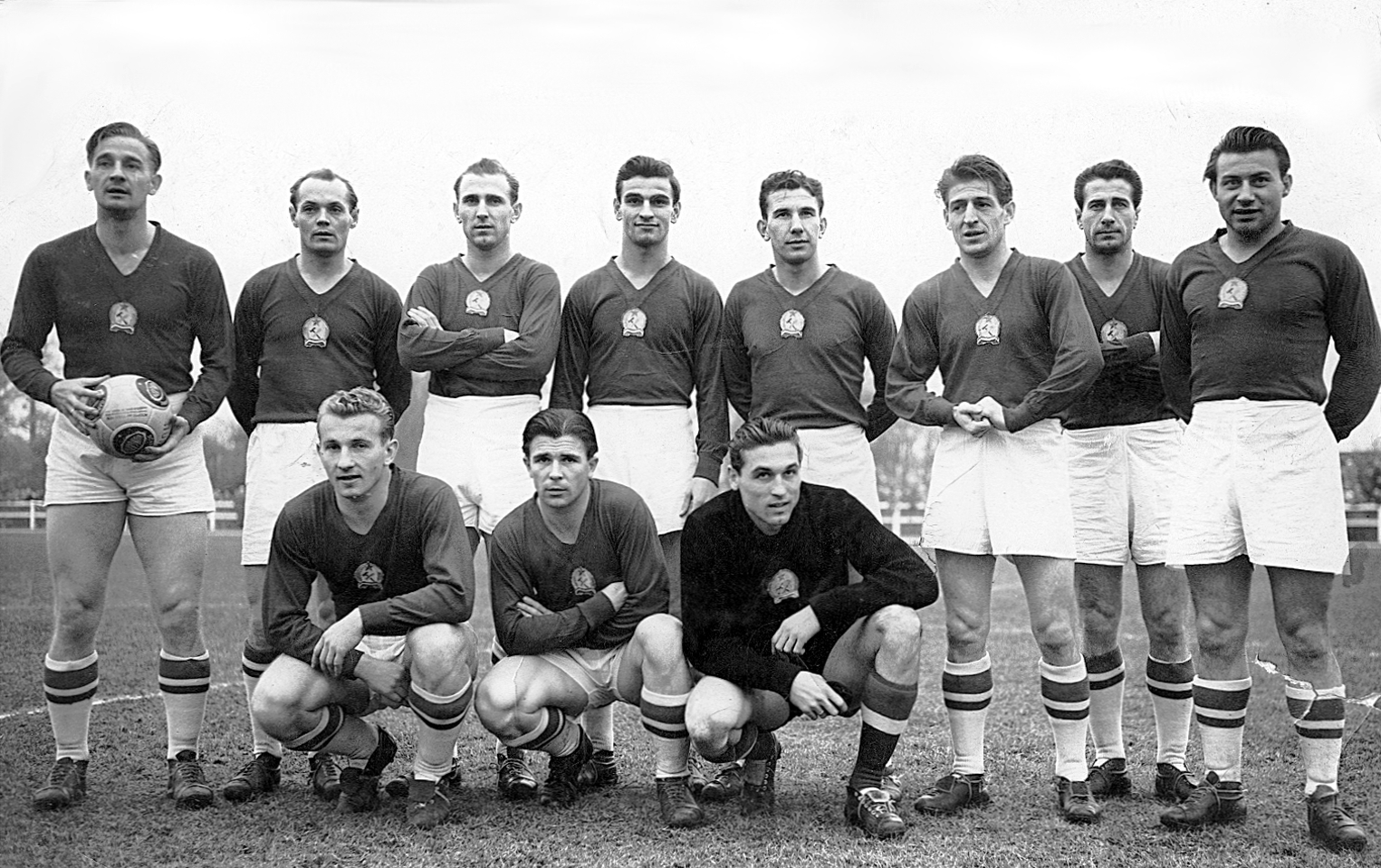
The Golden Team (Hungarian: Aranycsapat, pronounced [ˈɒrɒɲˈt͡ʃɒpɒt]) refers to the Hungary national football team of the 1950s. It is associated with several notable matches, including the quarter-final ("Battle of Berne") against Brazil, semi-final (against Uruguay) and final of the 1954 FIFA World Cup ("The Miracle of Bern"). The team inflicted notable defeats on then-footballing world powers Uruguay, Soviet Union, England, Germany, Brazil and Italy before the 1956 Hungarian Revolution caused the breakup of the side. The Golden Team was also known by different nicknames, such as the "Mighty Magyars", the "Magical Magyars", and the "Magnificent Magyars".
Between 1950 and 1956, the team played 69 games, recorded 58 victories, 10 draws, and is generally considered to have suffered only one defeat, in the 1954 World Cup final against West Germany. During this process, they scored 436 goals. Under the Elo rating system, they achieved the highest rating recorded by a national side (2231 points, achieved on 30 June 1954). In 2016, the BBC listed the team as the best international football team ever in football history.
The team is generally credited for successfully implementing an early form of "Total Football", later used effectively by the Dutch in the 1970s. The team is also generally recognized for introducing new, scientific coaching and tactical innovations, which were subsequently adopted throughout the game. The team's success became a subject of national pride in a period of oppression by the Communist regime imposed on Hungary by the Soviet Union. In this period, any "nationalistic" or even patriotic expression was strongly disapproved of, since these were considered being against the internationalist ideal of the Communist government. In this atmosphere, international sport events were the only tolerated fields of expression of national pride. [citation needed]
The team was built around a core of six key players: forwards Ferenc Puskás, Sándor Kocsis and Zoltán Czibor, defensive midfielder József Bozsik, and goalkeeper Gyula Grosics, all Kispest Honvéd players, as well as MTK offensive midfielder Nándor Hidegkuti. The manager of the team was Gusztáv Sebes, who had been a trade union organizer in Budapest and pre-war Paris at Renault car factories, and was therefore accorded a political clean bill of health to run affairs by the Deputy Sports Minister.
Sebes can be credited with three key innovations. Firstly, he implemented fitness regimes for his players, as well as a club-like policy at international level to give impetus to regular practice sessions. Secondly, he was responsible for the tactical concept of a deep-lying centre forward. At the time, the majority of footballing sides adopted the WM formation, where the centre forward spearheaded an attack line of 3 forwards and 2 wingers. Sebes's tactic was to withdraw the centre forward back to the midfield, as well as dropping the wingers back to the midfield when necessary. This effectively created an extremely flexible 3–2–3–2 formation, allowing the team to quickly switch between attack and defense. The tactic also drew defenders out of position, as centre halves used to man-marking a centre forward would follow the deep-lying centre forward back to the midfield. Thirdly, Sebes encouraged his players to be versatile – the ideal would be for any of his players to be able to play in any position. This was a revolutionary idea – most players were used to playing in one specific position. This was an early form of Total Football. Ferenc Puskas commented, "When we attacked, everyone attacked, and in defence it was the same. We were the prototype for Total Football."
Finally, the influence of Jimmy Hogan on Sebes and the team cannot be underestimated. The then president of the Hungarian Football Association, Sandor Barcs, said: "Jimmy Hogan taught us everything we know about football". and Sebes himself said of Hogan, "We played football as Jimmy Hogan taught us. When our football history is told, his name should be written in gold letters".
The Hungarians arrived at the 1952 Summer Olympics unbeaten for two years. The team easily defeated opponents in the preliminary rounds, before meeting the 1948 defending Olympic champions, Sweden, in the semi-finals. Hungary demolished Sweden 6–0 to set up a final against Yugoslavia. Goals from Ferenc Puskás and Zoltán Czibor ensured a 2–0 victory and the Olympic gold for Hungary.
Hungary took part in the 1948-53 Central European International Cup, a nations cup for teams from Central Europe and the forerunner of the European championship. The competing teams included Austria, Czechoslovakia, Italy and Switzerland. Hungary eased their way to a final against Italy on 17 May 1953, which they won 3–0 with a goal from Nándor Hidegkuti and two from Puskás.
Hub AI
Golden Team AI simulator
(@Golden Team_simulator)
Golden Team
The Golden Team (Hungarian: Aranycsapat, pronounced [ˈɒrɒɲˈt͡ʃɒpɒt]) refers to the Hungary national football team of the 1950s. It is associated with several notable matches, including the quarter-final ("Battle of Berne") against Brazil, semi-final (against Uruguay) and final of the 1954 FIFA World Cup ("The Miracle of Bern"). The team inflicted notable defeats on then-footballing world powers Uruguay, Soviet Union, England, Germany, Brazil and Italy before the 1956 Hungarian Revolution caused the breakup of the side. The Golden Team was also known by different nicknames, such as the "Mighty Magyars", the "Magical Magyars", and the "Magnificent Magyars".
Between 1950 and 1956, the team played 69 games, recorded 58 victories, 10 draws, and is generally considered to have suffered only one defeat, in the 1954 World Cup final against West Germany. During this process, they scored 436 goals. Under the Elo rating system, they achieved the highest rating recorded by a national side (2231 points, achieved on 30 June 1954). In 2016, the BBC listed the team as the best international football team ever in football history.
The team is generally credited for successfully implementing an early form of "Total Football", later used effectively by the Dutch in the 1970s. The team is also generally recognized for introducing new, scientific coaching and tactical innovations, which were subsequently adopted throughout the game. The team's success became a subject of national pride in a period of oppression by the Communist regime imposed on Hungary by the Soviet Union. In this period, any "nationalistic" or even patriotic expression was strongly disapproved of, since these were considered being against the internationalist ideal of the Communist government. In this atmosphere, international sport events were the only tolerated fields of expression of national pride. [citation needed]
The team was built around a core of six key players: forwards Ferenc Puskás, Sándor Kocsis and Zoltán Czibor, defensive midfielder József Bozsik, and goalkeeper Gyula Grosics, all Kispest Honvéd players, as well as MTK offensive midfielder Nándor Hidegkuti. The manager of the team was Gusztáv Sebes, who had been a trade union organizer in Budapest and pre-war Paris at Renault car factories, and was therefore accorded a political clean bill of health to run affairs by the Deputy Sports Minister.
Sebes can be credited with three key innovations. Firstly, he implemented fitness regimes for his players, as well as a club-like policy at international level to give impetus to regular practice sessions. Secondly, he was responsible for the tactical concept of a deep-lying centre forward. At the time, the majority of footballing sides adopted the WM formation, where the centre forward spearheaded an attack line of 3 forwards and 2 wingers. Sebes's tactic was to withdraw the centre forward back to the midfield, as well as dropping the wingers back to the midfield when necessary. This effectively created an extremely flexible 3–2–3–2 formation, allowing the team to quickly switch between attack and defense. The tactic also drew defenders out of position, as centre halves used to man-marking a centre forward would follow the deep-lying centre forward back to the midfield. Thirdly, Sebes encouraged his players to be versatile – the ideal would be for any of his players to be able to play in any position. This was a revolutionary idea – most players were used to playing in one specific position. This was an early form of Total Football. Ferenc Puskas commented, "When we attacked, everyone attacked, and in defence it was the same. We were the prototype for Total Football."
Finally, the influence of Jimmy Hogan on Sebes and the team cannot be underestimated. The then president of the Hungarian Football Association, Sandor Barcs, said: "Jimmy Hogan taught us everything we know about football". and Sebes himself said of Hogan, "We played football as Jimmy Hogan taught us. When our football history is told, his name should be written in gold letters".
The Hungarians arrived at the 1952 Summer Olympics unbeaten for two years. The team easily defeated opponents in the preliminary rounds, before meeting the 1948 defending Olympic champions, Sweden, in the semi-finals. Hungary demolished Sweden 6–0 to set up a final against Yugoslavia. Goals from Ferenc Puskás and Zoltán Czibor ensured a 2–0 victory and the Olympic gold for Hungary.
Hungary took part in the 1948-53 Central European International Cup, a nations cup for teams from Central Europe and the forerunner of the European championship. The competing teams included Austria, Czechoslovakia, Italy and Switzerland. Hungary eased their way to a final against Italy on 17 May 1953, which they won 3–0 with a goal from Nándor Hidegkuti and two from Puskás.
Recent media