


Community hub
Recent from talks
Contribute something
Nothing was collected or created yet.
Golden Team
View on Wikipedia | This article has multiple issues. Please help improve it or discuss these issues on the talk page. (Learn how and when to remove these messages)
|


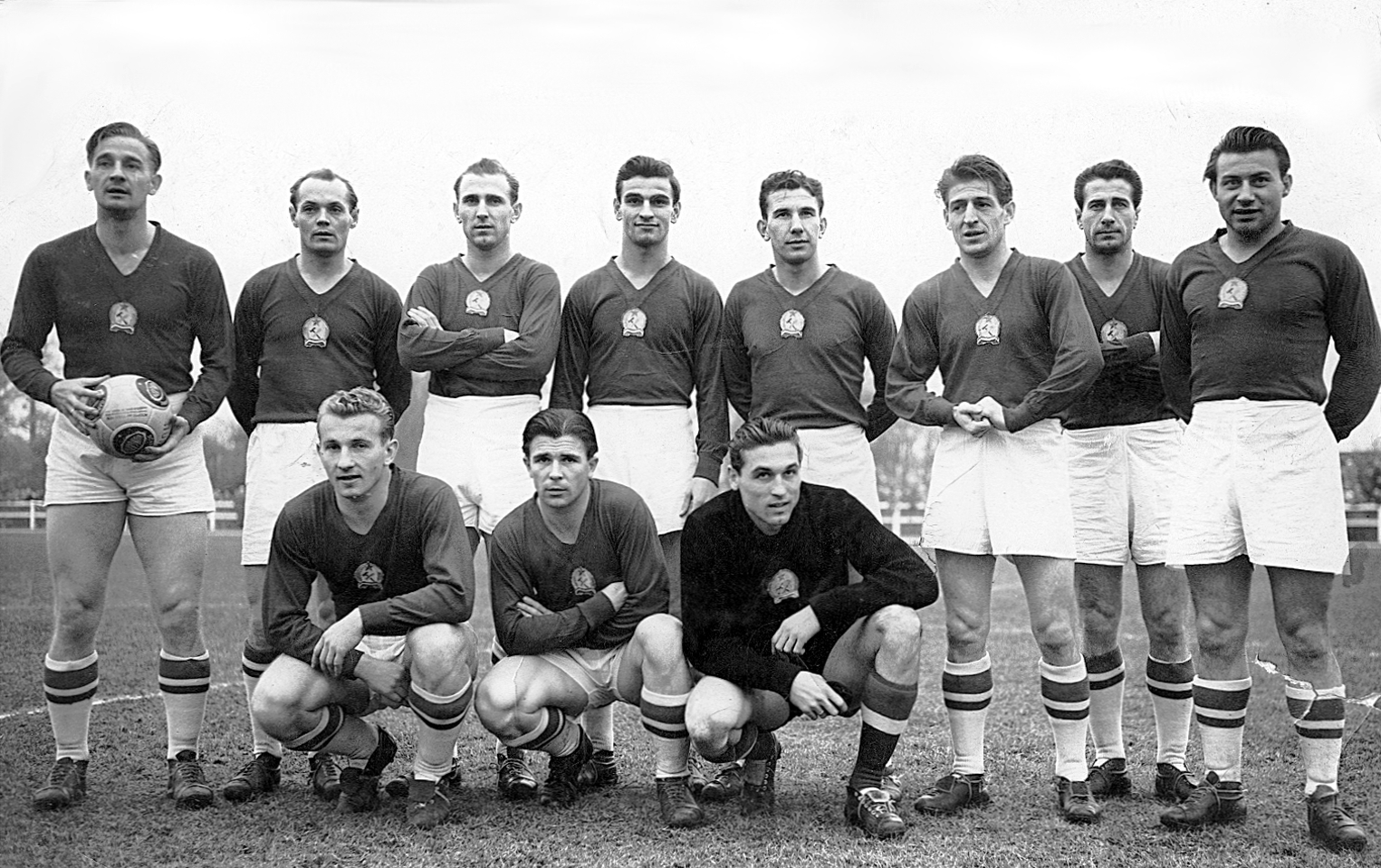
front row: Mihály Lantos, Ferenc Puskás, Gyula Grosics
back row: Gyula Lóránt, Jenő Buzánszky, Nándor Hidegkuti, Sándor Kocsis, József Zakariás, Zoltán Czibor, József Bozsik, László Budai
The Golden Team (Hungarian: Aranycsapat, pronounced [ˈɒrɒɲˈt͡ʃɒpɒt]) refers to the Hungary national football team of the 1950s. It is associated with several notable matches, including the quarter-final ("Battle of Berne") against Brazil, semi-final (against Uruguay) and final of the 1954 FIFA World Cup ("The Miracle of Bern"). The team inflicted notable defeats on then-footballing world powers Uruguay, Soviet Union, England, Germany, Brazil and Italy before the 1956 Hungarian Revolution caused the breakup of the side. The Golden Team was also known by different nicknames, such as the "Mighty Magyars", the "Magical Magyars", and the "Magnificent Magyars".
| Medal record | ||
|---|---|---|
| Olympic Games | ||
 |
1952 Helsinki | Team |
| World Cup | ||
 |
1954 Switzerland | Team |
| Central European International Cup | ||
|
1948–53 Central Europe | Team |
Between 1950 and 1956, the team played 69 games, recorded 58 victories, 10 draws, and is generally considered to have suffered only one defeat, in the 1954 World Cup final against West Germany.[1] During this process, they scored 436 goals. Under the Elo rating system, they achieved the highest rating recorded by a national side (2231 points, achieved on 30 June 1954). In 2016, the BBC listed the team as the best international football team ever in football history.[2]
The team is generally credited for successfully implementing an early form of "Total Football", later used effectively by the Dutch in the 1970s. The team is also generally recognized for introducing new, scientific coaching and tactical innovations, which were subsequently adopted throughout the game. The team's success became a subject of national pride in a period of oppression by the Communist regime imposed on Hungary by the Soviet Union. In this period, any "nationalistic" or even patriotic expression was strongly disapproved of, since these were considered being against the internationalist ideal of the Communist government. In this atmosphere, international sport events were the only tolerated fields of expression of national pride. [citation needed]
Key people
[edit]
The team was built around a core of six key players: forwards Ferenc Puskás, Sándor Kocsis and Zoltán Czibor, defensive midfielder József Bozsik, and goalkeeper Gyula Grosics, all Kispest Honvéd players, as well as MTK offensive midfielder Nándor Hidegkuti. The manager of the team was Gusztáv Sebes, who had been a trade union organizer in Budapest and pre-war Paris at Renault car factories, and was therefore accorded a political clean bill of health to run affairs by the Deputy Sports Minister.
Sebes can be credited with three key innovations. Firstly, he implemented fitness regimes for his players, as well as a club-like policy at international level to give impetus to regular practice sessions. Secondly, he was responsible for the tactical concept of a deep-lying centre forward. At the time, the majority of footballing sides adopted the WM formation, where the centre forward spearheaded an attack line of 3 forwards and 2 wingers. Sebes's tactic was to withdraw the centre forward back to the midfield, as well as dropping the wingers back to the midfield when necessary. This effectively created an extremely flexible 3–2–3–2 formation, allowing the team to quickly switch between attack and defense. The tactic also drew defenders out of position, as centre halves used to man-marking a centre forward would follow the deep-lying centre forward back to the midfield. Thirdly, Sebes encouraged his players to be versatile – the ideal would be for any of his players to be able to play in any position. This was a revolutionary idea – most players were used to playing in one specific position. This was an early form of Total Football. Ferenc Puskas commented, "When we attacked, everyone attacked, and in defence it was the same. We were the prototype for Total Football."[3]
Finally, the influence of Jimmy Hogan on Sebes and the team cannot be underestimated. The then president of the Hungarian Football Association, Sandor Barcs, said: "Jimmy Hogan taught us everything we know about football".[4] and Sebes himself said of Hogan, "We played football as Jimmy Hogan taught us. When our football history is told, his name should be written in gold letters".[5]
Notable matches
[edit]1952 Olympic Games (Yugoslavia vs. Hungary)
[edit]The Hungarians arrived at the 1952 Summer Olympics unbeaten for two years. The team easily defeated opponents in the preliminary rounds, before meeting the 1948 defending Olympic champions, Sweden, in the semi-finals. Hungary demolished Sweden 6–0 to set up a final against Yugoslavia. Goals from Ferenc Puskás and Zoltán Czibor ensured a 2–0 victory and the Olympic gold for Hungary.
1953 Central European Championship (Italy vs. Hungary)
[edit]Hungary took part in the 1948-53 Central European International Cup, a nations cup for teams from Central Europe and the forerunner of the European championship. The competing teams included Austria, Czechoslovakia, Italy and Switzerland. Hungary eased their way to a final against Italy on 17 May 1953, which they won 3–0 with a goal from Nándor Hidegkuti and two from Puskás.
1953 "Match of the Century" (England vs. Hungary)
[edit]A friendly match was arranged for 25 November 1953 against England. England had never been defeated on home soil by a team from outside the British Isles (they lost to the Republic of Ireland in 1949), and the FA were complacent – as the inventors of the game, they were assured that their players were technically and tactically superior to any other countries. At the time, England were ranked as the 3rd best team in the world and Hungary were ranked as the best team in the world. The game was eagerly anticipated; the British Press reported it as "the Match of the Century".[6][7]
The game was played in front of 105,000 in Wembley Stadium. Hungary scored in the first minute, and after 27 minutes they were 4–1 up. The final score was 6–3, with a hat-trick from Hidegkuti, two goals from Puskás and one from Bozsik. It was a footballing lesson that sent shockwaves through English football, and which ultimately caused English clubs to adapt more modern coaching and tactics.[6]
1954 Hungary 7 England 1
[edit]_Golden_Team.jpg)
England were anxious for revenge after the defeat at Wembley, and a return match was scheduled in Budapest for 23 May 1954, three weeks before the start of the 1954 World Cup. Any hopes that the Wembley game had been an aberration were immediately dispelled as Hungary won 7–1, inflicting England's heaviest ever defeat that still stands to this day.[6]
1954 World Cup First Round Games
[edit]Hungary went to the 1954 World Cup in Switzerland as firm favourites; they were unbeaten since 1950, and had issued served notice of their ability with 6–3 and 7–1 thrashings of England. The 16 finalists were assigned to four groups, with each group having four teams in it. Each group contained two seeded teams and two unseeded teams. Only four matches were scheduled for each group, each pitting a seeded team against an unseeded team (this contrasts with a conventional round-robin in which every team plays every other team, which would have resulted in six matches in each group). In a further oddity, extra time would be played if the teams were level after ninety minutes in the group games, with the result being a draw if the scores were still level after 120 minutes.
The top two teams from each group would qualify for the quarter-finals. Hungary shared Group B with Turkey, West Germany and South Korea; Hungary and Turkey were the two seeded sides in the group. Hungary won their opening game against South Korea 9–0, with Kocsis scoring a hat-trick. In the second game, Hungary thrashed West Germany 8–3, with Kocsis scoring another 4 goals; however, fouling on Puskás left him with a hairline fracture of the ankle which left him unavailable for selection for the quarter-final and semi final stages.
1954 World Cup Quarter-final: "Battle of Berne" (Brazil vs. Hungary 1954)
[edit]Hungary met Brazil in an eagerly anticipated quarter final; both sides had a reputation for open, attacking football. The Brazilians had lost the last and deciding match of the 1950 World Cup to Uruguay, and were anxious to reach the final again. The game was notable for the number of cynical fouls performed by both sides rather than as an exhibition of footballing technique; Hungary took a 2–0 lead after 7 minutes, and after that the game descended into a series of fouls, free kicks and fights on the pitch resulting in three dismissals. The game ended 4–2 to Hungary. Fighting continued off the pitch in the tunnels and in the players' dressing rooms. The game's English referee Arthur Ellis commented: "I thought it was going to be the greatest game I'd ever see. I was on top of the world. Whether politics and religion had something to do with it I don't know, but they behaved like animals. It was a disgrace. It was a horrible match. In today's climate so many players would have been sent off the game would have been abandoned. My only thought was that I was determined to finish it."[8]
1954 World Cup Semi-final (Uruguay vs. Hungary)
[edit]Uruguay were the defending champions, and had never lost a World Cup match in their history, winning both tournaments they had previously entered. Hungary were without Puskás, but still managed to take the lead via Zoltán Czibor. Uruguay rallied but were unable to even the scores before half-time. Almost immediately after the restart, Nándor Hidegkuti scored a second goal for Hungary. Uruguay's unbeaten World Cup record seemed to be over, but they still had most of the second half to recover.
The champions were not going to give up without a fight, and spent much of the remainder of the match launching attack after attack at the Hungarian defence. With a quarter of an hour to play Juan Hohberg scored for Uruguay; Hungary defended desperately until the 86th minute, when Hohberg scored his second to force extra time. Appearing to have much more energy than their opponents, Hungary retook the lead midway through the second period of extra-time when Sándor Kocsis headed home from close range; Kocsis scored again four minutes from injury time. Uruguay were beaten 4–2, their first ever World Cup loss, while Hungary went on to their second World Cup final. The game was in direct contrast to the quarter-final between Hungary and Brazil; both Hungary and Uruguay had played attractive, attacking football in what was arguably one of the finest displays of football in a World Cup.
1954 World Cup Final: "The Miracle of Bern" (West Germany vs. Hungary)
[edit]
The final was between Hungary and West Germany. Hungary were in their second World Cup Final (their 1938 team had lost to Italy 4–2 in Paris); in addition, they had a record of 34 wins, 6 draws, and 1 defeat since August 1949, and were unbeaten in their last 32 matches. Hungary had beaten West Germany 8–3 in a first-round game. The only issue the Hungarians faced was the ankle injury sustained to Puskás in the same game, from which he had not fully recovered – Sebes still took the decision to play him.
Hungary took an early lead in the 6th minute, with a goal from Puskás. Two minutes later, Czibor made it 2–0 to Hungary. However, the Germans rallied, and swiftly pulled the score back to 2–1 through Max Morlock. In the 18th minute, the Germans drew level from a corner kick; the goal was scored by Helmut Rahn. In the second half, Hungary poured forward looking to retake the lead, but their attempts were repeatedly foiled by the German defence, with goalkeeper Toni Turek pulling off several fine saves.[9]
With six minutes left and the score still 2–2, Helmut Rahn scored West Germany's third goal. Two minutes before the end, Puskás appeared to equalise, but he was ruled off-side. The match ended Hungary's unbeaten run in one of the biggest upsets in the history of football; West Germany won 3–2 in the "Miracle of Bern". There were three controversial incidents in the final, each favouring the Germans; Hungarian goalkeeper Grosics was allegedly obstructed for the second German goal, Puskás apparently equalised in the 89th minute but was deemed to be offside, and there was an alleged foul on Kocsis in the penalty area in the final minute of the game.
1955 Scotland 2 Hungary 4
[edit]On 8 December 1954, Scotland hosted Hungary at Hampden Park in a friendly match, before a crowd of 113,000.[10] Scotland were determined not to be humiliated as England had been a year earlier, and attempted to take the game to the Hungarians in a display of counterattacking football. This made for an open, attractive game with plenty of goals; Hungary scored on 20 minutes through Bozsik, and Hidegkuti made it 2–0 six minutes later. Scotland rallied and pulled one back on 36 minutes through Tommy Ring, but Sandor made it 3–1 to Hungary just before halftime.
The second half continued in the same vein, with Partick Thistle winger John Mackenzie constantly beating Hungary full back Mihály Lantos. Bobby Johnstone scored a second goal for Scotland on 46 minutes, and only poor finishing prevented Scotland from equalising. The home side continued to press forward, but were caught on a counter break right at the end of the match when Kocsis scored to make the final score 2–4 to Hungary. It was the closest any team had come to beating Hungary in a friendly competition since 1950. Afterwards, Puskas complimented the excellent work of Mackenzie, stating that he had "never seen wing play of such a high standard".[11]
1956 Soviet Union 0 Hungary 1
[edit]On 23 September 1956, the Soviet Union played Hungary in a friendly game at the Lenin Central Stadium in Moscow, before a crowd of 102,000.[12] The Soviet Union were unbeaten at home, and were generally regarded as the natural successors to the Hungarians as the world's premier footballing side. In addition, the Soviet team and players were regarded as ideals of socialist principles by senior Communist authorities, who expected the Soviet Union to win comfortably, as befitting the senior member of the Eastern Bloc. However, a single goal from Zoltán Czibor ended the Soviet Union's unbeaten home record; the result did little to encourage good relations between the two countries, and was a minor contributing factor to a wave of patriotic fervour that resulted in the Hungarian Revolution of 1956.
Demise
[edit]Hungary continued to dominate international football; between July 1954 and February 1956, Hungary played a further 19 games, winning 16, drawing 3 and losing none. From 1950 until their demise in 1956 the team played a total of 69 games, winning 58, drawing 10 and losing just once and scored 436 goals. Despite this, manager Sebes was sacked in June 1956, and was replaced by Márton Bukovi; however, Sebes remained President of the Hungarian Olympic Committee from 1948 to 1960, and was also Vice President of UEFA from 1954 to 1960.
The majority of the team played for Budapest Honvéd, who entered the 1956–57 European Cup and were drawn against Athletic Bilbao in the first round. Honvéd lost the away leg 3–2, but before the home leg could be played, the Hungarian Revolution erupted in Budapest. The players decided against going back to Hungary and arranged for the return with Athletic to be played at Heysel Stadium in Brussels, Belgium. With a 3–3 draw in the return game, Honvéd were eliminated 6–5 on aggregate, and the Hungarian players were left in limbo. They summoned their families from Budapest, and despite opposition from FIFA and the Hungarian football authorities, they organised a fundraising tour of Italy, Portugal, Spain, and Brazil. After returning to Europe, the players parted ways.
Kocsis and Czibor moved to Spain to play for Barcelona. Puskás emigrated to Spain to play for Real Madrid, eventually earning caps also for the Spanish national team (including at the 1962 FIFA World Cup) after obtaining Spanish citizenship. Hidegkuti returned to Hungary as a player and later became manager of MTK Budapest FC before emigrating to successfully manage clubs in Italy, Poland, and Egypt. Bozsik also returned in Hungary, and later becoming the manager of several Hungarian teams. They, as well as others who chose to return to Hungary, were among the few remnants of the Golden Team to take part in the following World Cup, in Sweden. Sebes also managed several Hungarian clubs in the 1960s (Ujpesti Dozsa, Budapest Honvéd FC and Diosgyori VTK) with moderate success.[13]
Historic significance
[edit]
The historical significance of the team lay in three areas; the introduction of new tactics, the concept of using a core set of well trained players used to playing as a team, and the idea that each player could play in any position if necessary. The importance of Gusztáv Sebes and the influence of Jimmy Hogan cannot be underestimated. The tactics of Sebes – especially the concept of a deep lying centre forward – revolutionised a game where the majority of club and international sides had played the WM formation for the previous 20 years. The introduction and success of the Hungarian 3–2–3–2 formation led other managers and countries to experiment, with the 3–2–3–2 eventually evolving into the 4–2–4 formation.
Sebes's idea of using a core set of players, drawn from just a handful of clubs, was a new idea that was critical to the success of the team. Most national teams were selected on the concept of picking the best players, not the best team; England famously had a selection committee that selected the team for each game, with little or no sense of continuity. By using players who were familiar with each other's strengths at a club level, Sebes introduced a sense of continuity at a national level – something no other nation had at the time. The Soviet Union adopted this approach throughout the 1960s, with success at a European level; England won the World Cup in 1966 with a core of players from one club, West Ham United. Sebes also demanded rigorous training and standards of physical fitness from his players, as well as good tactic awareness – again, these were areas that many national sides of the time neglected. As a consequence, the Hungarian side were able to outrun, outpass and outplay their opposition.
Finally, Sebes's successful implementation of Jimmy Hogan's theory that every player should be able to play in all positions was critical to the success of the team; previously, each player in a team was assigned a specific position or role, usually marking a specific opposition player. The Hungarian tactic of players constantly changing roles and positions could only be introduced by using a core set of talented players who were used to playing together at both a club and national level for a period of time. It would be nearly 20 years before the Netherlands national team of the 1970s utilised the same approach with their concept of Total Football.
All-time team highs and lows
[edit]The following is a list of national football teams ranked by the highest Elo rating they ever reached.[14] The table also includes the highest ranking as well as the lowest rating and ranking reached by each nation. The team that has achieved the highest rank in each confederation is shown in color.
|


- ^ The ranking in parentheses is that at the time the highest rating was reached.
- ^ a b The date given is when the highest or lowest rating was first reached.
- ^ The team's indicated lowest ratings and rank may not have coincided in time.
- ^ Russia reached its lowest rating as the Russian Empire (after 7 matches) and its highest rating and ranking as the Soviet Union.
International football's highest rated matches
[edit]The Mighty Magyars feature in three of the top 10 highest rated matches all-time. A list of the 10 matches between teams with the highest combined Elo ratings (the nation's points before the matches are given) as of July 16, 2010.
| Rank | Combined points |
Nation 1 | Elo 1 | Nation 2 | Elo 2 | Score | Date | Occasion | Location |
|---|---|---|---|---|---|---|---|---|---|
| 1 | 4211 |  Netherlands Netherlands
|
2100 |  Spain Spain
|
2111 | 0 : 1 | 2010-07-11 | World Cup F |  Johannesburg Johannesburg
|
| 2 | 4161 |  West Germany West Germany
|
1995 |  Hungary Hungary
|
2166 | 3 : 2 | 1954-07-04 | World Cup F |  Bern Bern
|
| 3 | 4157 | Netherlands
|
2050 |  Brazil Brazil
|
2107 | 2 : 1 | 2010-07-02 | World Cup QF | Port Elizabeth
|
| 4 | 4148 | West Germany
|
2068 | Brazil
|
2080 | 0 : 1 | 1973-06-16 | Friendly | Berlin
|
| 5 | 4129 | Spain
|
2085 | Germany
|
2044 | 1 : 0 | 2010-07-07 | World Cup SF | Durban
|
| 6 | 4119 | Brazil
|
2050 | West Germany
|
2069 | 1 : 0 | 1982-03-21 | Friendly | Rio de Janeiro
|
| 7 | 4118 | Hungary
|
2108 | Brazil
|
2010 | 4 : 2 | 1954-06-27 | World Cup QF | Bern
|
| 8 | 4116 | Hungary
|
2141 |  Uruguay Uruguay
|
1975 | 4 : 2 | 1954-06-30 | World Cup SF | Lausanne
|
| 9 | 4113 | West Germany
|
2079 | Netherlands
|
2034 | 2 : 1 | 1974-07-07 | World Cup F | Munich
|
| 10 | 4108 | Brazil
|
2015 | West Germany
|
2093 | 1 : 1 | 1977-06-12 | Friendly | Rio de Janeiro
|
Results
[edit]


Records and statistics
[edit]
- World Record: (June 4, 1950 – February 19, 1956) 42 victories, 7 draws, 1 defeat ("Miracle of Bern") – 91.0% winning percentage ratio.
- Team Record (June 4, 1950 – July 3, 1954) 32 game undefeated narrative.
- World Record: most consecutive games scoring at least one goal: 73 games (April 10, 1949 – June 16, 1957).
- World Record: longest time undefeated in 20th and 21st centuries: 4 years 1 month (June 4, 1950 – July 4, 1954).
- World Record: most collaborative goals scored between two starting players (Ferenc Puskás & Sándor Kocsis) on same national side (159 goals).
- World Record: Highest rating ever attained in the sport's history using the Elo rating system for national teams with 2230 points on June 30, 1954.

- 20th Century Record: Hungary manager Gusztáv Sebes holds the highest ratio of victories per game past 30 matches with 82.58% (49 wins, 11, draws, 6 defeats). Brazil legend Vicente Feola (1955–1966) owns the second highest with 81.25 (46 wins, 12 draws, 6 defeats).
- 20th Century Record: Most International Goals: Ferenc Puskás (84 goals).
- World Cup Record: 27 goals scored in a single World Cup finals tournament.
- World Cup Record: 5.4 goals-per-match in a single World Cup finals tournament.
- World Cup Record: +17 goal differential in a single World Cup finals tournament.
- World Cup Record: 2.2 goals-per-match average for individual goal scoring in a single World Cup finals tournament (Sándor Kocsis 11 goals in 5 games).
- World Cup Record: highest margin of victory ever recorded in a World Cup finals tournament match ( Hungary 9, South Korea 0 – July 17, 1954).
- World Cup Precedent: first national team to defeat two-time and reigning World Cup champion Uruguay in a World Cup finals tournament (Hungary 4, Uruguay 2, semi-final — July 30, 1954).
- World Cup Precedent: Sándor Kocsis, first player to score two hat tricks in a World Cup finals tournament (Hungary 8, West Germany 3 – July 20, 1954 & Hungary 9, South Korea 0 – July 17, 1954).
- National Record: Highest margin of victory recorded by the Hungary national team (Hungary 12, Albania 0 – Sept. 23, 1950).
- Precedent: first national side from outside the British Isles to defeat England at home since the codification of association football in 1863, a span of 90 years (Hungary 6, England 3, see "Match of the Century" – Nov. 25 1953).
- Hungary's 7–1 defeat of England in Budapest the next year is still England's record defeat.
- Precedent: first national side in the world to eclipse an 1888 Scottish record of being undefeated in 22 consecutive matches (32 games).
- Precedent: first non-South American national side to defeat Uruguay (Hungary 4, Uruguay 2, semi-final — July 30, 1954), breaking a 17-game Uruguayan unbeaten run against non-South American competition dating from May 26, 1924.
- Precedent: first national side to defeat the Soviet Union at home (Hungary 1, Soviet Union 0 – Sept. 23 1956).
- Precedent: first national team in history to simultaneously host the No.1 and No. 2 world record holders for most goals scored internationally (Ferenc Puskás 84 goals, Sándor Kocsis 75 goals) from May 11, 1955, to October 14, 1956.
- Team Record vs. Elo Ranked Opponents: (June 4, 1950 – Oct. 14 1956), vs. world Top 10 ranked opponents: 11 wins, 2 draws, 1 loss / vs. world Top 5 opponents: 4 wins, 0 draw, 1 loss.
Honours
[edit]- Central European International Cup
- Champions (1): 1948–53
- Summer Olympics
- Gold medal (1): 1952
- FIFA World Cup
- Runners-up (1): 1954
References
[edit]- ^ "Mighty Magyars and Hungary's four-year unbeaten streak". FIFA.
- ^ "The greatest international team ever?". BBC Sport.
- ^ FIFA.com
- ^ "How total football inventor was lost to Hungary". TheGuardian.com. 22 November 2003.
- ^ Jonathan Wilson, The Anatomy of England: a History in Ten Matches (Orion Publishing Group, London 2010)
- ^ a b c Glanville, Brian (17 May 2009). "The Hungarian disasters – England v Hungary, 1953-4". The Observer. Guardian News and Media Limited. Retrieved 23 March 2011.
- ^ "Hungary marks 50th year since England win". Sports Illustrated. CNN/Sports Illustrated. 25 November 2003. Archived from the original on November 4, 2012. Retrieved 23 March 2011.
- ^ "Football: Ellis a knockout during the Battle of Berne – Sport". The Independent. 1998-06-09. Retrieved 2011-03-14.
- ^ Werner Raupp: Toni Turek – „Fußballgott“. Eine Biographie. Arete Verlag, Hildesheim 2019 (ISBN 978-3-96423-008-9), p. 107-114.
- ^ "Scotland International Matches 1951–1955". Retrieved 2012-10-12.
- ^ "The firhill flyer | Comments | The Official Gateway to Scotland". Scotland.org. Archived from the original on 2011-07-21. Retrieved 2011-03-14.
- ^ "International football MATCH report: 23.09.1956 Soviet Union vs Hungary". Retrieved 2012-09-19.
- ^ "Classic Coach: Gusztav Sebes". FIFA.com. 1953-11-25. Archived from the original on 2007-07-09. Retrieved 2011-03-14.
- ^ World Football Elo Ratings; under the columns tab choose "Highest Rank / Rating" as well as "Lowest Rank / Rating"
Bibliography
[edit]- Rogan Taylor, ed. (1998). Puskas on Puskas: The Life and Times of a Footballing Legend. Robson Books. ISBN 1861051565.
- Terry Crouch, ed. (2006). The World Cup: The Complete History. Aurum Press Ltd. ISBN 1845131495.
- Michael L. LaBlanc & Richard Henshaw, ed. (1994). The World Encyclopedia of Soccer. Invisible Ink Press. ISBN 0810394421.
- Jonathan Wilson, ed. (2006). Behind the Curtain: Travels in Eastern European Football. Orion Publishing. ISBN 9780752879451.
- Rogan Taylor & Andrew War, ed. (1996). Kicking & Screaming: An Oral History of Football in England. Robson Books. ISBN 0860519120.
- Diego Mariottini, "Tiki-taka Budapest: leggenda, ascesa e declino dell'Ungheria di Puskás", Bradipolibri, 2016, ISBN 9788899146214
External links
[edit]Golden Team
View on GrokipediaOrigins and Development
Formation under Communist Regime
Following the imposition of communist rule in Hungary after World War II, the state centralized control over sports as part of broader nationalization efforts to promote ideological goals and collective achievement. Gusztáv Sebes, a committed communist and former trade union organizer who had led strikes at Renault factories in Paris during the 1930s, was appointed head coach of the national football team in 1949, simultaneously holding the position of Deputy Minister of Sport. This dual role granted him significant authority backed by the Hungarian Communist Party (MKP), enabling the allocation of substantial resources to football development amid postwar reconstruction.[2][5] Sebes restructured the team by discarding established prewar stars in favor of younger, adaptable players from clubs like MTK Budapest and Budapest Honvéd, many of whom aligned with the regime's emphasis on disciplined teamwork over individualism. He advocated for and secured government funding for a centralized sports complex to facilitate intensive training and tactical experimentation, reflecting the regime's view of sports as a propaganda tool to demonstrate socialist superiority. Player selection prioritized technical skill and ideological reliability, with talents such as Nándor Hidegkuti and Sándor Kocsis integrated into a cohesive unit by 1950, laying the groundwork for the team's tactical innovations.[5][2] The communist framework provided logistical support but also imposed constraints, including surveillance and pressure to embody state narratives, though Sebes' autonomy allowed for creative freedoms uncommon in other Eastern Bloc programs. This formation phase culminated in early successes, such as qualification for the 1952 Helsinki Olympics, where the team won gold, validating the state's investment while fostering national pride amid political repression.[6][2]Gusztáv Sebes' Coaching Innovations
Gusztáv Sebes, appointed manager of the Hungarian national team in 1948, centralized player selection and training under state influence, establishing a nationwide scouting network and mandatory weekly sessions to build a cohesive unit from club sides like MTK Budapest and Honvéd.[2] He implemented scientific training methods, including swimming exercises to improve lung capacity and endurance, alongside medical oversight that discouraged smoking and alcohol consumption, replacing such habits with educational outings to museums and galleries.[2] These approaches, combined with tactical drills using heavier balls to simulate English conditions ahead of the 1953 Wembley match, elevated physical conditioning beyond prevailing norms.[2][7] Tactically, Sebes deviated from the rigid WM formation by adopting a flexible 4-2-4 or 3-2-5 system, featuring a deep-lying centre-forward—exemplified by Nándor Hidegkuti dropping into midfield to draw defenders and open channels for inside forwards like Ferenc Puskás and Sándor Kocsis.[5][7] Wingers such as Zoltán Czibor and László Budai interchanged positions and advanced centrally during attacks, while full-backs like Jenő Buzánszky pushed forward aggressively, contrasting the era's defensive confinement of wide players.[8] This fluidity emphasized collective movement and short passing, influenced by earlier MTK coach Jimmy Hogan's principles of positional swapping, enabling total involvement where "everyone attacked and everyone defended."[2][5] Sebes prepared for opponents through targeted warm-up matches replicating their styles, fostering adaptability that proved effective in key fixtures, such as the 6–3 victory over England on November 25, 1953, where Hidegkuti's role yielded three goals.[2][7] His emphasis on high pressing and possession disrupted traditional long-ball tactics, laying groundwork for later developments like Total Football, though rooted in socialist ideals of team over individual stardom.[8][7] These innovations contributed to Hungary's unbeaten run from May 1950 to July 1954, spanning 31 matches.[2]Tactical Revolution
Departure from WM Formation
The WM formation, developed in the 1920s as a defensive evolution from the earlier 2-3-5 pyramid, positioned a center half-back as a third defender alongside two full-backs, with two wing halves and a central half-back providing midfield cover, followed by two inside forwards and a target-man center forward up top.[9] This rigid structure emphasized containment and direct play, dominating international football into the 1950s.[5] Hungary's Golden Team, under coach Gusztáv Sebes, fundamentally departed from the WM by deploying Nándor Hidegkuti as a deep-lying center forward who routinely dropped into midfield, forsaking the traditional static target man role to overload the central area and disrupt opposing defenses expecting a fixed forward line.[8] This tactical shift created fluidity, allowing Hidegkuti to initiate attacks from deeper positions, make late runs into space, and exploit gaps left by markers drawn out of position, effectively transforming the forward line into a dynamic unit rather than isolated finishers.[2] Sebes drew partial influence from Márton Bukovi's earlier "WW" adaptation, which inverted the WM's midfield "M" shape into a 2-3-2-3, but extended it further by prioritizing possession-based passing over the WM's reliance on long balls.[9] In structure, the Hungarians approximated a 3-2-3-2 when defending— with József Zakariás dropping back alongside full-backs Jenő Buzánszky and Gyula Lóránt to form a back three—but transitioned to a more attacking 2-3-3-2 or fluid 4-2-4 in possession, featuring József Bozsik as a sole defensive midfielder and advancing wingers like Zoltán Czibor and Sándor Budai who interchanged with inside forwards Ferenc Puskás and Sándor Kocsis.[10] Unlike the WM's two full-backs anchored defensively with three dedicated half-backs, Sebes employed effectively three overlapping full-backs and only two central half-backs, encouraging wider players to push forward and full-backs to join attacks, which maximized width and numerical advantages in midfield.[2] This departure was starkly demonstrated in the 6-3 victory over England on November 25, 1953, at Wembley, where Hidegkuti's midfield positioning led to three goals and England's WM setup proved unable to adapt to the spatial manipulation.[11] The innovation stemmed from Sebes' emphasis on scientific training, player versatility, and empirical testing against domestic and international opponents, rejecting the WM's positional rigidity in favor of causal linkages between phases of play—such as midfield overloads directly enabling forward penetration—though it required technically proficient players capable of short passing under pressure, a rarity at the time.[4] While precursors existed in Bukovi's work at MTK Hungaria, Sebes' implementation at national level marked the first widespread challenge to WM dominance, influencing later systems like Brazil's 1958 4-2-4.[12]Key Innovations: Deep-Lying Forward and Fluidity
The deep-lying forward role, pioneered by Gusztáv Sebes for the Golden Team, fundamentally altered traditional attacking structures by positioning Nándor Hidegkuti, nominally the center forward wearing the number 9 shirt, deeper in midfield as an attacking playmaker rather than a conventional target man. This innovation, first prominently deployed in the early 1950s, allowed Hidegkuti to drop into pockets of space between the opposition's midfield and defense, drawing center backs out of position and disrupting rigid defensive lines like England's WM formation. By facilitating late runs into the box and precise distribution to wingers Ferenc Puskás and Sándor Kocsis, Hidegkuti contributed to explosive attacking transitions, exemplified by his three goals in Hungary's 6–3 victory over England on November 25, 1953, at Wembley Stadium, where he exploited the disorientation of defenders expecting a static forward presence.[8][13][14] Complementing this was the team's emphasis on positional fluidity, where players routinely interchanged roles during matches to evade marking and maintain unpredictability, departing from the era's positional discipline. Sebes encouraged a "socialist football" ethos of collective movement, with midfielders like József Bozsik advancing to support attacks while forwards tracked back defensively, creating a dynamic 4-2-4 hybrid that blurred lines between defense and attack. This fluidity was evident in Hungary's 7–1 thrashing of England on May 23, 1954, at Wembley, where seamless rotations overwhelmed the hosts, leading to six different scorers and exposing the limitations of static systems. Such tactics not only maximized the technical prowess of stars like Puskás but also integrated amateur and professional elements from Hungary's state-supported training regime, fostering a total involvement that prefigured modern pressing and interchange systems.[13][14][2] These innovations proved empirically superior against contemporary opponents, with Hungary unbeaten in 31 matches from 1950 to 1953, scoring prolifically through space exploitation rather than individual duels, though vulnerabilities emerged in high-stakes knockout scenarios like the 1954 World Cup final due to physical intensity overriding fluidity. Sebes drew partial inspiration from Brazilian and Austrian experiments but adapted them via rigorous fitness drills and video analysis—uncommon for the time—to ensure execution under pressure, crediting Hidegkuti's vision and passing accuracy (evidenced by his 39 goals in 69 caps) as pivotal to the system's success.[15][2][16]Core Personnel
Coach: Gusztáv Sebes
Gusztáv Sebes, born on January 22, 1906, in Budafok, Budapest, began his career as a professional footballer playing primarily as a left-half for MTK Hungária FC and other Hungarian clubs during the interwar period. His playing days were modest, representing three clubs beyond MTK, but he transitioned into coaching and administrative roles influenced by his background as a trade union organizer and committed socialist. Appointed as Hungary's national team coach following a 1–2 defeat to Bulgaria on November 28, 1948, Sebes assumed the position in early 1949, leveraging his dual role as Deputy Minister of Sport to centralize player selection from state-favored clubs like Budapest Honvéd and MTK.[17][18][2] Under Sebes' leadership from 1949 to 1956, the Hungarian national team, dubbed the Mighty Magyars or Golden Team, achieved unprecedented success, including Olympic gold at the 1952 Helsinki Games with a 2–0 final victory over Yugoslavia on July 2, 1952, and runners-up at the 1954 FIFA World Cup, where they won nine of ten matches before losing 2–3 to West Germany in the Bern final on July 4, 1954. Sebes emphasized intensive fitness regimens and collective training camps, drawing top talents like Ferenc Puskás and Sándor Kocsis into a cohesive unit that maintained a 31-match unbeaten streak from June 1950 to February 1954. His administrative influence ensured state resources supported the squad, fostering a professional environment rare in Eastern Bloc football at the time.[19][5][20] Sebes' tenure ended amid political upheaval after the 1956 Hungarian Revolution, though he had already faced criticism for the 1954 World Cup loss despite the team's dominance, having scored 27 goals in the tournament. His record included 49 wins, 11 draws, and 6 losses in 66 matches with Hungary, underscoring his role in elevating the team to global prominence through disciplined preparation and player integration. While praised for tactical foresight, Sebes' methods were tied to the communist regime's sports apparatus, prioritizing ideological alignment in selections.[2][20][7]Midfield and Defense Anchors
The defensive foundation of the Golden Team rested on goalkeeper Gyula Grosics, who earned 86 caps for Hungary and pioneered the sweeper-keeper role by frequently advancing beyond the penalty area to intercept passes and distribute the ball, effectively acting as a fourth defender.[21] This approach allowed the team greater fluidity in possession while maintaining solidity, contributing to an unbeaten run that spanned over four years from 1950 to 1954.[22] Supporting Grosics was a backline typically comprising right-back Jenő Buzánszky, center-back Gyula Lóránt, and left-back or central defender Mihály Lantos, forming a compact unit that emphasized positional discipline over man-marking.[6] Buzánszky, known for his versatility and goal-scoring ability even during military service, provided reliable overlapping runs on the right flank.[23] Lóránt, a physically imposing figure who had escaped a labor camp prior to rejoining the squad, anchored the center with aggressive tackling.[6] Lantos complemented this with strong aerial presence and defensive intelligence, enabling the forwards' freedom. In midfield, József Bozsik served as the primary anchor, accumulating 101 caps—the only Hungarian to reach that milestone—and dictating tempo through precise passing and tireless coverage, which balanced the team's attacking inclinations. His partnership with forwards like Ferenc Puskás, developed from youth days at Honvéd, ensured seamless transitions, as evidenced in the 6–3 victory over England on November 25, 1953.[24] Bozsik's entire club career at Budapest Honvéd further honed his role in sustaining the Golden Team's dominance across 32 consecutive international wins.Attacking Stars: Puskás, Kocsis, Hidegkuti
The attacking nucleus of the Golden Team revolved around Ferenc Puskás, Sándor Kocsis, and Nándor Hidegkuti, whose complementary skills revolutionized forward play. Hidegkuti, listed as centre-forward, operated as a deep-lying forward, dropping into midfield to receive possession, evade markers, and orchestrate attacks, thereby creating exploitable spaces for his teammates.[5] This tactical innovation, pioneered under coach Gusztáv Sebes, confused rigid defenses accustomed to static positioning and influenced later concepts like the false nine.[16] Hidegkuti scored 39 goals in 69 appearances for Hungary between 1945 and 1958, with a standout performance in the 6–3 victory over England on November 25, 1953, where he netted a hat-trick playing from depth.[25][26] His vision and passing amplified the runs of inside forwards Puskás and Kocsis, as evidenced in the 1952 Olympic final against Yugoslavia, where Hungary's fluid attack secured gold.[4] Puskás, deployed as inside left and team captain, was a left-footed virtuoso renowned for his powerful shots and dribbling, amassing 84 goals in 85 international matches from 1945 to 1956.[27] His contributions included braces in pivotal games, such as two goals in the 1953 Wembley triumph, and four at the 1954 World Cup despite a lingering ankle injury from the quarter-final brawl.[26] Kocsis, the inside right, complemented Puskás with his aerial dominance and finishing, earning the moniker "Golden Head" for headers; he tallied 75 goals in 68 caps between 1948 and 1956.[28] At the 1954 World Cup, Kocsis led all scorers with 11 goals, including hat-tricks against West Germany in the first round and Spain in the semi-final.[29] Their synergy produced devastating overloads, with the trio contributing heavily to Hungary's 43 goals in 10 matches during the unbeaten streak from 1950 to 1953.[30]Rise to Dominance (1950–1953)
Unbeaten Streak Establishment
The unbeaten streak of Hungary's Golden Team commenced following a 5-3 loss to Austria on 14 May 1950, which prompted tactical adjustments by coach Gusztáv Sebes, including the reinstatement of goalkeeper Gyula Grosics.[6] The run began with a 5-2 victory over Poland in Warsaw on 4 June 1950, marking the start of 31 consecutive matches without defeat until the 1954 FIFA World Cup final.[3] This sequence showcased the team's revolutionary 4-2-4 formation and fluid attacking play, enabling consistent dominance over European opponents.[31] In the latter half of 1950, Hungary solidified the streak with decisive wins, including a 7-3 thrashing of Finland on 20 August and a 12-0 rout of Luxembourg on 24 September, during which Sándor Kocsis scored five goals. These results demonstrated the forward line's potency, with Ferenc Puskás and Nándor Hidegkuti contributing heavily to the goal tally. By the end of 1950, the team had netted 32 goals in five competitive fixtures, averaging over six per match, underscoring their offensive efficiency.[3] The streak extended into 1951 with further convincing victories, such as 4-1 against Austria on 11 November and 6-0 over Finland on 16 September, maintaining an impeccable record against regional rivals. In 1952, prior to Olympic success, Hungary defeated Czechoslovakia 5-0 on 18 May and Italy 3-0 on 9 November, elevating their status as Europe's preeminent side. These matches, characterized by high-scoring affairs and defensive solidity—conceding just 11 goals across 14 games from mid-1950 to end-1952—established the Golden Team's reputation for invincibility.[6] [31] By 1953, the unbeaten run had reached 24 games, bolstered by experimental lineups that integrated emerging talents while preserving core synergy. The streak's establishment reflected not only superior talent but also Sebes' emphasis on physical conditioning and strategic depth, allowing the team to adapt against varied defenses. This period of 1950–1953 yielded 23 wins and 2 draws in competitive internationals, with a goal difference exceeding 100, cementing Hungary's ascent to global football prominence.[3]Victories over England: 6–3 and 7–1 Thrashings
On 25 November 1953, Hungary defeated England 6–3 at Wembley Stadium in London before a record crowd of 100,000 spectators, marking the first time a continental European team had beaten England on home soil.[26][32] Hungary struck first after just 60 seconds through Nándor Hidegkuti, exploiting England's rigid WM formation with a deep-lying forward role that pulled defenders out of position. Further goals from Hidegkuti, Ferenc Puskás (two), and Sándor Kocsis sealed the victory, with Hungary registering 35 shots to England's five, demonstrating superior possession and fluidity.[26] England's captain Billy Wright later described the match as a tactical revelation, prompting widespread analysis and reforms in English football tactics.[26] The rematch on 23 May 1954 in Budapest's Nepstadion drew 92,000 fans and resulted in an even more emphatic 7–1 Hungarian triumph, underscoring the Golden Team's dominance just weeks before the World Cup.[33][34] Mihály Lantos opened scoring in the 8th minute, followed by Puskás and Kocsis (two each), with Hidegkuti and József Toth adding to the tally; England's lone goal came late from Tommy Taylor.[35][33] This result, England's heaviest defeat to date against a foreign opponent, highlighted Hungary's innovative 4-2-4 system and pressing game, which overwhelmed England's outdated strategies.[33] The victories collectively shattered England's aura of invincibility, influencing global football evolution and affirming Hungary's status as the world's preeminent team.1952 Olympic Gold
Hungary's national football team clinched the gold medal at the 1952 Summer Olympics in Helsinki, defeating all opponents en route to the final victory over Yugoslavia. The team, coached by Gusztáv Sebes, advanced through the preliminary round with a 2–1 win against Romania on 15 July, where Zoltán Czibor scored in the 21st minute and Sándor Kocsis equalized and secured the lead in the 73rd minute before Romania's late reply.[36] In the quarter-finals on 21 July, they dismantled Italy 3–0, demonstrating tactical discipline and attacking fluidity.[37] The semi-final on 24 July saw a dominant 7–1 thrashing of Turkey, with multiple scorers including Kocsis netting twice, underscoring the team's offensive depth led by forwards Ferenc Puskás, Kocsis, and Nándor Hidegkuti.[38] The final on 2 August pitted Hungary against Yugoslavia at the Olympiastadion before 22,000 spectators, ending in a 2–0 victory that affirmed their superiority. Puskás opened the scoring in the 70th minute with a precise finish, followed by Czibor's insurance goal in the 88th minute, as Hungary controlled possession and limited Yugoslavia to few chances despite the opponents' resilience.[39] Throughout the tournament, Hungary scored 14 goals and conceded only 3, reflecting their innovative 4-2-4 formation with a deep-lying forward in Hidegkuti, which overwhelmed defenses unaccustomed to such fluidity.[4] This Olympic triumph elevated the team's global profile, initiating a period of dominance that included an unbeaten run extending into 1954, and highlighted the effectiveness of Sebes' strategies in integrating amateur professionalism under state support. The gold medal, Hungary's first in Olympic football since 1912 in other contexts but a milestone for this era's squad, symbolized emerging prowess against established European sides.[4]1954 World Cup Campaign
Group Stage and Quarter-Final Brawl
Hungary entered the 1954 FIFA World Cup group stage as heavy favorites, having established dominance in international football prior to the tournament. Placed in Group 2 alongside West Germany, Turkey, and South Korea, the team secured advancement with two emphatic victories. On 17 June 1954, Hungary defeated South Korea 9–0 in Geneva, with Sándor Kocsis scoring a hat-trick, Nándor Hidegkuti adding two goals, and Ferenc Puskás contributing a brace; this remains one of the largest margins of victory in World Cup history. Three days later, on 20 June 1954, they thrashed West Germany 8–3 in Basel, with goals from Nándor Hidegkuti (2), Sándor Kocsis (3), Zoltán Czibor, József Tóth, and Mihály Lantos; Puskás scored but suffered an ankle injury during this match, sidelining him for the quarter-final.[40] These results propelled Hungary atop the group with a +13 goal difference, underscoring their attacking prowess as they scored 17 goals across the two fixtures without conceding until the West Germany encounter. Advancing to the quarter-finals, Hungary faced Brazil on 27 June 1954 at Wankdorf Stadium in Bern. Absent Puskás, the Magyars still prevailed 4–2 in a notoriously contentious affair dubbed the "Battle of Bern" for its physicality and post-match chaos. Hungary took the lead through Zoltán Czibor in the 17th minute, with Nándor Hidegkuti and Sándor Kocsis (scoring twice) extending the advantage, while Brazil responded via Vavá and Pinheiro despite the efforts of stars like Didi and Julinho. The match featured 42 free-kicks, multiple brawls on the pitch, and three red cards—issued to Brazilian players Humberto and Nilton Santos, and Hungarian József Bozsik—reflecting referee Arthur Ellis's struggles to control escalating tensions rooted in tactical fouling and national rivalries. Post-whistle, Brazilian players invaded the Hungarian dressing room, leading to further violence quelled by Swiss police wielding batons; FIFA fined Brazil CHF 250 and warned Hungary, highlighting the era's limited disciplinary frameworks amid high-stakes international play. This victory, despite the turmoil, confirmed Hungary's semi-final berth against Uruguay, affirming their resilience even without key personnel.Semi-Final Triumph
Hungary met Uruguay in the semi-final on 30 June 1954 at the Stade Olympique de la Pontaise in Lausanne, Switzerland, drawing a crowd of 45,000.[41] The encounter pitted the unbeaten pre-tournament favorites Hungary against the 1950 World Cup champions Uruguay, who had maintained an 11-match unbeaten streak in World Cup competition.[42] Hungary seized an early advantage, with Zoltán Czibor scoring in the 12th minute to make it 1–0, followed by Nándor Hidegkuti's goal just two minutes into the second half at the 47th minute, extending the lead to 2–0.[42] [41] Uruguay responded forcefully after the hour mark, as Juan Hohberg netted twice—first in the 75th minute and again in the 86th—to equalize at 2–2 and push the match into extra time.[42] [41] In extra time, Sándor Kocsis delivered the decisive blows for Hungary, heading in goals in the 109th and 116th minutes to secure a 4–2 victory.[42] [41] Kocsis's aerial dominance proved crucial, with both strikes coming from headers that overwhelmed Uruguay's defense.[42] This result propelled Hungary into the final while snapping Uruguay's long-standing World Cup unbeaten record.[42] The semi-final unfolded as a thrilling, end-to-end spectacle marked by relentless attacking play from both sides, later hailed as one of the tournament's standout matches for its intensity and drama.[42] Hungary's resilience in extra time underscored their tactical depth and individual brilliance under coach Gusztáv Sebes, setting the stage for the championship decider.[41]Final Defeat: The Miracle of Bern
The 1954 FIFA World Cup final occurred on 4 July 1954 at Wankdorf Stadium in Bern, Switzerland, drawing an attendance of 62,000.[43] Hungary entered as overwhelming favorites, unbeaten in 32 matches over four years and having thrashed West Germany 8–3 in the first group stage round on 20 June.[43] West German coach Sepp Herberger had deliberately rested eight starters in that loss, preserving key players like Fritz Walter and Helmut Rahn for later rounds, a tactical ploy enabled by the tournament's unusual format allowing advancement despite the defeat.[44] Hungary struck twice within the first eight minutes, with Ferenc Puskás opening the scoring in the 6th minute via a deflected shot and Zoltán Czibor doubling the lead in the 8th after a move involving Nándor Hidegkuti and Sándor Kocsis.[45] West Germany responded swiftly, as Rahn equalized the pressure with a 18th-minute volley from a Horst Eckel cross, narrowing the gap to 2–1 by halftime despite Hungary's possession dominance.[43] The second half saw persistent rain turn the pitch into a waterlogged mire, disrupting Hungary's fluid passing game while suiting West Germany's direct, physical style; German players, equipped with Adidas boots featuring superior screw-in studs for wet conditions, maintained better traction than the Hungarians' nailed footwear.[46] With Hungary pressing for a third goal, West Germany capitalized on counterattacks: Max Morlock equalized in the 84th minute from a Walter assist, and Rahn scored the decisive winner five minutes later with a low shot past Gyula Grosics.[45] In stoppage time, Puskás netted what appeared to be an equalizer, but referee Arthur Ellis disallowed it for offside—a call later contested by Hungarian accounts as marginal, though replays were unavailable.[47] Key Hungarian absences compounded the issues: József Bozsik was hobbled by a semi-final injury, and Puskás played through ankle pain sustained against Uruguay on 30 June, limiting his mobility and effectiveness post-intermission.[44] The 3–2 upset, etched in German lore as the Wunder von Bern, ended Hungary's reign and marked West Germany's first world title, amid post-war national rejuvenation.[44] Persistent claims of West German doping via Pervitin (methamphetamine), evidenced by team doctor Franz Loogen's prescriptions in squad medical kits, have been raised to explain their late stamina surge, though FIFA inquiries found no formal proof and such practices were common in era athletics without universal bans.[48] Empirical factors—injuries, adverse weather, and Herberger's squad rotation—provide substantiated causal explanations over unsubstantiated enhancements, underscoring Hungary's vulnerability despite tactical brilliance when physical contingencies intervened.[46]Later Matches and Decline (1955–1956)
Continued Successes: Scotland and Soviet Union Wins
In December 1954, shortly after their World Cup final defeat, Hungary traveled to Glasgow and defeated Scotland 4–2 at Hampden Park before a record crowd of 111,000 spectators.[49] The visitors took a 2–0 lead within 26 minutes through goals from József Bozsik and Nándor Hidegkuti, before Scotland pulled one back via Tommy Ring; Károly Sándor restored the two-goal advantage just before halftime, and although Bobby Johnstone scored early in the second half, Sándor Kocsis sealed the win with a late strike.[50] This result affirmed Hungary's dominance in challenging away conditions, with Scotland unable to replicate the physical intensity that had troubled other opponents. On 29 May 1955, Hungary hosted Scotland in Budapest and prevailed 3–1 in front of approximately 80,000 fans at the Nepstadion.[51] Scotland opened the scoring through Gordon Smith, but Hidegkuti equalized quickly, followed by goals from Kocsis and Mátyás Fenyvesi to secure the victory.[52] These encounters against a competitive British side demonstrated the Golden Team's tactical adaptability and finishing prowess, maintaining their reputation for fluid, attacking football even as fixture demands intensified. A landmark achievement occurred on 23 September 1956, when Hungary edged the Soviet Union 1–0 away in Moscow at the Central Lenin Stadium, attended by 102,000 supporters.[53] This marked the first defeat of the Soviets on home soil in a FIFA-recognized international match, achieved through disciplined defending and clinical execution against a formidable opponent unbeaten in prior home fixtures.[54] Coming amid domestic political ferment in Hungary, the win symbolized the team's resilience and technical superiority, though it preceded the upheavals that would disrupt their cohesion.[55]Internal Strains and Pre-Revolution Signs
Despite continued dominance on the pitch, including a 4–1 victory over Scotland on May 8, 1955, and an unbeaten run through early 1956, the Golden Team operated amid mounting regime pressures that strained team cohesion and morale. Coach Gusztáv Sebes, a staunch communist and deputy sports minister, faced criticism for tactical decisions post-1954 World Cup, while goalkeeper Gyula Grosics endured scapegoating for defensive lapses in the final, fostering resentment toward state interference in player selection and preparation.[56][57] These internal frictions compounded broader societal discontent, evident in riots that erupted in Budapest immediately after the July 4, 1954, World Cup defeat, where crowds directed anger at government failures rather than solely the players, signaling the team's symbolic role as a regime propaganda tool had limits amid public disillusionment.[58] Local strikes surged during summer 1955, driven by bureaucratic mismanagement, supply shortages, and economic stagnation under the Stalinist policies of Mátyás Rákosi, eroding the national pride the team was meant to instill.[58] Pre-revolution indicators intensified in 1956, as Nikita Khrushchev's February de-Stalinization speech emboldened calls for reform, culminating in Rákosi's ouster on July 18 and Imre Nagy's interim premiership, which promised liberalization but heightened uncertainties for state-dependent athletes like the Golden Team members, many tied to army club Honvéd. Sebes coached his final match on June 9, 1956, amid these shifts, reflecting regime instability trickling into sports administration.[59] Players' exposure to Western lifestyles during international tours amplified awareness of domestic repression, planting seeds of defection that would materialize as political upheaval loomed.[2]Political Context
State Control and Propaganda Utilization
The communist regime in Hungary, established after the 1948 nationalization of sports organizations by the Hungarian Communist Party (MKP), exerted tight control over football through state-owned clubs and federations, subordinating athletic development to ideological goals.[60] Major teams like MTK (affiliated with the secret police) and Honvéd (the army club, which fielded most Golden Team players including Ferenc Puskás and József Bozsik) functioned as extensions of state institutions, with player selection and training regimes aligned to foster loyalty and collective discipline.[61] Gusztáv Sebes, appointed national coach in 1949 and a high-ranking MKP member who later served as deputy defense minister, implemented training models inspired by Soviet sports science but adapted with innovative tactics, framing the team's fluid 2-3-3-2 formation as a reflection of socialist cooperation over bourgeois individualism.[2] The Golden Team's triumphs were systematically exploited for propaganda to legitimize the Stalinist government under Mátyás Rákosi, portraying victories as empirical proof of communism's superiority in talent cultivation from proletarian roots. The 6–3 defeat of England at Wembley on 25 November 1953, followed by the 7–1 rematch in Budapest on 23 May 1954, was heralded in state media as validation of planned economy-driven athletics triumphing over capitalist decay, with official narratives emphasizing how state investment in working-class players yielded unmatched results.[14] [62] The 1952 Olympic gold medal in Helsinki, where Hungary scored 17 goals in four matches including a 2–0 final win over Yugoslavia on 2 August, reinforced this messaging, as regime outlets credited collective training camps and egalitarian access to facilities—unavailable under pre-war systems—for producing a squad that outscored opponents 17–2 overall.[4] Such propaganda extended to films and press campaigns depicting players as model socialist workers, though empirical analysis reveals Sebes's tactical autonomy contributed more to success than rigid ideology, with the regime's claims often exaggerating causal links to obscure domestic repression.[63] Even the 1954 World Cup runner-up finish, despite the 3–2 final loss to West Germany on 4 July in Bern, sustained propaganda value by sustaining national morale amid economic hardships, with state broadcasts framing the campaign's 23 goals in five matches as ideological export of Hungarian prowess.[14] This utilization masked underlying controls, such as mandatory political education for athletes and restrictions on player movement, which prioritized regime stability over pure meritocracy; post-1956 Revolution defections by figures like Puskás underscored how propaganda glossed over coerced participation in a system where success served state narratives above individual agency.[60]Player Autonomy versus Regime Pressures
The Hungarian Golden Team operated within a framework of state-directed sports under the communist regime, where players were conscripted into the army-affiliated club Honvéd, receiving military ranks such as lieutenant for key figures like Ferenc Puskás and Sándor Kocsis, which provided structured privileges including advanced training facilities and nutritional programs but tied their careers to regime loyalty.[59][64] Officially classified as semi-amateurs following the abolition of professionalism after 1945, players held civilian jobs—often nominal factory roles—while deriving income from state-assigned government positions that paid approximately five times the average Hungarian worker's salary, granting them relative economic autonomy compared to ordinary citizens yet subordinating their livelihoods to political compliance.[59][63] On the field, players exercised notable tactical autonomy, pioneering innovations like the withdrawn centre-forward role played by Nándor Hidegkuti and fluid positional interchanges that prefigured total football, driven by individual skill and coach Gusztáv Sebes's emphasis on versatility rather than rigid ideological dictates, as evidenced by their 31-match unbeaten streak from 1950 to 1953.[64] This creative expression contrasted with regime pressures, including pervasive surveillance by the ÁVH secret police, which thwarted at least 20 defection attempts among athletes in 1949 alone and enforced travel restrictions during international tours organized through Honvéd's military connections.[59] Severe repercussions for disloyalty underscored the limits of autonomy; for instance, player Sándor Szűcs was executed in 1951 for attempting to flee the country, highlighting the lethal risks of seeking personal freedom.[59] Regime expectations extended to propaganda duties, with the team's successes—such as the 6–3 victory over England on November 25, 1953—portrayed in state media and films like Try and Win (1951) as embodiments of socialist collectivism, compelling players to publicly align with communist ideals despite underlying personal reservations, as Puskás later defected without immediate party reprisal only due to the 1956 revolution's chaos.[59] Following the 1954 World Cup final defeat on July 4, 1954, state scrutiny intensified, with officials like State Secretary Zoltán Vás confronting the squad upon return, eroding prior tolerances and exposing vulnerabilities in their privileged status.[65] Honvéd's foreign tours, intended to generate revenue and prestige, inadvertently offered glimpses of autonomy through exposure to Western opportunities, but pre-revolution defections remained rare under ÁVH oversight, culminating in mass exiles during the 1956 uprising when players like Puskás, Zoltán Czibor, and Sándor Kocsis refused repatriation amid the Soviet invasion on November 4, 1956.[59][66] This episode revealed the fragility of the regime's control, as sustained international success had previously shielded players from harsher impositions, fostering a precarious balance between performative loyalty and suppressed desires for defection.[59]Controversies and Criticisms
On-Field Disputes: Battle of Berne
The quarter-final match between Hungary and Brazil at the 1954 FIFA World Cup, held on 27 June 1954 at Wankdorf Stadium in Bern, Switzerland, ended with a 4–2 victory for Hungary but descended into notorious violence, earning the moniker "Battle of Berne."[67] Hungary, the pre-tournament favorites with an unbeaten streak including a 6–3 win over England earlier in the competition, scored first through Sándor Kocsis in the 6th minute, followed by László Budai in the 17th minute to lead 2–0 at halftime.[68] Brazil mounted a comeback in the second half with goals from Humberto Tozzi in the 51st minute and Julinho in the 79th minute, but Kocsis added his second in the 50th minute and Zoltán Czibor sealed the win in the 76th minute.[68] [69] Tensions escalated during the match due to aggressive play, with English referee Arthur Ellis issuing three red cards: Hungary's József Bozsik in the 71st minute for clashing with Brazil's Nílton Santos, who was also ejected, and Brazil's Pinheiro for violent conduct.[67] [70] Brazil's frustration stemmed from conceding early goals and their contrasting styles—Hungary's fluid, possession-based "Golden Team" tactics against Brazil's physical pressing—leading to numerous fouls and retaliatory challenges.[69] No goals directly resulted from set pieces amid the chaos, but the ejections reduced both teams to 10 players, intensifying the brutality without altering the outcome.[67] Post-match hostilities erupted in the tunnel and dressing rooms, where Brazilian players, including Julinho and others, pursued and assaulted Hungarian counterparts, prompting Swiss police to intervene with truncheons and batons.[70] [69] The brawl spilled onto the streets near the stadium, involving broken bottles, punches, and even family members of players; reports described broken noses, torn jerseys, and windows shattered in the commotion.[67] FIFA's disciplinary committee investigated, attributing primary responsibility to Brazil for instigating the off-field violence, resulting in a 3,000 Swiss franc fine levied on the Brazilian Football Confederation on 28 June 1954, with no penalties imposed on Hungary.[70] [69] The incident highlighted emerging concerns over player conduct in international football, though it did not lead to broader rule changes at the time.[67]1954 Final Allegations: Cheating Claims and Causal Factors
Following Hungary's 3–2 defeat to West Germany in the 1954 FIFA World Cup final on July 4 at Wankdorf Stadium in Bern, Hungarian captain Ferenc Puskás publicly accused the West German players of receiving illicit intravenous injections to enhance performance, labeling it cheating.[71] This claim gained renewed attention in 2010 with a University of Mainz study commissioned by the German Olympic Sports Confederation, which analyzed historical records and concluded that the West German squad likely received methamphetamine (Pervitin), a stimulant used by German forces in World War II, rather than the vitamin C injections officially reported by team physician Franz Loogen.[71] Evidence included post-match jaundice in some players, inconsistent with vitamin C administration (which is rarely injected), and the stark contrast between Hungary's 8–3 group-stage thrashing of West Germany on June 20 and the final's outcome.[71] West German officials and surviving players, including winner Horst Eckel, have consistently denied doping, insisting only legal vitamins were used, with no contemporary drug testing to verify claims.[71] The German Football Association declined comment on the study, while the German Olympic Sports Union emphasized that findings offered indications but not conclusive proof, noting the era's lax regulations on performance enhancers.[71] Hungarian accounts, including from Puskás, framed the injections as systemic unfairness, but empirical verification remains elusive, with critics attributing such allegations partly to national disappointment over the upset.[71] Refereeing decisions by English official William Ling also drew scrutiny, particularly the disallowance of Puskás's potential equalizer in the 85th minute, ruled offside by Welsh linesman Mervyn Griffiths after initial goal validation.[72] Hungarian players protested the call as erroneous, citing Puskás's position behind the ball, but Ling upheld it amid chaotic celebrations; post-match reviews have debated its accuracy without overturning the ruling, reflecting the era's limited video evidence and subjective linesman judgment.[72] Other calls, such as fouls leading to West Germany's goals by Max Morlock (10th minute) and Helmut Rahn (18th and 84th minutes), faced Hungarian complaints of leniency, though no formal FIFA investigation substantiated bias.[72] Beyond allegations, verifiable causal factors contributed to Hungary's collapse from a 2–0 lead (goals by Nándor Hidegkuti in the 6th minute and Puskás in the 8th). Heavy rain throughout the match created a waterlogged pitch, impeding Hungary's fluid, ground-based passing style while aiding West Germany's direct, physical approach and superior traction from new Adidas screw-in studs suited to mud.[46][73] Cumulative fatigue from intense prior fixtures— a 4–2 quarter-final win over Brazil marred by violence and a 4–2 semi-final semifinal triumph over Uruguay in 180 minutes including extra time—left players depleted, with goalkeeper Gyula Grosics stretchered off early after a collision.[73] Coach Gusztáv Sebes's insistence on starting Puskás, despite his lingering ankle injury from Max Morlock's foul in the group encounter (initially diagnosed as a severed ligament, with incomplete recovery by July 4), proved detrimental; Puskás scored early but missed further chances and lacked mobility, a choice later deemed a tactical misjudgment amid pressure from Communist regime officials prioritizing the star's symbolism over fitness.[73][74] Overconfidence following the 8–3 preliminary rout may have fostered complacency, as West Germany, under Sepp Herberger, adjusted defensively and exploited Hungary's tiring press, scoring three counters despite inferior pre-tournament form.[73] These elements—environmental, physical, and strategic—interacted to undermine Hungary's dominance, independent of unproven doping assertions.[73]Overhype versus Empirical Shortcomings
The Hungarian Golden Team garnered immense international acclaim as potentially the finest side in football history, credited with pioneering fluid, attacking formations that prefigured modern total football and dismantling established powers like England with a 6–3 victory at Wembley on November 25, 1953.[6] This hype was amplified by an unbeaten run of 31 matches entering the 1954 World Cup final and their scoring 25 goals across four tournament games prior to the decider, fostering perceptions of near-invincibility.[6] Domestic propaganda further elevated them as symbols of national and ideological superiority, yet such portrayals often glossed over vulnerabilities evident in high-stakes scenarios.[63] Empirically, the team's record from May 1950 to February 1956 spanned 49 matches with 42 victories, 6 draws, and just one defeat, underscoring genuine dominance against varied opposition including Uruguay, Brazil, and the Soviet Union.[6] They secured Olympic gold in 1952 and routinely overwhelmed foes with technical prowess and goal tallies averaging over five per game in key periods.[75] However, this streak masked defensive frailties, as they conceded in numerous encounters and struggled against physical, counterattacking styles that disrupted their possession-based approach.[6] The pivotal empirical shortcoming materialized in the 1954 World Cup final on July 4 against West Germany, where Hungary squandered a 2–0 halftime lead to lose 3–2 despite entering as overwhelming favorites. Factors included complacency after early dominance, exhaustion from a compressed schedule of three intense matches in six days, and Ferenc Puskás operating at reduced capacity due to an ankle injury sustained eight days prior against West Germany's reserve side. A waterlogged pitch from heavy rain hampered their passing precision, while West Germany's direct "Kreisel" short-passing counters exploited gaps at the back; a late Puskás goal was disallowed amid contentious refereeing.[6] [75] These elements reveal how hype outpaced reality: while tactically innovative, the team's reliance on key figures like Puskás and susceptibility to fatigue or adverse conditions undermined claims of supremacy in clutch moments. Contemporary and retrospective analyses often frame them as a "glorious failure"—exceptional yet ultimately unproven at the sport's zenith—prompting debates on whether their legacy endures more from stylistic allure than trophy hardware, especially when benchmarked against World Cup victors like Brazil's 1958 or 1970 squads.[6] [75]Demise and Immediate Aftermath
Impact of 1956 Hungarian Revolution
The 1956 Hungarian Revolution, erupting on October 23, profoundly disrupted the Golden Team's continuity, as many core players were abroad with Budapest Honvéd during a European Cup campaign against Real Madrid, with the second leg played in Madrid on October 24.[76] Following the Soviet invasion on November 4 that crushed the uprising, Honvéd's contingent— including Ferenc Puskás, Sándor Kocsis, Zoltán Czibor, and József Bozsik—faced a dilemma upon attempting to return via Vienna; ultimately, Puskás, Kocsis, and Czibor opted for defection to the West, while Bozsik repatriated.[77][14] These defections severed the team's structural integrity, depriving Hungary of its attacking nucleus responsible for 501 goals in 302 matches from 1949 to 1956 under coach Gusztáv Sebes.[66] Puskás settled in Spain, joining Real Madrid in 1958 after a two-year ban, where he scored 242 goals in 262 games; Kocsis and Czibor signed with Barcelona, contributing to the club's 1960s successes but never reuniting with their Hungarian teammates in national colors.[76] The exodus, amid broader athlete defections totaling over 200 from Hungarian sports, signaled the regime's loss of control over its propaganda tool, as the Golden Team had embodied state-directed athletic supremacy.[60] Post-revolution purges and tightened ideological oversight further eroded the team's innovative framework, with replacement players unable to replicate the fluid 4-2-4 formation or passing precision that had yielded an unbeaten streak of 31 matches from 1950 to 1954.[15] Hungary's national side managed a quarterfinal appearance at the 1958 World Cup but suffered early eliminations thereafter, averaging fewer than 2 goals per match in subsequent internationals compared to the Golden Team's 3.2-goal average.[14] The revolution thus catalyzed a permanent diaspora of talent, transforming Hungary from football innovator to peripheral force in global competitions for decades.[66]Player Defections and Diaspora
The 1956 Hungarian Revolution, culminating in the Soviet invasion on November 4, triggered the defection of core Golden Team members who were abroad with Budapest Honvéd FC on a European tour for the inaugural European Cup and friendlies.[78][79] Facing uncertainty and reprisals back home, Honvéd players organized additional exhibition matches across Europe to delay their return, summoning families from Budapest amid the chaos.[78] In late December 1956, after a European Cup second-leg defeat to Athletic Bilbao on December 19, key figures including captain Ferenc Puskás, Sándor Kocsis, and Zoltán Czibor refused repatriation, seeking asylum in the West and effectively dissolving the team's cohesion.[78][80] FIFA imposed a 18-month ban on the defectors' international eligibility starting in 1957, forcing them into temporary play with lower-tier European clubs or further friendlies before professional contracts materialized.[81] Puskás signed with Real Madrid in 1958, scoring 242 goals in 262 La Liga appearances over eight seasons and winning three European Cups.[81] Kocsis and Czibor joined FC Barcelona that same year, where Kocsis netted 59 goals in 78 top-flight games and Czibor added 28 in 63 before 1965, aiding the club's 1959-1961 La Liga titles and contributing to the forward line alongside figures like Luis Suárez and Evaristo.[82][66] This exodus scattered the Golden Team's talent, with remaining players like József Bozsik and Nándor Hidegkuti staying in Hungary under the post-revolution regime, while others from Honvéd dispersed to Austria, Italy, and Switzerland.[21] The defections, involving at least seven Honvéd squad members initially, crippled Hungarian football's international standing, as the loss of Puskás (84 international goals), Kocsis (75), and Czibor (17) prevented any viable successor unit.[82][79] The diaspora embedded Hungarian tactical expertise in Western clubs, particularly Spain, but at the cost of national team revival for over a decade.[66]Records and Statistical Legacy
Win-Loss Metrics and Goal Tallies
The Hungarian Golden Team recorded 58 wins, 10 draws, and 1 loss across 69 international matches from 1950 to 1956, with their sole defeat occurring in the 1954 FIFA World Cup final against West Germany by a 3–2 scoreline on July 4, 1954.[62] This performance yielded an average of over six goals scored per match, totaling 436 goals for the period.[62] Excluding the World Cup final loss, the team maintained an unbeaten streak of 31 consecutive matches from May 14, 1950—a 5–3 victory over Austria—through the group stage and knockout rounds leading to the final, comprising 24 wins and 7 draws.[3] In the 1954 World Cup, Hungary established a tournament record by scoring 27 goals across five matches, averaging 5.4 goals per game, with notable tallies including 9–0 against South Korea on June 14, 1954, and 8–3 against West Germany in the group stage on June 20, 1954.[83] This offensive output featured contributions from forwards Ferenc Puskás (4 goals), Sándor Kocsis (11 goals, tying the single-tournament record), and Nándor Hidegkuti (3 goals), underscoring the team's fluid attacking system.[3] The streak and scoring prowess reflected empirical dominance against European and international opposition, including a 6–3 upset of England at Wembley on November 25, 1953, and a 7–1 rematch victory in Budapest on May 23, 1954.[5]| Metric | Value (1950–1956) |
|---|---|
| Matches Played | 69 |
| Wins | 58 |
| Draws | 10 |
| Losses | 1 |
| Goals Scored | 436 |
| Unbeaten Streak (1950–1954) | 31 matches (24W, 7D) |
| World Cup 1954 Goals Scored | 27 in 5 matches |