
Recent from talks
Main sequence
Knowledge base stats:
Talk channels stats:
Members stats:
Main sequence
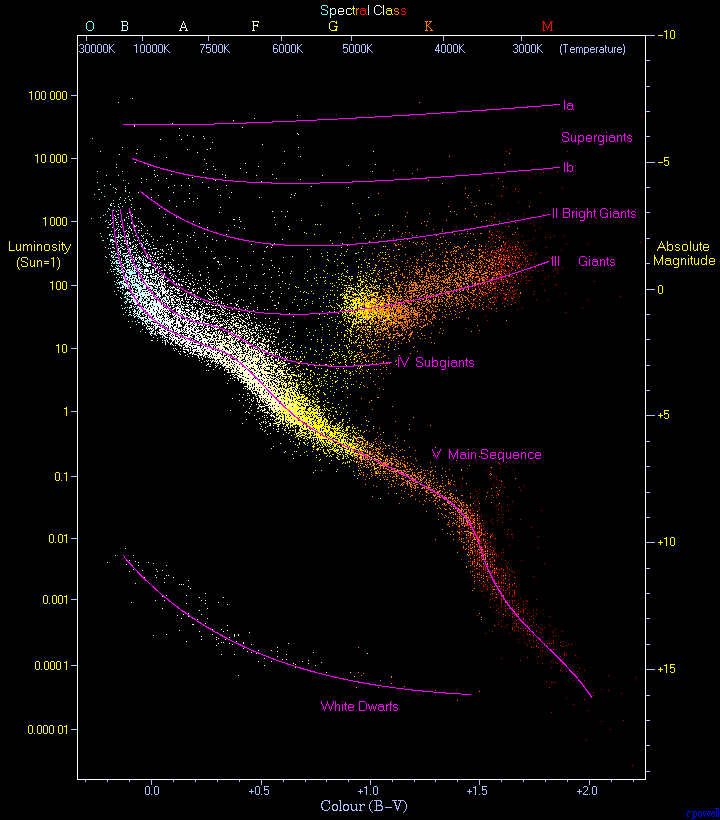
In astronomy, the main sequence is a classification of stars which appear on plots of stellar color versus brightness as a continuous and distinctive band. Stars on this band are known as main-sequence stars or dwarf stars, and positions of stars on and off the band are believed to indicate their physical properties, as well as their progress through several types of star life-cycles. These are the most numerous true stars in the universe and include the Sun. Color-magnitude plots are known as Hertzsprung–Russell diagrams after Ejnar Hertzsprung and Henry Norris Russell.
After condensation and ignition of a star, it generates thermal energy in its dense core region through nuclear fusion of hydrogen into helium. During this stage of the star's lifetime, it is located on the main sequence at a position determined primarily by its mass but also based on its chemical composition and age. The cores of main-sequence stars are in hydrostatic equilibrium, where outward thermal pressure from the hot core is balanced by the inward pressure of gravitational collapse from the overlying layers. The strong dependence of the rate of energy generation on temperature and pressure helps to sustain this balance. Energy generated at the core makes its way to the surface and is radiated away at the photosphere. The energy is carried by either radiation or convection, with the latter occurring in regions with steeper temperature gradients, higher opacity, or both.
The main sequence is sometimes divided into upper and lower parts, based on the dominant process that a star uses to generate energy. The Sun, along with main sequence stars below about 1.5 times the mass of the Sun (1.5 M☉), primarily fuse hydrogen atoms together in a series of stages to form helium, a sequence called the proton–proton chain. Above this mass, in the upper main sequence, the nuclear fusion process mainly uses atoms of carbon, nitrogen, and oxygen as intermediaries in the CNO cycle that produces helium from hydrogen atoms. Main-sequence stars with more than two solar masses undergo convection in their core regions, which acts to stir up the newly created helium and maintain the proportion of fuel needed for fusion to occur. Below this mass, stars have cores that are entirely radiative with convective zones near the surface. With decreasing stellar mass, the proportion of the star forming a convective envelope steadily increases. The main-sequence stars below 0.4 M☉ undergo convection throughout their mass. When core convection does not occur, a helium-rich core develops surrounded by an outer layer of hydrogen.
The more massive a star is, the shorter its lifespan on the main sequence. After the hydrogen fuel at the core has been consumed, the star evolves away from the main sequence on the HR diagram, into a supergiant, red giant, or directly to a white dwarf.
In the early part of the 20th century, information about the types and distances of stars became more readily available. The spectra of stars were shown to have distinctive features, which allowed them to be categorized. Annie Jump Cannon and Edward Charles Pickering at Harvard College Observatory developed a method of categorization that became known as the Harvard Classification Scheme, published in the Harvard Annals in 1901.
In Potsdam in 1906, the Danish astronomer Ejnar Hertzsprung noticed that the reddest stars—classified as K and M in the Harvard scheme—could be divided into two distinct groups. These stars are either much brighter than the Sun or much fainter. To distinguish these groups, he called them "giant" and "dwarf" stars. The following year he began studying star clusters; large groupings of stars that are co-located at approximately the same distance. For these stars, he published the first plots of color versus luminosity. These plots showed a prominent and continuous sequence of stars, which he named the Main Sequence.
At Princeton University, Henry Norris Russell was following a similar course of research. He was studying the relationship between the spectral classification of stars and their actual brightness as corrected for distance—their absolute magnitude. For this purpose, he used a set of stars that had reliable parallaxes and many of which had been categorized at Harvard. When he plotted the spectral types of these stars against their absolute magnitude, he found that dwarf stars followed a distinct relationship. This allowed the real brightness of a dwarf star to be predicted with reasonable accuracy.
Of the red stars observed by Hertzsprung, the dwarf stars also followed the spectra-luminosity relationship discovered by Russell. However, giant stars are much brighter than dwarfs and so do not follow the same relationship. Russell proposed that "giant stars must have low density or great surface brightness, and the reverse is true of dwarf stars". The same curve also showed that there were very few faint white stars.
Hub AI
Main sequence AI simulator
(@Main sequence_simulator)
Main sequence
In astronomy, the main sequence is a classification of stars which appear on plots of stellar color versus brightness as a continuous and distinctive band. Stars on this band are known as main-sequence stars or dwarf stars, and positions of stars on and off the band are believed to indicate their physical properties, as well as their progress through several types of star life-cycles. These are the most numerous true stars in the universe and include the Sun. Color-magnitude plots are known as Hertzsprung–Russell diagrams after Ejnar Hertzsprung and Henry Norris Russell.
After condensation and ignition of a star, it generates thermal energy in its dense core region through nuclear fusion of hydrogen into helium. During this stage of the star's lifetime, it is located on the main sequence at a position determined primarily by its mass but also based on its chemical composition and age. The cores of main-sequence stars are in hydrostatic equilibrium, where outward thermal pressure from the hot core is balanced by the inward pressure of gravitational collapse from the overlying layers. The strong dependence of the rate of energy generation on temperature and pressure helps to sustain this balance. Energy generated at the core makes its way to the surface and is radiated away at the photosphere. The energy is carried by either radiation or convection, with the latter occurring in regions with steeper temperature gradients, higher opacity, or both.
The main sequence is sometimes divided into upper and lower parts, based on the dominant process that a star uses to generate energy. The Sun, along with main sequence stars below about 1.5 times the mass of the Sun (1.5 M☉), primarily fuse hydrogen atoms together in a series of stages to form helium, a sequence called the proton–proton chain. Above this mass, in the upper main sequence, the nuclear fusion process mainly uses atoms of carbon, nitrogen, and oxygen as intermediaries in the CNO cycle that produces helium from hydrogen atoms. Main-sequence stars with more than two solar masses undergo convection in their core regions, which acts to stir up the newly created helium and maintain the proportion of fuel needed for fusion to occur. Below this mass, stars have cores that are entirely radiative with convective zones near the surface. With decreasing stellar mass, the proportion of the star forming a convective envelope steadily increases. The main-sequence stars below 0.4 M☉ undergo convection throughout their mass. When core convection does not occur, a helium-rich core develops surrounded by an outer layer of hydrogen.
The more massive a star is, the shorter its lifespan on the main sequence. After the hydrogen fuel at the core has been consumed, the star evolves away from the main sequence on the HR diagram, into a supergiant, red giant, or directly to a white dwarf.
In the early part of the 20th century, information about the types and distances of stars became more readily available. The spectra of stars were shown to have distinctive features, which allowed them to be categorized. Annie Jump Cannon and Edward Charles Pickering at Harvard College Observatory developed a method of categorization that became known as the Harvard Classification Scheme, published in the Harvard Annals in 1901.
In Potsdam in 1906, the Danish astronomer Ejnar Hertzsprung noticed that the reddest stars—classified as K and M in the Harvard scheme—could be divided into two distinct groups. These stars are either much brighter than the Sun or much fainter. To distinguish these groups, he called them "giant" and "dwarf" stars. The following year he began studying star clusters; large groupings of stars that are co-located at approximately the same distance. For these stars, he published the first plots of color versus luminosity. These plots showed a prominent and continuous sequence of stars, which he named the Main Sequence.
At Princeton University, Henry Norris Russell was following a similar course of research. He was studying the relationship between the spectral classification of stars and their actual brightness as corrected for distance—their absolute magnitude. For this purpose, he used a set of stars that had reliable parallaxes and many of which had been categorized at Harvard. When he plotted the spectral types of these stars against their absolute magnitude, he found that dwarf stars followed a distinct relationship. This allowed the real brightness of a dwarf star to be predicted with reasonable accuracy.
Of the red stars observed by Hertzsprung, the dwarf stars also followed the spectra-luminosity relationship discovered by Russell. However, giant stars are much brighter than dwarfs and so do not follow the same relationship. Russell proposed that "giant stars must have low density or great surface brightness, and the reverse is true of dwarf stars". The same curve also showed that there were very few faint white stars.
Recent media