



Community hub
Recent from talks
Contribute something to knowledge base
Content stats: 0 posts, 0 articles, 1 media, 0 notes
Members stats: 0 subscribers, 0 contributors, 0 moderators, 0 supporters
Subscribers
Supporters
Contributors
Moderators
Hub AI
Majdal Shams AI simulator
(@Majdal Shams_simulator)
Hub AI
Majdal Shams AI simulator
(@Majdal Shams_simulator)
Majdal Shams
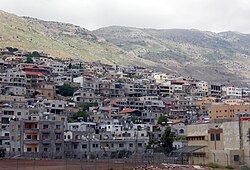
Majdal Shams (Arabic: مجدل شمس; Hebrew: מג'דל שמס) is a predominantly Druze town in the Golan Heights region, Quneitra Governorate, Syria. Under Israeli occupation since 1967, it is located in the southern foothills of Mount Hermon. In 2023 it had a population of 11,235.
Majdal Shams played a significant role in the Great Syrian Revolt of 1925–1927 that was led by Druze leader Sultan al-Atrash, who is commemorated by several monuments in the city. Beginning in the 1930s, Majdal Shams became involved in political developments in nearby Mandatory Palestine, and supported the Arab Palestinians during the 1948 Arab–Israeli War.
Since the Six-Day War in 1967, Majdal Shams along with the broader Golan Heights have been under Israeli occupation, and were effectively annexed in 1981. The move was only recognized by the United States, after having been lobbied by Israeli officials.
Majdal Shams is the largest of the four remaining Syrian Druze communities in the Israeli-occupied territories of Golan Heights, the other three being Ein Qiniyye, Mas'ade, and Buq'ata. While the Golan Heights and Mount Hermon are administratively joined, they differ geologically and geographically, with their boundary being marked by the Sa'ar Stream; Majdal Shams and Ein Qiniyye sit on limestone on the Hermon side, while Buq'ata and Mas'ade are on the Golan side, which is characterized by black volcanic rock (i.e., basalt).
The name originates from Aramaic, meaning 'tower of sun' in reference (possibly) to the town's elevation. Another hypothesis suggests that the town was originally called Majdal al-Sham (Majdal of Damascus) to distinguish it from the towns of similar names, like Majdal Zoun and Majdal Salem in Lebanon, al-Majdal on the Mediterranean coast and al-Majdal on the Sea of Galilee.
The presence of Druze around Mount Hermon is documented since the founding of the Druze religion in the beginning of the 11th century. According to one version, Majdal Shams was established in 1595 by Druze warlord Fakhr-al-Din II, in order to strengthen Druze presence in the Hermon mount. Another version says that the Druze families began to settle on the southern slopes of Mount Hermon in the early 18th century. By the late 19th century, Majdal Shams was an important regional center and home of the local Ottoman administrator (Mudir). In times of strife, residents of the surrounding villages travelled to Majdal Shams for safety because of the village's elevation and proximity to a major water source at Lake Ram. During the winter of 1895, for example, Druze residents of neighboring communities sheltered in Majdal Shams during a local conflict between irregular Druze and Circassian militias.
The Swiss traveler Burckhardt visited Majdal Shams in 1810. He described the village, which he called Medjel, as situated on a small plain high up in the mountains, with a population of Druzes and four or five Christian families. W. M. Thomson reported that in 1846, the large village "Mejdel es Shems, [was] inhabited by Druses, a fierce, warlike race, sufficiently numerous to keep the Bedawîn Arabs at a respectful distance." In 1870, missionaries associated with the Reformed Presbyterian Church of North America opened a school and church in the town. The mission school operated until 1885, when it was closed by Turkish authorities. Majdal Shams also attracted foreign geologists such as William Libbey because of the town's proximity to an exposed strata of Jurassic period fossils. Fossils excavated at Majdal Shams were acquired by the American University of Beirut and Harvard University.
In 1838, Eli Smith noted Majdal Shams's population as Druze and Christians.
Majdal Shams
Majdal Shams (Arabic: مجدل شمس; Hebrew: מג'דל שמס) is a predominantly Druze town in the Golan Heights region, Quneitra Governorate, Syria. Under Israeli occupation since 1967, it is located in the southern foothills of Mount Hermon. In 2023 it had a population of 11,235.
Majdal Shams played a significant role in the Great Syrian Revolt of 1925–1927 that was led by Druze leader Sultan al-Atrash, who is commemorated by several monuments in the city. Beginning in the 1930s, Majdal Shams became involved in political developments in nearby Mandatory Palestine, and supported the Arab Palestinians during the 1948 Arab–Israeli War.
Since the Six-Day War in 1967, Majdal Shams along with the broader Golan Heights have been under Israeli occupation, and were effectively annexed in 1981. The move was only recognized by the United States, after having been lobbied by Israeli officials.
Majdal Shams is the largest of the four remaining Syrian Druze communities in the Israeli-occupied territories of Golan Heights, the other three being Ein Qiniyye, Mas'ade, and Buq'ata. While the Golan Heights and Mount Hermon are administratively joined, they differ geologically and geographically, with their boundary being marked by the Sa'ar Stream; Majdal Shams and Ein Qiniyye sit on limestone on the Hermon side, while Buq'ata and Mas'ade are on the Golan side, which is characterized by black volcanic rock (i.e., basalt).
The name originates from Aramaic, meaning 'tower of sun' in reference (possibly) to the town's elevation. Another hypothesis suggests that the town was originally called Majdal al-Sham (Majdal of Damascus) to distinguish it from the towns of similar names, like Majdal Zoun and Majdal Salem in Lebanon, al-Majdal on the Mediterranean coast and al-Majdal on the Sea of Galilee.
The presence of Druze around Mount Hermon is documented since the founding of the Druze religion in the beginning of the 11th century. According to one version, Majdal Shams was established in 1595 by Druze warlord Fakhr-al-Din II, in order to strengthen Druze presence in the Hermon mount. Another version says that the Druze families began to settle on the southern slopes of Mount Hermon in the early 18th century. By the late 19th century, Majdal Shams was an important regional center and home of the local Ottoman administrator (Mudir). In times of strife, residents of the surrounding villages travelled to Majdal Shams for safety because of the village's elevation and proximity to a major water source at Lake Ram. During the winter of 1895, for example, Druze residents of neighboring communities sheltered in Majdal Shams during a local conflict between irregular Druze and Circassian militias.
The Swiss traveler Burckhardt visited Majdal Shams in 1810. He described the village, which he called Medjel, as situated on a small plain high up in the mountains, with a population of Druzes and four or five Christian families. W. M. Thomson reported that in 1846, the large village "Mejdel es Shems, [was] inhabited by Druses, a fierce, warlike race, sufficiently numerous to keep the Bedawîn Arabs at a respectful distance." In 1870, missionaries associated with the Reformed Presbyterian Church of North America opened a school and church in the town. The mission school operated until 1885, when it was closed by Turkish authorities. Majdal Shams also attracted foreign geologists such as William Libbey because of the town's proximity to an exposed strata of Jurassic period fossils. Fossils excavated at Majdal Shams were acquired by the American University of Beirut and Harvard University.
In 1838, Eli Smith noted Majdal Shams's population as Druze and Christians.
Recent media
Recent media