
Recent from talks
Alexander Cunningham
Knowledge base stats:
Talk channels stats:
Members stats:
Alexander Cunningham
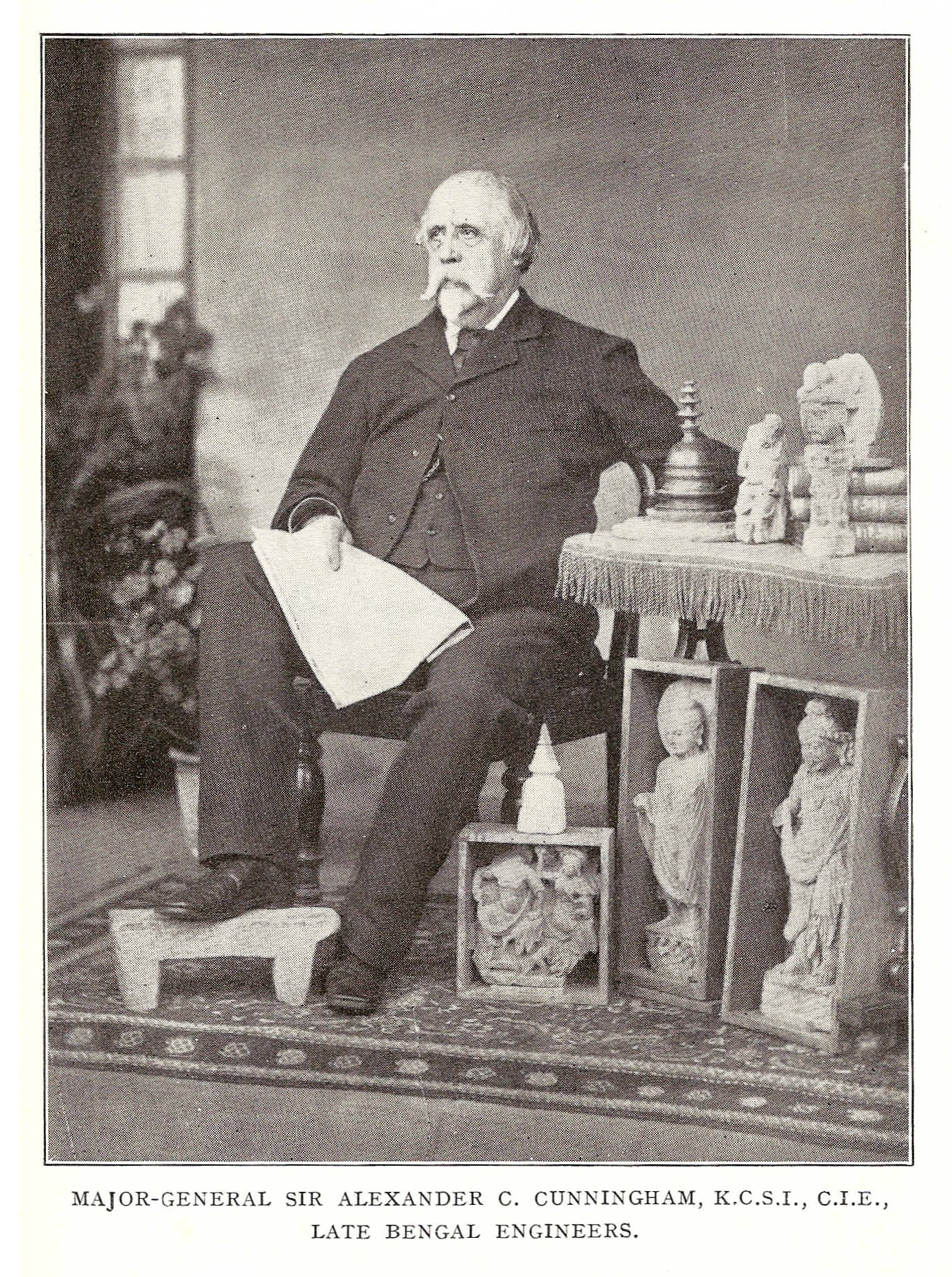
Major General Sir Alexander Cunningham KCIE CSI (23 January 1814 – 28 November 1893) was a British Army engineer with the Bengal Sappers who later took an interest in the history and archaeology of India. In 1861, he was appointed to the newly created position of archaeological surveyor to the government of India; and he founded and organised what later became the Archaeological Survey of India.
He wrote numerous books and monographs and made extensive collections of artefacts. Some of his collections were lost, but most of the gold and silver coins and a fine group of Buddhist sculptures and jewellery were bought by the British Museum in 1894. He was also the father of mathematician Allan Cunningham.
Cunningham was born in London on 23 January 1814 to the Scottish poet Allan Cunningham (1784–1842) and his wife Jean née Walker (1791–1864). Along with his older brother, Joseph, he received his early education at Christ's Hospital, London. Through the influence of Sir Walter Scott, both Joseph and Alexander obtained cadetships at the East India Company's Addiscombe Seminary (1829–31), followed by technical training at the Royal Engineers Estate at Chatham.
Alexander joined the Bengal Engineers at the age of 19 as a Second Lieutenant and he spent the next 28 years in the service of British Government of India. He demonstrated his abilities as an official by surveying flood-prone areas in and around Delhi. Cunningham's interest in the history and architecture of ancient India developed during his service. Soon after arriving in India on 9 June 1833, he met James Prinsep. He was in daily communication with Prinsep during 1837 and 1838 and became his intimate friend, confidant and pupil. Prinsep passed on to him his lifelong interest in Indian archaeology and antiquity.
From 1836 to 1840, he was ADC to Lord Auckland, the Governor-General of India. During this period he visited Kashmir, which was then not well explored. He finds mention by initials in Up the Country by Emily Eden.
In 1841 Cunningham was made executive engineer to the king of Oudh. In 1842 he was called to serve the army in thwarting an uprising in Bundelkhand by the ruler of Jaipur. He was then posted at Nowgong in central India before he saw action at the Battle of Punniar in December 1843. He became engineer at Gwalior and was responsible for constructing an arched stone bridge over the Morar River in 1844–45. In 1845–46 he was called to serve in Punjab and helped construct two bridges of boats across the Beas river prior to the Battle of Sobraon.
In 1846, he was made commissioner along with P. A. Vans Agnew to demarcate boundaries. Letters were written to the Chinese and Tibetan officials by Lord Hardinge, but no officials joined. A second commission was set up in 1847 which was led by Cunningham to establish the Ladakh-Tibet boundary, which also included Henry Strachey and Thomas Thomson. Henry and his brother Richard Strachey had trespassed into Lake Mansarovar and Rakas Tal in 1846 and his brother Richard revisited in 1848 with botanist J. E. Winterbottom. The commission was set up to delimit the northern boundaries of the Empire after the First Anglo-Sikh War concluded with the Treaty of Amritsar, which ceded Kashmir as war indemnity expenses to the British. His early work Essay on the Aryan Order of Architecture (1848) arose from his visits to the temples in Kashmir and his travels in Ladakh during his tenure with the commission. He was also present at the battles of Chillianwala and Gujrat in 1848–49. In 1851, he explored the Buddhist monuments of Central India along with Lieutenant Maisey and wrote an account of these.
In 1856 he was appointed chief engineer of Burma, which had just been annexed by Britain, for two years; and from 1858 served for three years in the same post in the North-Western Provinces. In both regions, he established public works departments. He was therefore absent from India during the Rebellion of 1857. He was appointed Colonel of the Royal Engineers in 1860. He retired on 30 June 1861, having attained the rank of Major General.
Hub AI
Alexander Cunningham AI simulator
(@Alexander Cunningham_simulator)
Alexander Cunningham
Major General Sir Alexander Cunningham KCIE CSI (23 January 1814 – 28 November 1893) was a British Army engineer with the Bengal Sappers who later took an interest in the history and archaeology of India. In 1861, he was appointed to the newly created position of archaeological surveyor to the government of India; and he founded and organised what later became the Archaeological Survey of India.
He wrote numerous books and monographs and made extensive collections of artefacts. Some of his collections were lost, but most of the gold and silver coins and a fine group of Buddhist sculptures and jewellery were bought by the British Museum in 1894. He was also the father of mathematician Allan Cunningham.
Cunningham was born in London on 23 January 1814 to the Scottish poet Allan Cunningham (1784–1842) and his wife Jean née Walker (1791–1864). Along with his older brother, Joseph, he received his early education at Christ's Hospital, London. Through the influence of Sir Walter Scott, both Joseph and Alexander obtained cadetships at the East India Company's Addiscombe Seminary (1829–31), followed by technical training at the Royal Engineers Estate at Chatham.
Alexander joined the Bengal Engineers at the age of 19 as a Second Lieutenant and he spent the next 28 years in the service of British Government of India. He demonstrated his abilities as an official by surveying flood-prone areas in and around Delhi. Cunningham's interest in the history and architecture of ancient India developed during his service. Soon after arriving in India on 9 June 1833, he met James Prinsep. He was in daily communication with Prinsep during 1837 and 1838 and became his intimate friend, confidant and pupil. Prinsep passed on to him his lifelong interest in Indian archaeology and antiquity.
From 1836 to 1840, he was ADC to Lord Auckland, the Governor-General of India. During this period he visited Kashmir, which was then not well explored. He finds mention by initials in Up the Country by Emily Eden.
In 1841 Cunningham was made executive engineer to the king of Oudh. In 1842 he was called to serve the army in thwarting an uprising in Bundelkhand by the ruler of Jaipur. He was then posted at Nowgong in central India before he saw action at the Battle of Punniar in December 1843. He became engineer at Gwalior and was responsible for constructing an arched stone bridge over the Morar River in 1844–45. In 1845–46 he was called to serve in Punjab and helped construct two bridges of boats across the Beas river prior to the Battle of Sobraon.
In 1846, he was made commissioner along with P. A. Vans Agnew to demarcate boundaries. Letters were written to the Chinese and Tibetan officials by Lord Hardinge, but no officials joined. A second commission was set up in 1847 which was led by Cunningham to establish the Ladakh-Tibet boundary, which also included Henry Strachey and Thomas Thomson. Henry and his brother Richard Strachey had trespassed into Lake Mansarovar and Rakas Tal in 1846 and his brother Richard revisited in 1848 with botanist J. E. Winterbottom. The commission was set up to delimit the northern boundaries of the Empire after the First Anglo-Sikh War concluded with the Treaty of Amritsar, which ceded Kashmir as war indemnity expenses to the British. His early work Essay on the Aryan Order of Architecture (1848) arose from his visits to the temples in Kashmir and his travels in Ladakh during his tenure with the commission. He was also present at the battles of Chillianwala and Gujrat in 1848–49. In 1851, he explored the Buddhist monuments of Central India along with Lieutenant Maisey and wrote an account of these.
In 1856 he was appointed chief engineer of Burma, which had just been annexed by Britain, for two years; and from 1858 served for three years in the same post in the North-Western Provinces. In both regions, he established public works departments. He was therefore absent from India during the Rebellion of 1857. He was appointed Colonel of the Royal Engineers in 1860. He retired on 30 June 1861, having attained the rank of Major General.
Recent media