


Community hub
Recent from talks
Contribute something
Nothing was collected or created yet.
Emily Eden
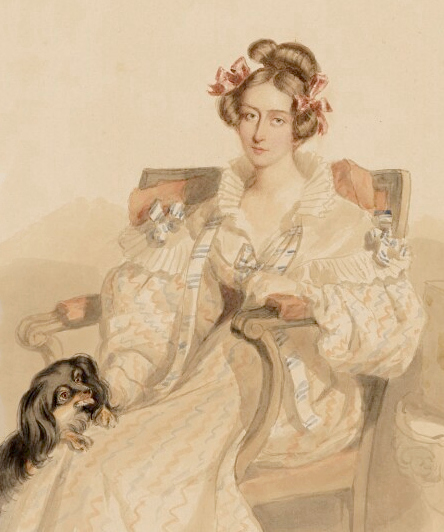
View on WikipediaEmily Eden (3 March 1797 – 5 August 1869)[1] was an English poet and novelist who gave witty accounts of life in the 19th century. She wrote a celebrated account of her travels in India, and two novels that sold well. She was also an accomplished amateur artist.[2][3][4]
Key Information


Family ties
[edit]Born in Westminster, Eden was the seventh daughter of William Eden, 1st Baron Auckland, and his wife Eleanor Elliot. She was the great-great-great-aunt of Prime Minister Anthony Eden.
The India years
[edit]In her late thirties, she and her sister Fanny travelled to India, where her brother George Eden, 1st Earl of Auckland was in residence as Governor-General from 1835 to 1842.[5] She wrote accounts of her time there, which were journal-letters to her other sister, Mary Drummond, later collected in the volume Up The Country: Letters Written to Her Sister from the Upper Provinces of India (1867).[5] While the emphasis of her Indian writings was on travel descriptions, local colour and details of the ceremonial and social functions that she attended, Eden also provided a perceptive record of the major political events that occurred during her brother's term of office. These included the total destruction of a British and Indian army during the retreat from Kabul in 1842, a disaster for which George Eden was held partly responsible.[6]
Eden was also an artist who, during her years in India, created portraits and paintings of Indian princes, soldiers, and servants with both technical skill and "psychological insights".[5] Her book, Portraits of the Princes and People of India, was published in 1844. IT contained 24 lithographs that were drawn from her sketches of important Indian subjects such as Dost Mahomed Khan and Ranjit Singh.[5]
Eden also collected coins.[7]
Fiction
[edit]Eden wrote two successful novels: The Semi-Detached House (1859) and The Semi-Attached Couple (1860). Semi-detached houses were becoming a more widespread form of dwelling for the middle classes, as Britain continued to industrialise and urbanise. The latter book was written in 1829, but not published until 1860. Both have a comic touch that critics have compared with that of Jane Austen, who was Eden's favourite author.[8] The first of the two has been described by John Sutherland as "an accomplished study in the social contrasts of aristocratic style, bourgeois respectability and crass vulgarity."[9]
Eden's letters were published by Violet Dickinson, a close friend of Virginia Woolf. They contain memorable comments on English public life, most famously her welcome for the new King William IV as "an immense improvement on the last unforgiving animal George IV — this man at least wishes to make everybody happy."
Emily Eden's niece Eleanor Lena Eden also took to writing, mainly children's books under the pseudonym Lena. The structure of her 1867 novel Dumbleton Common, which has "Little Miss Patty" detailing gossip in a hamlet outside London, was inspired by Cranford.[10]
Lord Melbourne
[edit]Emily Eden never married and was financially well enough off not to need to write, but did so out of passion. After the death of Lady Caroline Lamb, mutual friends hoped she might marry Lord Melbourne, who had become a close friend, although she claimed to find him "bewildering" and to be shocked by his profanity.[5] Melbourne's biographer Lord David Cecil remarks that it might have been an excellent thing if they had married, but "love is not the child of wisdom, and neither of them wanted to."[11]
Personality
[edit]Her letters explored London, the colonies, and the high seas. Prudence Hannay argues that armed with "strong feelings and a forthright outlook on life, acute powers of observation and a gift of beautifully translating into words the sense of the ridiculous", she devoted her life to writing.[12] In a 2013 history of her brother's term as Governor General of India, Emily Eden is described as a "waspish but adoring" sister, whose diary was to become one of the most celebrated travel accounts of the period.[6]
References
[edit]- ^ Dictionary of National Biography. 1888. p. 356. Retrieved 20 August 2017.
- ^ Poon, Angelia (2017), Enacting Englishness in the Victorian Period: Colonialism and the Politics of Performance, Routledge, pp. 98–, ISBN 978-1-351-94036-8,
By the end of six years, Eden, an accomplished amateur artist, had accumulated a fair number of paintings of ordinary Indians, regal maharajahs and other Indian luminaries, which she subsequently published as Portraits of the Princes and People of India (1844) upon her return to England.
- ^ Nevile, Pran (2010), Sahibs' India: Vignettes from the Raj, Penguin Books India, pp. 42–43, ISBN 978-0-14-306691-0,
Emily Eden, the sister of Lord Auckland, the Governor General (1836-32), was a notable writer and artist. She has left for posterity the remarkable three-volume album of nearly 200 studies entitled 'Watercolour Sketches of Princes and Peoples of India'. Most of the drawings in the album, however, concern the lives of the common people rather than those of the princes. During her travels from Calcutta to Lahore in her brother's suite, she continually sketched the interesting figures she encountered and wrote long letters to her sister which were published in London in 1866 under the title 'Up the Country'. Eden had taken lessons in England from the best drawing masters of the day. Judging from her work we find that she was an accomplished amateur artist and her talent for painting flowered under the Indian sun
- ^ Codell, Julie F.; Macleod, Dianne Sachko (2018), Orientalism Transposed: Impact of the Colonies on British Culture, Routledge, pp. 100–, ISBN 978-0-429-76164-5,
'Emily Eden depicts a different, more privileged point of view.' Published in London two years after her return from the colonial subcontinent in 1842, her volume is a sweeping vision of Indian royalty, political leaders, servants associated with royal households, and even royal pets she encountered during her stay. The 'princes' recorded in her book were mainly political characters crucial to the British imperial enterprise, and took up more space than the 'people' she observed. Of these princes, the Sikh rulers understandably formed the majority, due to the time she spent in the Punjab when the Maharaja Ranjit Singh and Lord Auckland signed a treaty to curb the Russian presence in Afghanistan.
- ^ a b c d e Marian Fowler (1987). Below the Peacock Fan: First Ladies of the Raj. Viking Press. ISBN 978-0-670-80748-2. OCLC 17576624. OL 3236422W. Wikidata Q126672688.
- ^ a b Dalrymple, William (14 January 2014). Return of a King. Knopf Doubleday Publishing. p. 390. ISBN 9780307948533.
- ^ Pratipal Bhatia, "Emily Eden collection of Sasanian, Kushano-Sasanian, Kidarite and Indo-Sasanian type coins (British Museum, London)", Journal of the Oriental Society of Australia, 48, 2016, [97]-134.
- ^ "Not new but fresh", Time, 23 June 1947.
- ^ John Sutherland: Longman Companion to Victorian Fiction (1988), quoted in XIX Century Fiction, Part I, A–K (Jarndyce, Bloomsbury, 2019).
- ^ XIX Century Fiction, Part I, A–K (Jarndyce, Bloomsbury, 2019).
- ^ David Cecil, Lord Melbourne (Constable and Co., London, 1965).
- ^ Prudence Hannay, "Emily Eden as a Letter-Writer", History Today (1971) 21#7 pp 491-501.
Further reading
[edit]- Brigid Allen, George and Emily Eden: Pride, Privilege, Empire and the Whigs. Lutterworth Press, 2024. ISBN 9780718897451
- Janet Dunbar, Golden Interlude: The Edens in India 1836-1842. John Murray, 1955.
- Marian Fowler. Below the Peacock Fan: First Ladies of the Raj. Viking, 1987. ISBN 0-670-80748-6. The first of the four sections is an account of Eden's years in India.
- John Pemble, editor. Miss Fane in India. Allan Sutton Publishing, 1985. ISBN 0-86299-240-0. Accounts of Emily Eden, her sister and Lord Auckland appear in Miss Fane's letters written to her paternal aunt back in England.
- Mary Ann Prior. An Indian Portfolio: the Life and Work of Emily Eden. Quartet Books, 2012. ISBN 9780704372177. This comprehensive study of Emily Eden's life emphasizes the paintings she produced in India from 1836 to 1842.
External links
[edit]

- Works by Emily Eden at Project Gutenberg
- Works by or about Emily Eden at the Internet Archive
- Works by Emily Eden at LibriVox (public domain audiobooks)


Emily Eden
View on GrokipediaEmily Eden (3 March 1797 – 5 August 1869) was an English writer, artist, and traveller, renowned for her vivid accounts of colonial India and Regency-era society.[1] The seventh daughter of William Eden, 1st Baron Auckland, she served as the lifelong companion to her brother George Eden, 1st Earl of Auckland, who was appointed Governor-General of India in 1836.[2] Accompanying him and her sister Fanny to India from 1836 to 1842, Eden produced a series of portraits depicting Indian rulers and their courts, alongside letters that captured the splendors, hardships, and social dynamics of Anglo-Indian life during the early British Raj.[2] These letters, published posthumously as Up the Country in 1866, offer empirical insights into the era's imperial administration and cultural encounters.[3] Earlier works, such as her novels The Semi-Attached Couple (written circa 1830s, published 1860) and The Semi-Detached House (1860), provide witty, observational critiques of English domestic and political circles.[1]
Early Life and Family
Birth and Parentage
Emily Eden was born on 3 March 1797 at Old Palace Yard, Westminster, London, as the tenth of fourteen children to William Eden, 1st Baron Auckland, and his wife Eleanor (née Elliot).[1][4] Her father, William Eden (1745–1814), was a Whig politician and diplomat who negotiated trade treaties, served as Under-Secretary of State, and was elevated to the peerage as Baron Auckland in 1793 for his contributions to Anglo-French relations and economic policy. Eleanor's family provided additional political ties; she was the daughter of Sir Gilbert Elliot, 6th Baronet of Stobs, whose brother Andrew Elliot had been governor of New York, linking the Edens to broader aristocratic and colonial networks. The Eden household reflected the status of a politically active peerage family, with William's career involving frequent residences in London and diplomatic postings, though Emily's early years were primarily spent in England amid the family's estates, including Eden Farm in Beckenham, Kent.[5] Eleanor's death in 1818 left a lasting influence on her unmarried daughters, including Emily, who remained closely tied to her siblings thereafter.[4]Siblings and Household Dynamics
Emily Eden was the seventh of eight daughters born to William Eden, 1st Baron Auckland (1744–1814), a diplomat and politician, and Eleanor Elliot (1757–1818), daughter of Sir Gilbert Elliot, 1st Baronet, of Minto. The couple had fourteen children in total, comprising eight daughters and six sons, though infant mortality reduced the surviving number; notable surviving sons included George Eden (1784–1849), who succeeded his father as 2nd Baron Auckland and was elevated to 1st Earl of Auckland, and Robert Eden (1799–1840), later 3rd Baron Auckland.[6][7] Other sisters included Frances (Fanny) Eden, who accompanied Emily and George to India, and Charlotte Eden, whose son William Godolphin Osborne traveled with the family party in 1835.[4] The Eden household, centered in London and at Eden Farm in Beckenham, Kent, was marked by aristocratic privilege and political engagement, reflecting the father's career in Whig politics and diplomacy, including roles as Under-Secretary for the North and envoy to France during the American Revolutionary War negotiations. Emily received home tutoring alongside her sisters, fostering skills in languages, arts, and social graces suited to elite circles, while the family's connections—such as marriages of elder sisters to peers like Nicholas Vansittart, 1st Baron Bexley—reinforced ties to government and nobility.[8][9] Dynamics within the household emphasized familial loyalty and support, particularly among unmarried siblings; Emily formed a close, lifelong companionship with her brother George, thirteen years her senior, who remained a bachelor and relied on her as confidante and hostess, a bond contemporaries viewed as mildly unconventional yet accepted within Whig social networks. She maintained affectionate correspondence with Fanny, to whom she addressed letters detailing her Indian experiences, underscoring enduring sisterly ties amid separations. The family's structure prioritized collective advancement, with younger siblings like Emily benefiting from elder brothers' positions, though early deaths, such as that of sister Catharine Isabella in 1810, likely influenced a resilient interdependence.[2][10][11]Pre-India Career and Relationships
Social Engagements in Britain
Following the deaths of her parents—her father in 1814 and mother in 1818—Emily Eden and her younger sister Fanny established a household in London with their bachelor brother George Eden, who held positions such as commissioner of the lottery and later First Lord of the Admiralty under Whig administrations.[8] This arrangement positioned the Edens at the heart of Whig political networks, with their home functioning as a key venue for gatherings of party figures including Lord Lansdowne and Lord Brougham, where Emily contributed equally to discussions on policy and current affairs.[8] [12] Eden's social orbit extended to the broader aristocratic milieu of early 19th-century London, where she entertained and corresponded with celebrities and statesmen, leveraging her family's Whig affiliations to influence political circles through personal interactions and sharp observations.[4] A pivotal engagement was her intimate friendship with William Lamb, 2nd Viscount Melbourne—Prime Minister from 1835 to 1835 and again from 1835 to 1841—developed after his wife Caroline Lamb's death in 1828.[13] Mutual acquaintances anticipated a match, and Melbourne, recently widowed, proposed marriage around 1830, an offer Eden rejected despite its probable sincerity amid their shared intellectual and social compatibility.[2] [14] These engagements underscored Eden's role as an unmarried woman navigating elite society without formal political office, relying on familial ties and personal acumen to participate in the era's power dynamics, though her activities waned as her brother's appointment as Governor-General of India loomed in 1836.[15]Correspondence and Association with Lord Melbourne
Emily Eden formed a close friendship with William Lamb, 2nd Viscount Melbourne, during the late 1820s and early 1830s, particularly after the death of his wife, Lady Caroline Lamb, on 26 January 1828.[16] This association developed within Whig political and social circles, where Eden served as a confidante; by 1834, she reported seeing Melbourne "very often and confidentially," without any "sinister designs" on his part, and noted his high spirits upon assuming the premiership in July of that year.[5] Mutual acquaintances anticipated a potential marriage, fueled by Melbourne's admiration, though Eden ranked herself low in his affections, writing in January 1832 to Theresa Lister that she derived "but little vanity" from it, as she "stand very low in the list of his loves."[4] Despite the rapport, Eden rejected Melbourne's proposal of marriage, which biographers describe as likely half-hearted.[16] In the same January 1832 letter to Lister, she expressed reservations, stating, "I do not take to him at all" and elaborating that "he frightens me and bewilders me, and he swears too much."[5] Their interactions remained chaste and intellectually oriented, with Eden later channeling aspects of Melbourne—alongside her brother George—into the character of "Mr. G.," an idealized prime minister in her 1860 novel The Semi-Attached Couple.[16] Correspondence between them intensified as Eden prepared for her departure to India with her brother, Lord Auckland, in 1836. On 24 September 1835, Melbourne sent her a letter enclosing a copy of John Milton's works, expressing profound reluctance to bid farewell: "Very few events could be more painful to me than your going, and therefore I am not unwilling to avoid wishing you good-bye," while promising future letters and advising on health amid Eastern climates.[5] Eden reciprocated with political support, defending Melbourne against Tory accusations following his dismissal by William IV in November 1834 and sharing his private note of dismay: "I do not like to tell my story; I cannot."[5] This exchange underscored a bond of trust, though rumors of engagement were reportedly quashed by her father, underscoring Eden's independence in navigating such overtures.[4]Experiences in India
Journey and Role with Lord Auckland
In October 1835, Emily Eden, then aged 38, joined her brother George Eden, Lord Auckland, and their sister Fanny on the naval frigate HMS Jupiter for a voyage to India, departing from Portsmouth on 3 October.[2][17] The five-month journey covered approximately 10,000 miles via the Cape of Good Hope, during which Eden produced watercolor sketches documenting life aboard ship, including scenes of crew activities and fellow passengers.[2][18] The party reached Calcutta on 4 March 1836, where Lord Auckland was sworn in as Governor-General of India, succeeding Lord William Bentinck.[8][17] Eden's presence was prompted by her brother's bachelor status; lacking a wife, he relied on her to fulfill the duties of official hostess at Government House, the residence of the Governor-General.[19][14] In this capacity, Eden oversaw a household staff exceeding 2,000 servants and managed an extensive social calendar, including levees, balls, and dinners for British officials, Indian princes, and European visitors, which often involved up to 300 guests per event.[14][4] Her role extended to diplomatic protocol, such as receiving tributes and hosting durbars, thereby supporting Auckland's administration amid the formalities of British colonial governance.[19] Despite the position's prestige, Eden privately expressed reservations about the isolation and formalities of Indian society in correspondence, viewing her duties as a familial obligation rather than a personal ambition.[14][4]Extensive Travels and Daily Life
During her brother's tenure as Governor-General, Emily Eden accompanied Lord Auckland on an extensive northern tour from October 21, 1837, to March 1840, traveling from Calcutta up the Ganges River and across the upper provinces to key locations including Patna (arrived November 1), Benares (November 15), Allahabad (December 2), Cawnpore (December 21), Lucknow (December 28), Delhi (February 20, 1838), Simla (April 3, 1838), Ferozepore (November 28, 1838), Lahore (December 21, 1838), and Gwalior (January 10, 1840).[3][4] The expedition involved river navigation on steamers like the Soonamookie and flats, often delayed by sandbanks, followed by land marches covering 5 to 17 miles daily in palanquins, elephant howdahs, carriages, or on horseback, with early starts around 4 to 6 a.m. to avoid peak heat.[3][20] Encampments during the tour housed up to 12,000 people, 850 camels, and 140 elephants in tents with red cloth walls, amid dust storms, mud, fleas, rats, and occasional flooding or theft of supplies such as clothing and horses.[3] Daily routines commenced with marches, followed by breakfast, letter writing, and sketching sessions; afternoons involved rest under punkahs to combat temperatures reaching 90°F (32°C), while evenings featured band music, short walks, tea, and visits from officials or locals.[3][4] Eden frequently sketched ruins (e.g., at Benares ghauts on November 15, 1837, and Delhi's Kootûb on February 23, 1838), native figures, and landscapes, sometimes directing servants to pose or fetch subjects, and participated in durbars such as those at Patna (November 5, 1837), Delhi (February 25, 1838), and Lahore with Maharaja Ranjit Singh (December 2-3, 1838).[3] In settled residences like Government House in Calcutta or Barrackpore, Eden's routine included receiving 60 to 100 visitors from 10 a.m. to noon, luncheon at 2 p.m., rest periods for reading English novels or writing, and dusk drives or elephant rides around 5:30 to 6 p.m., with dinners at 8 p.m. and bed by 10 p.m.[20][4] She managed a household with native servants, cared for pets including dogs (e.g., Chance, groomed as a poodle), a deer named Gazelle, and a squirrel, while gardening and airing rooms to mitigate humidity and insects; health issues like headaches, fever, and influenza prompted cooler retreats to Sandheads or Barrackpore.[20] Challenges pervaded both touring and stationary life, including extreme heat (e.g., 95°F or 35°C indoors), cold nights dropping to 45°F (7°C), cholera outbreaks, and isolation, with limited interactions beyond European elites, rajahs, and servants whom she viewed as picturesque but distant.[3][4]Political and Social Observations
Emily Eden's letters and journals from her time in India (1836–1842) reveal a discerning eye for the intricacies of British colonial governance and the prevailing political dynamics under her brother Lord Auckland's administration as Governor-General. She documented the elaborate durbars and levées, such as the gathering of 70 native nobility in Benares in November 1837, which underscored the ceremonial pomp required to maintain authority amid diverse princely states.[3] Eden noted the logistical burdens of gubernatorial progresses, involving up to 12,000 attendants and 850 camels for routine marches, highlighting inefficiencies like steamer delays attributed to broader imperial orders from the Persian Gulf.[3] She advocated for policies encouraging meritorious natives, critiquing the neglect that stifled local talent, as observed during her April 1838 halt at Sabathoo.[3] Eden's commentary extended to interactions with regional rulers, portraying Maharaja Ranjit Singh of Punjab as a just governor with a disciplined army, though marred by personal excesses like drunkenness; she attended his durbars at Ferozepore in late 1838, where lavish nautch performances and gifts masked underlying Sikh political tensions.[3] [20] Accounts of dethroned rajahs pleading for intervention, as in Simla in May 1838, reflected British non-interference doctrines, which she viewed pragmatically amid appeals for restoration.[3] Regarding the First Anglo-Afghan War (1839–1842), initiated during Auckland's tenure to counter perceived Russian and Persian threats, Eden expressed early uncertainty over Cabul and Kandahar intrigues in August 1838, noting intercepted letters and Persian sieges of Herat as escalatory factors; later dispatches conveyed growing anxiety, though official narratives sanitized officer hardships to mere shortages of wine and cigars.[3] [20] On the social front, Eden's writings depict stark contrasts in Indian society, from the opulence of rajahs' courts—evident in the Benares rajah's unprecedented illuminations—to widespread famine distress, where she witnessed skeletal children and oversaw daily feeding of 700 at Kynonze in January 1838.[3] She observed entrenched customs like Hindu sepoys' ritual ablutions and tree veneration during marches near Thanesir in March 1839, alongside horrors such as female infanticide in Jummoo families and Gholab Singh's reported flaying of 300 men.[3] Eden critiqued British influences for "merchandising" and spoiling native economies, while decrying local magistrates' oppression that eroded trust in justice, as relayed in June 1839.[3] Her portrayal of servants' resilience—67 enduring initial discomforts without lodging in Simla—contrasted with class contempt toward "uncovenanted" clerks, revealing intra-colonial hierarchies.[3] Sikh chiefs' fascination with European dances at Simla balls in October 1839 illustrated tentative cultural exchanges, yet her accounts often framed natives through a lens of picturesque detachment, emphasizing visual spectacle over deeper integration.[3] [20] In "Letters from India," she further noted persistent practices like sati, as in the November 1840 immolation of two young wives with Noor Mahal, and the social isolation afflicting British women amid native festivals such as Mohurrum, which disrupted routines in April 1837.[20]Creative Works
Artistic Productions
Emily Eden produced an extensive body of artwork primarily during her residence in India from 1836 to 1842, consisting mainly of pencil sketches and watercolor paintings that documented landscapes, daily life, and notable figures encountered during travels accompanying her brother, Lord Auckland.[21] [22] These works, numbering in the hundreds, served as personal visual records rather than formal commissions, capturing scenes of Indian aristocracy, servants, royal ceremonies, and political events with attention to ethnographic detail.[23] [21] Her most prominent artistic publication, Portraits of the Princes and People of India (1844), comprises 24 hand-colored lithographic plates derived from her original sketches, lithographed by Lowes Cato Dickinson and issued in four privately printed parts.[24] [25] [26] The volume depicts Indian rulers and their families met during Lord Auckland's tenure, including portraits such as those of the Akalees or Immortals, rendered with fine detail in monochrome and hand-painted variants to convey cultural attire and settings.[27] [28] Eden's originals were worked up post-return to England in 1842, emphasizing observational accuracy over artistic embellishment.[26] Original sketches and watercolors are held in public collections, with the Victoria Memorial Hall in Kolkata maintaining the largest assemblage of her Indian-period works.[21] Additional pieces, classified as prints and drawings, reside in institutions like the Asian Art Museum, which catalogs 34 such items focused on South Asian subjects.[29] These artworks have been exhibited, as in the Phoenix Art Museum's 2020 display of selections from Portraits of the Princes and Peoples of India, highlighting their value as 19th-century visual ethnographies.[30] Eden's productions reflect amateur proficiency honed through self-taught practice, prioritizing documentary fidelity amid the logistical challenges of colonial travel.[22]Literary Publications
Emily Eden's principal literary contributions were two novels published in the late 1850s, drawing on her observations of British social life, followed by posthumous editions of her correspondence from India. The Semi-Detached House, released in 1859, satirizes the pretensions and domestic absurdities of middle-class suburban life in England, reflecting the era's growing popularity of semi-detached housing among the aspiring gentry.[31] Written with sharp wit, it critiques social climbing and marital mismatches through the story of a baronet's family navigating new neighbors and personal vanities.[32] The following year, 1860, saw the publication of The Semi-Attached Couple, a novel she had composed earlier in life, possibly during the 1830s, which examines the tensions of an arranged marriage between an impulsive young woman and a reserved aristocrat, highlighting incompatibilities in temperament and class expectations.[33] Both works earned acclaim for their humorous portrayals of Regency and Victorian societal norms, establishing Eden as a notable commentator on interpersonal dynamics.[34] Her Indian experiences informed subsequent publications of her private letters, edited and released after her death in 1869. Up the Country: Letters Written to Her Sister from the Upper Provinces of India, compiled from correspondence dated 1837–1839 during travels with her brother Lord Auckland, appeared in 1866 via publisher Richard Bentley in London; these vivid dispatches detail the rigors of overland journeys, encounters with local rulers, and the isolation of colonial administration, blending personal anecdotes with candid critiques of imperial pomp.[35] [36] A larger collection, Letters from India, edited by her niece Eleanor Eden and issued in two volumes in 1872, encompasses broader epistolary material from her time in Calcutta and beyond, offering insights into daily governance, social events, and the physical hardships of the climate, with unvarnished reflections on Anglo-Indian society.[20] [37] These volumes, valued for their unfiltered prose and historical detail, were drawn directly from originals without substantial alteration, preserving Eden's voice as a perceptive observer.[38]Personality, Later Years, and Legacy
Character Traits and Personal Views
Emily Eden exhibited a sharp wit and biting humor, evident in her letters where she playfully critiqued social absurdities, such as imagining post-childbearing "lie-ins" for novels or china instead of more children.[5] Her observational acuity allowed her to capture eccentricities with precision, often employing self-aware irony, as in describing herself as "about as fit to go to the play as to go in a balloon."[5] Intelligent yet occasionally deemed "wrong-headed" by contemporaries like Charles Greville, she prioritized personal independence, rejecting marriage in 1832 with the assertion, "I am too old to marry... I know that I am very happy now, and have been so for some years, and that I had rather not change."[15] [5] Deeply devoted to her family, particularly her brother George, she served as his steadfast companion in India, enduring hardships out of loyalty rather than ambition.[15] [4] Eden's personal views reflected an aristocratic attachment to English identity and comforts, fostering a critical stance toward colonial life in India, which she termed a "hot land of strangers" and whose climate she lamented as "so very HOT, I do not know how to spell it large enough."[4] She perceived Indians as picturesque yet uncivilized, noting their "mud huts" and light dress with detachment, while resisting "Indianization" and longing for European society, books, and letters that she valued above rupees.[4] Though embedded in empire, she critiqued colonial attitudes and admired select non-British figures, such as the "kingly" Dost Muhammad Khan, and Mughal architecture in Delhi, contrasting it unfavorably with Calcutta's provincial women.[15] Politically shaped by her Whig family, she found Tories "a shade more dull" than Whigs and abandoned direct political engagement after personal setbacks, while decrying gender inequities: "tho’ a man be raised high in office, yet that the unfortunate women remain just as poor as ever."[5] She preferred rural English simplicity over urban or colonial excess, deeming "every day spent in London... a mistake."[5]Post-India Life and Death
Upon her return to England in 1842, after accompanying her brother George Eden, Lord Auckland, during his tenure as Governor-General of India from 1836 to 1842, Emily Eden settled into a life centered on London society and literary pursuits. She privately published Portraits of the Princes and People of India in 1844, a collection of 24 lithographed images derived from her sketches made during extensive travels in India. Following Lord Auckland's death in 1849, Eden maintained an active presence in elite social circles, hosting from her residence at Eden Lodge in London, where she remained a fixture among Whig-connected aristocrats and intellectuals for over two decades. In her later years, Eden focused on writing, producing novels that drew on observations of English domestic and social life, including The Semi-Detached House in 1859 and The Semi-Attached Couple in 1860, both of which received favorable notice for their wit and character depictions. She also edited and published Up the Country: Letters Written to Her Sister from the Upper Provinces of India in 1866, compiling correspondence from her Indian travels that offered candid insights into colonial administration and daily hardships. These works reflected her enduring interest in memorializing personal experiences, though she expressed private reservations about the imperial project's long-term viability in later reflections. Emily Eden died on 5 August 1869 at Eden Lodge, aged 72, after a period of declining health. She was buried at Tunbridge Wells, where she had occasionally resided in later life. Her passing marked the end of a prominent unmarried sibling partnership that had shaped much of her public and private identity.[8]Reception, Influence, and Critical Assessments
Emily Eden's posthumously published collections Up the Country: Letters Written to Her Sister from the Upper Provinces of India (1866) and Letters from India (1872) garnered immediate popularity among Victorian readers for their candid, anecdotal portrayals of British colonial life, travel hardships, and encounters with Indian society during the Auckland administration from 1836 to 1842.[39] Contemporary reviewers highlighted the works' charm and wit, though some noted inconsistencies in tone, ranging from melancholic reflections on imperial isolation to lighter observations of daily discomforts like extreme heat and monotonous routines.[40] These texts provided rare female perspectives on the Anglo-Afghan War's prelude and regional poverty, influencing public understanding of Britain's expanding role in northern India without overt policy advocacy.[41] Modern scholarly assessments frequently apply Edward Said's framework of Orientalism to Eden's writings, identifying patterns of cultural othering—such as depictions of Indians as superstitious or effeminate—that reinforced British self-perception as rational administrators, thereby sustaining imperial legitimacy.[42] [39] Yet analyses also underscore nuances, including Eden's occasional empathy for local hardships and detachment from unqualified Western superiority, complicating simplistic Orientalist readings and revealing her as a product of Whig aristocratic values rather than unreflective propagandist.[43] Her commitment to empire emerges through sympathetic yet paternalistic accounts of famine-stricken regions and princely courts, framing British intervention as a civilizing duty amid critiques of indigenous governance inefficiencies.[40] [44] These letters serve as primary sources in studies of gender dynamics in colonialism, where Eden's unmarried status and viceregal proximity enabled unfiltered commentary on power imbalances, though often filtered through class privilege.[4] Eden's artistic output, including over 130 watercolor sketches compiled into Portraits of the Princes and Peoples of India (1844, privately printed lithographs), received acclaim from peers like Fanny Parks, who described them as "most spirited and masterly" for capturing royal ceremonies, ethnic diversity, and everyday scenes with ethnographic detail.[22] Exhibited in institutions such as the Phoenix Art Museum in 2020, these works endure as visual records of pre-1857 princely states, influencing later colonial iconography by blending portraiture with travelogue realism, though critiqued for exoticizing subjects to affirm British gaze.[30] Their influence extends to historiography, providing verifiable depictions of figures like the Maharaja of Lahore, Ranjit Singh, absent from official records, and informing analyses of visual Orientalism in amateur British art.[45] Overall, Eden's oeuvre has shaped understandings of mid-19th-century Anglo-Indian relations, valued for empirical insights despite interpretive debates over inherent biases in elite colonial narratives.[46]References
- https://en.wikisource.org/wiki/Dictionary_of_National_Biography%2C_1885-1900/Eden%2C_Emily