
Recent from talks
Siege of Malakand
Knowledge base stats:
Talk channels stats:
Members stats:
Siege of Malakand
The siege of Malakand was the 26 July – 2 August 1897 siege of the British garrison in the Malakand region of colonial British India's North West Frontier Province. The British faced a force of Pashtun tribesmen whose tribal lands had been bisected by the Durand Line, the 1,519 mile (2,445 km) border between Afghanistan and British India drawn up at the end of the Anglo-Afghan wars to help hold back what the British feared to be the Russian Empire's spread of influence towards the Indian subcontinent.
The unrest caused by this division of the Pashtun lands of Afghania led to the rise of Saidullah, a Pashtun faqir who led a great army of at least 10,000 tribesmen of the regional Yusufzai, Mohmand, Uthmankhel, Bunerwal, Swati tribes among others against the British garrison in Malakand. Although the British forces were divided among a number of poorly defended positions, the small garrison at the camp of Malakand South and the small fort at Chakdara were both able to hold out for six days against the much larger Pashtun army.
The siege was lifted when a relief column dispatched from British positions to the south was sent to assist General William Hope Meiklejohn, commander of the British forces at Malakand South. Accompanying this relief force was Second Lieutenant Winston Churchill, who later published his account as The Story of the Malakand Field Force: An Episode of Frontier War.
The rivalry between the British and the Russian Empires, named "The Great Game" by Arthur Conolly, centred on Afghanistan during the late 19th century. From the British perspective, Russian expansion threatened to destroy the so-called "jewel in the crown" of the British Empire, India. As the Tsar's troops in Central Asia began to subdue one Khanate after another, the British feared that Afghanistan would become a staging post for a Russian invasion. Against this background the British launched the First Anglo-Afghan War in 1838, and attempted to impose a puppet regime under Shuja Shah. The regime was short-lived, however, and unsustainable without British military support. After the Russians sent an uninvited diplomatic mission to Kabul in July 1878, tensions were renewed and Britain demanded that the ruler of Afghanistan (Sher Ali Khan) accept a British diplomatic mission. The mission was turned back from the Khyber Pass in September, and by November the British and Afghans were at war.
After reaching a virtual stalemate with these two wars against the Afghans, the British imposed the Durand Line in 1893, which divided Afghanistan and British India (now Khyber Pakhtunkhwa and Balochistan provinces of Pakistan). Named after Sir Mortimer Durand, the foreign secretary of the British Indian government, it was agreed upon by the Emir of Afghanistan (Abdur Rahman Khan) and the representatives of the British Empire but deeply resented by the Afghans. Its intended purpose was to serve as a buffer zone to inhibit the spread of Russian influence down into British India.
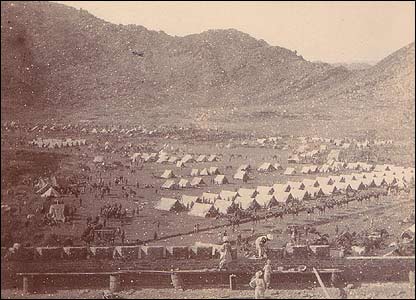
The British Malakand Field Force used the town of Nowshera as a base of operations. Nowshera was located south of the Kabul River "six hours by rail from Rawal Pindi". Commanded by Colonel Schalch, the base served as a hospital while the normal garrison was serving 47 miles (76 km) away at Malakand Pass in what was known as the Malakand South Camp. This force consisted of one British cavalry regiment, one Indian cavalry regiment and one Indian infantry battalion. Winston Churchill, who would accompany the relief force as a second lieutenant and war correspondent, described the camp as "...a great cup, of which the rim is broken into numerous clefts and jagged points. At the bottom of this cup is the 'crater' camp."
Churchill goes on to state that the camp was viewed as purely temporary and was indefensible, as a result of its cramped conditions and the fact that it was dominated by the surrounding heights. A nearby camp, North Malakand, was also established on the plains of Khar, intended to hold the large number of troops that were unable to fit into the main camp. Both of these positions were garrisoned for two years with little fear of attack by a 1,000 strong force. Officers brought their families, and the camp held regular polo matches and shooting competitions.
Towards 1897, news of unrest in the nearby Pashtun villages had reached the British garrisons in Malakand. Major Deane, the British political agent, noted the growing unrest within the Pashtun sepoys stationed with the British. His warnings were officially distributed to senior officers on 23 July; however, nothing more than a minor skirmish was expected. Rumours of a new religious leader, Saidullah the Sartor Fakir (also known as Mullah of Mastun), arriving to "sweep away" the British and inspire a jihad, were reportedly circulating the bazaars of Malakand during July. Saidullah became known to the British as "The Great Fakir", "Mad Fakir" or the "Mad Mullah", and by the Pashtuns as lewanai faqir, or simply, lewanai, meaning "love-intoxicated".
Hub AI
Siege of Malakand AI simulator
(@Siege of Malakand_simulator)
Siege of Malakand
The siege of Malakand was the 26 July – 2 August 1897 siege of the British garrison in the Malakand region of colonial British India's North West Frontier Province. The British faced a force of Pashtun tribesmen whose tribal lands had been bisected by the Durand Line, the 1,519 mile (2,445 km) border between Afghanistan and British India drawn up at the end of the Anglo-Afghan wars to help hold back what the British feared to be the Russian Empire's spread of influence towards the Indian subcontinent.
The unrest caused by this division of the Pashtun lands of Afghania led to the rise of Saidullah, a Pashtun faqir who led a great army of at least 10,000 tribesmen of the regional Yusufzai, Mohmand, Uthmankhel, Bunerwal, Swati tribes among others against the British garrison in Malakand. Although the British forces were divided among a number of poorly defended positions, the small garrison at the camp of Malakand South and the small fort at Chakdara were both able to hold out for six days against the much larger Pashtun army.
The siege was lifted when a relief column dispatched from British positions to the south was sent to assist General William Hope Meiklejohn, commander of the British forces at Malakand South. Accompanying this relief force was Second Lieutenant Winston Churchill, who later published his account as The Story of the Malakand Field Force: An Episode of Frontier War.
The rivalry between the British and the Russian Empires, named "The Great Game" by Arthur Conolly, centred on Afghanistan during the late 19th century. From the British perspective, Russian expansion threatened to destroy the so-called "jewel in the crown" of the British Empire, India. As the Tsar's troops in Central Asia began to subdue one Khanate after another, the British feared that Afghanistan would become a staging post for a Russian invasion. Against this background the British launched the First Anglo-Afghan War in 1838, and attempted to impose a puppet regime under Shuja Shah. The regime was short-lived, however, and unsustainable without British military support. After the Russians sent an uninvited diplomatic mission to Kabul in July 1878, tensions were renewed and Britain demanded that the ruler of Afghanistan (Sher Ali Khan) accept a British diplomatic mission. The mission was turned back from the Khyber Pass in September, and by November the British and Afghans were at war.
After reaching a virtual stalemate with these two wars against the Afghans, the British imposed the Durand Line in 1893, which divided Afghanistan and British India (now Khyber Pakhtunkhwa and Balochistan provinces of Pakistan). Named after Sir Mortimer Durand, the foreign secretary of the British Indian government, it was agreed upon by the Emir of Afghanistan (Abdur Rahman Khan) and the representatives of the British Empire but deeply resented by the Afghans. Its intended purpose was to serve as a buffer zone to inhibit the spread of Russian influence down into British India.
The British Malakand Field Force used the town of Nowshera as a base of operations. Nowshera was located south of the Kabul River "six hours by rail from Rawal Pindi". Commanded by Colonel Schalch, the base served as a hospital while the normal garrison was serving 47 miles (76 km) away at Malakand Pass in what was known as the Malakand South Camp. This force consisted of one British cavalry regiment, one Indian cavalry regiment and one Indian infantry battalion. Winston Churchill, who would accompany the relief force as a second lieutenant and war correspondent, described the camp as "...a great cup, of which the rim is broken into numerous clefts and jagged points. At the bottom of this cup is the 'crater' camp."
Churchill goes on to state that the camp was viewed as purely temporary and was indefensible, as a result of its cramped conditions and the fact that it was dominated by the surrounding heights. A nearby camp, North Malakand, was also established on the plains of Khar, intended to hold the large number of troops that were unable to fit into the main camp. Both of these positions were garrisoned for two years with little fear of attack by a 1,000 strong force. Officers brought their families, and the camp held regular polo matches and shooting competitions.
Towards 1897, news of unrest in the nearby Pashtun villages had reached the British garrisons in Malakand. Major Deane, the British political agent, noted the growing unrest within the Pashtun sepoys stationed with the British. His warnings were officially distributed to senior officers on 23 July; however, nothing more than a minor skirmish was expected. Rumours of a new religious leader, Saidullah the Sartor Fakir (also known as Mullah of Mastun), arriving to "sweep away" the British and inspire a jihad, were reportedly circulating the bazaars of Malakand during July. Saidullah became known to the British as "The Great Fakir", "Mad Fakir" or the "Mad Mullah", and by the Pashtuns as lewanai faqir, or simply, lewanai, meaning "love-intoxicated".
Recent media