


Community hub
Recent from talks
Contribute something
Nothing was collected or created yet.
Arthur Conolly
View on Wikipedia
Arthur Conolly (2 July 1807, London – 17 June 1842, Bukhara) was a British intelligence officer, explorer and writer. He was a captain of the 6th Bengal Light Cavalry in the service of the British East India Company.[1] He participated in many reconnaissance missions into Central Asia and coined the term The Great Game to describe the struggle between the United Kingdom and the Russian Empire for domination over Central Asia.
Key Information


Biography
[edit]A descendant of an Ó Conghalaigh clan of Ireland, Conolly was a cousin of Sir William Macnaghten, Secretary of the British East India Company's Political and Secret Department.[2]
As a sixteen-year-old impressionable cadet, he sailed to India on the Grenville and listened to Reginald Heber, the newly-appointed Bishop of Calcutta, evangelise. Thereafter, Conolly sought to win over Muslims to a "kindlier" view of Christians, the first step - in his view - of propagating the Gospel.[2]
In July 1840, in a correspondence with Major Henry Rawlinson, who had been recently appointed as the political agent in Kandahar, Conolly stated:
You've a great game, a noble game, before you.[3]
Conolly believed that Rawlinson's new post gave him the opportunity to advance humanitarianism in Afghanistan, and summed up his hopes:[4]
If the British Government would only play the grand game – help Russia cordially to all that she has a right to expect – shake hands with Persia – get her all possible amends from Oosbegs – force the Bokhara Amir to be just to us, the Afghans, and other Oosbeg states, and his own kingdom – but why go on; you know my, at any rate in one sense, enlarged views. Inshallah! The expediency, nay the necessity of them will be seen, and we shall play the noble part that the first Christian nation of the world ought to fill."[2]
Often travelling in disguise, he used the name "Khan Ali" in a word-play on his true name. In late 1829, he left Moscow for the Caucasus and Central Asia, arriving in Herat in September 1830 and in India in January 1831. In 1834, he published an account of his trip, which established his reputation as a traveller and writer.[5]

In 1841, in an attempt to counter the growing penetration of Russia into Central Asia, Conolly unsuccessfully tried to persuade the various khanates there to put aside their differences. In November 1841 he was captured while on a rescue mission to free fellow British officer Lieutenant Colonel Charles Stoddart, held in Bukhara.[6] The two were executed by the Emir of Bukhara, Nasrullah Khan, on 24 June 1842 on charges of spying for the British Empire. They were both beheaded in the square in front of the Ark of Bukhara.[7] Arthur Conolly's elder brother, Lieutenant Henry Valentine Conolly, administrator of Malabar, was murdered in 1855 in Calicut (in present-day Kerala, South India).
Legacy
[edit]In 1845, Rev Joseph Wolff, who had undertaken an expedition to discover the two officers' fate and barely escaped with his life, published an extensive account of his travels in Central Asia, which made Conolly and Stoddart household names in Britain for years to come.
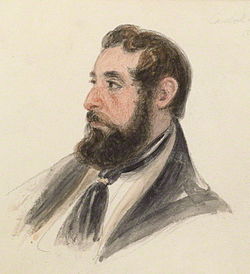
Conolly's portrait by James Atkinson is in the British National Portrait Gallery. His 1840–1842 diaries as well as his letters and reports to Sir John Hobhouse and William Cabell are in the British Library; his 1839 letters to Viscount Ponsonby are in the Durham University Library.
References
[edit]Notes
[edit]- ^ Stephen, Leslie, ed. (1887). . Dictionary of National Biography. Vol. 12. London: Smith, Elder & Co.
- ^ a b c Brysac, Shareen; and Meyer, Karl. Tournament of Shadows: The Great Game and the Race for Empire in Asia. Basic Books.
- ^ J.W. Kaye, Lives of Indian Officers, 2 vols, (1867), ii, p.101. cited in the 2000 Lectures and Memoirs, by the British Academy, Chapter: The Legend of the Great Game by Malcolm Yap. pages 180-1
- ^ 2000 Lectures and Memoirs, by the British Academy, Chapter: The Legend of the Great Game by Malcolm Yap. pages 180-1
- ^ Journey to the North of India through Russia, Persia and Afghanistan, Lt. Arthur Conolly. London, Richard Bentley, 1834. Volume 1 and Volume 2
- ^ s:Dictionary of Indian Biography/Conolly, Arthur
- ^ "Dictionary of National Biography volume 12.djvu/31". wikisource.org. Retrieved 16 September 2012.
Bibliography
[edit]
- Lt. Arthur Conolly. Journey to the North of India through Russia, Persia and Afghanistan- (2 Vols.). London, Richard Bentley, 1834. Reprints:
- Elibron Classics, 2002.
- New Delhi, Laurier Books Ltd, Asian Educational Services, 2001, ISBN 81-206-1589-1
- Hopkirk, Peter (1992). The Great Game: The Struggle for Empire in Central Asia. Kodansha International. pp. 564. ISBN 9781568360225.
- Meyer, Karl; Brysac, Shareen (2006). Tournament of Shadows: The Great Game and the Race for Empire in Asia. Basic Books. p. 704. ISBN 9780465045761.
- Stephen M. Bland Does it yurt? Travels in Central Asia or How I Came to Love the Stans, Hertfordshire Press, 2016, ISBN 978-1910886298
- Leonard Arthur Bethell, Tales from the Outposts - Vol 1, Frontiers of Empire. Edinburgh: Blackwood. 1st edition 1932, pp 267-268. See - 'The Silver Hand of Alexander'.
- Rev. Joseph Wolff (1795 - 1862). Narrative of a mission to Bokhara, in the years 1843-1845, to ascertain the fate of Colonel Stoddart and Captain Conolly. London, J.W. Parker, 1845. First and second (revised) edition both came out in 1845. Reprints:
- New York, Harper & Bros., 1845
- Edinburgh and London, William Blackwood & Sons, 1848
- New York, Arno Press, 1970 ISBN 0-405-03072-X
- Elibron Classics, 2001, ISBN 1-4021-6116-6
- A mission to Bokhara. Edited and abridged with an introduction by Guy Wint. London, Routledge & K. Paul, 1969. ISBN 0-7100-6456-X
| International | |
|---|---|
| National | |
| Other | |

Arthur Conolly
View on GrokipediaEarly Life and Education
Family Background and Upbringing
Arthur Conolly was born in London in 1807 to Valentine Conolly, a resident of 37 Portland Place, and his wife Matilda Dunkin.[3][4] He was one of six sons in the family, which traced its ancestry to the Ó Conghalaigh clan of Ireland, reflecting a heritage of Irish gentry with connections to British colonial administration.[3][5] Conolly was also a cousin to Sir William Macnaghten, later Secretary of the British East India Company, through familial ties that facilitated his entry into imperial service.[5] By the age of twelve, Conolly was orphaned following the deaths of both parents within a single week, an event that abruptly ended his early home life in London and shifted responsibility for his care to guardians or relatives.[1] This loss marked a pivotal disruption in his upbringing, compelling a transition to institutional education and self-reliance amid the era's norms for children of Anglo-Irish military or administrative families.[1] The family's Protestant Anglo-Irish background, common among East India Company officers, likely instilled values of duty, exploration, and evangelical Christianity that influenced Conolly's later career choices, though direct evidence of parental influence remains limited due to his young age at their passing.[3]Formal Education and Early Influences
Conolly received his initial formal education at Rugby School in Warwickshire after being orphaned at the age of twelve, when his parents died within a week of each other in 1819.[1] On 3 May 1822, he enrolled at the Addiscombe Military Seminary, the East India Company's training institution for aspiring officers, to prepare for artillery or infantry service. However, he resigned soon after obtaining a coveted cavalry cadetship and sailed for Bengal in the same year, marking his entry into active military duty at age fifteen.[1] Early influences on Conolly included his family's connections to British imperial administration, as the son of Valentine Conolly, a Fellow of the Royal Society residing at 37 Portland Place in London, which facilitated his rapid advancement into East India Company service. Additionally, a religious disposition, characterized by evangelical Protestant convictions prevalent in early nineteenth-century Britain, instilled in him a sense of moral purpose and adventurism that complemented his military training.[6][7] This blend of imperial orientation and personal faith foreshadowed his later involvement in intelligence and exploratory missions.[8]Military and Intelligence Career
Commission in the East India Company
Arthur Conolly, born on 2 July 1807, secured a cadetship in the Bengal Presidency Army of the British East India Company in 1823 at the age of sixteen, following brief attendance at Rugby School and the Addiscombe Military Seminary.[9] This appointment, typical for young men of British families seeking military careers in India, involved nomination through Company directors or patronage networks, with cadets destined for infantry or cavalry regiments after arrival and basic training.[1] He departed England that year aboard the ship Grenville, sharing the voyage with Bishop Reginald Heber, whose evangelical influence reportedly shaped Conolly's later religious convictions.[3] Upon reaching Calcutta, Conolly was posted to the 6th Bengal Native Light Cavalry, a regiment raised in 1801 for reconnaissance and irregular warfare duties in northern India.[9] As a newly commissioned cornet—the junior cavalry rank equivalent to an infantry ensign—Conolly began active service amid the Company's expanding frontier operations, though specific early postings remain sparsely documented beyond regimental attachments in the Bengal Presidency.[1] His rapid adaptation to military life positioned him for subsequent promotions, reaching lieutenant by the late 1820s, reflecting competence in horsemanship and command expected of light cavalry officers.[9]Service in India and Initial Operations
Conolly arrived in India in 1823 following education at Rugby School and Addiscombe Military Seminary, enlisting as a cadet in the East India Company's 6th Bengal Native Light Cavalry.[2] He sailed aboard the Grenville at age sixteen, marking the start of his military career in the Bengal Presidency.[1] Appointed cornet upon arrival, Conolly advanced to lieutenant on 13 May 1826. His early duties involved standard cavalry operations, including patrols and escorts in northern India, amid the Company's expansion and frontier tensions during the First Anglo-Burmese War (1824–1826), though specific engagements for his unit remain undocumented in primary records. By 1829, Conolly was on sick leave in England, during which he sought and received permission for overland travel back to India via Constantinople and Persia, initiating informal reconnaissance that foreshadowed his later intelligence roles. He resumed active service upon return, attaining captaincy on 30 July 1838 while continuing duties with the 6th Bengal Light Cavalry.Entry into Central Asian Intelligence Work
Conolly's transition to Central Asian intelligence work began during his early military service with the British East India Company. After joining as a cadet in 1823 at age sixteen and sailing to India, he was commissioned as an ensign in the 6th Bengal Native Light Cavalry, where he initially served in standard regimental duties amid the Company's expanding operations in northern India.[1] By 1829, while on sick leave in England due to health issues contracted in service, Conolly requested and received permission from Company authorities to return to India via an unconventional overland route through Ottoman and Persian territories into Central Asia, rather than the typical sea voyage—a decision that aligned with emerging British interests in scouting potential threats from Russian advances southward. Departing London on August 10, 1829, Conolly traversed Constantinople, Tehran, Mashhad, and Herat, navigating tribal territories and documenting routes, local rulers, and geopolitical dynamics en route, before reaching India on January 30, 1830. This self-initiated expedition, though not a formal intelligence assignment, effectively served as reconnaissance, yielding maps and observations of passes, water sources, and khanate alliances that informed British strategic assessments of overland vulnerabilities. His detailed account, published as Journey to the North of India, overland from England, in 1829-30 in 1834, disseminated this intelligence to policymakers, establishing Conolly as one of the first British officers to systematically explore and report on Central Asian interior conditions beyond mere adventure travel.[10] Promoted to lieutenant shortly thereafter, Conolly leveraged this experience for official roles in the Company's political and intelligence apparatus, initiating structured reconnaissance and mapmaking operations in the region during the mid-1830s. These efforts focused on surveying Afghan borders and Turkmen steppes, driven by fears of Russian encroachment toward India, and positioned him among a cadre of officers tasked with countering intelligence gaps in khanates like Bukhara and Khiva.[10] By advising local rulers—such as urging the Khan of Khiva to engage neighboring powers—and coordinating with figures like Henry Rawlinson, Conolly's work formalized British probing of Central Asian power structures, blending military scouting with diplomatic intrigue under East India Company oversight.[11] This phase underscored the causal linkage between individual officer initiatives and broader imperial imperatives, as Conolly's reports highlighted the fragility of tribal alliances and the need for preemptive mapping to secure northwest frontiers.[10]Involvement in the Great Game
Strategic Context and Reconnaissance Missions
In the early 19th century, British strategic concerns in Central Asia arose from Russian territorial expansions following the Russo-Persian Wars (1804–1813 and 1826–1828), which secured Russian dominance in the Caucasus and positioned forces closer to the Persian and Afghan frontiers. The East India Company's policymakers, wary of India's exposure via the Hindu Kush and Khyber Pass, initiated reconnaissance to evaluate Russian military reach, map invasion corridors through deserts and mountain passes, and probe alliances with khanates such as Khiva, Kokand, and Bukhara as potential buffers against southward thrusts. These missions operated under the guise of scientific or personal travel to evade diplomatic friction, yielding reports on local governance, trade routes, and tribal loyalties that informed defensive fortifications and preemptive diplomacy.[12] Arthur Conolly, commissioned as a lieutenant in the 6th Bengal Native Light Cavalry, undertook pivotal reconnaissance during his 1829–1830 overland journey from England to India, authorized by the Company amid growing intelligence gaps on Russian intentions. Departing London by sea to St. Petersburg in summer 1829, Conolly proceeded southward through European Russia, crossing into the Caucasus via Tiflis (modern Tbilisi) by late 1829, where he noted Russian garrison strengths and logistical strains in the region. Entering northern Persia near Astrabad in early 1830, he shifted eastward across the Caspian steppe toward Khiva, aiming to gauge Russian diplomatic overtures to the khanate; en route through the Karakum Desert, his party faced ambush by Turkmen tribesmen on March 17, 1830, losing equipment but escaping with observations of nomadic raiding patterns and sparse water sources impeding large-scale armies.[2][1] From Khiva, Conolly traversed Afghanistan via Merv and Herat, arriving in the latter by mid-1830 to assess Emir Yar Mohammad's court and Russian-Persian influences, before navigating the Bolan Pass to reach British India in October 1830. His dispatches highlighted the impracticability of Russian overland advances due to arid terrains and hostile tribes, while advocating Christian missionary efforts to undermine Islamic unity as a long-term counter to Russian Orthodox expansionism. Detailed in his 1834 publication Journey to the North of India, Overland from England, Through Russia, Persia, and Afghanistan, these accounts included route sketches and population estimates, aiding Company cartographers in prioritizing frontier defenses.[13][14] Throughout the 1830s, Conolly extended these efforts with frontier patrols and covert liaisons in Peshawar and Kabul, monitoring Russian envoys to Dost Mohammad Khan and mapping alternative passes amid the 1835–1837 Persian siege of Herat, which signaled potential encirclement. His operations emphasized empirical assessments over speculative threats, revealing fragmented Central Asian polities vulnerable to divide-and-rule tactics but reliant on British subsidies for anti-Russian resistance. These missions, though risking personal peril without formal diplomatic cover, supplied actionable intelligence that shaped the 1839–1842 Anglo-Afghan War's preemptive rationale, prioritizing Afghan stabilization to block Russian proxies.[15][16]Coining the Term "The Great Game"
Captain Arthur Conolly, a British intelligence officer serving with the East India Company, first employed the phrase "the Great Game" in a letter dated July 1840 to Major Henry Rawlinson, another key figure in British Central Asian operations.[17] In the correspondence, Conolly wrote, "You've a great game, a noble game before you," referring to the imperative for proactive British efforts to counter expanding Russian influence in the region and safeguard routes to India.[18] This usage encapsulated the era's clandestine rivalry, involving espionage, reconnaissance, and diplomatic maneuvering between the British and Russian empires over Central Asia, particularly Afghanistan and the khanates of Bukhara, Khiva, and Kokand.[1] Conolly's phrasing arose amid heightened British alarm over Russian advances, including diplomatic missions and territorial encroachments that threatened the security of British India. As a veteran of multiple intelligence forays into the area, Conolly advocated for bolder policies, such as alliances with local rulers and preemptive actions, to establish British dominance before Russian consolidation.[17] The term "Great Game" thus highlighted not merely territorial competition but a high-stakes contest of wits and strategy, where intelligence gathering—often conducted by officers like Conolly under the guise of travelers or traders—was paramount.[18] Though originating in Conolly's private missive, the expression gained wider currency over time, notably through Rudyard Kipling's 1901 novel Kim, which romanticized the intrigue of British agents in the region.[1] Historians attribute the coinage squarely to Conolly, distinguishing it from earlier vague references to imperial rivalries, and it has since become the standard descriptor for the 19th-century Anglo-Russian struggle in Central Asia.[17][18]Mission to Bukhara
Objectives and Preparations
Captain Arthur Conolly volunteered for a mission to Bukhara in 1841 primarily to secure the release of Lieutenant Colonel Charles Stoddart, who had been imprisoned there since December 1839 following the breakdown of his diplomatic efforts to ally the emirate against Russian advances in Central Asia.[19] Conolly, leveraging his prior reconnaissance experience in the region, aimed to negotiate directly with Emir Nasrullah Khan using personal rapport and intelligence on local dynamics, while also seeking to mend fractured Anglo-Bukhara relations amid British concerns over Russian encirclement of India.[20] This objective aligned with broader East India Company strategy to stabilize buffer states, though Conolly's evangelical leanings and optimism about converting the emir influenced his approach.[16] Preparations centered on discreet overland travel to avoid detection, given the emir's hostility toward British envoys. Conolly obtained letters of credence from Governor-General Lord Auckland and other officials, intended to affirm British goodwill and request Stoddart's freedom.[10] He adopted the alias "Khan Ali" and disguised himself as a Muslim merchant, assembling a modest caravan with local guides and pack animals for the route through Afghanistan via Kabul and the Hindu Kush passes.[21] Departing from northern India in the autumn of 1841, Conolly relied on his fluency in Persian and knowledge from earlier journeys, such as his 1831-1832 overland expedition, to navigate tribal territories without formal escort.[19] These measures reflected calculated risks, as no large military support was feasible due to ongoing tensions in Afghanistan following the 1841 uprisings.[20]Journey, Capture, and Execution
Conolly departed from British India in early 1841, undertaking an overland journey northward through the Punjab and into Central Asia as part of his mission to negotiate the release of Lieutenant Colonel Charles Stoddart, who had been imprisoned in Bukhara since December 1839.[20] His route involved traversing unstable territories, including stops in Khiva where the local khan advised against proceeding to Bukhara due to the Emir Nasrullah Khan's hostility toward British agents.[22] Despite warnings, Conolly pressed on, arriving in Bukhara on November 10, 1841, accompanied by an interpreter and minimal entourage.[23] Upon entry, Conolly was initially permitted to meet Stoddart, who was temporarily released from confinement, and was granted an audience with Emir Nasrullah; however, the emir, already distrustful of British motives amid reports of Russian advances and British military difficulties in Afghanistan, soon accused Conolly of espionage and collusion with rival khanates like Khiva and Kokand.[24] Nasrullah's spies had monitored Conolly's approach, amplifying suspicions that his mission masked intelligence-gathering efforts in the ongoing Anglo-Russian rivalry known as the Great Game.[25] By late November 1841, Conolly was arrested, stripped of his possessions, and confined alongside Stoddart in the Zindon prison within Bukhara's Ark citadel, enduring harsh conditions including a vermin-infested pit described by later accounts as a "black hole" or "bug pit."[16][26] The prisoners' situation deteriorated further after January 1842, when news reached Bukhara of the British army's catastrophic retreat from Kabul, including the annihilation of a 4,500-strong force; Nasrullah interpreted this as evidence of British vulnerability and imperial overreach, justifying intensified persecution.[20] Efforts by Conolly to appeal for clemency, including letters to British authorities and offers of ransom, were ignored or deemed insufficient by the emir, who viewed the officers as symbols of foreign interference.[22] On June 17, 1842, both men were publicly beheaded in Bukhara's main square on Nasrullah's orders, with their remains reportedly left unburied initially before being interred under the execution site; the emir cited charges of spying and treaty violations, though contemporary reports, including those relayed to missionary Joseph Wolff, emphasized the arbitrary nature of the ruling amid the emir's consolidation of power.[20][27]Writings and Intellectual Contributions
Key Publications
Conolly's primary published work, Journey to the North of India: Overland from England, through Russia, Persia, and Affghaunistaun, appeared in two volumes from London publisher Richard Bentley in 1834.[2] This account detailed his 1829–1831 expedition, which traversed approximately 5,000 miles from St. Petersburg through Persian territories and Afghan principalities to reach British India, combining ethnographic observations with assessments of regional vulnerabilities to Russian expansion.[28] Volume 1 focused on Russian infrastructure and Persian court intrigues, including interactions with officials in Tehran, while Volume 2 examined Afghan tribal dynamics and routes like the Khyber Pass, warning of their exploitability for invasion.[29] Appendices in the volumes appended strategic analyses, such as maps of potential overland advances from the Caspian Sea toward the Indus River, grounded in Conolly's direct surveys and interrogations of local khans.[30] The text emphasized empirical details—like caravan speeds, fortification weaknesses, and water sources—over speculation, reflecting Conolly's intelligence-gathering mandate from the East India Company.[31] Though not a commercial bestseller, it circulated among British policymakers, informing early formulations of Central Asian defense strategies amid fears of Tsarist encroachment.[1] No other major books by Conolly survive from his lifetime, though unpublished dispatches and letters, including a 1830 epistle coining "the Great Game," contributed to internal Company records on religious influences in Afghan politics.[32] A second edition appeared in 1838, incorporating minor revisions but retaining the original's focus on verifiable itineraries and geopolitical risks.[18]Ideas on Geopolitics and Religion
Conolly viewed the geopolitical contest between Britain and Russia in Central Asia as a strategic imperative to safeguard British India from Russian encroachment, advocating reconnaissance missions, alliances with khanates like Khiva and Bukhara, and proactive diplomacy to disrupt Russian advances. In correspondence dated July 1840 to Major Henry Rawlinson, he coined the phrase "the Great Game" to encapsulate this rivalry, emphasizing the need for Britain to play it "in earnest" through intelligence operations and forward policy rather than passive defense.[33] His 1834 publication Journey to the North of India, Overland from England, through Russia, Persia, and Afghanistan detailed Russian military capabilities and Persian weaknesses, arguing that unchecked Russian influence would enable overland threats to India via Afghanistan and the Hindu Kush passes. Influenced by evangelical Christianity from his youth—exposed during his 1823 voyage to India aboard the Grenville under the Bishop of Calcutta—Conolly integrated religious conviction with geopolitical strategy, seeing British expansion as a divine mandate to promote Christian values, abolish slavery, and counter Islamic despotism in Central Asia.[34] He proposed forming a "Christian band of heroes" across Khiva, Bukhara, and Kokand to foster anti-slavery coalitions, contain Russia, and soften Muslim prejudices against Christians, framing such efforts as moral duties intertwined with imperial security.[24] This evangelical zeal motivated his 1841 mission to Bukhara, where he aimed not only to negotiate alliances but also to rescue Captain Charles Stoddart and potentially evangelize amid perceived religious persecution.[25] In Overland to the Caspian (1838 serialization), Conolly critiqued Persian religious bigotry and Russian Orthodox proselytism as barriers to stable alliances, positing that British policy should leverage Protestant ethics to build trust with Muslim rulers while undermining autocratic theocracies. He attributed Central Asian instability to fanaticism and slavery—evils he linked causally to Islamic governance—urging Britain to export liberal reforms as geopolitical leverage, though he cautioned against overt missionary aggression to avoid alienating locals.[1] These ideas reflected a fusion of realpolitik and providentialism, where securing trade routes and borders served the higher purpose of civilizational advancement under Christian auspices.[19]Legacy and Assessments
Immediate Impact on British Policy
The execution of Arthur Conolly and Charles Stoddart on June 24, 1842, by Emir Nasrullah Khan of Bukhara elicited condemnation in British parliamentary debates as early as August 1843, where members questioned the government's receipt of official accounts of the "barbarous murder" and its prior inaction toward their captivity.[35] However, the British government mounted no military or diplomatic retaliation against Bukhara, prioritizing the reoccupation of Kabul and stabilization in Afghanistan following the January 1842 retreat, which had already strained resources and exposed vulnerabilities in forward policy.[16] [22] Official disavowal of Conolly's mission as unauthorized further insulated the government from demands for reprisal, with authorities asserting he acted independently after failing to secure formal approval, thereby limiting accountability for his and Stoddart's fates.[24] Press coverage and public sentiment, including missionary Joseph Wolff's 1844 inquiries into their deaths, amplified criticism of governmental neglect but yielded no substantive policy redirection toward Central Asian khanates like Bukhara.[36] [19] This episode reinforced existing hesitations in the Great Game's more aggressive reconnaissance tactics, as Britain's focus remained on consolidating Afghan buffers against Russian influence rather than punitive expeditions into unannexed territories, where logistical challenges and local enmities posed high risks without assured gains.[19] By mid-1843, with Kabul recaptured and the Sirdar Valley secured, policy emphasized defensive perimeters over the proactive diplomacy Conolly had championed, though the broader rivalry persisted without interruption.Long-Term Influence and Recognition
Conolly's coining of the phrase "the Great Game" in a 1840 letter to Major Henry Rawlinson endures as his most significant long-term contribution, establishing the standard nomenclature for the Anglo-Russian geopolitical rivalry in Central Asia within historical scholarship and popular discourse.[17] This terminology, initially describing efforts to counter Russian expansion through intelligence and alliances, has framed analyses of 19th-century imperial competition, influencing subsequent works on strategy and espionage.[19] Its adoption extended to Rudyard Kipling's 1901 novel Kim, which dramatized the intrigue and embedded the concept in British cultural memory.[1] Posthumous recognition emerged through 19th-century biographies and public campaigns following his 1842 execution, which ignited debates on British government accountability for agents in hostile territories, shaping Victorian foreign policy discussions on risk and intervention.[19] John William Kaye's 1867 Lives of Indian Officers portrayed Conolly as a model of devout heroism, reinforcing his image among military and evangelical circles despite limited policy alterations from his missions.[19] 20th-century histories, such as Peter Hopkirk's 1990 The Great Game, revived interest by crediting Conolly's reconnaissance and writings for early insights into Central Asian dynamics, though assessing his direct strategic influence as modest compared to the term's lexical legacy.[19] In modern reappraisals, Conolly's role receives attention in studies of imperial intelligence, with his 1834 travelogue Journey to the North of India cited for documenting routes and tribal alliances that informed later British mapping efforts.[37] A 2025 rediscovery of his correspondence has renewed scholarly focus, highlighting unpublished details on his anti-slavery advocacy and geopolitical observations, potentially expanding archival understandings of early Great Game motivations.[38] These developments underscore a niche but persistent recognition among historians of exploration and rivalry, rather than broad commemoration, reflecting the era's opaque intelligence operations.[19]Modern Reappraisals and Recent Discoveries
In the 21st century, historians have increasingly critiqued the traditional depiction of the Great Game as a unified, high-stakes imperial contest, portraying it instead as a retrospective construct exaggerated by later accounts. Scholars like Malcolm Yapp have argued that Anglo-Russian interactions in Central Asia lacked centralized strategic direction from either empire, with Conolly's role emblematic of ad hoc adventurism rather than orchestrated policy, dubbing elements of the narrative "legendary" due to sparse contemporary evidence of systematic rivalry.[17] Similarly, B.D. Hopkins has characterized the Great Game as a "myth" forged in hindsight, emphasizing how Conolly's 1840 letter to Henry Rawlinson—where he first used the phrase to urge evangelical and geopolitical maneuvering—reflected personal zeal more than official doctrine, with the term's broader adoption stemming from Rudyard Kipling's fiction and Peter Hopkirk's 1990 popularization rather than 19th-century records.[39] Recent scholarship extends this reappraisal by broadening the rivalry's scope beyond Central Asia. V.V. Degoev's 2025 analysis traces Anglo-Russian tensions to the late 18th-century Ochakov crisis in the Black Sea region, involving multiple powers like France and the Ottoman Empire, and views Conolly's terminology as initially limited to 1830s maneuvers around Khiva, Bukhara, and Kokand, rather than emblematic of a grand Eurasian struggle.[40] These interpretations highlight Conolly's evangelical motivations—his advocacy for Christian proselytism to counter Islamic unity—as influencing his geopolitical framing, but question whether British policy systematically heeded his warnings about Russian expansion, attributing outcomes more to local contingencies than prescient intelligence.[18] A notable recent discovery occurred in 2025, when correspondence attributed to Conolly surfaced in the Russian State Archive of Literature and Art in Moscow, providing fresh primary material on his Central Asian reconnaissance and the phrase's early invocation amid Anglo-Russian maneuvering.[38] This find, potentially including captured British documents from his Bukhara mission, underscores archival gaps in Western collections and invites further scrutiny of Russian perspectives on Conolly's espionage, though its authenticity and precise contents await peer-reviewed verification. Such revelations reinforce ongoing debates about source biases in imperial histories, where Russian archives may preserve overlooked British initiatives suppressed in London dispatches.References
- https://en.wikisource.org/wiki/Dictionary_of_National_Biography%2C_1885-1900/Conolly%2C_Arthur