
Recent from talks
Malbone Street wreck
Knowledge base stats:
Talk channels stats:
Members stats:
Malbone Street wreck
The Malbone Street wreck, also known as the Brighton Beach Line accident, was a rapid transit railroad accident that occurred on November 1, 1918, on the New York City Subway's BMT Brighton Line (now part of the BMT Franklin Avenue Line) in the Flatbush neighborhood of Brooklyn in New York City. A speeding train derailed in the sharply curved tunnel beneath Willink Plaza, the intersection of Flatbush Avenue, Ocean Avenue, and Malbone Street (now known as Empire Boulevard). At least 93 people died, making it the second-deadliest train crash in American history, as well as the deadliest crash in the history of the New York City Subway.
The circumstances leading to the crash included a labor strike against the Brooklyn Rapid Transit Company (BRT). The BRT had tried to keep service running with non-striking personnel, and decided to use Antonio Edward Luciano, a crew dispatcher with no experience operating the line. Other factors in the crash included the serpentine layout of the track and the weight of the individual train cars.
In the aftermath of the crash, Luciano and BRT officials were placed on trial for manslaughter. Ultimately, all the defendants were acquitted or their indictments were dropped. The BRT gradually phased out wooden cars and additional train protection devices were installed. The two most heavily damaged train cars were scrapped. In 1923, the BRT became the Brooklyn–Manhattan Transit Corporation, having gone bankrupt due to the accident. The tunnel in which the wreck occurred remained in daily passenger operation for forty years. A memorial to the crash was installed in 2019.
The Malbone Street wreck occurred on Friday, November 1, 1918, at 6:42 p.m., during the end-of-week rush hour, and involved about 650 passengers. The elevated train, consisting of five cars constructed primarily of wood, entered the tunnel portal beneath Malbone Street, going toward the Prospect Park station, negotiating a reverse curve designated to be taken at 6 mph (10 km/h) at a speed estimated at between 30 and 40 mph (50 and 60 km/h).
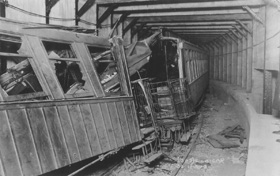
The back wheels of the first car derailed, and the two following cars completely left the tracks, tearing off their left-hand sides and most of their roofs. The first and fourth cars sustained relatively minor damage, while the second and third cars were severely damaged. The fifth suffered no damage at all. The motorman, 25-year-old Antonio Edward Luciano, was not injured and left the scene of the accident. Passengers were trapped in what The New York Times later described as "a darkened jungle of steel dust and wood splinters, glass shards and iron beams projecting like bayonets."
One surviving passenger, lawyer Charles Darling, had become so concerned about the train's speed that he dropped to the floor and braced himself moments before the crash. Darling later confronted Luciano and asked the motorman what had gone wrong. "I don't know," Luciano told Darling. "I lost control of the damn thing. That's all."
It took 45 minutes for all rescuers to descend to the site of the accident. The nearest hospital was at capacity with patients from the Spanish flu epidemic, and a makeshift infirmary was set up at Ebbets Field for crash injuries.
The Malbone Street wreck was the result of a series of individual circumstances.
Hub AI
Malbone Street wreck AI simulator
(@Malbone Street wreck_simulator)
Malbone Street wreck
The Malbone Street wreck, also known as the Brighton Beach Line accident, was a rapid transit railroad accident that occurred on November 1, 1918, on the New York City Subway's BMT Brighton Line (now part of the BMT Franklin Avenue Line) in the Flatbush neighborhood of Brooklyn in New York City. A speeding train derailed in the sharply curved tunnel beneath Willink Plaza, the intersection of Flatbush Avenue, Ocean Avenue, and Malbone Street (now known as Empire Boulevard). At least 93 people died, making it the second-deadliest train crash in American history, as well as the deadliest crash in the history of the New York City Subway.
The circumstances leading to the crash included a labor strike against the Brooklyn Rapid Transit Company (BRT). The BRT had tried to keep service running with non-striking personnel, and decided to use Antonio Edward Luciano, a crew dispatcher with no experience operating the line. Other factors in the crash included the serpentine layout of the track and the weight of the individual train cars.
In the aftermath of the crash, Luciano and BRT officials were placed on trial for manslaughter. Ultimately, all the defendants were acquitted or their indictments were dropped. The BRT gradually phased out wooden cars and additional train protection devices were installed. The two most heavily damaged train cars were scrapped. In 1923, the BRT became the Brooklyn–Manhattan Transit Corporation, having gone bankrupt due to the accident. The tunnel in which the wreck occurred remained in daily passenger operation for forty years. A memorial to the crash was installed in 2019.
The Malbone Street wreck occurred on Friday, November 1, 1918, at 6:42 p.m., during the end-of-week rush hour, and involved about 650 passengers. The elevated train, consisting of five cars constructed primarily of wood, entered the tunnel portal beneath Malbone Street, going toward the Prospect Park station, negotiating a reverse curve designated to be taken at 6 mph (10 km/h) at a speed estimated at between 30 and 40 mph (50 and 60 km/h).
The back wheels of the first car derailed, and the two following cars completely left the tracks, tearing off their left-hand sides and most of their roofs. The first and fourth cars sustained relatively minor damage, while the second and third cars were severely damaged. The fifth suffered no damage at all. The motorman, 25-year-old Antonio Edward Luciano, was not injured and left the scene of the accident. Passengers were trapped in what The New York Times later described as "a darkened jungle of steel dust and wood splinters, glass shards and iron beams projecting like bayonets."
One surviving passenger, lawyer Charles Darling, had become so concerned about the train's speed that he dropped to the floor and braced himself moments before the crash. Darling later confronted Luciano and asked the motorman what had gone wrong. "I don't know," Luciano told Darling. "I lost control of the damn thing. That's all."
It took 45 minutes for all rescuers to descend to the site of the accident. The nearest hospital was at capacity with patients from the Spanish flu epidemic, and a makeshift infirmary was set up at Ebbets Field for crash injuries.
The Malbone Street wreck was the result of a series of individual circumstances.
Recent media