
Recent from talks
Man o' War
Knowledge base stats:
Talk channels stats:
Members stats:
Man o' War
Man o' War (March 29, 1917 – November 1, 1947) was an American Thoroughbred racehorse who is widely regarded as one of the greatest racehorses of all time. Several sports publications, including The Blood-Horse, Sports Illustrated, and the Associated Press, voted Man o' War as the best American racehorse of the 20th century. During his racing career, just after World War I, Man o' War won 20 of 21 races and $249,465 (equivalent to $3,916,000 in 2024) in purses. He was the unofficial 1920 American horse of the year and was honored with Babe Ruth as the outstanding athlete of the year by The New York Times. He was inducted into the National Museum of Racing and Hall of Fame in 1957. On March 29, 2017, the museum opened a special exhibit in his honor, "Man o' War at 100".
In 1919, Man o' War won 9 of 10 starts, including the Hopeful Stakes and Belmont Futurity, then the most important races for two-year-old horses in the United States. His only loss came at Saratoga Race Course, later nicknamed the Graveyard of Champions, where he lost by a neck to a colt fittingly named Upset.
Man o' War was not entered in the 1920 Kentucky Derby because his owner, Samuel Riddle, did not believe in racing at the distance of ten furlongs (2,000 m) (one mile and a quarter) so early in a young horse's career. Instead, Man o' War made his three-year-old debut in the Preakness Stakes where he defeated Upset by 1+1⁄2 lengths. Man o' War later won the Belmont Stakes by 20 lengths while setting a world record. Throughout the summer and fall, he continued to dominate his fellow three-year-olds, setting multiple records while conceding large amounts of weight to his rivals. The only time he faced older horses was in the final race of his career in a match race against Sir Barton, who had won what would later be known as the American Triple Crown in 1919. Man o' War won easily by seven lengths in the first horserace to be filmed in its entirety.
Riddle originally intended to race Man o' War in 1921 but decided against it because Man o' War would have been assigned record weights in the handicap format used in almost all races for older horses at the time. Instead, Man o' War was retired to stud, where he became a leading sire whose multiple champions included Triple Crown winner War Admiral. He was the grandsire of Seabiscuit and his sire line continues today through horses such as In Reality, Tiznow, Da' Tara and Tourist. Also successful as a broodmare sire, Man o' War is found in almost all modern American pedigrees.
Man o' War was a chestnut horse with a white star and stripe on his forehead. He was foaled at Nursery Stud near Lexington, Kentucky. He was bred by August Belmont Jr., whose father's accomplishments were recognized through the naming of the Belmont Stakes in 1867. Belmont Jr. was an equally notable horseman who served as the chairman of The Jockey Club from 1895 until his death in 1924. Belmont Park was named in the family's honor when it opened in 1905.
Man o' War was sired by Fair Play, a multiple stakes winner who finished second in the 1908 Belmont Stakes to the undefeated Colin. Man o' War was the second foal out of Mahubah, a lightly raced mare by English Triple Crown Champion Rock Sand. Not long after the colt was foaled on March 29, 1917, Belmont Jr. joined the United States Army at age 65 to serve in France during World War I. While he was overseas, his wife named the foal "Man o' War" in honor of her husband. Originally, the Belmonts intended to race Man o' War themselves. However, in the summer of 1918 with the ongoing war effort, they decided to liquidate their racing stable. At the Saratoga yearling sale, Man o' War was sold at a final bid of $5,000 (equivalent to $105,000 in 2024) to Samuel D. Riddle, who brought him to his Glen Riddle Farm near Berlin, Maryland. The underbidder at the auction was Robert L. Gerry, Sr., who is reported to have said to his wife, "Forty-five hundred is enough to spend for any yearling." Two years later in 1920, Riddle declined an offer of $400,000 for the horse.
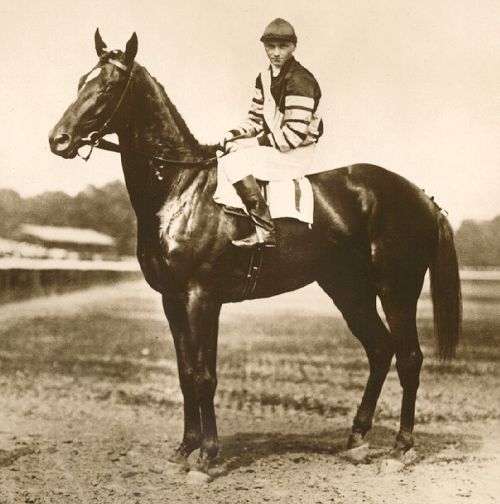
At maturity, Man o' War stood 16.2 1⁄2 hands (66.5 inches, 169 cm), with prominent withers and a high croup, but was sometimes faulted for a dipped back that grew more pronounced with age. He had virtually flawless legs and solid bone, traits he passed on to his offspring. He had a slightly Roman nose and notably high head carriage. His nickname was "Big Red", though his coat had tinges of yellow and gold. An energetic, spirited horse, he is often pictured standing very still and gazing off into the distance, described as the "look of eagles". His stride was measured at 28 feet and, to this day, is believed to still be the longest of all time.
Man o' War was the odds-on favorite in every start of his career and justified that faith even in his sole defeat. He typically won in front-running fashion and was only closely pushed in two of his starts. He won the Belmont Stakes by twenty lengths and the Lawrence Realization by a hundred lengths. He set record times in both of those races plus many more at distances ranging from 6 to 13 furlongs (1,200–2,600 m). In many of his starts, he won under heavy restraint and often conceded his rivals large amounts of weight. He retired as the then-leading money-earner in American history.
Hub AI
Man o' War AI simulator
(@Man o' War_simulator)
Man o' War
Man o' War (March 29, 1917 – November 1, 1947) was an American Thoroughbred racehorse who is widely regarded as one of the greatest racehorses of all time. Several sports publications, including The Blood-Horse, Sports Illustrated, and the Associated Press, voted Man o' War as the best American racehorse of the 20th century. During his racing career, just after World War I, Man o' War won 20 of 21 races and $249,465 (equivalent to $3,916,000 in 2024) in purses. He was the unofficial 1920 American horse of the year and was honored with Babe Ruth as the outstanding athlete of the year by The New York Times. He was inducted into the National Museum of Racing and Hall of Fame in 1957. On March 29, 2017, the museum opened a special exhibit in his honor, "Man o' War at 100".
In 1919, Man o' War won 9 of 10 starts, including the Hopeful Stakes and Belmont Futurity, then the most important races for two-year-old horses in the United States. His only loss came at Saratoga Race Course, later nicknamed the Graveyard of Champions, where he lost by a neck to a colt fittingly named Upset.
Man o' War was not entered in the 1920 Kentucky Derby because his owner, Samuel Riddle, did not believe in racing at the distance of ten furlongs (2,000 m) (one mile and a quarter) so early in a young horse's career. Instead, Man o' War made his three-year-old debut in the Preakness Stakes where he defeated Upset by 1+1⁄2 lengths. Man o' War later won the Belmont Stakes by 20 lengths while setting a world record. Throughout the summer and fall, he continued to dominate his fellow three-year-olds, setting multiple records while conceding large amounts of weight to his rivals. The only time he faced older horses was in the final race of his career in a match race against Sir Barton, who had won what would later be known as the American Triple Crown in 1919. Man o' War won easily by seven lengths in the first horserace to be filmed in its entirety.
Riddle originally intended to race Man o' War in 1921 but decided against it because Man o' War would have been assigned record weights in the handicap format used in almost all races for older horses at the time. Instead, Man o' War was retired to stud, where he became a leading sire whose multiple champions included Triple Crown winner War Admiral. He was the grandsire of Seabiscuit and his sire line continues today through horses such as In Reality, Tiznow, Da' Tara and Tourist. Also successful as a broodmare sire, Man o' War is found in almost all modern American pedigrees.
Man o' War was a chestnut horse with a white star and stripe on his forehead. He was foaled at Nursery Stud near Lexington, Kentucky. He was bred by August Belmont Jr., whose father's accomplishments were recognized through the naming of the Belmont Stakes in 1867. Belmont Jr. was an equally notable horseman who served as the chairman of The Jockey Club from 1895 until his death in 1924. Belmont Park was named in the family's honor when it opened in 1905.
Man o' War was sired by Fair Play, a multiple stakes winner who finished second in the 1908 Belmont Stakes to the undefeated Colin. Man o' War was the second foal out of Mahubah, a lightly raced mare by English Triple Crown Champion Rock Sand. Not long after the colt was foaled on March 29, 1917, Belmont Jr. joined the United States Army at age 65 to serve in France during World War I. While he was overseas, his wife named the foal "Man o' War" in honor of her husband. Originally, the Belmonts intended to race Man o' War themselves. However, in the summer of 1918 with the ongoing war effort, they decided to liquidate their racing stable. At the Saratoga yearling sale, Man o' War was sold at a final bid of $5,000 (equivalent to $105,000 in 2024) to Samuel D. Riddle, who brought him to his Glen Riddle Farm near Berlin, Maryland. The underbidder at the auction was Robert L. Gerry, Sr., who is reported to have said to his wife, "Forty-five hundred is enough to spend for any yearling." Two years later in 1920, Riddle declined an offer of $400,000 for the horse.
At maturity, Man o' War stood 16.2 1⁄2 hands (66.5 inches, 169 cm), with prominent withers and a high croup, but was sometimes faulted for a dipped back that grew more pronounced with age. He had virtually flawless legs and solid bone, traits he passed on to his offspring. He had a slightly Roman nose and notably high head carriage. His nickname was "Big Red", though his coat had tinges of yellow and gold. An energetic, spirited horse, he is often pictured standing very still and gazing off into the distance, described as the "look of eagles". His stride was measured at 28 feet and, to this day, is believed to still be the longest of all time.
Man o' War was the odds-on favorite in every start of his career and justified that faith even in his sole defeat. He typically won in front-running fashion and was only closely pushed in two of his starts. He won the Belmont Stakes by twenty lengths and the Lawrence Realization by a hundred lengths. He set record times in both of those races plus many more at distances ranging from 6 to 13 furlongs (1,200–2,600 m). In many of his starts, he won under heavy restraint and often conceded his rivals large amounts of weight. He retired as the then-leading money-earner in American history.
Recent media