


Community hub
Recent from talks
Contribute something
Nothing was collected or created yet.
Seabiscuit
View on Wikipedia | This article needs additional citations for verification. (May 2021) |

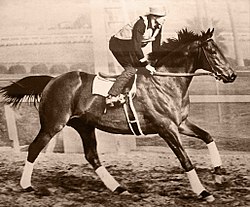
Seabiscuit (May 23, 1933 – May 17, 1947) was a champion thoroughbred racehorse in the United States who became the top money-winning racehorse up to the 1940s. He beat the 1937 Triple Crown winner, War Admiral, by four lengths in a two-horse special at Pimlico and was voted American Horse of the Year for 1938.
A small horse, at 15.2 hands high,[1] Seabiscuit had an inauspicious start to his racing career, winning only a quarter of his first 40 races, but became an unlikely champion and a symbol of hope to many Americans during the Great Depression.
Seabiscuit has been the subject of numerous books and films, including Seabiscuit: the Lost Documentary (1939); the Shirley Temple film The Story of Seabiscuit (1949); a book, Seabiscuit: An American Legend (1999) by Laura Hillenbrand; and a film adaptation of Hillenbrand's book, Seabiscuit (2003), that was nominated for the Academy Award for Best Picture. There is also a street in Indian Trail, North Carolina named after him.
Early days
[edit]
Seabiscuit was foaled in Lexington, Kentucky, on May 23, 1933,[2][3] from the mare Swing On and sire Hard Tack, a son of Man o' War.[4] Seabiscuit was named for his father; "sea biscuit" is another name for hardtack, a type of cracker eaten by sailors.[5][6]
The bay colt grew up on Claiborne Farm in Paris, Kentucky, where he was trained. He was undersized, knobby-kneed,[4] and given to sleeping and eating for long periods.
Initially, Seabiscuit was owned by the powerful Wheatley Stable and trained by "Sunny Jim" Fitzsimmons, who had taken Gallant Fox to the United States Triple Crown of Thoroughbred Racing. Fitzsimmons saw some potential in Seabiscuit but felt the horse was too lazy. Fitzsimmons devoted most of his time to training Omaha, who won the 1935 Triple Crown.
Seabiscuit was relegated to a heavy schedule of smaller races. He failed to win any of his first 17 races, usually finishing back in the field. After that, Fitzsimmons did not spend much time on him, and the horse was sometimes the butt of stable jokes. However, Seabiscuit began to gain attention after winning two races at Narragansett Park and setting a new track record in the second—Claiming Stakes race.
As a two-year-old, Seabiscuit raced 35 times (a heavy racing schedule),[4] coming in first five times and finishing second seven times. These included three claiming races, in which he could have been purchased for $2,500, but he had no takers.[4]
While Seabiscuit had not lived up to his racing potential, he was not the poor performer Fitzsimmons had taken him for. His last two wins as a two-year-old came in minor stakes races. The next season started with a similar pattern. The colt ran 12 times in less than four months, winning four times. One of those races was a cheap allowance race on the "sweltering afternoon of June 29," 1936, at Suffolk Downs. That was where trainer Tom Smith first laid eyes on Seabiscuit.[7] His owners sold the horse to automobile entrepreneur Charles S. Howard for $8,000 at Saratoga, in August.[4]
1936/1937: The beginning of success
[edit]
Howard assigned Seabiscuit to a new trainer, Tom Smith,[4] who, with his unorthodox training methods, gradually brought Seabiscuit out of his lethargy. Smith paired the horse with Canadian jockey Red Pollard (1909–1981), who had experience racing in the West and in Mexico. On August 22, 1936, they raced Seabiscuit for the first time. Improvements came quickly, and in their remaining eight races in the East, Seabiscuit and Pollard won several times, including the Detroit Governor's Handicap (worth $5,600) and the Scarsdale Handicap ($7,300) at Empire City Race Track in Yonkers, New York.
In early November 1936, Howard and Smith shipped the horse to California by rail. His last two races of the year were at Bay Meadows racetrack in San Mateo, California. The first was the $2,700 Bay Bridge Handicap, run over one-mile (1.6 km). Despite starting badly and carrying the top weight of 116 pounds (53 kg), Seabiscuit won by five lengths. At the World's Fair Handicap (Bay Meadows' most prestigious stakes race), Seabiscuit led throughout.
In 1937, the Santa Anita Handicap, California's most prestigious race, was worth over $125,000 ($2.9 million in 2010) to the winner; it was known colloquially as "The Hundred Grander." In his first warm-up race at Santa Anita Park, Seabiscuit won easily. In his second race of 1937, the San Antonio Handicap, he suffered a setback after he was bumped at the start and then pushed wide; Seabiscuit came in fifth, losing to Rosemont.
The two met again in the Santa Anita Handicap a week later, where Rosemont won by a nose. The defeat was devastating to Smith and Howard and was widely attributed in the press to a jockey error.[4][a] Pollard, who had not seen Rosemont over his shoulder until too late, was blind in one eye due to an accident during a training ride, a fact he had hidden throughout his career. A week after this defeat Seabiscuit won the San Juan Capistrano Handicap by seven lengths in track record time of 1:484⁄5 for the 1+1⁄8 mile event.[8]
Seabiscuit was rapidly becoming a favorite among California racing fans, and his fame spread as he won his next three races. With his successes, Howard decided to ship the horse east for its more prestigious racing circuit.
Seabiscuit's run of victories continued. Between June 26 and August 7, he ran five times, each time in a stakes race, and each time he won under steadily increasing handicap weights (imposts) of up to 130 pounds (59 kg). For the third time, Seabiscuit faced off against Rosemont again, this time beating him by seven lengths. On September 11, Smith accepted an impost of 132 pounds (60 kg) for the Narragansett Special at Narragansett Park. On race day, the ground was slow and heavy, and unsuited to "the Biscuit", carrying the heaviest burden of his career. Smith wanted to scratch, but Howard overruled him. Never in the running, Seabiscuit finished third. His winning streak was snapped, but the season was not over; Seabiscuit won his next three races (one a dead heat) before finishing the year with a second-place at Pimlico.
In 1937, Seabiscuit won 11 of his 15 races and was the year's leading money winner in the United States. However, War Admiral, having won the Triple Crown that season, was voted the most prestigious honor, the American Horse of the Year Award.
Early five-year-old season
[edit]
In 1938, as a five-year-old, Seabiscuit's success continued. On February 19, Pollard suffered a terrible fall while racing on Fair Knightess, another of Howard's horses. With half of Pollard's chest caved in by the weight of the fallen horse, Howard had to find a new jockey. After trying three, he settled on George Woolf, an already successful rider and old friend of Pollard's.
Woolf's first race aboard Seabiscuit was the Santa Anita Handicap, "The Hundred Grander" the horse had narrowly lost the previous year. Seabiscuit was drawn on the outside, and at the start was impeded by another horse, Count Atlas, angling out. The two were locked together for the first straight, and by the time Woolf disentangled his horse, they were six lengths off the pace. Seabiscuit worked his way to the lead but lost in a photo finish to the fast-closing Santa Anita Derby winner, Stagehand (owned by Maxwell Howard, not related to Charles), who had been assigned 30 pounds (14 kg) less than Seabiscuit.
Throughout 1937 and 1938, the media speculated about a match race between Seabiscuit and the seemingly invincible War Admiral (sired by Man o' War, Seabiscuit's grandsire). The two horses were scheduled to meet in three stakes races, but one or the other was scratched, usually due to Seabiscuit's dislike of heavy ground. After extensive negotiation, the owners organized a match race for May 1938 at Belmont, but Seabiscuit was scratched.
By June, Pollard had recovered, and on June 23, he agreed to work a young colt named Modern Youth. Spooked by something on the track, the horse broke rapidly through the stables and threw Pollard, shattering his leg and seemingly ending his career.
Howard arranged a match race for Seabiscuit against Ligaroti, a highly regarded horse owned by the Hollywood entertainer Bing Crosby and Howard's son, Lindsay, through Binglin Stable, in an event organized to promote Crosby's resort and Del Mar Racetrack in Del Mar, California. With Woolf aboard, Seabiscuit won that race, despite persistent fouling from Ligaroti's jockey. After three more outings and with only one win, he was scheduled to go head-to-head with War Admiral in the Pimlico Special in November, in Baltimore, Maryland.[9]
Sent to race on the East Coast, on October 16, 1938, Seabiscuit ran second by two lengths in the Laurel Stakes to the filly Jacola, who set a new Laurel Park Racecourse record of 1:37.00 for one mile.[10]
"George Woolf always said he never had more fun on a racehorse than he did that day in 1938 at Pimlico, when Tom Smith, the horse's trainer, lifted Woolf aboard Seabiscuit for the big match race against War Admiral."[9]
On November 1, 1938, Seabiscuit met War Admiral and jockey Charles Kurtsinger in what was dubbed the "Match of the Century." The event was run over 1+3⁄16 miles (1.9 km) at Pimlico Race Course. From the grandstands to the infield, the track was jammed with fans. Trains were run from all over the country to bring fans to the race, and the estimated 40,000 at the track were joined by 40 million listening on the radio. War Admiral was the favorite (1–4 with most bookmakers) and a nearly unanimous selection of the writers and tipsters, excluding a California contingent.
Head-to-head races favor fast starters, and War Admiral's speed from the gate was well known. Seabiscuit, on the other hand, was a pace stalker, skilled at holding with the pack before pulling ahead with late acceleration. From the scheduled walk-up start, few gave him a chance to lead War Admiral into the first turn. Smith knew these things and trained Seabiscuit to run against this type, using a starting bell and a whip to give the horse a Pavlovian burst of speed from the start.
When the bell rang, Seabiscuit broke in front, led by over a length after 20 seconds, and soon crossed over to the rail position. Halfway down the backstretch, War Admiral started to cut into the lead, gradually pulling level with Seabiscuit, then slightly ahead. Following advice he had received from Pollard, Woolf had eased up on Seabiscuit, allowing his horse to see his rival, then asked for more effort. Two hundred yards from the wire, Seabiscuit pulled away again and continued to extend his lead over the closing stretch, finally winning by four lengths despite War Admiral running his best time for the distance.
As a result of his races that year, Seabiscuit was named American Horse of the Year for 1938, beating War Admiral by 698 points to 489 in a poll conducted by the Turf and Sport Digest magazine.[11] Seabiscuit was the number one newsmaker of 1938.[12] The only major prize that eluded him was the Santa Anita Handicap.
Injury and return
[edit]Seabiscuit was injured during a race. Woolf, who was riding him, said that he felt the horse stumble. The injury was not life-threatening, although many predicted Seabiscuit would never race again. The diagnosis was a ruptured suspensory ligament in the front left leg. With Seabiscuit out of action, Smith and Howard concentrated on their horse Kayak II, an Argentine stallion. In the spring of 1939, Seabiscuit covered seven of Howard's mares, all of which had healthy foals in spring of 1940. One, Fair Knightess's colt, died as a yearling.
Seabiscuit and a still-convalescing Pollard recovered together at Howard's ranch, with the help of Pollard's new wife Agnes, who had nursed him through his initial recovery. Slowly, both horse and rider learned to walk again (Pollard joked that they "had four good legs between" them).[13] Poverty and his injury had brought Pollard to the edge of alcoholism. A local doctor broke and reset Pollard's leg to aid his recovery, and slowly Pollard regained the confidence to sit on a horse. Wearing a brace to stiffen his atrophied leg, he began to ride Seabiscuit again, first at a walk and later at a trot and canter. Howard was delighted at their improvement, as he longed for Seabiscuit to race again, but was extremely worried about Pollard, as his leg was still fragile.
Over the fall and winter of 1939, Seabiscuit's fitness seemed to improve by the day. By the end of the year, Smith was ready to return the horse to race training, with a collection of stable jockeys in the saddle. By the time of his comeback race, Pollard had cajoled Howard into allowing him the ride. After the horse was scratched due to soft going, the pair finally lined up at the start of the La Jolla Handicap at Santa Anita, on February 9, 1940. Seabiscuit was third, beaten by two lengths. By their third comeback race, Seabiscuit was back to his winning ways, running away from the field in the San Antonio Handicap to beat his erstwhile training partner, Kayak II, by two and a half lengths. Under 124 pounds (56 kg), Seabiscuit equalled the track record for a mile and 1/16.

One race was left in the season. A week after the San Antonio, Seabiscuit and Kayak II both took the gate for the Santa Anita Handicap and its $121,000 prize. Seventy-eight thousand paying spectators crammed the racetrack, most backing Seabiscuit. Pollard found his horse blocked almost from the start. Picking his way through the field, Seabiscuit briefly led. As they thundered down the back straight, Seabiscuit became trapped in third place, behind leader Whichcee and Wedding Call on the outside.
Trusting in his horse's acceleration, Pollard steered between the leaders and burst into the lead, taking the firm ground just off the rail. As Seabiscuit showed his old surge, Wedding Call and Whichcee faltered, and Pollard drove his horse on, taking "The Hundred Grander" by a length and a half from the fast-closing Kayak II under jockey Leon Haas. Pandemonium engulfed the course. Neither horse and rider, nor trainer and owner, could get through the crowd of well-wishers to the winner's enclosure for some time.
Retirement, later life, and offspring
[edit]On April 10, 1940, Seabiscuit's retirement from racing was officially announced. When he was retired to the Ridgewood Ranch near Willits, California, he was horse racing's all-time leading money winner. Put out to stud, Seabiscuit sired 108 foals, including two moderately successful racehorses: Sea Sovereign and Sea Swallow. Over 50,000 visitors went to Ridgewood Ranch to see Seabiscuit in those seven years before his death in 1947.[14]
Death and interment
[edit]Seabiscuit died of a probable heart attack[15] on May 17, 1947, in Willits, California, six months before his grandsire Man o' War. He is buried at Ridgewood Ranch in Mendocino County, California.[14][16]
Legacy and honors
[edit]Awards and honorable distinctions
[edit]- 1938 American Horse of the Year
- In 1958, Seabiscuit was voted into the National Museum of Racing and Hall of Fame.
- In the Blood-Horse magazine List of the Top 100 U.S. Racehorses of the 20th Century (1999), Seabiscuit was ranked 25th. War Admiral was 13th, and Seabiscuit's grandsire and War Admiral's sire, Man o' War, placed 1st.
Portrayals in film and television
[edit]Documentaries
[edit]- American Experience: "Seabiscuit" (April 21, 2003)[17]) is a documentary episode that aired as Season 15, Episode 11[17] of the PBS American Experience series.[18]
- ESPN SportsCentury: "Seabiscuit" (November 17, 2003), Seabiscuit was featured on ESPN's SportsCentury Greatest Athletes series.[19]
- The True Story of Seabiscuit (July 27, 2003) is a 45-minute made-for-TV documentary directed by Craig Haffner, written by Martin Gillam, and containing interviews and footage with William H. Macy, Seabiscuit, and Tobey Maguire, that aired on the USA Network.[20]
- Seabiscuit: the Lost Documentary (1939) by Seabiscuit's owner Charles Howard. The film was directed by Manny Nathan, and written by Nathan and Hazel Merry Hawkins. It stars Martin Mason, Doc Bond, Charles Howard as himself and his wife, Marcella.[21] It was colorized and released in 2003 by Legend Films to coincide with interest around the movie.[21]
- Seabiscuit: America's Legendary Racehorse (2003) directed and produced by Nick Krantz.
Fiction films
[edit]- Stablemates (1938), starring Wallace Beery and Mickey Rooney. Film producer Harry Rapf arranged a deal whereby he could film the $50,000 Hollywood Gold Cup, and actual footage of Seabiscuit running in the race was used. The field is headed by Seabiscuit for the "straight" race in the film.[22]
- Porky and Teabiscuit (1939) is Warner Bros.' Porky Pig cartoon take on Seabiscuit's underdog story.
- The Story of Seabiscuit (1949), starring Shirley Temple in her penultimate film, is a fictionalized account featuring Sea Sovereign in the title role. An otherwise undistinguished film, it did include actual footage of the 1938 match race against War Admiral and the 1940 Santa Anita Handicap.
- Seabiscuit (2003), Universal Studios' adaptation of Laura Hillenbrand's bestselling 2001 book, was nominated for seven Academy Awards, including Best Picture
- The Making of Seabiscuit (December 16, 2003) is a documentary short directed by Laurent Bouzereau and starring Tobey Maguire, Jeff Bridges, Chris Cooper, and William Goldenberg, produced by DreamWorks SKG, Herzog Productions, Spyglass Entertainment, and Universal Studios, and distributed by Universal Studios Home Video.[23]
Non-fiction books
[edit]- Track writer B.K. Beckwith wrote Seabiscuit: The Saga of a Great Champion (1940), with a foreword by Grantland Rice.[24]
- Ralph Moody wrote Come On, Seabiscuit! (1963),[25] illustrated by Robert Riger.[26]
- Laura Hillenbrand's book Seabiscuit: An American Legend (2001)[27] became a bestseller, and in 2003 it was adapted for film.
Postage stamp
[edit]In 2009, after an eight-year-long grassroots effort by Maggie Van Ostrand and Chuck Lustick, Seabiscuit was honored by the United States Postal Service with a stamp bearing his likeness. Thousands of signatures were obtained from all over the nation, and the final approval was given by Citizens Stamp Committee member Joan Mondale, wife of former Vice President Walter Mondale.[28]
Statues
[edit].jpg)
- A statue of Seabiscuit (not life-sized) sits outside the main entrance of The Shops at Tanforan, a shopping mall built upon the former site of the Tanforan Racetrack. Seabiscuit was stabled there briefly in 1939, while preparing for his comeback.[30]
- In the 1940s, businessman and racehorse owner W. Arnold Hanger donated a statuette of Seabiscuit to the Keeneland library.
- In 1941, American sculptor Jame Hughlette "Tex" Wheeler cast two life-sized bronze statues of Seabiscuit hand-tooled by Frank Buchler, the German immigrant owner of Washington Ornamental Iron Company Los Angeles: one stands in "Seabiscuit Court", the walking ring at Santa Anita Park racetrack in Arcadia, CA; the other is outside the National Museum of Racing in Saratoga Springs, NY.[31]
- On June 23, 2007, a statue of Seabiscuit was unveiled at Ridgewood Ranch, Seabiscuit's final resting place.
- On July 17, 2010, a life-size statue of George Woolf and Seabiscuit was unveiled at the Remington Carriage Museum in Woolf's hometown of Cardston, Alberta. This coincided with the 100th anniversary of Woolf's birth, though not the actual date.
-
 "Seabiscuit" statue at Santa Anita in 2016, draped in a Breeders' Cup winner's blanket.

Pedigree
[edit]| Sire Hard Tack b. 1926 |
Man o' War ch. 1917 |
Fair Play ch. 1905 |
Hastings |
|---|---|---|---|
| Fairy Gold | |||
| Mahubah b. 1910 |
Rock Sand | ||
| Merry Token | |||
| Tea Biscuit 1912 |
Rock Sand br. 1900 |
Sainfoin | |
| Roquebrune | |||
| Tea's Over ch. 1893[33] |
Hanover | ||
| Tea Rose | |||
| Dam Swing On b. 1926 |
Whisk Broom II ch. 1907 |
Broomstick b. 1901 |
Ben Brush |
| Elf | |||
| Audience 1901 |
Sir Dixon | ||
| Sallie McClelland | |||
| Balance b. 1919 |
Rabelais br. 1900 |
St. Simon | |
| Satirical | |||
| Balancoire b. 1911 |
Meddler | ||
| Ballantrae |
Notable races won
[edit]Seabiscuit ran 89 times at 16 different distances over the course of his career.[34]
- Brooklyn Handicap (1937)[35]
- San Antonio Handicap (1940)
- Santa Anita Handicap (1940)
See also
[edit]Notes
[edit]^ a: The Saturday Evening Post, dated April 27, 1940, reported: "By the following
March the horse failed only by inches—because
his jockey erred in looking back—to win in
his first try at the Santa Anita Handicap, richest
of all races."[4]
References
[edit]- ^ "USATODAY.com". USA Today. Archived from the original on May 24, 2016. Retrieved April 14, 2019.
- ^ "Seabiscuit (1933–1947)". IMDb.
- ^ "Seabiscuit Biography". IMDb.
- ^ a b c d e f g h "Champion". Saturday Evening Post. Vol. 212, no. 44. April 27, 1940. p. 28.
- ^ Stradley, Linda (2004). "H (see "hardtack")". Linda's Culinary Dictionary. Archived from the original on July 9, 2015. Retrieved June 18, 2015.
- ^ "Definition of 'sea biscuit'". Collins English Dictionary.
- ^ Hillenbrand, Laura (2001). Seabiscuit: An American Legend. Random House Publishing. ISBN 978-0-449-00561-3.
- ^ Lowry, Paul (March 7, 1937). "Seabiscuit Triumphs By Seven Lengths (1937 San Juan Capistrano Handicap - race 6: held 6 March 1937)". Los Angeles Times. pp. 25, 26. Retrieved June 18, 2020.
- ^ a b Nack, William (November 29, 1999). "A Match Made in Heaven". Sports Illustrated. Vol. 91, no. 21. p. 128.
- ^ "Wall Rides Jacola to Two-Length Triumph Over Seabiscuit in Laurel Stakes; Jacola, 7-1, Breaks Laurel Mile Mark; Filly Conquers Seabiscuit in 1:37". The New York Times. October 16, 1938. Archived from the original on July 23, 2018. Retrieved July 23, 2018.
- ^ "Seabiscuit voted best of 1938 crop". Prescott Evening Courier. December 12, 1938. Retrieved February 26, 2012.
- ^ Andriani, Lynn (January 1, 2001), "PW Talks with Laura Hillenbrand". Publishers Weekly. 248 (1):75
- ^ Hillenbrand, Laura (July–August 1998). "Four good legs between us". American Heritage. Vol. 49, no. 4. p. 38.
- ^ a b "In the 1930s, San Francisco Tycoon Charles Howard". SFgate. Archived from the original on March 29, 2014. Retrieved March 29, 2014.
- ^ "Seabiscuit Biography". IMDb.
- ^ "Seabiscuit (1933–1947)". IMDb.
- ^ a b "Seabiscuit". American Experience. IMDb. April 21, 2003. Archived from the original on February 10, 2017. Retrieved June 30, 2018.
- ^ "Seabiscuit". American Experience. WGBH. PBS. April 21, 2003. Archived from the original on October 19, 2012. Retrieved November 14, 2012.
- ^ "ESPN SportsCentury - Seabiscuit". November 17, 2003. Archived from the original on February 8, 2017. Retrieved June 30, 2018.
- ^ The True Story of Seabiscuit. USA Network. July 27, 2003.
- ^ a b "Seabiscuit". Archived from the original on February 9, 2017. Retrieved July 24, 2017 – via www.imdb.com.
- ^ "Seabiscuit Runs In Gold Cup Race". Vol. XII, no. 14. Desert Sun. November 4, 1938. p. 9. Archived from the original on June 30, 2016. Retrieved June 5, 2016.
- ^ The Making of Seabiscuit. Universal Studios Home Video. December 16, 2003. Archived from the original on March 24, 2016. Retrieved June 30, 2018.
- ^ "Seabiscuit book now on sale". The Pasadena Post. July 6, 1940. p. 6. Retrieved April 20, 2025.
- ^ ""Seabiscuit" book tells story about famous race horse". Half Moon Bay Review and Pescadero Pebble. December 12, 1963. p. 11. Retrieved April 20, 2025 – via Newspapers.com.
- ^ Goodwin, Polly (December 15, 1963). "The junior bookshelf". Chicago Tribune. p. 147. Retrieved April 20, 2025 – via Newspapers.com.
- ^ Hillenbrand, Laura (2001). Seabiscuit: An American Legend. Random House Publishing. ISBN 0-449-00561-5.
- ^ "As Seabiscuit Looks On, US Postal Service Gives Racing Legend Big Stamp of Approval at Historic Ridgewood Ranch, CA(New Stamped Envelope Honoring the Great Horse Goes on Sale Today)". Sea Biscuit Heritage. Willits, CA. May 11, 2009. Archived from the original on September 24, 2015. Retrieved August 29, 2015.
- ^ Dickinson, J. W. (2006). Remembering Orlando: Tales from Elvis to Disney. Charleston, South Carolina: The History Press.
- ^ "Seabiscuit at Tanforan; Howard Horse to Start Training for Racing Comeback". The New York Times. October 24, 1939. Archived from the original on November 7, 2012. Retrieved February 12, 2017.
- ^ "Statue of Seabiscuit". (Saratoga Springs, New York, 1940). Archived from the original on August 20, 2017. Retrieved August 19, 2017.
- ^ "Seabiscuit". Equineline. Archived from the original on September 29, 2017. Retrieved September 29, 2017.
- ^ "Vintner Mare - Family 9". Bloodlines.net. Archived from the original on May 24, 2012. Retrieved August 4, 2012.
- ^ Hillenbrand, Laura (May/June 2000), "Racehorse". American Heritage. 51 (3):78
- ^ Durso, Joseph (June 17, 1994). "Horse Racing: Notebook; A Revival at Belmont For Stars Who Stayed". The New York Times: B00017. Archived from the original on January 8, 2019. Retrieved January 7, 2019.
Further reading
[edit]
- Beckwith, B.K. (1940), Seabiscuit: The Saga of a Great Champion, with drawings by Howard Brodie, Wilfred Crowell, Inc., San Francisco.
- Hillenbrand, Laura (2001), Seabiscuit: An American Legend.
External links
[edit]- Newsreel film of Seabiscuit v War Admiral
- Seabiscuit Heritage Foundation. Livingston, Tracy (2005), retrieved June 26, 2005.
- "Seabiscuit", Snopes.com (2005), retrieved June 18, 2015.
- Seabiscuit, 1938 Horse of the Year
- Seabiscuit, Hollywood film, 2003[dead link]
- The Story of Seabiscuit, Hollywood film, 1949
- The Biscuit's pedigree
- Quick online racing game, inc. The Biscuit
- Article about the Seabiscuit-War Admiral match race
- Youtube of the 1938 match race
- Seabiscuit, an American Experience documentary film by Stephen Ives, shown on PBS
- www.janiburon.com, website of author of Seabiscuit books Archived February 20, 2012, at the Wayback Machine
| International | |
|---|---|
| National | |
| People | |
| Other | |

Seabiscuit
View on GrokipediaBackground
Pedigree
Seabiscuit was a bay Thoroughbred colt foaled on May 23, 1933, at Claiborne Farm in Kentucky, sired by the chestnut stallion Hard Tack (foaled 1926) out of the bay mare Swing On (foaled 1926).[1][4] He was bred by the Wheatley Stable of Gladys Mills Phipps in Kentucky.[5] Hard Tack, a son of the legendary Man o' War (foaled 1917), was out of the mare Tea Biscuit (foaled 1912) and stood at 16 hands with a reputation for speed but inconsistency on the track as a juvenile, where he won stakes like the 1928 Flash Stakes before fading due to temperament issues.[6] Man o' War, widely regarded as one of the greatest racehorses in history, was sired by Fair Play (foaled 1905, by Hastings out of Fairy Gold) and out of Mahubah (foaled 1910, by Rock Sand out of Merry Token), infusing the lineage with exceptional speed and versatility across distances.[7] Tea Biscuit herself traced to Rock Sand (foaled 1900, Epsom Derby winner) on both sides, contributing a double influence of stamina-oriented blood from this influential English sire.[7] Swing On, by the Hall of Fame champion Whisk Broom II (foaled 1907), was out of Balance (foaled 1919, by Rabelais out of Balancoire) and was a half-sister to stakes winners Flippant (by Pennant), Hornpipe (by Chantey), and Uneasy (by Royal Minstrel), though she herself had a modest racing record with limited starts.[6] Whisk Broom II, a versatile speed influence who swept New York's handicap triple crown in 1913 including the Preakness Stakes, was sired by Broomstick (foaled 1901, by Ben Brush out of Elf) out of Audience (foaled 1901), bringing sprinting prowess and precocity to the pedigree.[8][7] Seabiscuit's extended pedigree highlighted key ancestors like Man o' War and Whisk Broom II, with notable inbreeding including 5x4 to the English champion sire St. Simon (foaled 1881, nine-time leading sire) and 5x5 to the American champion Hindoo (foaled 1878, three-time leading sire), patterns that concentrated influences from lines known for blending speed and endurance.[6][9] This genetic background, combining Man o' War's dynamic speed and stamina with Whisk Broom II's precocious brilliance, provided Seabiscuit with a rare mix of traits despite his parents' unremarkable individual records as racers or initial producers.[10] Subsequent DNA analysis from Seabiscuit's preserved remains confirmed variants associated with elite distance-running stamina alongside speed capabilities, underscoring how his lineage supported unexpected excellence from modest breeding origins.[11]Early Life and Ownership
Seabiscuit was foaled on May 23, 1933, at Claiborne Farm in Kentucky by the prominent Wheatley Stable, owned by Gladys Mills Phipps in partnership with her brother Ogden Livingston Mills.[1][12][4] As a young colt, he exhibited a compact bay coat and a laid-back disposition, often preferring to sleep and eat over displaying athletic promise.[2] Physically unremarkable for a Thoroughbred, Seabiscuit stood at just 15.2 hands high at maturity, with knobby knees, a slightly oversized head, and short legs that contributed to his "ugly" appearance and initial undervaluation by breeders and trainers.[6][2] Under the guidance of his first trainer, James E. "Sunny Jim" Fitzsimmons at Wheatley Stable, the colt showed moderate potential but was overlooked amid the stable's stable of more promising horses.[1] In late 1936, following a string of inconsistent performances, Wheatley Stable sold Seabiscuit to California automobile magnate Charles S. Howard for $8,000, a modest sum reflecting the horse's perceived limitations.[2][13] Howard, seeking a reliable racer for West Coast tracks, had the horse shipped by train to California, where he would begin a new chapter under owner Howard's management.[1]Racing Career
1935–1936 Seasons
Seabiscuit made his racing debut as a two-year-old on January 19, 1935, at Hialeah Park, finishing fourth, and went on to suffer 17 consecutive losses before securing his first victory on June 26, 1935, at Narragansett Park in a $5,000 claiming race over six furlongs in a time of 1:12 flat, ridden by jockey Johnny Adams.[14][15] Under trainer James "Sunny Jim" Fitzsimmons for owner Wheatley Stable, the colt faced a grueling schedule, competing in 35 races that year across East Coast tracks like Saratoga, Belmont, and Pimlico, often in low-level claiming events against modest competition.[16] Despite the volume, Seabiscuit secured only five victories, seven seconds, and five thirds, earning $12,578 while showing flashes of speed but struggling with consistency and laziness in workouts.[17] His performances were unremarkable, leading Wheatley Stable to view him as a reliable but unexceptional allowance horse rather than a stakes contender.[1] In early 1936, Seabiscuit continued racing for Wheatley under Fitzsimmons and later short-term trainers, adding to his inconsistent record with additional starts in claiming and allowance races on the East Coast. By mid-year, the three-year-old had been overshadowed by stablemates like Pompoon, prompting Wheatley to offer him for sale. In August 1936, automobile magnate Charles Howard purchased Seabiscuit for $8,000 after his trainer, Tom Smith, spotted the horse's untapped potential during a workout at Suffolk Downs, noting his explosive closing speed despite a lazy demeanor.[18] Smith, known for his quiet, intuitive methods, immediately implemented a tailored regimen emphasizing rest and natural conditioning, which began to unlock Seabiscuit's abilities.[19] Under Smith's guidance and primarily ridden by jockey Red Pollard, Seabiscuit shipped west in late 1936 and adapted swiftly to tracks like Bay Meadows and Santa Anita. He competed in 23 races that year, achieving nine wins, one second, and five thirds for earnings of $28,995, a marked improvement from his juvenile form.[17] His breakthrough came in December with his first stakes victory in the Bay Bridge Handicap at Bay Meadows, covering one mile in a track-record 1:36 while carrying 108 pounds to defeat older rivals by three lengths.[2] This win, followed closely by the World's Fair Handicap, signaled the start of his rise, as Seabiscuit thrived on the longer distances and firmer West Coast surfaces that suited his strong finishing kick.[6]1937 Season
In 1937, Seabiscuit emerged as a dominant force in American horse racing, securing 11 victories in 15 starts and amassing earnings of $168,580, which led all thoroughbreds that year.[20] This breakthrough season marked his transformation from an inconsistent performer in prior years to the nation's top handicapper, earning him the title of Champion Handicap Horse.[2] His success came primarily on the West Coast tracks, where he excelled in weight-carrying handicap races, often conceding significant pounds to rivals while setting multiple track records.[6] Seabiscuit's most notable performances included a close second by a nose to Rosemont in the Santa Anita Handicap in March, carrying 124 pounds in a time of 2:01 3/5 for 1 1/4 miles.[1] [21] Other key triumphs that year were the Brooklyn Handicap, Butler Handicap, and Continental Handicap. Later, he captured the Bay Meadows Handicap at 1 1/8 miles, under a heavy impost of 130 pounds, shattering the track record with a clocking of 1:49 flat.[6] These victories highlighted his stamina and closing speed in grueling conditions.[1] Under trainer Tom Smith's innovative methods, which emphasized patient conditioning, mental recovery from over-racing, and tailored workouts to build Seabiscuit's confidence for handicap burdens, the horse thrived after a rocky start to his career.[22] Jockey Red Pollard, who had begun riding Seabiscuit regularly the previous year, formed a symbiotic partnership during this campaign, guiding him to tactical brilliance in races where positioning and late surges were crucial.[23] Smith's strategies focused on Seabiscuit's quirky personality, incorporating rest periods and companion animals to reduce stress, enabling the horse to carry up to 133 pounds effectively against top competition.[22] Seabiscuit's rapid ascent fueled widespread media coverage and public enthusiasm, positioning him as an underdog symbol of resilience amid the Great Depression, particularly as he outshone established Eastern contenders in high-profile events like the Continental Handicap at Jamaica.[24] Newspapers across the country chronicled his improbable rise, drawing comparisons to everyday Americans overcoming adversity and sparking a national fascination that boosted attendance at West Coast tracks.[25]1938 Season
Seabiscuit entered the 1938 racing season as the reigning handicap champion, building on his strong performances from the previous year. Early in the year, he secured victories in key West Coast stakes, including the Agua Caliente Handicap in Mexico and the Bay Meadows Handicap at Bay Meadows Racetrack, where he set a new track record of 1:49 for 1 1/8 miles.[1] Despite carrying high weight as the favorite, he faced disappointment in the Santa Anita Handicap on March 5, finishing second by a nose to Stagehand after a grueling stretch run.[26] Later, on July 16, Seabiscuit won the inaugural Hollywood Gold Cup at Hollywood Park, prevailing by 1 1/2 lengths over Pasteurized in a time of 2:03 4/5 for 1 1/4 miles, further solidifying his dominance in California racing.[27] He also triumphed in the Havre de Grace Handicap in Maryland and a match race against Argentine star Ligaroti at Del Mar, extending his win streak and heightening anticipation for a showdown with East Coast rival War Admiral.[1] The pinnacle of the season came on November 1, 1938, in the highly anticipated "Match of the Century" against War Admiral, the 1937 Triple Crown winner, at Pimlico Race Course in Baltimore. Billed as the Pimlico Special, the 1 3/16-mile event drew a crowd of 40,000 spectators and pitted Seabiscuit, ridden by George Woolf, against War Admiral and jockey Charles Kurtsinger. Seabiscuit broke sharply from the gate—a strategic adjustment to counter War Admiral's renowned speed—and maintained the lead throughout, winning by four lengths in a track-record time of 1:56 3/5.[28] The race, organized by owners Charles Howard and Samuel Riddle to settle their horses' supremacy, captured national attention amid the Great Depression, symbolizing an underdog triumph.[29] The victory elevated Seabiscuit to national hero status, with the event broadcast live on radio to an estimated 40 million listeners across the United States, including President Franklin D. Roosevelt, who reportedly paused a cabinet meeting to tune in.[29] Newspapers hailed the win as a morale booster for the era, and Seabiscuit was subsequently voted Horse of the Year for 1938, his second consecutive handicap championship.[1]1939 Season and Retirement
Following his dominant 1938 campaign, Seabiscuit made just one start in 1939, the San Antonio Handicap on February 14 at Santa Anita Park, where he finished second but suffered a severe injury—a ruptured suspensory ligament in his left front leg—leading to his scratch from the Santa Anita Handicap later that month due to concerns over his fitness.[16][1] This incident marked a significant setback, sidelining the horse for the remainder of the year and raising doubts about his future in racing.[15][30] Under the careful guidance of trainer Tom Smith, Seabiscuit underwent an extended rehabilitation at owner Charles S. Howard's Ridgewood Ranch in northern California. Smith, known for his intuitive and patient approach, coordinated the recovery alongside jockey Red Pollard, who was himself healing from a broken leg sustained earlier. The process emphasized rest, nutritious feed, and gradual conditioning through long daily walks across the ranch grounds to rebuild strength and mobility in the injured leg.[3] This methodical regimen, spanning much of 1939, restored Seabiscuit's physical condition and spirit, allowing him to regain his competitive edge without rushing back to the track.[1] Seabiscuit made a triumphant brief comeback in early 1940 at age seven, starting with a victory in the San Antonio Handicap on February 24 at Santa Anita Park, where he equaled the track record for 1 1/16 miles while carrying 130 pounds.[1] Just one week later, on March 2, he captured the prestigious Santa Anita Handicap—his elusive "Hundred-Grander"—by 1 1/2 lengths over Kayak II, setting a new track record of 2:01 1/5 for the 1 1/4-mile distance under the same 130-pound impost before a crowd of 78,000.[16][1] This win, his third attempt at the race after near-misses in 1937 and 1938, cemented his legacy as undefeated in major stakes upon return. On April 10, 1940, Howard officially announced Seabiscuit's retirement to stud at Ridgewood Ranch, concluding a career that spanned 89 starts with 33 wins and total earnings of $437,730—the highest in racing history at the time.[16][1] At age seven, the horse retired sound and celebrated, having overcome adversity to deliver one of the most inspiring finales in Thoroughbred racing.[15]Post-Racing Life
Breeding Career
Upon retirement in 1940 following his victory in the Santa Anita Handicap, Seabiscuit was relocated to Ridgewood Ranch in Willits, California, the 5,000-acre property owned by his longtime benefactor, Charles S. Howard.[31][13] The ranch, which Howard had acquired in 1919 and developed into a Thoroughbred breeding operation by the 1930s, provided a serene environment for the horse's recovery from a severe leg injury sustained in 1939.[31] Seabiscuit resided there until his death in 1947, enjoying a post-racing life that included light ranch duties and close companionship with Howard. The ranch drew over 50,000 visitors in the seven years following his retirement.[3] From 1939 to 1947, Seabiscuit stood at stud at Ridgewood Ranch, siring 108 foals primarily from Howard's own broodmares.[31] His breeding career achieved modest success, producing 66 winners—including four stakes winners—though his remote California location limited broader demand compared to eastern stallions like War Admiral.[6] World War II further constrained efforts through gas rationing and travel restrictions, reducing access to outside mares and confining most matings to the ranch's resident stock.[31] Seabiscuit's daily routine at the ranch emphasized recovery and relaxation, with Howard occasionally saddling him for leisurely walks across the property, fostering their deep bond amid Howard's declining health.[13] The horse's interactions with Howard were marked by affection, as the owner visited frequently, and public access to view Seabiscuit remained limited during the war years due to wartime restrictions, though over time the ranch drew admirers seeking to see the champion in his retirement.[31][32]Offspring and Descendants
Seabiscuit sired 108 registered foals during his breeding career at Ridgewood Ranch, producing 66 winners from those starters, which represented approximately 61.1% of his progeny. However, his impact as a sire was modest compared to his extraordinary racing achievements, with only four stakes winners emerging from his get, accounting for 3.7% of the foals. This limited success in producing elite performers contrasted sharply with the high expectations set by his status as a champion handicapper and top money-earner of his era.[6] Among his notable offspring were Sea Sovereign, foaled in 1942 out of Queen Helen, who achieved success by winning the Santa Catalina Handicap in 1945 and earning $34,070 in his career. Another prominent progeny was Sea Swallow, a 1942 foal out of Illeanna, who secured victories in the Yankee Handicap, Tijuana Derby, and Derby Trial Stakes, marking her as a multiple stakes winner.[1][33][4][34][35] Seabiscuit's descendants exerted a subtle influence on subsequent generations of Thoroughbreds, primarily through indirect lines rather than dominant sire success. For instance, his grandson Windy Sea became a stakes winner known for exceptional speed, carrying forward Seabiscuit's blood to produce further competitors like the Grade 1-winning mare Windy's Daughter. While these lines contributed to the breed's diversity, they did not lead to widespread prominence in leading sire lists or major racing dynasties, reflecting the unpredictable nature of Thoroughbred inheritance where Seabiscuit's racing legacy far outshone his breeding one. As of 2025, seven Seabiscuit descendants reside at Ridgewood Ranch.[31][36][37]Death and Burial
Seabiscuit died on May 17, 1947, at the age of 14 from a heart attack at Ridgewood Ranch in Willits, California, where he had spent his retirement.[38] His owner, Charles S. Howard, announced the death the following day. Seabiscuit was buried at a secret site on the ranch under an oak tree, with the exact location known only to the Howard family to prevent disturbance. A monument now marks the gravesite area at Ridgewood Ranch.[39][40]Legacy
Racing Honors and Records
Seabiscuit was inducted into the National Museum of Racing and Hall of Fame in 1958, recognizing his extraordinary contributions to Thoroughbred racing.[1] During his career, he earned several top honors, including U.S. Horse of the Year in 1938 and U.S. Champion Older Male Horse in both 1937 and 1938; these achievements are now retrospectively acknowledged as Eclipse Awards equivalents for historical champions.[1][41] Seabiscuit concluded his racing career with 33 wins from 89 starts, achieving a 37% win rate, along with 15 second-place finishes and 13 thirds.[1] His total earnings of $437,730 established him as the highest money-winning horse in U.S. history at the time, a record that remained unbroken until the 1940s.[15] In 1999, an expert panel assembled by Blood-Horse magazine ranked Seabiscuit #25 on their list of the top 100 U.S. Thoroughbred racehorses of the 20th century, highlighting his enduring legacy in the sport.[2]Cultural Impact
Seabiscuit emerged as a profound cultural icon during the Great Depression, embodying the archetype of the American underdog and offering a narrative of resilience amid widespread economic despair. Born in 1933, the undersized Thoroughbred, initially dismissed as lazy and unremarkable after losing his first 17 races, captured the public's imagination through his improbable victories, symbolizing hope for ordinary Americans grappling with unemployment and hardship. Fans across the nation sent thousands of letters to Seabiscuit and his owner, Charles Howard, expressing personal stories of inspiration, congratulations on wins, and even suggestions for future foals' names; these correspondences, preserved and compiled in the 2003 book Letters to Seabiscuit by Barbara Howard, underscore the horse's emotional connection to a downtrodden populace.[42][43] His influence extended to boosting public morale, with Seabiscuit's comeback trajectory paralleling the nation's tentative economic recovery under the New Deal. The horse's dramatic triumphs, particularly the 1938 match race against Triple Crown winner War Admiral at Pimlico Race Course, became a national spectacle broadcast to an estimated 40 million radio listeners, temporarily uniting a divided country and providing an escapist diversion from daily struggles. Special cross-country train trips transporting Seabiscuit between California and the East Coast drew massive crowds who lined tracks for glimpses of the champion, a phenomenon dubbed "Seabiscuit-itis" by journalists, reflecting his role in revitalizing interest in horse racing as a communal outlet.[44][45][42] In broader cultural analyses since the 1940s, Seabiscuit's story has symbolized themes of perseverance and the triumph of will over adversity, resonating as a metaphor for human potential in works like Laura Hillenbrand's 2001 biography Seabiscuit: An American Legend, which explores the psychological allure of his underdog narrative in fostering collective optimism. Recent equine history examinations, including a 2025 educational packet from the National Museum of Racing and Hall of Fame, highlight Seabiscuit's enduring legacy in popularizing Thoroughbred racing by drawing record crowds—such as 75,000 at his 1940 Santa Anita Handicap victory—and sustaining the sport's visibility through economic turmoil into the postwar era.[46][42]Media Portrayals
Seabiscuit's life and career have been extensively portrayed in film and television, capturing the public's enduring fascination with the underdog racehorse. The most prominent depiction is the 2003 biographical drama Seabiscuit, directed by Gary Ross and based on Laura Hillenbrand's book Seabiscuit: An American Legend. Starring Tobey Maguire as jockey Red Pollard, alongside Jeff Bridges and Chris Cooper, the film chronicles Seabiscuit's rise from an overlooked colt to a national icon during the Great Depression, emphasizing themes of resilience and teamwork. It received seven Academy Award nominations, including for Best Picture, Best Director, and Best Adapted Screenplay, though it did not win any. The movie was a commercial success, grossing $148.7 million worldwide on a $35 million budget.[47][48] Documentaries have also played a key role in preserving Seabiscuit's legacy through archival footage and historical analysis. In 1939, shortly after Seabiscuit was named Horse of the Year, owner Charles Howard commissioned Seabiscuit: The Lost Documentary, a short film that includes rare footage of the horse's training sessions with trainer Tom Smith and jockeys like Red Pollard and George Woolf. This intimate portrait, rediscovered decades later, highlights Seabiscuit's daily life and key victories, offering an authentic glimpse into his era. More recently, the PBS series American Experience aired a 2003 episode titled Seabiscuit, directed by Stephen Ives, which contextualizes the horse's triumphs against the backdrop of 1930s America, drawing on interviews, photographs, and newsreels to illustrate his cultural significance. The episode received positive reviews for its engaging narrative and historical depth.[49][50] Seabiscuit has made recurring appearances in television programming, particularly in documentaries and racing specials. The American Experience episode has been rebroadcast multiple times, including in the 2010s and 2020s during horse racing seasons, often tied to events like the Triple Crown. Additional features include segments in ESPN's racing retrospectives and History Channel specials on American sports icons, where Seabiscuit's match race against War Admiral is frequently highlighted as a pivotal moment in the sport's history. These TV portrayals underscore his role as a symbol of perseverance, with modern episodes incorporating DNA analysis and expert commentary to explore his genetic legacy.[50] Fictional representations of Seabiscuit extend to animation, where the horse inspired early comedic tributes. The 1939 Looney Tunes short Porky and Teabiscuit, directed by Ben Hardaway and Cal Dalton, parodies Seabiscuit through a character named Teabiscuit, an unlikely racehorse entered in a steeplechase by Porky Pig, satirizing the era's racing mania and the horse's improbable success. This Warner Bros. cartoon, released during Seabiscuit's peak fame, captures the public's enthusiasm in a lighthearted, exaggerated style. While later animated cameos are sparse, Seabiscuit's archetype occasionally appears in modern shows as a nod to underdog stories in racing-themed episodes.[51]Monuments and Tributes
Seabiscuit has been honored through various physical monuments and official tributes that celebrate his legacy as a racing icon. In 2009, the United States Postal Service issued a 44-cent stamped envelope featuring an illustration of Seabiscuit during his famous 1938 match race against War Admiral at Pimlico Race Course, designed by artist John Mattos to commemorate the horse's enduring cultural significance.[52] Several bronze statues pay tribute to Seabiscuit, crafted from life during his racing career. Sculptor Hughlette "Tex" Wheeler created two life-sized bronze figures in 1940–1941; one was unveiled at Santa Anita Park in Arcadia, California, in February 1941, with Seabiscuit himself participating in the ceremony, and it remains in the park's garden paddock area as a symbol of his triumphs there.[53] The second statue, originally from owner Charles Howard's estate, was returned to Ridgewood Ranch in Willits, California, and unveiled in June 2007 near Seabiscuit's gravesite, restoring a key piece of his post-racing history to its original location.[54] A third casting resides at the National Museum of Racing and Hall of Fame in Saratoga Springs, New York, where it stands as a prominent outdoor exhibit.[55] Ridgewood Ranch, Seabiscuit's final home and burial place, has been preserved as a historic site to honor his memory. The Seabiscuit Heritage Foundation offers guided walking tours of the property, including the stud barn museum and key structures from the Howard era, which began in the mid-2000s to educate visitors on his life and retirement.[56] In 2014, the ranch's stud barn was added to the National Register of Historic Places for its association with Seabiscuit's breeding career and cultural impact.[57] Additional tributes include named races such as the Grade II Seabiscuit Handicap at Del Mar Racetrack, an annual event for thoroughbreds aged three and older run over 1 1/16 miles on turf, established to perpetuate his competitive spirit.[58] Seabiscuit was also inducted into the New England Racing Hall of Fame in 2009, recognizing his influence on American sports history beyond traditional racing circuits.[59]Race Record
Major Victories
Seabiscuit's major victories highlighted his resilience and dominance in American Thoroughbred racing during the late 1930s and early 1940s, often under challenging conditions like high weights and against top competition. His wins in prestigious handicaps and special match races not only boosted his earnings but also captured national attention during the Great Depression era. Key triumphs included stake races at major tracks, where he frequently set track records and carried heavy imposts. The following table summarizes Seabiscuit's most significant victories, focusing on five pivotal races that defined his legacy:| Race Name | Date | Track | Distance | Purse | Margin of Victory | Notable Details |
|---|---|---|---|---|---|---|
| Brooklyn Handicap | June 26, 1937 | Aqueduct Racetrack | 1 1/8 miles | $25,000 | 2 lengths | Won carrying 127 pounds, defeating Aneroid; marked an early breakthrough in his breakout 1937 season with 11 wins. [1] [60] |
| Massachusetts Handicap | August 7, 1937 | Suffolk Downs | 1 1/8 miles | $30,000 | 1 length | Jockey Red Pollard guided Seabiscuit to victory under 130 pounds, setting a track record of 1:49 and solidifying his status as a top handicap horse and contributing to his leading earnings that year ($168,580 total). [61] [62] [63] |
| Hollywood Gold Cup | July 16, 1938 | Hollywood Park | 1 1/4 miles | $25,000 | 1 1/2 lengths | Carrying 130 pounds, Seabiscuit set a track record of 2:03 4/5 while defeating Stagehand; this win elevated his career earnings past $400,000, establishing a weight-carrying benchmark for the era. [1] |
| Pimlico Special (Match Race vs. War Admiral) | November 1, 1938 | Pimlico Race Course | 1 3/16 miles | $15,000 | 4 lengths | In the "Race of the Century," jockey George Woolf employed an aggressive early-lead strategy to wear down the favored Triple Crown winner War Admiral (1-4 odds), setting a track record of 1:56 3/5 before 40,000 spectators and earning Seabiscuit Horse of the Year honors. [61] [3] |
| Santa Anita Handicap | March 2, 1940 | Santa Anita Park | 1 1/4 miles | $100,000 | 1 1/2 lengths | Returning from a career-threatening leg injury, Seabiscuit, ridden by Red Pollard, defeated stablemate Kayak II while carrying 130 pounds, setting a track record of 2:01 1/5 in his final race before 78,000 fans and clinching all-time leading earnings of $437,730. [1] [64] |
Career Statistics
Seabiscuit competed in 89 races over six seasons from 1935 to 1940, achieving 33 wins, 15 second-place finishes, and 13 third-place finishes, placing him in the money in 61 races for a 68.5% rate.[17][2] His overall win rate was 37%, reflecting a progression from modest early success to dominant performances in high-stakes events.[65] The horse's career earnings totaled $437,730, a record that stood as the highest for any U.S. Thoroughbred until Whirlaway surpassed it in 1942.[1][15] Adjusted for inflation, this sum equates to approximately $9.85 million in 2025 dollars, underscoring the financial impact of his victories during the Great Depression era.[66] Earnings were heavily concentrated in his peak years, as shown below:| Year | Starts | Wins | Earnings |
|---|---|---|---|
| 1935 | 35 | 5 | $12,510[15] |
| 1936 | 23 | 9 | $28,995[14] |
| 1937 | 15 | 11 | $168,580[4] |
| 1938 | 11 | 6 | $130,395[1] |
| 1939 | 1 | 0 | $400 (finished 2nd in San Antonio Handicap; injured during the race)[1] |
| 1940 | 4 | 2 | $96,850 (wins in San Antonio and Santa Anita Handicaps; one 3rd place)[1] |
| Total | 89 | 33 | $437,730 |