
Recent from talks
Mandragora (genus)
Knowledge base stats:
Talk channels stats:
Members stats:
Mandragora (genus)
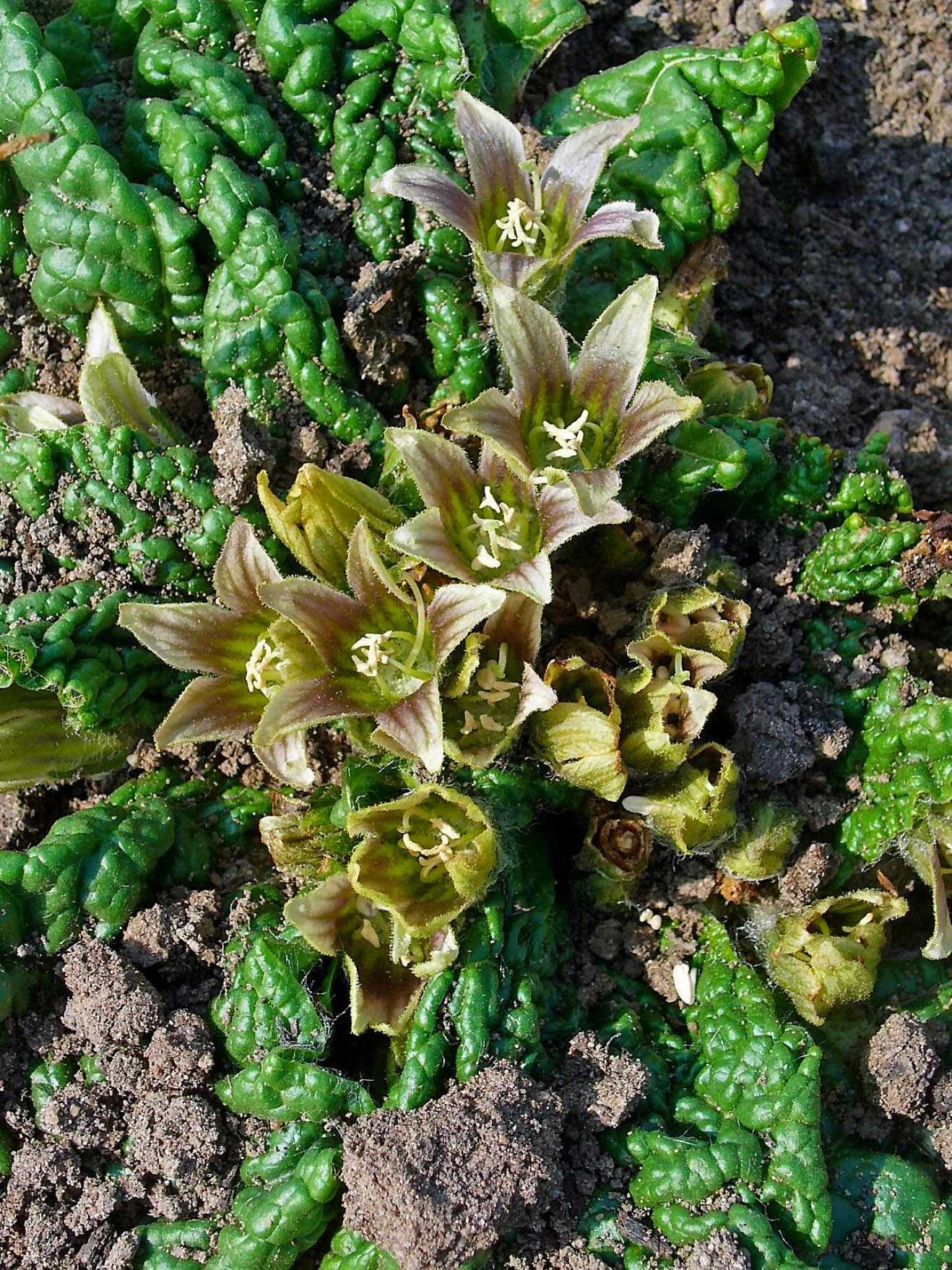
Mandragora is a plant genus belonging to the nightshade family (Solanaceae). Members of the genus are known as mandrakes. Between three and five species are placed in the genus. The one or two species found around the Mediterranean constitute the mandrake of ancient writers such as Dioscorides. Two or three further species are found eastwards into China. All are perennial herbaceous plants, with large tap roots and leaves in the form of a rosette. Individual flowers are bell-shaped, whitish through to violet, and followed by yellow or orange berries.
Like many members of the Solanaceae, species of Mandragora contain highly biologically active alkaloids that make the plants poisonous. Their roots in particular have a long use in traditional medicine. Mandrakes are involved in many myths and superstitions.
Species of Mandragora are perennial herbaceous plants. They have large vertical tap roots, sometimes forked. Their stems are short or virtually absent. The leaves form a rosette at the base of the plant. The flowers are sometimes borne on a short stalk (scape), and are solitary, with whorls of five parts. The sepals are joined at the base, as are the petals, both in the shape of a lobed bell. The stamens are shorter than the petals, joined to the floral tube towards the base. The ovary has two chambers (locules). After fertilization, a yellow or orange fruit forms (botanically a berry).
The genus Mandragora was first used in 1753 by Carl Linnaeus in the first edition of Species Plantarum where the Mediterranean species Mandragora officinarum was described, which is thus the type species of the genus. (Linnaeus later changed his mind and in 1759 placed M. officinarum in the genus Atropa as A. mandragora.)
Jackson and Berry (1979) and Ungricht et al. (1998) have documented the subsequent confusion over the number of Mediterranean species of Mandragora and their scientific names. Dioscorides was among those who distinguished between "male" and "female" mandrakes, a distinction used in 1764 when Garsault published the names Mandragora mas and Mandragora foemina. The size and shape of the fruit and the colour and time of appearance of the flowers have been used to distinguish possible species. In the 1820s, Antonio Bertoloni used flowering time to name two species as Mandragora vernalis, the spring-flowering mandrake, and Mandragora autumnalis, the autumn-flowering mandrake. Identifying the former as Linnaeus's M. officinarum, works such as Flora Europaea listed two Mediterranean species of Mandragora: M. officinarum and M. autumnalis. Using statistical analysis of morphological characters, Ungricht et al. found no distinct clusters among the specimens they examined and concluded that Linnaeus's M. officinarum is a single, variable species. Other sources divide M. officinarum sensu lato differently. Plants from the western Mediterranean, from Turkey westwards to the Iberian peninsula and Morocco, are placed in M. officinarum; plants from the eastern Mediterranean, from Syria to Israel, are placed in M. autumnalis.
Traditionally, Mandragora has been considered to be closely related to Atropa and Lycium, being grouped together in the same tribe or subtribe as at least the first of these genera. Molecular phylogenetic studies suggest that the genus belongs in the large subfamily Solanoideae, but that within this subfamily, it is one of a number of isolated genera with no immediate relatives. It has thus been placed in its own tribe, Mandragoreae.
Within the genus, studies have used different circumscriptions of the Mediterranean mandrakes. Two studies that separate plants found in the Levant (Mandragora autumnalis) from those found in the rest of the Mediterranean area (Mandragora officinarum) suggest that there are two clades in the genus - one based in the Mediterranean and beyond to Turkmenistan and Iran, and one in the Sino-Himalayan region. A simplified cladogram based on these studies is shown below. In one of the studies, M. chinghaiensis was embedded within M. caulescens.
The Solanaceae are primarily a New World family. Mandragora is suggested to have originated around 20 million years ago, arriving in Eurasia through the agency of birds, with the main split between the species occurring around 10 million years ago.
Hub AI
Mandragora (genus) AI simulator
(@Mandragora (genus)_simulator)
Mandragora (genus)
Mandragora is a plant genus belonging to the nightshade family (Solanaceae). Members of the genus are known as mandrakes. Between three and five species are placed in the genus. The one or two species found around the Mediterranean constitute the mandrake of ancient writers such as Dioscorides. Two or three further species are found eastwards into China. All are perennial herbaceous plants, with large tap roots and leaves in the form of a rosette. Individual flowers are bell-shaped, whitish through to violet, and followed by yellow or orange berries.
Like many members of the Solanaceae, species of Mandragora contain highly biologically active alkaloids that make the plants poisonous. Their roots in particular have a long use in traditional medicine. Mandrakes are involved in many myths and superstitions.
Species of Mandragora are perennial herbaceous plants. They have large vertical tap roots, sometimes forked. Their stems are short or virtually absent. The leaves form a rosette at the base of the plant. The flowers are sometimes borne on a short stalk (scape), and are solitary, with whorls of five parts. The sepals are joined at the base, as are the petals, both in the shape of a lobed bell. The stamens are shorter than the petals, joined to the floral tube towards the base. The ovary has two chambers (locules). After fertilization, a yellow or orange fruit forms (botanically a berry).
The genus Mandragora was first used in 1753 by Carl Linnaeus in the first edition of Species Plantarum where the Mediterranean species Mandragora officinarum was described, which is thus the type species of the genus. (Linnaeus later changed his mind and in 1759 placed M. officinarum in the genus Atropa as A. mandragora.)
Jackson and Berry (1979) and Ungricht et al. (1998) have documented the subsequent confusion over the number of Mediterranean species of Mandragora and their scientific names. Dioscorides was among those who distinguished between "male" and "female" mandrakes, a distinction used in 1764 when Garsault published the names Mandragora mas and Mandragora foemina. The size and shape of the fruit and the colour and time of appearance of the flowers have been used to distinguish possible species. In the 1820s, Antonio Bertoloni used flowering time to name two species as Mandragora vernalis, the spring-flowering mandrake, and Mandragora autumnalis, the autumn-flowering mandrake. Identifying the former as Linnaeus's M. officinarum, works such as Flora Europaea listed two Mediterranean species of Mandragora: M. officinarum and M. autumnalis. Using statistical analysis of morphological characters, Ungricht et al. found no distinct clusters among the specimens they examined and concluded that Linnaeus's M. officinarum is a single, variable species. Other sources divide M. officinarum sensu lato differently. Plants from the western Mediterranean, from Turkey westwards to the Iberian peninsula and Morocco, are placed in M. officinarum; plants from the eastern Mediterranean, from Syria to Israel, are placed in M. autumnalis.
Traditionally, Mandragora has been considered to be closely related to Atropa and Lycium, being grouped together in the same tribe or subtribe as at least the first of these genera. Molecular phylogenetic studies suggest that the genus belongs in the large subfamily Solanoideae, but that within this subfamily, it is one of a number of isolated genera with no immediate relatives. It has thus been placed in its own tribe, Mandragoreae.
Within the genus, studies have used different circumscriptions of the Mediterranean mandrakes. Two studies that separate plants found in the Levant (Mandragora autumnalis) from those found in the rest of the Mediterranean area (Mandragora officinarum) suggest that there are two clades in the genus - one based in the Mediterranean and beyond to Turkmenistan and Iran, and one in the Sino-Himalayan region. A simplified cladogram based on these studies is shown below. In one of the studies, M. chinghaiensis was embedded within M. caulescens.
The Solanaceae are primarily a New World family. Mandragora is suggested to have originated around 20 million years ago, arriving in Eurasia through the agency of birds, with the main split between the species occurring around 10 million years ago.
Recent media