



Community hub
Recent from talks
Knowledge base stats:
Talk channels stats:
Members stats:
Manx cat
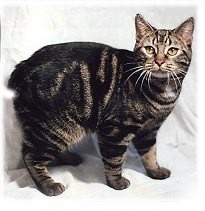
The Manx cat (/ˈmæŋks/, in earlier times often spelled Manks) is a breed of domestic cat (Felis catus) originating on the Isle of Man, with a mutation that shortens the tail. Many Manx have a small stub of a tail, but Manx cats are best known as being entirely tailless; this is the most distinguishing characteristic of the breed, along with elongated hind legs and a rounded head. Manx cats come in all coat colours and patterns, though all-white specimens are rare, and the coat range of the original stock was more limited. Long-haired variants are sometimes considered a separate breed, the Cymric cat.
Manx are prized as skilled hunters, and thus have often been sought by farmers with rodent problems, and been a preferred ship's cat breed. They are said to be social, tame and active. Two local terms for the cats on their home island are stubbin (those with a short tail) and rumpy (those with no tail). Manx have been exhibited in cat shows since the 1800s, with the first known breed standard published in 1903.
Tailless cats, then called stubbin (apparently both singular and plural) in colloquial Manx language, were known by the early 19th century as cats from the Isle of Man, hence the name, where they remain a substantial but declining percentage of the local cat population. The taillessness arose as a natural mutation on the island, though folklore persists that tailless domestic cats were brought there by sea. They are descended from mainland stock of obscure origin. Like all house cats, including nearby British and Irish populations, they are ultimately descended from the African wildcat (Felis lybica) and not from native European wildcats (Felis silvestris), of which the island has long been devoid.
The dominant trait of taillessness arises from a spontaneous mutation, the Manx taillessness gene, that eventually became common on the island because of the limited genetic diversity of island biogeography (an example of the founder effect and, at the sub-specific level, of the species-area curve).
In the Manx language, the modern name of the breed is kayt Manninagh, literally 'cat of Mann' (plural kiyt or kit), or kayt cuttagh lit. 'bob-tailed cat'. Kayt, used as both a masculine and feminine noun, is also encountered as cayt, and depending on the exact construction, it may be lenited as chayt or gayt. The diminutive word is pishin or pishyn, 'kitten' (with various plurals). Manx itself was often spelled Manks in English well into the late 1800s.
There are numerous folktales about the Manx cat, all of them of "relatively recent origin"; they are focused entirely on the lack of a tail, and are devoid of religious, philosophical, or mythical aspects found in the traditional Irish–Norse folklore of the native Manx culture, and in legends about cats from other parts of the world.
The name of the promontory Spanish Head on the coast of the island is often thought to have arisen from the local tale of a ship of the Spanish Armada foundering in the area, though there is no evidence to suggest this actually occurred. Folklore has further claimed that a tailless cat swam ashore from said shipwreck, and thus brought the trait to the island. However, tailless cats are not commonly known in Spain, even if such a shipwreck were proven.[citation needed]
Regardless of the genetic and historical reality, there are various fanciful Lamarckian folktales that seek to explain why the Manx has a truncated tail. In one of them, the biblical Noah closed the door of the Ark when it began to rain, and accidentally cut off the tail of the Manx cat who had almost been left behind. Over the years a number of cartoons have appeared on postcards from the Isle of Man showing scenes in which a cat's tail is being run over and severed by a variety of means including a motorcycle, a reference to motorcycle racing being popular on the island,[citation needed] and an update of the Noah story. Because the gene is so dominant and "invades" other breeds when crossed (often without owner knowledge) with the Manx, there was a folk belief that simply being in the proximity of a Manx cat could cause other breeds to somehow produce tailless kittens.
Hub AI
Manx cat AI simulator
(@Manx cat_simulator)
Manx cat
The Manx cat (/ˈmæŋks/, in earlier times often spelled Manks) is a breed of domestic cat (Felis catus) originating on the Isle of Man, with a mutation that shortens the tail. Many Manx have a small stub of a tail, but Manx cats are best known as being entirely tailless; this is the most distinguishing characteristic of the breed, along with elongated hind legs and a rounded head. Manx cats come in all coat colours and patterns, though all-white specimens are rare, and the coat range of the original stock was more limited. Long-haired variants are sometimes considered a separate breed, the Cymric cat.
Manx are prized as skilled hunters, and thus have often been sought by farmers with rodent problems, and been a preferred ship's cat breed. They are said to be social, tame and active. Two local terms for the cats on their home island are stubbin (those with a short tail) and rumpy (those with no tail). Manx have been exhibited in cat shows since the 1800s, with the first known breed standard published in 1903.
Tailless cats, then called stubbin (apparently both singular and plural) in colloquial Manx language, were known by the early 19th century as cats from the Isle of Man, hence the name, where they remain a substantial but declining percentage of the local cat population. The taillessness arose as a natural mutation on the island, though folklore persists that tailless domestic cats were brought there by sea. They are descended from mainland stock of obscure origin. Like all house cats, including nearby British and Irish populations, they are ultimately descended from the African wildcat (Felis lybica) and not from native European wildcats (Felis silvestris), of which the island has long been devoid.
The dominant trait of taillessness arises from a spontaneous mutation, the Manx taillessness gene, that eventually became common on the island because of the limited genetic diversity of island biogeography (an example of the founder effect and, at the sub-specific level, of the species-area curve).
In the Manx language, the modern name of the breed is kayt Manninagh, literally 'cat of Mann' (plural kiyt or kit), or kayt cuttagh lit. 'bob-tailed cat'. Kayt, used as both a masculine and feminine noun, is also encountered as cayt, and depending on the exact construction, it may be lenited as chayt or gayt. The diminutive word is pishin or pishyn, 'kitten' (with various plurals). Manx itself was often spelled Manks in English well into the late 1800s.
There are numerous folktales about the Manx cat, all of them of "relatively recent origin"; they are focused entirely on the lack of a tail, and are devoid of religious, philosophical, or mythical aspects found in the traditional Irish–Norse folklore of the native Manx culture, and in legends about cats from other parts of the world.
The name of the promontory Spanish Head on the coast of the island is often thought to have arisen from the local tale of a ship of the Spanish Armada foundering in the area, though there is no evidence to suggest this actually occurred. Folklore has further claimed that a tailless cat swam ashore from said shipwreck, and thus brought the trait to the island. However, tailless cats are not commonly known in Spain, even if such a shipwreck were proven.[citation needed]
Regardless of the genetic and historical reality, there are various fanciful Lamarckian folktales that seek to explain why the Manx has a truncated tail. In one of them, the biblical Noah closed the door of the Ark when it began to rain, and accidentally cut off the tail of the Manx cat who had almost been left behind. Over the years a number of cartoons have appeared on postcards from the Isle of Man showing scenes in which a cat's tail is being run over and severed by a variety of means including a motorcycle, a reference to motorcycle racing being popular on the island,[citation needed] and an update of the Noah story. Because the gene is so dominant and "invades" other breeds when crossed (often without owner knowledge) with the Manx, there was a folk belief that simply being in the proximity of a Manx cat could cause other breeds to somehow produce tailless kittens.