


Community hub
Recent from talks
Contribute something
Nothing was collected or created yet.
Founder effect
View on Wikipedia
In population genetics, the founder effect is the loss of genetic variation that occurs when a new population is established by a very small number of individuals from a larger population. It was first fully outlined by Ernst Mayr in 1942,[1] using existing theoretical work by those such as Sewall Wright.[2] As a result of the loss of genetic variation, the new population may be distinctively different, both genotypically and phenotypically, from the parent population from which it is derived. In extreme cases, the founder effect is thought to lead to the speciation and subsequent evolution of new species.[3]
In the figure shown, the original population has nearly equal numbers of blue and red individuals. The three smaller founder populations show that one or the other color may predominate (founder effect), due to random sampling of the original population. A population bottleneck may also cause a founder effect, though it is not strictly a new population.
The founder effect occurs when a small group of migrants—not genetically representative of the population from which they came—establish in a new area.[4][5] In addition to founder effects, the new population is often very small, so it shows increased sensitivity to genetic drift, an increase in inbreeding, and relatively low genetic variation.
Founder mutation
[edit]In genetics, a founder mutation is a mutation that appears in the DNA of one or more individuals which are founders of a distinct population. Founder mutations initiate with changes that occur in the DNA and can be passed down to other generations.[6][7] Any organism—from a simple virus to something complex like a mammal—whose progeny carry its mutation has the potential to express the founder effect,[8] for instance a goat[9][10] or a human.[11]
Founder mutations originate in long stretches of DNA on a single chromosome; indeed, the original haplotype is the whole chromosome. As the generations progress, the proportion of the haplotype that is common to all carriers of the mutation is shortened (due to genetic recombination). This shortening allows scientists to roughly estimate the age of the mutation.[12]
General
[edit]The founder effect is a type of genetic drift, occurring when a small group in a population splinters off from the original population and forms a new one. The new colony may have less genetic variation than the original population, and through the random sampling of alleles during reproduction of subsequent generations, continue rapidly towards fixation. The homozygosity increase can be calculated as , where equals inbreeding coefficient and equals population size.[13] This consequence of inbreeding makes the colony more vulnerable to extinction.[14]


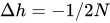
The per generation loss of heterozygosity can be calculated as , where equals heterozygosity.[13] The population of the founders of the colony can also be calculated if the loss of heterozygosity from the bottleneck is known using the same equation.[13]

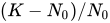
When a newly formed colony is small, its founders can strongly affect the population's genetic makeup far into the future. In humans, who have a slow reproduction rate, the population will remain small for many generations, effectively amplifying the drift effect generation after generation until the population reaches a certain size. The post-bottleneck population can be calculated with , where equals the number of generations, is the growth rate, is the population equilibrium size, is the natural logarithm base, and is the constant , where is the original size of the founding colony.[13]



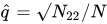
Alleles which were present but relatively rare in the original population can move to one of two extremes. The most common one is that the allele is soon lost altogether, but the other possibility is that the allele survives and within a few generations has become much more dispersed throughout the population. The new colony can experience an increase in the frequency of recessive alleles, as well, and as a result, an increased number who are homozygous for certain recessive traits.[13] The equation to calculate reccessive allele frequencies is based on Hardy-Wienberg assumptions.[13]
The variation in gene frequency between the original population and colony may also trigger the two groups to diverge significantly over the course of many generations. As the variance, or genetic distance, increases, the two separated populations may become distinctively different, both genetically and phenotypically, although not only genetic drift, but also natural selection, gene flow and mutation all contribute to this divergence. This potential for relatively rapid changes in the colony's gene frequency led most scientists to consider the founder effect (and by extension, genetic drift) a significant driving force in the evolution of new species. Sewall Wright was the first to attach this significance to random drift and small, newly isolated populations with his shifting balance theory of speciation.[16] Following behind Wright, Ernst Mayr created many persuasive models to show that the decline in genetic variation and small population size accompanying the founder effect were critically important for new species to develop.[17] However, much less support for this view is shown today, since the hypothesis has been tested repeatedly through experimental research, and the results have been equivocal at best.[further explanation needed] Speciation by genetic drift is a specific case of peripatric speciation which in itself occurs in rare instances.[18] It takes place when a random change in genetic frequency of population favours the survival of a few organisms of the species with rare genes which cause reproductive mutation. These surviving organisms then breed among themselves over a long period of time to create a whole new species whose reproductive systems or behaviors are no longer compatible with the original population. [further explanation needed][19]
Serial founder effect
[edit]Serial founder effects have occurred when populations migrate over long distances. Such long-distance migrations typically involve relatively rapid movements followed by periods of settlement. The populations in each migration carry only a subset of the genetic diversity carried from previous migrations. As a result, genetic differentiation tends to increase with geographic distance as described by the "isolation by distance" model.[20] The migration of humans out of Africa is characterized by serial founder effects.[21] Africa has the highest degree of human genetic diversity of any continent, which is consistent with an African origin of modern humans.[22]
In island ecology
[edit]Founder populations are essential to the study of island biogeography and island ecology. A natural "blank slate" is not easily found, but a classic series of studies on founder population effects was done following the catastrophic 1883 eruption of Krakatoa, which erased all life on the island.[23][24] Another continuing study has been following the biocolonization of Surtsey, Iceland, a new volcanic island that erupted offshore between 1963 and 1967. An earlier event, the Toba eruption in Sumatra about 73,000 years ago, covered some parts of India with 3–6 m (10–20 ft) of ash, and must have coated the Nicobar Islands and Andaman Islands, much nearer in the ash fallout cone, with life-smothering layers, forcing the restart of their biodiversity.[25]
However, not all founder effect studies are initiated after a natural disaster; some scientists study the reinstatement of a species that became locally extinct or hadn't existed there before. A study has been in place since 1958 studying the wolf/moose interaction on Isle Royale in Lake Superior after those animals naturally migrated there, perhaps on winter ice. Hajji and others, and Hundertmark & Van Daele, studied the current population statuses of past founder effects in Corsican red deer and Alaskan elk, respectively. Corsican red deer are still listed as an endangered species, decades after a severe bottleneck. They inhabit the Tyrrhenian islands and surrounding mainlands currently, and before the bottleneck, but Hajji and others wanted to know how the deer originally got to the islands, and from what parent population or species they were derived. Through molecular analysis, they were able to determine a possible lineage, with red deer from the islands of Corsica and Sardinia being the most related to one another. These results are promising, as the island of Corsica was repopulated with red deer from the Sardinian island after the original Corsican red deer population became extinct, and the deer now inhabiting the island of Corsica are diverging from those inhabiting Sardinia.[26][27]
Kolbe and others set up a pair of genetically sequenced and morphologically examined lizards on seven small islands to watch each new population's growth and adaptation to its new environment. Specifically, they were looking at the effects on limb length and perch width, both widely varying phenotypic ranges in the parent population. Unfortunately, immigration did occur, but the founder effect and adaptive differentiation, which could eventually lead to peripatric speciation, were statistically and biologically significant between the island populations after a few years. The authors also point out that although adaptive differentiation is significant, the differences between island populations best reflect the differences between founders and their genetic diversity that has been passed down through the generations.[28]
Founder effects can affect complex traits, such as song diversity. In the Common Myna (Acridotheres tristis), the percentage of unique songs within a repertoire and within‐song complexity were significantly lower in birds from founder populations.[29]
It was found by Tarr et al. (1998) that the loss of heterozygosity of the Laysan finch (Telespiza cantans) after founding events on small islands in the Pacific Ocean closely matched theoretical calculations upon examination of microsatellite loci.[30]
Among human populations
[edit]Genetic studies of founder effect have concentrated on discovering ancestral and novel genetic diseases caused by founder effect and, to a lesser degree, on ancestry-related founder effects on populations, races, and ancient migrations, as well as other aspects. The founder population could be the common ancestry of race or ethnicity or the forced localizations caused by artificial countries inside the larger group of ancestry, hence causing an original founder effect.[clarification needed] Race and specific founder effect mutation diseases are found in all races or ethnicities,[citation needed] and country-specific mutation diseases are caused by increasing homozygosity (the existence of same gene on both chromosomes pairs, hence a recessive disease may increase in just few generations). The genetic abnormality will increase incrementally with the decrease of number of isolated populations making tribe-specific diseases (such as Ashkenazi Jews, Amish, and Bedouins) and novel genetic defects.[31] In recessive diseases, founder populations where underlying levels of genome-wide homozygosity are high due to shared common ancestry, but also for consanguineous populations that will have large genome-wide homozygous regions due to inbreeding. Having a catalog of disease-associated variation in these populations enables rapid, early, and accurate diagnoses that may improve patient outcomes due to informed clinical management and early interventions. Enclosed communities such as Amish communities, Ashkenazi communities, and relatively isolated islands allow scientists to better understand and further discover the mutated genes that cause these rare diseases and allow them to also discover protective genes as well.[32]
Due to various migrations throughout human history, founder effects are somewhat common among humans in different times and places. The French Canadians of Quebec are a classical example of founder population. Over 150 years of French colonization, between 1608 and 1760, an estimated 8,500 pioneers married and left at least one descendant on the territory.[33] Following the takeover of the colony by the British crown in 1760, immigration from France effectively stopped, but descendants of French settlers continued to grow in number mainly due to their high fertility rate. Intermarriage occurred mostly with the deported Acadians and migrants coming from the British Isles. Since the 20th century, immigration in Quebec and mixing of French Canadians involve people from all over the world. While the French Canadians of Quebec today may be partly of other ancestries, the genetic contribution of the original French founders is predominant, explaining about 90% of regional gene pools, while Acadian (descended from other French settlers in eastern Canada) admixtures contributing 4% British and 2% Native American and other groups contributing less.[34] The founder effect can also be observed among some communities of the Romani people, an Indo-Aryan ethnic group, which numbers approximately 8-10 million people in Europe, and additional numbers in other parts of the world, such as the United States and Latin America, and who were traditionally a nomadic population.[35]
In humans, founder effects can arise from cultural isolation, and inevitably, endogamy. For example, the Amish populations in the United States exhibit founder effects because they have grown from a very few founders, have not recruited newcomers, and tend to marry within the community. Though still rare, phenomena such as polydactyly (extra fingers and toes, a symptom of a condition such as[36][37] Weyers acrodental dysostosis[36] or Ellis–Van Creveld syndrome[37]) are more common in Amish communities than in the American population at large.[38] Maple syrup urine disease affects about one out of 180,000 infants in the general population.[citation needed] Due in part to the founder effect,[39] however, the disease has a much higher prevalence in children of Amish, Mennonite, and Jewish descent.[40][41] Similarly, a high frequency of fumarase deficiency exists among the 10,000 members of the Fundamentalist Church of Jesus Christ of Latter Day Saints, a community which practices both endogamy and polygyny, where an estimated 75–80% of the community are blood relatives of just two men—founders John Y. Barlow and Joseph Smith Jessop.[42] In South Asia, castes like the Gujjars, the Baniyas and the Pattapu Kapu have estimated founder effects about 10 times as strong as those of Finns and Ashkenazi Jews.[43]
In Africa, many members of the Vadoma tribe inherit ectrodactyly, giving them the nickname of the "two-toed tribe".[44][failed verification]
The island of Pingelap also suffered a population bottleneck in 1775 following a typhoon that had reduced the population to only 20 people. As a result, complete achromatopsia has a current rate of occurrence of roughly 10%, with an additional 30% being carriers of this recessive condition.
Around 1814, a small group of British colonists founded a settlement on Tristan da Cunha, a group of small islands in the Atlantic Ocean, midway between Africa and South America. One of the early colonists apparently carried a rare, recessive allele for retinitis pigmentosa, a progressive form of blindness that afflicts homozygous individuals. As late as 1961, the majority of the genes in the gene pool on Tristan were still derived from 15 original ancestors; as a consequence of the inbreeding, of 232 people tested in 1961, four were suffering from retinitis pigmentosa. This represents a prevalence of 1 in 58, compared with a worldwide prevalence of around 1 in 4,000.[45]
The abnormally high rate of twin births in Cândido Godói could be explained by the founder effect.[46]
On 31 August 2023, researchers reported, based on genetic studies, that a human ancestor population bottleneck (from a possible 100,000 to 1000 individuals) occurred "around 930,000 and 813,000 years ago ... lasted for about 117,000 years and brought human ancestors close to extinction."[47][48]
See also
[edit]References
[edit]- ^ Provine, W. B. (2004). "Ernst Mayr: Genetics and speciation". Genetics. 167 (3): 1041–6. doi:10.1093/genetics/167.3.1041. PMC 1470966. PMID 15280221.
- ^ Templeton, A. R. (1980). "The theory of speciation via the founder principle". Genetics. 94 (4): 1011–38. doi:10.1093/genetics/94.4.1011. PMC 1214177. PMID 6777243.
- ^ Joly E (December 2011). "The existence of species rests on a metastable equilibrium between inbreeding and outbreeding. An essay on the close relationship between speciation, inbreeding and recessive mutations". Biology Direct. 6: 62. doi:10.1186/1745-6150-6-62. PMC 3275546. PMID 22152499.
- ^ Hartwell, Leland; Hood, Leroy; Goldberg, Michael; Reynolds, Ann E.; Silver, Lee; Veres, Ruth C (2004). Genetics: From Genes to Genomes. McGraw-Hill Higher Education. p. 241. ISBN 978-0-07-121468-1.
- ^ Raven, Peter H.; Evert, Ray F.; Eichhorn, Susan E. (1999). Biology of Plants. W H Freeman and Company. p. 241.
- ^ "Bioinformatics Glossary". bscs.org. Archived from the original on March 25, 2009. Retrieved 2009-03-23.
- ^ "Colorectal Cancer Research Definitions". www.mshri.on.ca. Archived from the original on July 24, 2009. Retrieved 2009-03-23.
- ^ Joseph, S. B.; Swanstrom, R.; Kashuba, A. D.; Cohen, M. S. (2015). "Bottlenecks in HIV-1 transmission: insights from the study of founder viruses". Nature Reviews Microbiology. 13 (7): 414–425. doi:10.1038/nrmicro3471. PMC 4793885. PMID 26052661.
- ^ Cooper, C. A.; Garas Klobas, L. C.; Maga, E. A.; Murray, J. D. (2013). "Consuming transgenic goats' milk containing the antimicrobial protein lysozyme helps resolve diarrhea in young pigs". PLOS ONE. 8 (3) e58409. Bibcode:2013PLoSO...858409C. doi:10.1371/journal.pone.0058409. PMC 3596375. PMID 23516474.
- ^ Molteni, Megan (June 30, 2016). "Spilled Milk". Retrieved 2017-01-12.
- ^ Ossa, C. A.; Torres, D. (2016). "Founder and Recurrent Mutations in BRCA1 and BRCA2 Genes in Latin American Countries: State of the Art and Literature Review". The Oncologist. 21 (7): 832–839. doi:10.1634/theoncologist.2015-0416. PMC 4943386. PMID 27286788.
- ^ Drayna, Dennis (2005). "Founder Mutations: Scientific American". Scientific American. 293 (4): 78–85. doi:10.1038/scientificamerican1005-78. PMID 16196257.
- ^ a b c d e f Allendorf, Fred W.; Funk, W. Chris; Aitken, Sally N.; Byrne, Margaret; Luikart, Gordon; Antunes, Agostinho (2022-02-10). Conservation and the Genomics of Populations (3 ed.). Oxford University Press. doi:10.1093/oso/9780198856566.001.0001. ISBN 978-0-19-885656-6.
- ^ Reece, Jane B. (2011). Campbell biology, AP edition (9th ed.). Boston, MA: Pearson Education/Benjamin Cummings. ISBN 978-0-13-137504-8. OCLC 792861278.
- ^ "File:Founder effect Illustration.jpg - Wikipedia". commons.wikimedia.org. 13 May 2015. Retrieved 2023-03-16.
- ^ Wade, Michael S.; Wolf, Jason; Brodie, Edmund D. (2000). Epistasis and the evolutionary process. Oxford [Oxfordshire]: Oxford University Press. p. 330. ISBN 978-0-19-512806-2.
- ^ Mayr, Ernst; Hey, Jody; Fitch, Walter M.; Ayala, Francisco José (2005). Systematics and the Origin of Species: on Ernst Mayr's 100th anniversary (Illustrated ed.). National Academies Press. p. 367. ISBN 978-0-309-09536-5.
- ^ "Peripatric Speciation". evolution.berkeley.edu. Archived from the original on April 23, 2004.
- ^ Howard, Daniel J.; Berlocher, Steward H. (1998). Endless Forms (Illustrated ed.). United States: Oxford University Press. p. 470. ISBN 978-0-19-510901-6.
- ^ Ramachandran, S.; Deshpande, O.; Roseman, C. C.; Rosenberg, N. A.; Feldman, M. W.; Cavalli-Sforza, L. L. (2005). "Support from the relationship of genetic and geographic distance in human populations for a serial founder effect originating in Africa". Proceedings of the National Academy of Sciences. 102 (44): 15942–7. Bibcode:2005PNAS..10215942R. doi:10.1073/pnas.0507611102. JSTOR 4143304. PMC 1276087. PMID 16243969.
- ^ Degiorgio, M.; Jakobsson, M.; Rosenberg, N. A. (2009). "Explaining worldwide patterns of human genetic variation using a coalescent-based serial founder model of migration outward from Africa". Proceedings of the National Academy of Sciences. 106 (38): 16057–62. Bibcode:2009PNAS..10616057D. doi:10.1073/pnas.0903341106. JSTOR 40485019. PMC 2752555. PMID 19706453.
- ^ Schlebusch, Carina M.; Jakobsson, Mattias (2018-08-31). "Tales of Human Migration, Admixture, and Selection in Africa". Annual Review of Genomics and Human Genetics. 19 (1): 405–428. doi:10.1146/annurev-genom-083117-021759. ISSN 1527-8204. PMID 29727585.
- ^ Treub, Melchior (1888). "Notice sur la nouvelle flore de Krakatau". Annales du Jardin botanique de Buitenzorg. 7: 213–223 – via Biodiversity Heritage Library.
- ^ Bordage, Edmond (1916). "Le repeuplement végétal et animal des îles Krakatoa depuis l'éruption de 1883". Annales de géographie. 25 (133): 1–22. doi:10.3406/geo.1916.8848.
- ^ O'Connell, Kyle A.; Oaks, Jamie R.; Hamidy, Amir; Shaney, Kyle J.; Kurniawan, Nia; Smith, Eric N.; Fujita, Matthew K. (August 2020). "Impacts of the Toba eruption and montane forest expansion on diversification in Sumatran parachuting frogs ( Rhacophorus )". Molecular Ecology. 29 (16): 2994–3009. Bibcode:2020MolEc..29.2994O. doi:10.1111/mec.15541. ISSN 0962-1083. PMID 32633832. S2CID 220384153.
- ^ Hajji, Ghaiet M.; Charfi-Cheikrouha, F.; Lorenzini, Rita; Vigne, Jean-Denis; Hartl, Günther B.; Zachos, Frank E. (2007). "Phylogeography and founder effect of the endangered Corsican red deer (Cervus elaphus corsicanus)". Biodiversity and Conservation. 17 (3): 659–73. doi:10.1007/s10531-007-9297-9. S2CID 26357327.
- ^ Hundertmark, Kris J.; Van Daele, Larry J. (2009). "Founder effect and bottleneck signatures in an introduced, insular population of elk". Conservation Genetics. 11: 139–47. doi:10.1007/s10592-009-0013-z. S2CID 24280253.
- ^ Kolbe, J. J.; Leal, M.; Schoener, T. W.; Spiller, D. A.; Losos, J. B. (2012). "Founder Effects Persist Despite Adaptive Differentiation: A Field Experiment with Lizards". Science. 335 (6072): 1086–9. Bibcode:2012Sci...335.1086K. CiteSeerX 10.1.1.363.77. doi:10.1126/science.1209566. PMID 22300849. S2CID 12374679.
- ^ Hill, Samuel D.; Pawley, Matthew D. M. (2019). "Reduced song complexity in founder populations of a widely distributed songbird". Ibis. 161 (2): 435–440. doi:10.1111/ibi.12692. ISSN 1474-919X. S2CID 92000651.
- ^ Tarr, C. L.; Conant, S.; Fleischer, R. C. (1998). "Founder events and variation at microsatellite loci in an insular passerine bird, the Laysan finch ( Telespiza cantans )". Molecular Ecology. 7 (6): 719–731. Bibcode:1998MolEc...7..719T. doi:10.1046/j.1365-294x.1998.00385.x.
- ^ "founder effect". Emery and Rimoin's Principles and Practice of Medical Genetics and Genomics (Seventh ed.). 2020.
- ^ Puffenberger, Erik (2021). "Recessive diseases and founder genetics". Genomics of Rare Diseases.
- ^ Charbonneau, Hubert; Desjardins, Bertrand; Légaré, Jacques; Denis, Hubert (2010). "The Population of the St. Lawrence Valley 1608–1760". In Haines, Michael R.; Stecke, Richard H. (eds.). A Population History of North America. Cambridge University Press. pp. 99–142. ISBN 978-0-521-49666-7.
- ^ Bherer, Claude; Labuda, Damian; Roy-Gagnon, Marie-Hélène; Houde, Louis; Tremblay, Marc; Vézina, Hélène (2011). "Admixed ancestry and stratification of Quebec regional populations" (PDF). American Journal of Physical Anthropology. 144 (3): 432–41. doi:10.1002/ajpa.21424. PMID 21302269.
- ^ https://pmc.ncbi.nlm.nih.gov/articles/PMC31389/
- ^ a b "Weyers acrofacial dysostosis / "Genetics Home Reference" ("Your Guide to Understanding Genetic Conditions"), from the "US National Library of Medicine"". National Library of Medicine (NLM), which is part of the National Institutes of Health, an agency of the U.S. Department of Health and Human Services ... ((Note: archived from an earlier version of the original.)). July 18, 2017. Archived from the original on June 27, 2017. Retrieved July 24, 2017.
People with Weyers acrofacial dysostosis have abnormally small or malformed fingernails and toenails. Most people with the condition are relatively short, and they may have extra fingers or toes (polydactyly). [...] The features of Weyers acrofacial dysostosis overlap with those of another, more severe condition called Ellis–Van Creveld syndrome. In addition to tooth and nail abnormalities, people with Ellis-van Creveld syndrome have very short stature and are often born with heart defects. The two conditions are caused by mutations in the same genes.
- ^ a b "How are genetic conditions and genes named? / "Genetics Home Reference" ("Your Guide to Understanding Genetic Conditions"), from the "US National Library of Medicine"". National Library of Medicine (NLM), which is part of the National Institutes of Health, an agency of the U.S. Department of Health and Human Services ... ((Note: archived from an earlier version of the original.)). July 18, 2017. Archived from the original on July 9, 2017. Retrieved July 24, 2017.
- ^ McKusick, V. A.; Egeland, J. A.; Eldridge, R; Krusen, D. E. (1964). "Dwarfism in the Amish I. The Ellis-Van Creveld Syndrome". Bulletin of the Johns Hopkins Hospital. 115: 306–36. PMID 14217223.
- ^ Jaworski, M. A.; Severini, A; Mansour, G; Konrad, H. M.; Slater, J; Hennig, K; Schlaut, J; Yoon, J. W.; Pak, C. Y.; MacLaren, N (1989). "Genetic conditions among Canadian Mennonites: Evidence for a founder effect among the old colony (Chortitza) Mennonites". Clinical and Investigative Medicine. 12 (2): 127–41. PMID 2706837.
- ^ Puffenberger, E.G. (2003). "Genetic heritage of the Old Order Mennonites of southeastern Pennsylvania". American Journal of Medical Genetics. 121C (1): 18–31. doi:10.1002/ajmg.c.20003. PMID 12888983. S2CID 25317649.
- ^ "Maple Syrup Urine Disease (MSUD) - Jewish Genetic Disease".
- ^ Forbidden Fruit:Inbreeding among polygamists along the Arizona-Utah border is producing a caste of severely retarded and deformed children, by John Dougherty, The Phoenix New Times News, December 29, 2005, page 2.
- ^ Yin, Steph (2017-07-17). "In South Asian Social Castes, a Living Lab for Genetic Disease". The New York Times. ISSN 0362-4331. Retrieved 2020-03-13.
- ^ Farrell HB (1984). "The two-toed Wadoma--familial ectrodactyly in Zimbabwe". S. Afr. Med. J. 65 (13): 531–3. PMID 6710256.
- ^ Berry, RJ (1967). "Genetical changes in mice and men". Eugen Rev. 59 (2): 78–96. PMC 2906351. PMID 4864588.
- ^ De Oliveira, Marcelo Zagonel; Schüler-Faccini, Lavínia; Demarchi, Dario A.; Alfaro, Emma L.; Dipierri, José E.; Veronez, Mauricio R.; Colling Cassel, Marlise; Tagliani-Ribeiro, Alice; Silveira Matte, Ursula; Ramallo, Virginia (2013). "So Close, So Far Away: Analysis of Surnames in a Town of Twins (Cândido Godói, Brazil)". Annals of Human Genetics. 77 (2): 125–36. doi:10.1111/ahg.12001. hdl:11336/11007. PMID 23369099. S2CID 206980257.
- ^ Zimmer, Carl (31 August 2023). "Humanity's Ancestors Nearly Died Out, Genetic Study Suggests - The population crashed following climate change about 930,000 years ago, scientists concluded. Other experts aren't convinced by the analysis". the New York Times. Archived from the original on 31 August 2023. Retrieved 2 September 2023.
- ^ Hu, Wangjie; et al. (31 August 2023). "Genomic inference of a severe human bottleneck during the Early to Middle Pleistocene transition". Science. 381 (6661): 979–984. Bibcode:2023Sci...381..979H. doi:10.1126/science.abq7487. PMID 37651513. Archived from the original on 1 September 2023. Retrieved 2 September 2023.
Further reading
[edit]- Mayr, Ernst (1954). "Change of genetic environment and evolution". In Julian Huxley (ed.). Evolution as a Process. London: George Allen & Unwin. OCLC 974739.
- Mayr, Ernst (1963). Animal Species and Evolution. Cambridge: Belknap Press of Harvard University Press. ISBN 978-0-674-03750-2.
{{cite book}}: ISBN / Date incompatibility (help)
External links
[edit]

