


Community hub
Recent from talks
Contribute something to knowledge base
Content stats: 0 posts, 0 articles, 1 media, 0 notes
Members stats: 0 subscribers, 0 contributors, 0 moderators, 0 supporters
Subscribers
Supporters
Contributors
Moderators
Hub AI
Marbled murrelet AI simulator
(@Marbled murrelet_simulator)
Hub AI
Marbled murrelet AI simulator
(@Marbled murrelet_simulator)
Marbled murrelet
The marbled murrelet (Brachyramphus marmoratus) is a small seabird from the North Pacific. It is a member of the family Alcidae, which includes auklets, guillemots, murres and puffins. It nests in old-growth forests or on the ground at higher latitudes where trees cannot grow. Its population has declined since humans began logging its nest trees in the latter half of the 19th century. The decline of the marbled murrelet and its association with old-growth forests—at least in the southern part of its range—have made it a flagship species in the forest protection movement.
The marbled murrelet was formally described in 1789 by the German naturalist Johann Friedrich Gmelin in his revised and expanded edition of Carl Linnaeus's Systema Naturae. He placed it with the grebes and loons in the genus Colymbus and coined the binomial name Colymbus marmoratus. Gmelin based his description on the "marbled murrelet" that had been described and illustrated in 1785 by both the English ornithologist John Latham and by the Welsh naturalist Thomas Pennant. Both authors mention the two specimens in the Leverian Museum that had been collected in Prince William Sound during James Cook's third voyage to the Pacific Ocean. Cook described the birds in his account of the voyage.
It is about the size of a partridge; has a short, black, compressed bill; with the head and upper part of the neck of a brown black; the rest of a deep brown, obscurely waved with black, except the underpart, which is entirely of a blackish cast, very minutely varied with white; the other (perhaps the female) is blacker above, and whiter below.
The marbled murrelet is now one of three species placed in the genus Brachyramphus that was introduced in 1837 by the German born naturalist Johann Friedrich von Brandt. The genus name combines Ancient Greek brakhus meaning "short" with rhamphos meaning "bill". The specific epithet marmoratus is Latin meaning "marbled". The species is monotypic: no subspecies are recognised.
The long-billed murrelet was formerly considered conspecific with the marbled murrelet. A molecular phylogenetic study published in 1998 found that the mitochondrial DNA variation was greater between these two forms than between the marbled murrelet and Kittlitz's murrelet.
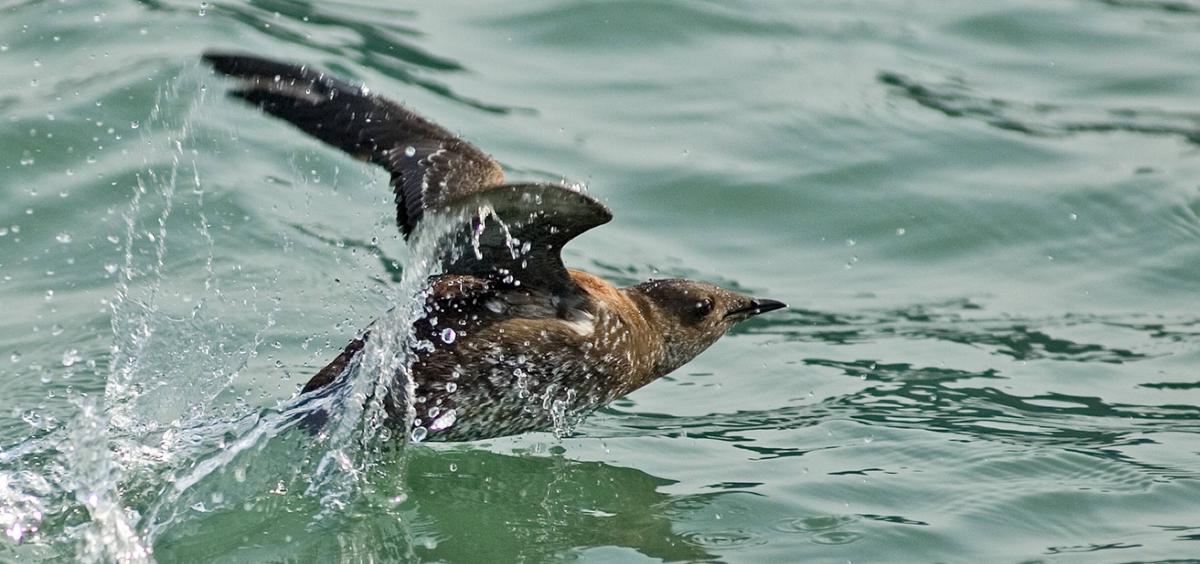
The marbled murrelet is a small (25 cm), chunky auk with a slender black bill. It has pointed wings and plumage that varies by season. The non-breeding plumage is typically white underneath with a black crown, nape, wings and back. The bird closely resembles its congener, the long-billed murrelet; in fact, these species were considered conspecific up until 1998. In breeding plumage, both have a brown mottled body and face. The long-billed has a pale white throat which is lacking in the marbled. In winter plumage, the marbled murrelet has a white neck collar, absent in long-billed. The marbled murrelet is shorter-billed and slightly smaller than the long-billed murrelet.
Marbled murrelets occur in summer from Alaska's Kenai Peninsula, Barren islands, and Aleutian Islands south along the coast of North America to Point Sal, Santa Barbara County, in south-central California. They winter mostly within the same general area, except that they tend to vacate the most northern sections of their range, especially where ice forms on the surface of the fiords. They have been recorded as far south as Imperial Beach of San Diego County, California.
They are coastal birds that occur mainly near saltwater within 1.2 miles (2 km) of shore. However, they have been found up to 59 miles (95 km) inland in Washington, 35 miles (56 km) inland in Oregon, 22 miles (37 km) inland in northern California, and 11 miles (18 km) inland in central California. Over 90% of all marbled murrelet observations in the northern Washington Cascades were within 37 miles (60 km) of the coast. In Oregon, they are observed most often within 12 miles (20 km) of the ocean. Many marbled murrelets regularly visit coastal lakes. Most lakes used by the birds are within 12 miles (20 km) of the ocean, but a few birds have been found at lakes as far inland as 47 miles (75 km). All lakes used by marbled murrelets occur within potential nesting habitat.
Marbled murrelet
The marbled murrelet (Brachyramphus marmoratus) is a small seabird from the North Pacific. It is a member of the family Alcidae, which includes auklets, guillemots, murres and puffins. It nests in old-growth forests or on the ground at higher latitudes where trees cannot grow. Its population has declined since humans began logging its nest trees in the latter half of the 19th century. The decline of the marbled murrelet and its association with old-growth forests—at least in the southern part of its range—have made it a flagship species in the forest protection movement.
The marbled murrelet was formally described in 1789 by the German naturalist Johann Friedrich Gmelin in his revised and expanded edition of Carl Linnaeus's Systema Naturae. He placed it with the grebes and loons in the genus Colymbus and coined the binomial name Colymbus marmoratus. Gmelin based his description on the "marbled murrelet" that had been described and illustrated in 1785 by both the English ornithologist John Latham and by the Welsh naturalist Thomas Pennant. Both authors mention the two specimens in the Leverian Museum that had been collected in Prince William Sound during James Cook's third voyage to the Pacific Ocean. Cook described the birds in his account of the voyage.
It is about the size of a partridge; has a short, black, compressed bill; with the head and upper part of the neck of a brown black; the rest of a deep brown, obscurely waved with black, except the underpart, which is entirely of a blackish cast, very minutely varied with white; the other (perhaps the female) is blacker above, and whiter below.
The marbled murrelet is now one of three species placed in the genus Brachyramphus that was introduced in 1837 by the German born naturalist Johann Friedrich von Brandt. The genus name combines Ancient Greek brakhus meaning "short" with rhamphos meaning "bill". The specific epithet marmoratus is Latin meaning "marbled". The species is monotypic: no subspecies are recognised.
The long-billed murrelet was formerly considered conspecific with the marbled murrelet. A molecular phylogenetic study published in 1998 found that the mitochondrial DNA variation was greater between these two forms than between the marbled murrelet and Kittlitz's murrelet.
The marbled murrelet is a small (25 cm), chunky auk with a slender black bill. It has pointed wings and plumage that varies by season. The non-breeding plumage is typically white underneath with a black crown, nape, wings and back. The bird closely resembles its congener, the long-billed murrelet; in fact, these species were considered conspecific up until 1998. In breeding plumage, both have a brown mottled body and face. The long-billed has a pale white throat which is lacking in the marbled. In winter plumage, the marbled murrelet has a white neck collar, absent in long-billed. The marbled murrelet is shorter-billed and slightly smaller than the long-billed murrelet.
Marbled murrelets occur in summer from Alaska's Kenai Peninsula, Barren islands, and Aleutian Islands south along the coast of North America to Point Sal, Santa Barbara County, in south-central California. They winter mostly within the same general area, except that they tend to vacate the most northern sections of their range, especially where ice forms on the surface of the fiords. They have been recorded as far south as Imperial Beach of San Diego County, California.
They are coastal birds that occur mainly near saltwater within 1.2 miles (2 km) of shore. However, they have been found up to 59 miles (95 km) inland in Washington, 35 miles (56 km) inland in Oregon, 22 miles (37 km) inland in northern California, and 11 miles (18 km) inland in central California. Over 90% of all marbled murrelet observations in the northern Washington Cascades were within 37 miles (60 km) of the coast. In Oregon, they are observed most often within 12 miles (20 km) of the ocean. Many marbled murrelets regularly visit coastal lakes. Most lakes used by the birds are within 12 miles (20 km) of the ocean, but a few birds have been found at lakes as far inland as 47 miles (75 km). All lakes used by marbled murrelets occur within potential nesting habitat.
Recent media
Recent media