



Community hub
Recent from talks
Contribute something
Nothing was collected or created yet.
Margules activity model
View on WikipediaThe Margules activity model is a simple thermodynamic model for the excess Gibbs free energy of a liquid mixture introduced in 1895 by Max Margules.[1][2] After Lewis had introduced the concept of the activity coefficient, the model could be used to derive an expression for the activity coefficients of a compound i in a liquid, a measure for the deviation from ideal solubility, also known as Raoult's law.

In 1900, Jan Zawidzki proved the model via determining the composition of binary mixtures condensed at different temperatures by their refractive indices.[3]
In chemical engineering, the Margules Gibbs free energy model for liquid mixtures is better known as the Margules activity or activity coefficient model. Although the model is old it has the characteristic feature to describe extrema in the activity coefficient, which modern models like NRTL and Wilson cannot.
Equations
[edit]Excess Gibbs free energy
[edit]Margules expressed the intensive excess Gibbs free energy of a binary liquid mixture as a power series of the mole fractions xi:

In here the A, B are constants, which are derived from regressing experimental phase equilibria data. Frequently the B and higher order parameters are set to zero. The leading term assures that the excess Gibbs energy becomes zero at x1=0 and x1=1.

Activity coefficient
[edit]The activity coefficient of component i is found by differentiation of the excess Gibbs energy towards xi. This yields, when applied only to the first term and using the Gibbs–Duhem equation,:[4]
![{\displaystyle \left\{{\begin{matrix}\ln \ \gamma _{1}=[A_{12}+2(A_{21}-A_{12})x_{1}]x_{2}^{2}\\\ln \ \gamma _{2}=[A_{21}+2(A_{12}-A_{21})x_{2}]x_{1}^{2}\end{matrix}}\right.}](https://wikimedia.org/api/rest_v1/media/math/render/svg/76d138182885d0f00a1797b5c3538edd93d725e9)
In here A12 and A21 are constants which are equal to the logarithm of the limiting activity coefficients: and respectively.


When , which implies molecules of same molecular size but different polarity, the equations reduce to the one-parameter Margules activity model:

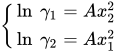
In that case the activity coefficients cross at x1=0.5 and the limiting activity coefficients are equal. When A=0 the model reduces to the ideal solution, i.e. the activity of a compound is equal to its concentration (mole fraction).
Extrema
[edit]Using simple algebraic manipulation, it can be stated that increases or decreases monotonically within all range, if or with , respectively. When and , the activity coefficient curve of component 1 shows a maximum and compound 2 minimum at:



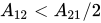
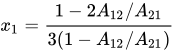
Same expression can be used when and , but in this situation the activity coefficient curve of component 1 shows a minimum and compound 2 a maximum. It is easily seen that when A12=0 and A21>0 that a maximum in the activity coefficient of compound 1 exists at x1=1/3. Obviously, the activity coefficient of compound 2 goes at this concentration through a minimum as a result of the Gibbs-Duhem rule.

The binary system Chloroform(1)-Methanol(2) is an example of a system that shows a maximum in the activity coefficient of Chloroform. The parameters for a description at 20 °C are A12=0.6298 and A21=1.9522. This gives a minimum in the activity of Chloroform at x1=0.17.
In general, for the case A=A12=A21, the larger parameter A, the more the binary systems deviates from Raoult's law; i.e. ideal solubility. When A>2 the system starts to demix in two liquids at 50/50 composition; i.e. plait point is at 50 mol%. Since:


For asymmetric binary systems, A12≠A21, the liquid-liquid separation always occurs for

Or equivalently:

The plait point is not located at 50 mol%. It depends on the ratio of the limiting activity coefficients.
Recommended values
[edit]An extensive range of recommended values for the Margules parameters can be found in the literature.[6][7] Selected values are provided in the table below.
| System | A12 | A21 |
|---|---|---|
| Acetone(1)-Chloroform(2)[7] | -0.8404 | -0.5610 |
| Acetone(1)-Methanol(2)[7] | 0.6184 | 0.5788 |
| Acetone(1)-Water(2)[7] | 2.0400 | 1.5461 |
| Carbon tetrachloride(1)-Benzene (2)[7] | 0.0948 | 0.0922 |
| Chloroform(1)-Methanol(2)[7] | 0.8320 | 1.7365 |
| Ethanol(1)-Benzene(2)[7] | 1.8362 | 1.4717 |
| Ethanol(1)-Water(2)[7] | 1.6022 | 0.7947 |
See also
[edit]Literature
[edit]- ^ Margules, Max (1895). "Über die Zusammensetzung der gesättigten Dämpfe von Misschungen". Sitzungsberichte der Kaiserliche Akadamie der Wissenschaften Wien Mathematisch-Naturwissenschaftliche Klasse II. 104: 1243–1278.https://archive.org/details/sitzungsbericht10wiengoog
- ^ Gokcen, N.A. (1996). "Gibbs-Duhem-Margules Laws". Journal of Phase Equilibria. 17 (1): 50–51. doi:10.1007/BF02648369. S2CID 95256340.
- ^ Hildebrand, J. H. (October 1981). "A History of Solution Theory". Annual Review of Physical Chemistry. 32 (1): 1–24. doi:10.1146/annurev.pc.32.100181.000245. ISSN 0066-426X.
- ^ Phase Equilibria in Chemical Engineering, Stanley M. Walas, (1985) p180 Butterworth Publ. ISBN 0-409-95162-5
- ^ Wisniak, Jaime (1983). "Liquid—liquid phase splitting—I analytical models for critical mixing and azeotropy". Chem Eng Sci. 38 (6): 969–978. doi:10.1016/0009-2509(83)80017-7.
- ^ Gmehling, J.; Onken, U.; Arlt, W.; Grenzheuser, P.; Weidlich, U.; Kolbe, B.; Rarey, J. (1991–2014). Chemistry Data Series, Volume I: Vapor-Liquid Equilibrium Data Collection. Dechema. Archived from the original on 2017-05-22. Retrieved 2017-05-05.
- ^ a b c d e f g h Perry, Robert H.; Green, Don W. (1997). Perry's Chemical Engineers' Handbook (7th ed.). New York: McGraw-Hill. pp. 13:20. ISBN 978-0-07-115982-1.
External links
[edit]Margules activity model
View on GrokipediaOverview
Definition and Scope
The Margules activity model is a thermodynamic framework that employs a polynomial expansion to represent the excess Gibbs free energy of liquid mixtures, thereby accounting for deviations from ideal solution behavior caused by molecular interactions.[6][7] Primarily designed for binary liquid systems, the model addresses non-ideality through assumptions of either symmetric (regular solution-like) or asymmetric interactions between components, limiting its scope to condensed phases where such deviations significantly influence mixture properties.[7][8] Its core purpose lies in predicting activity coefficients, which enable accurate calculations of phase equilibria, such as vapor-liquid equilibria, in applications spanning chemical engineering and physical chemistry.[7][6] Compared to more sophisticated models like Wilson or NRTL, the Margules approach offers notable simplicity with fewer parameters, making it ideal for introductory thermodynamic analyses and quick evaluations of non-ideal mixing.[6][7]Historical Background
The Margules activity model originated with the work of Austrian physicist and meteorologist Max Margules, who introduced it in 1895, in his paper "Über die Zusammensetzung der gesättigten Dämpfe von Mischungen" (On the Composition of the Saturated Vapors of Mixtures), as an empirical framework to describe deviations from ideal behavior in liquid mixtures. Margules' approach focused on relating the partial vapor pressures of components in binary mixtures to their liquid-phase compositions, drawing from experimental observations of vapor pressures in binary mixtures, such as those reported by Konowalow. This model represented one of the earliest systematic attempts to quantify non-ideality in mixtures through a polynomial expansion of excess properties.[9][10] Margules' contribution emerged amid the rapid advancements in thermodynamics during the late 19th century, a period marked by efforts to extend classical ideal gas laws to real fluids and mixtures. His work built upon foundational developments such as Johannes Diderik van der Waals' 1873 equation of state, which accounted for intermolecular attractions and molecular volumes in real gases, and subsequent extensions to liquid-vapor equilibria in mixtures. By addressing vapor-liquid behavior empirically, Margules provided a practical tool for phase equilibrium calculations that complemented these theoretical foundations.[10] In the 20th century, the Margules model transitioned from its initial empirical roots to a cornerstone in vapor-liquid equilibrium (VLE) studies, particularly for binary systems where simple non-ideal effects dominated. Its polynomial form facilitated fitting experimental data and inspired refinements, such as the two-parameter extension and related models like van Laar's (1910), which further refined VLE predictions for industrial applications. This adoption solidified its role in chemical engineering and physical chemistry, influencing phase equilibrium analysis well into modern thermodynamic modeling.[10][11]Theoretical Basis
Excess Gibbs Free Energy
The excess Gibbs free energy, denoted as , is defined as the difference between the actual Gibbs free energy of a mixture and that of an ideal mixture at the same temperature, pressure, and overall composition; it quantifies the departure from ideal solution behavior due to non-ideal molecular interactions.[12] This quantity drives deviations in thermodynamic properties, such as phase equilibria, by accounting for the energetic and structural effects of mixing unlike molecules.[13] In the Margules activity model for binary mixtures, the molar excess Gibbs free energy is represented by a symmetric polynomial expansion: where and are the mole fractions of the two components, is the universal gas constant, is the absolute temperature, and and are adjustable parameters that embody the asymmetric interaction energies between pairs of molecules (e.g., relates to the energy change when a molecule of component 2 is surrounded by component 1).[13] These parameters capture the relative strengths of unlike-pair interactions compared to like-pair interactions, allowing the model to describe both symmetric and skewed non-idealities in liquid mixtures.[6] Physically, reflects enthalpic contributions from differences in intermolecular forces (e.g., dispersion, polar, or hydrogen bonding) and entropic contributions from changes in molecular packing or configurational freedom upon mixing in the liquid phase.[12] For instance, positive indicates net repulsive interactions leading to reduced miscibility, while negative values suggest attractive interactions enhancing solubility. The model's polynomial form provides a flexible, empirical yet thermodynamically consistent way to interpolate these deviations across compositions.[13] The excess Gibbs free energy connects to other excess thermodynamic properties through the fundamental relation , where is the excess enthalpy and is the excess entropy; more precisely, the Gibbs-Helmholtz equation enables computation of from the temperature derivative of , highlighting how thermal effects influence non-ideality.[14] This linkage underscores 's role as a central quantity for understanding mixture thermodynamics. The excess Gibbs free energy in the Margules model serves as the basis for deriving activity coefficients, which quantify non-ideal fugacity corrections in phase equilibrium calculations.[13]Derivation of Activity Coefficients
The activity coefficients in the Margules model for binary mixtures are derived from the excess Gibbs free energy using the thermodynamic relation that equates the natural logarithm of the activity coefficient to the partial molar excess Gibbs energy per mole of RT, specifically , applied here to the binary case where the excess Gibbs free energy is expressed as a quadratic polynomial in composition.[6] This relation stems from the definition of activity coefficients in the Lewis-Randall standard state, ensuring thermodynamic consistency.[9] For a binary mixture of components 1 and 2, the derivation involves taking the appropriate partial derivatives of the molar excess Gibbs free energy with respect to the mole fractions, yielding the explicit expressions and , where and are the Margules parameters.[6] These forms are obtained by substituting the polynomial form into the partial derivative relations and simplifying for the binary system.[15] When , the expressions introduce asymmetry in the activity coefficients, allowing the model to represent systems where the deviation from ideality differs depending on which component is the solvent, such as in mixtures with varying molecular sizes or interactions.[9] This asymmetry is evident in the differing influences of the parameters on each coefficient, enabling fits to experimental data showing non-symmetric behavior in phase equilibria.[6] In the limits, as (so ), and thus , while so ; conversely, as , and .[15] These boundary conditions satisfy the Gibbs convention for activity coefficients, ensuring consistency with Raoult's law in the pure-component limit where the mixture behaves ideally at unit activity.[9]Model Formulations
One-Parameter Model
The one-parameter Margules model assumes symmetry in the interactions between components in a binary mixture, setting the interaction parameters equal such that . This simplifies the expression for the excess molar Gibbs free energy to where is the single adjustable parameter, and are the mole fractions of components 1 and 2 (with ), is the gas constant, and is the absolute temperature.[6][16] From this symmetric form, the natural logarithms of the activity coefficients are derived as where and are the activity coefficients of components 1 and 2, respectively.[6] This results in activity coefficients that are symmetric about the composition midpoint , reflecting equal deviations from ideality for both components when their interactions are balanced.[6] The model is particularly suited for nearly ideal or symmetrically non-ideal binary mixtures, such as those formed by substances of similar nature, including certain hydrocarbon systems where deviations from Raoult's law are modest and symmetric.[17] It provides a satisfactory representation of activity coefficients in these cases without requiring complex parameter adjustments.[17] A key advantage of the one-parameter model is its simplicity, employing only a single fitting parameter , which facilitates easier regression from experimental data and supports preliminary predictions of vapor-liquid equilibrium (VLE) behavior in symmetric systems.[6][16] This reduced complexity makes it an efficient starting point for modeling mixtures where asymmetry is negligible, though it limits applicability to cases without significant interaction differences between components.[6]Two-Parameter Model
The two-parameter Margules model introduces asymmetry into the excess Gibbs free energy expression by employing two distinct binary interaction parameters, and , to account for unequal interactions between unlike molecules in binary liquid mixtures where deviations from ideality vary with composition.[3] This extension is particularly suited for systems exhibiting skewed non-ideal behavior, such as those forming azeotropes.[18] The model's expression for the molar excess Gibbs free energy is where and are the liquid mole fractions of components 1 and 2, respectively, is the gas constant, and is the absolute temperature; the parameters and are dimensionless and typically determined from experimental vapor-liquid equilibrium data.[18] From this, the activity coefficients derive as These expressions satisfy the Gibbs-Duhem equation and reduce to unity as or , ensuring thermodynamic consistency at the limits.[3] When and differ significantly—particularly if they have opposite signs—the model predicts azeotropes by allowing the activity coefficients to cross unity at an intermediate composition, where the relative volatility equals one. The symmetric one-parameter model emerges as a special case when .[18] This model finds application in systems with pronounced composition-dependent non-idealities, such as the ethanol(1)-water(2) mixture at 101.3 kPa, where fitted parameters and yield root-mean-square deviations of about 1.25% in vapor-liquid equilibrium predictions, capturing the positive azeotrope effectively.[19]Parameter Determination
Estimation Methods
The parameters of the Margules activity model are typically determined through regression techniques applied to experimental vapor-liquid equilibrium (VLE) data for binary mixtures. This involves calculating activity coefficients from measured compositions, temperatures, and pressures using the modified Raoult's law, then fitting the model parameters and by minimizing the sum of squared deviations between experimental and calculated values, such as relative volatilities or bubble/dew point pressures, via least-squares optimization.[20] Such fittings are commonly performed using numerical solvers to ensure thermodynamic consistency, with objective functions focused on deviations in the - diagram or total pressure.[21] An alternative approach utilizes activity coefficients at infinite dilution, and , which are directly related to the parameters in the two-parameter Margules model as and , obtained from experimental measurements like gas-liquid chromatography or ebulliometry.[22] These values provide initial estimates or exact parameters when the model is symmetric or data at extreme compositions is available, though full VLE datasets are often needed to refine them for better accuracy across the composition range.[22] Process simulation software such as Aspen Plus facilitates parameter estimation through built-in regression tools, where users input experimental VLE data and optimize Margules parameters by minimizing specified error metrics, often incorporating thermodynamic consistency tests.[23] For temperature dependence, parameters are frequently assumed constant over narrow ranges, but for broader applicability, linear variations with temperature (e.g., ) can be fitted using multi-temperature VLE data, with the form selected based on the system's behavior.[24]Recommended Values
The Margules model parameters are typically determined from experimental vapor-liquid equilibrium (VLE) data and compiled in databases such as the DECHEMA Chemistry Data Series, which provides fitted values for numerous binary systems. For near-ideal mixtures, the one-parameter model suffices with a single interaction parameter A close to zero, while azeotropic or asymmetric systems require the two-parameter model to capture differences in component interactions. Selection guidance favors the one-parameter model for systems with small deviations from Raoult's law, such as hydrocarbon pairs, and the two-parameter model for those exhibiting positive deviations or azeotropes, like alcohol-water mixtures, to better represent activity coefficient asymmetry. Representative parameter values for common binary systems at 25°C are summarized in the following table, drawn from Perry's Chemical Engineers' Handbook. These examples illustrate typical magnitudes: small values for ideal behavior and larger, unequal values for non-ideal cases.[25]| Binary System | Model Type | A_{12} | A_{21} | Notes |
|---|---|---|---|---|
| Benzene(1)-Toluene(2) | One-parameter | ≈0 | - | Near-ideal; minimal excess Gibbs energy. |
| Ethanol(1)-Water(2) | Two-parameter | ≈1.60 | ≈0.79 | Asymmetric; positive deviations leading to azeotrope at ~95.6 wt% ethanol. |