



Community hub
Recent from talks
Knowledge base stats:
Talk channels stats:
Members stats:
Marino dialect
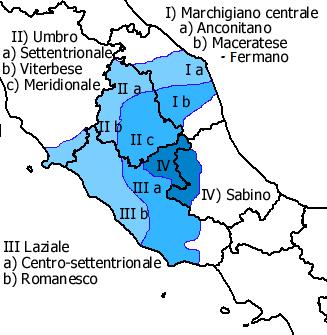
The Marino dialect is a dialect belonging to the dialects of the Roman Castles in the linguistic family of Central Italian and, specifically, the Central-Northern Latian dialect. It is spoken within the metropolitan city of Rome in the city of Marino and its territory in the Alban Hills.
Marino is located south of the "Ancona-Rome Line," an ideal dividing line drawn by glottologists to divide the northern Etruscan and Tuscan area of influence from the southern area, which remained tied to Sabine and Latin influence. Despite its long oral tradition, Marinese seems to be losing ground in favour of the Roman dialect, reduced more to "parlance" and the use of characteristic expressions, a phenomenon similar to all the Castellan dialects and those of centers in the southern quadrant of the metropolitan city of Rome and the Lazio coast.
The Marino dialect does not have legal recognition (Law No. 482 of 15 December 1999) nor is it regulated by a regulating body, but it was studied for the first time by the Marinese historian Girolamo Torquati in 1886, at the same time that a dictionary of the most frequently used words in the dialect was compiled.
The first mention of the existence of the castle of Marino would date back to 1090, or at the latest to 1114: the fief had most likely belonged to the Counts of Tusculum, and then with their decline had come into the possession of the Frangipane: with the extinction of the latter, the castle was purchased in 1266 by Cardinal Matteo Rubeo Orsini and came into the orbit of the Orsini, in whose possession Marino remained until 1379. In that year, due to the Western Schism, a period of feudal anarchy began, which lasted until the election of Pope Martin V in 1417: in the same year, the pope's brother Giordano Colonna bought the castle of Marino, initiating the long period of Colonna rule.
Marino's importance throughout the Middle Ages was linked to its strong position close to the Ager Romanus, which made it a coveted first-class outpost on Rome. However, with the glory also came peril: the castle was besieged in 1267 and 1347, conquered in 1379, in 1385, in 1399, in 1405 (twice), in 1408 and 1413 (twice), in 1482, razed to the ground in 1501, sacked in 1526 and 1599. It was only at the end of this long period of local wars that ravaged Lazio that the Colonna family was able to devote itself to governing the fiefdom, carrying out during the seventeenth century important urban works and public works such as the Colonna palace, the basilica of San Barnaba, the fountain of the Four Moors, and Corso Trieste. In 1606 Pope Paul V elevated the fief to a duchy. By the early eighteenth century Marino had about 4,000 inhabitants, and was thus one of the most populous and wealthiest centers in the Alban Hills.
Immigration to Marino was fostered as early as the sixteenth century: Marcantonio II Colonna, the papal admiral who won the Battle of Lepanto in 1571, issued a decree on 26 December 1574, exempting any foreigner who wished to settle in his fief of Marino from paying any kind of tax for four years, provided that he swore an oath of allegiance. In 1656, the terrible plague epidemic that struck Rome and central-southern Italy decimated the population of Marino to such an extent that only seventeen families were left in the fiefdom: Duke Cardinal Girolamo Colonna incentivized repopulation by encouraging immigration from less economically vibrant areas of his domains, such as the Marsica fiefdom of Tagliacozzo or some of the Campagna and Marittima fiefdoms. An immigration from these areas and from other parts of Abruzzo and the eastern quadrant of the present province of Rome continued throughout the eighteenth century, but still in the early twentieth century there existed throughout the Roman Castles a seasonal immigration of peasant laborers employed for work in the vineyards, for a long time poorly paid and excluded from the conquests progressively obtained by local laborers. Many of these seasonal migrants settled permanently in Marino and the other Castellan centers, especially after the Second World War: this phenomenon, together with the increasingly disproportionate growth of Rome, the attraction of the Urbe or the factories of the Pontine Marshes, have determined a frenetic development that has occurred in the last thirty years of new urban expansions in the historic centers and the birth of new centers.
Marino has had to deal with the birth of Ciampino, the "garden city" founded in 1919 for veterans of World War I and made autonomous from the municipality in 1974, and with the birth of the hamlets of Santa Maria delle Mole, Frattocchie, and Due Santi, whose autonomy drive was curbed by the constitutional court in 1995 after the experience of the autonomous municipality of Boville. The origin of the "new Marinese" is varied: people from Veneto, Romagna, Abruzzo, Naples, Sardinia, Basso Lazio, Apulia and Calabria, and Sicily, alongside Romans who fled the metropolis. Since the mid-1990s, the flow of foreign immigrants began: in 2007 there were 2331 foreign citizens living in Marino, with the largest Albanian community in the Roman Castles (300 people) and over 600 Romanians.
The Marino dialect was formed along with the castle and its growing population: the most intense wave of immigration that might have affected the dialect the most was the one following the plague of 1656.
Hub AI
Marino dialect AI simulator
(@Marino dialect_simulator)
Marino dialect
The Marino dialect is a dialect belonging to the dialects of the Roman Castles in the linguistic family of Central Italian and, specifically, the Central-Northern Latian dialect. It is spoken within the metropolitan city of Rome in the city of Marino and its territory in the Alban Hills.
Marino is located south of the "Ancona-Rome Line," an ideal dividing line drawn by glottologists to divide the northern Etruscan and Tuscan area of influence from the southern area, which remained tied to Sabine and Latin influence. Despite its long oral tradition, Marinese seems to be losing ground in favour of the Roman dialect, reduced more to "parlance" and the use of characteristic expressions, a phenomenon similar to all the Castellan dialects and those of centers in the southern quadrant of the metropolitan city of Rome and the Lazio coast.
The Marino dialect does not have legal recognition (Law No. 482 of 15 December 1999) nor is it regulated by a regulating body, but it was studied for the first time by the Marinese historian Girolamo Torquati in 1886, at the same time that a dictionary of the most frequently used words in the dialect was compiled.
The first mention of the existence of the castle of Marino would date back to 1090, or at the latest to 1114: the fief had most likely belonged to the Counts of Tusculum, and then with their decline had come into the possession of the Frangipane: with the extinction of the latter, the castle was purchased in 1266 by Cardinal Matteo Rubeo Orsini and came into the orbit of the Orsini, in whose possession Marino remained until 1379. In that year, due to the Western Schism, a period of feudal anarchy began, which lasted until the election of Pope Martin V in 1417: in the same year, the pope's brother Giordano Colonna bought the castle of Marino, initiating the long period of Colonna rule.
Marino's importance throughout the Middle Ages was linked to its strong position close to the Ager Romanus, which made it a coveted first-class outpost on Rome. However, with the glory also came peril: the castle was besieged in 1267 and 1347, conquered in 1379, in 1385, in 1399, in 1405 (twice), in 1408 and 1413 (twice), in 1482, razed to the ground in 1501, sacked in 1526 and 1599. It was only at the end of this long period of local wars that ravaged Lazio that the Colonna family was able to devote itself to governing the fiefdom, carrying out during the seventeenth century important urban works and public works such as the Colonna palace, the basilica of San Barnaba, the fountain of the Four Moors, and Corso Trieste. In 1606 Pope Paul V elevated the fief to a duchy. By the early eighteenth century Marino had about 4,000 inhabitants, and was thus one of the most populous and wealthiest centers in the Alban Hills.
Immigration to Marino was fostered as early as the sixteenth century: Marcantonio II Colonna, the papal admiral who won the Battle of Lepanto in 1571, issued a decree on 26 December 1574, exempting any foreigner who wished to settle in his fief of Marino from paying any kind of tax for four years, provided that he swore an oath of allegiance. In 1656, the terrible plague epidemic that struck Rome and central-southern Italy decimated the population of Marino to such an extent that only seventeen families were left in the fiefdom: Duke Cardinal Girolamo Colonna incentivized repopulation by encouraging immigration from less economically vibrant areas of his domains, such as the Marsica fiefdom of Tagliacozzo or some of the Campagna and Marittima fiefdoms. An immigration from these areas and from other parts of Abruzzo and the eastern quadrant of the present province of Rome continued throughout the eighteenth century, but still in the early twentieth century there existed throughout the Roman Castles a seasonal immigration of peasant laborers employed for work in the vineyards, for a long time poorly paid and excluded from the conquests progressively obtained by local laborers. Many of these seasonal migrants settled permanently in Marino and the other Castellan centers, especially after the Second World War: this phenomenon, together with the increasingly disproportionate growth of Rome, the attraction of the Urbe or the factories of the Pontine Marshes, have determined a frenetic development that has occurred in the last thirty years of new urban expansions in the historic centers and the birth of new centers.
Marino has had to deal with the birth of Ciampino, the "garden city" founded in 1919 for veterans of World War I and made autonomous from the municipality in 1974, and with the birth of the hamlets of Santa Maria delle Mole, Frattocchie, and Due Santi, whose autonomy drive was curbed by the constitutional court in 1995 after the experience of the autonomous municipality of Boville. The origin of the "new Marinese" is varied: people from Veneto, Romagna, Abruzzo, Naples, Sardinia, Basso Lazio, Apulia and Calabria, and Sicily, alongside Romans who fled the metropolis. Since the mid-1990s, the flow of foreign immigrants began: in 2007 there were 2331 foreign citizens living in Marino, with the largest Albanian community in the Roman Castles (300 people) and over 600 Romanians.
The Marino dialect was formed along with the castle and its growing population: the most intense wave of immigration that might have affected the dialect the most was the one following the plague of 1656.