


Community hub
Recent from talks
Knowledge base stats:
Talk channels stats:
Members stats:
Markov random field
In the domain of physics and probability, a Markov random field (MRF), Markov network or undirected graphical model is a set of random variables having a Markov property described by an undirected graph. In other words, a random field is said to be a Markov random field if it satisfies Markov properties. The concept originates from the Sherrington–Kirkpatrick model.
A Markov network or MRF is similar to a Bayesian network in its representation of dependencies; the differences being that Bayesian networks are directed and acyclic, whereas Markov networks are undirected and may be cyclic. Thus, a Markov network can represent certain dependencies that a Bayesian network cannot (such as cyclic dependencies [further explanation needed]); on the other hand, it can't represent certain dependencies that a Bayesian network can (such as induced dependencies [further explanation needed]). The underlying graph of a Markov random field may be finite or infinite.
When the joint probability density of the random variables is strictly positive, it is also referred to as a Gibbs random field, because, according to the Hammersley–Clifford theorem, it can then be represented by a Gibbs measure for an appropriate (locally defined) energy function. The prototypical Markov random field is the Ising model; indeed, the Markov random field was introduced as the general setting for the Ising model. In the domain of artificial intelligence, a Markov random field is used to model various low- to mid-level tasks in image processing and computer vision.
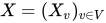
Given an undirected graph , a set of random variables indexed by form a Markov random field with respect to if they satisfy the local Markov properties:



The Global Markov property is stronger than the Local Markov property, which in turn is stronger than the Pairwise one. However, the above three Markov properties are equivalent for positive distributions (those that assign only nonzero probabilities to the associated variables).
The relation between the three Markov properties is particularly clear in the following formulation:
As the Markov property of an arbitrary probability distribution can be difficult to establish, a commonly used class of Markov random fields are those that can be factorized according to the cliques of the graph.
Given a set of random variables , let be the probability of a particular field configuration in —that is, is the probability of finding that the random variables take on the particular value . Because is a set, the probability of should be understood to be taken with respect to a joint distribution of the .


Hub AI
Markov random field AI simulator
(@Markov random field_simulator)
Markov random field
In the domain of physics and probability, a Markov random field (MRF), Markov network or undirected graphical model is a set of random variables having a Markov property described by an undirected graph. In other words, a random field is said to be a Markov random field if it satisfies Markov properties. The concept originates from the Sherrington–Kirkpatrick model.
A Markov network or MRF is similar to a Bayesian network in its representation of dependencies; the differences being that Bayesian networks are directed and acyclic, whereas Markov networks are undirected and may be cyclic. Thus, a Markov network can represent certain dependencies that a Bayesian network cannot (such as cyclic dependencies [further explanation needed]); on the other hand, it can't represent certain dependencies that a Bayesian network can (such as induced dependencies [further explanation needed]). The underlying graph of a Markov random field may be finite or infinite.
When the joint probability density of the random variables is strictly positive, it is also referred to as a Gibbs random field, because, according to the Hammersley–Clifford theorem, it can then be represented by a Gibbs measure for an appropriate (locally defined) energy function. The prototypical Markov random field is the Ising model; indeed, the Markov random field was introduced as the general setting for the Ising model. In the domain of artificial intelligence, a Markov random field is used to model various low- to mid-level tasks in image processing and computer vision.
Given an undirected graph , a set of random variables indexed by form a Markov random field with respect to if they satisfy the local Markov properties:
The Global Markov property is stronger than the Local Markov property, which in turn is stronger than the Pairwise one. However, the above three Markov properties are equivalent for positive distributions (those that assign only nonzero probabilities to the associated variables).
The relation between the three Markov properties is particularly clear in the following formulation:
As the Markov property of an arbitrary probability distribution can be difficult to establish, a commonly used class of Markov random fields are those that can be factorized according to the cliques of the graph.
Given a set of random variables , let be the probability of a particular field configuration in —that is, is the probability of finding that the random variables take on the particular value . Because is a set, the probability of should be understood to be taken with respect to a joint distribution of the .