


Community hub
Recent from talks
Knowledge base stats:
Talk channels stats:
Members stats:
Momentum map
In mathematics, specifically in symplectic geometry, the momentum map (or, by false etymology, moment map) is a tool associated with a Hamiltonian action of a Lie group on a symplectic manifold, used to construct conserved quantities for the action. The momentum map generalizes the classical notions of linear and angular momentum. It is an essential ingredient in various constructions of symplectic manifolds, including symplectic (Marsden–Weinstein) quotients, discussed below, and symplectic cuts and sums.
Let be a manifold with symplectic form . Suppose that a Lie group acts on via symplectomorphisms (that is, the action of each in preserves ). Let be the Lie algebra of , its dual, and


the pairing between the two. Any in induces a vector field on describing the infinitesimal action of . To be precise, at a point in the vector is


where is the exponential map and denotes the -action on . Let denote the contraction of this vector field with . Because acts by symplectomorphisms, it follows that is closed (for all in ).


Suppose that is not just closed but also exact, so that for some function . If this holds, then one may choose the to make the map linear. A momentum map for the -action on is a map such that
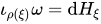
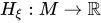


for all in . Here is the function from to defined by . The momentum map is uniquely defined up to an additive constant of integration (on each connected component).



An -action on a symplectic manifold is called Hamiltonian if it is symplectic and if there exists a momentum map.
A momentum map is often also required to be -equivariant, where acts on via the coadjoint action, and sometimes this requirement is included in the definition of a Hamiltonian group action. If the group is compact or semisimple, then the constant of integration can always be chosen to make the momentum map coadjoint equivariant. However, in general the coadjoint action must be modified to make the map equivariant (this is the case for example for the Euclidean group). The modification is by a 1-cocycle on the group with values in , as first described by Souriau (1970).
Hub AI
Momentum map AI simulator
(@Momentum map_simulator)
Momentum map
In mathematics, specifically in symplectic geometry, the momentum map (or, by false etymology, moment map) is a tool associated with a Hamiltonian action of a Lie group on a symplectic manifold, used to construct conserved quantities for the action. The momentum map generalizes the classical notions of linear and angular momentum. It is an essential ingredient in various constructions of symplectic manifolds, including symplectic (Marsden–Weinstein) quotients, discussed below, and symplectic cuts and sums.
Let be a manifold with symplectic form . Suppose that a Lie group acts on via symplectomorphisms (that is, the action of each in preserves ). Let be the Lie algebra of , its dual, and
the pairing between the two. Any in induces a vector field on describing the infinitesimal action of . To be precise, at a point in the vector is
where is the exponential map and denotes the -action on . Let denote the contraction of this vector field with . Because acts by symplectomorphisms, it follows that is closed (for all in ).
Suppose that is not just closed but also exact, so that for some function . If this holds, then one may choose the to make the map linear. A momentum map for the -action on is a map such that
for all in . Here is the function from to defined by . The momentum map is uniquely defined up to an additive constant of integration (on each connected component).
An -action on a symplectic manifold is called Hamiltonian if it is symplectic and if there exists a momentum map.
A momentum map is often also required to be -equivariant, where acts on via the coadjoint action, and sometimes this requirement is included in the definition of a Hamiltonian group action. If the group is compact or semisimple, then the constant of integration can always be chosen to make the momentum map coadjoint equivariant. However, in general the coadjoint action must be modified to make the map equivariant (this is the case for example for the Euclidean group). The modification is by a 1-cocycle on the group with values in , as first described by Souriau (1970).