Hubbry Logo
Martin ClemensMartin ClemensMain
Open search
Martin Clemens
Community hub
Martin Clemens
logo
8 pages, 0 posts
0 subscribers
Be the first to start a discussion here.
Martin Clemens
Martin Clemens
from Wikipedia

Major Warren Frederick Martin Clemens CBE, AM, MC (17 April 1915 – 31 May 2009) was a British-Australian colonial administrator and military officer. In late 1941 and early 1942, while serving as a District Officer in the Solomon Islands, he helped prepare the area for eventual resistance to Japanese occupation. His additional duties as a coastwatcher alerted the Allies to Japanese plans to build an airstrip on Guadalcanal. This resulted in Allied carrier raids and eventually a landing by United States forces and the beginning of the epic struggle in the Solomons. Clemens then directly served the U.S. Marines in coordinating intelligence on Japanese activities.

Key Information

Early life

[edit]

Martin Clemens was born in Aberdeen, Scotland, son of Warren Clemens, a musician. He won scholarships to Bedford School and Christ's College, Cambridge, where he studied agriculture and natural sciences from 1933 to 1937.[1]

Early career

[edit]

In 1938, Clemens joined the Colonial Service and was sent out to the British Solomon Islands Protectorate (BSIP). He served for three years as a cadet in Malaita, and became a District Officer in 1941.

With the coming of the Pacific War, he volunteered for military service in the British Solomon Islands Protectorate Defence Force and was commissioned a captain. After a short leave in Australia in late 1941, Martin Clemens returned to the Solomons on a ship sent to evacuate European and Chinese residents from Guadalcanal.[2]

Second World War

[edit]

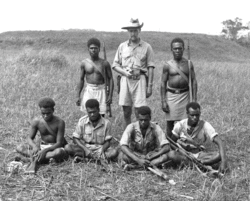
While responsible for nearly fifteen thousand citizens and various other people on Guadalcanal, District Officer Clemens additionally served as a coastwatcher. The Japanese planned to cut off the United States' communications with New Zealand and Australia by building an airstrip on Guadalcanal. When they began landing infantry, support troops and engineers to begin the airstrip, Clemens reported such to the Allies by radio.[2]

Meanwhile, the managers of the coconut plantations had fled Guadalcanal in panic, abandoning the native workers from neighboring islands, who were left to be repatriated by Clemens. He then established his radio station and coastwatching activities. Though he was a commissioned officer, Clemens received no support from the military and had no uniform. After the Japanese occupied the island of Tulagi in early May, they initiated searches for Clemens, and the other Guadalcanal coastwatchers Donald S. Macfarlan, Kenneth D. Hay, Hugh A. Mackenzie, Leif Schroeder, and F. Ashton Rhoades.[2]: 41  In June, the Japanese started constructing an airfield on Guadalcanal, further isolating Clemens and forcing him to conduct his activities from enclaves in the mountains. Clemens, on his jungle-shielded mountain, played a dangerous game of hide and seek with the Japanese. He and his tiny coastwatcher contingent were running low on everything they needed: food, supplies, and most critically, radio batteries. Barefoot, Clemens shared the privations of his coastwatchers. His shoes had disintegrated.

Guadalcanal became the site of the first major land offensive against the Japanese in the South Pacific. Upon the American invasion of Guadalcanal, Clemens and his scouts were ordered to join the Marines at Lunga on 13 August.[2]: 196  Cooperation between Clemens and the U.S. Marines made him a key operative on the island. Major General Alexander Vandegrift gave Clemens "complete charge of all matters of native administration and of intelligence outside the perimeter".[2]: 199–200  Clemens and his scouts provided the U.S. Marines much assistance with continuous raids on Japanese supplies and radio reports of the enemy's position.[2]

Post-war

[edit]

His war service earned him the Military Cross (MC) on 15 December 1942,[3] and in 1944 the U.S. Legion of Merit.[4] The First Marine Division also awarded him the commemorative Faciat Georgius medal, which he helped design.[2]: 311 

Following the war, Clemens served in Palestine in 1946–1947 and Cyprus in 1948–1949, returning to Cyprus in 1951–1957 as District Commissioner, and was Defence Secretary during 1959–1960. Offered a further colonial position variously reported as having been in Burma[1] or Sarawak,[5] he instead moved to Australia, which was home to his wife Anne. This later colonial career led to his appointment as Officer of the Order of the British Empire (OBE) in the 1956 Queen's Birthday Honours,[6] and promotion to Commander in that order (CBE) in the 1960 New Year Honours.[7]

Clemens became an Australian citizen in 1961 and was involved in numerous public service and charity efforts.[1] According to the official Australian Government online database of honours, he was appointed Member of the Order of Australia (AM) in 1993,[8] but obituaries report this honour as the lesser Medal of the Order of Australia (OAM).[1][5]

Personal life

[edit]

Martin Clemens married Anne Turnbull in 1948. They had four children.

See also

[edit]

Footnotes

[edit]
[edit]
Revisions and contributorsEdit on WikipediaRead on Wikipedia
from Grokipedia
Warren Frederick Martin Clemens CBE MC (17 April 1915 – 31 May 2009) was a Scottish-born British colonial administrator and soldier who served as a district officer in the British Solomon Islands Protectorate. During the Second World War, he operated as a coastwatcher on Guadalcanal, providing critical intelligence on Japanese naval and troop movements to Allied forces after the island's invasion in early 1942. Educated at and , where he earned an , Clemens joined the colonial service and was posted to the Solomons in 1938. From February 1942, he evaded Japanese occupation by retreating to the island's interior, where he organized a network of local Melanesian scouts and commandos to monitor enemy activities, relaying reports via radio that influenced key naval engagements in the . His efforts, conducted under constant threat of capture, supported U.S. Marine landings and contributed to the eventual Allied eviction of Japanese forces from the island by February 1943. Clemens documented his experiences in the memoir Alone on Guadalcanal: A Coastwatcher's Story (1992), based on his wartime diaries, which detail survival behind enemy lines and leadership of indigenous irregular forces. For his service, he received the and later the Commander of the , among other honors, and continued in colonial administration postwar before retiring to .

Early Life and Education

Birth and Upbringing

Warren Frederick Martin Clemens was born on 17 April 1915 in , . He was the eldest of four children of Warren Clemens, a church organist and musician of Moravian descent, and Blanche Clemens. Clemens's early years in were marked by his father's early death, which occurred during his childhood. The family background, rooted in heritage through his paternal line, emphasized cultural and possibly religious influences typical of such stock in early 20th-century . Limited public records detail his precise upbringing beyond these familial circumstances, though his subsequent academic scholarships suggest a focus on scholarly development from a young age.

Formal Education and Early Influences

Warren Frederick Martin Clemens, born in , , on April 17, 1915, pursued his secondary education at in , where he secured a recognizing his academic aptitude. Following this, Clemens matriculated at , studying agricultural and natural sciences from 1933 to 1937, during which he achieved honours status. His choice of agricultural sciences at reflected an early orientation toward practical fields amenable to colonial administration, aligning with the empirical demands of managing tropical territories like the , where such knowledge aided in overseeing plantations and resource surveys. This academic foundation, earned through competitive scholarships, underscored Clemens's disciplined intellect, honed in England's rigorous public school system despite his Scottish origins, and positioned him for entry into the British Colonial Service upon graduation in 1937.

Pre-War Colonial Career

Entry into Colonial Service

In 1938, shortly after graduating from Cambridge University—where he had competed in rowing—Clemens entered the British Colonial Administrative Service and was assigned to the British Solomon Islands Protectorate (BSIP). This posting marked his initial foray into overseas administration, reflecting the standard recruitment pathway for university-educated Britons into the colonial cadre, which emphasized practical governance skills over specialized tropical expertise. Upon arrival in the Solomons, Clemens served as a cadet officer, undertaking foundational duties such as surveying districts, mediating local disputes, and overseeing rudimentary infrastructure amid the Protectorate's dispersed islands and sparse European presence. His early service involved immersion in the BSIP's administrative challenges, including managing indigenous labor recruitment for plantations and navigating inter-island logistics with limited resources. By 1941, Clemens had progressed to District Officer for , responsible for a vast, underdeveloped territory prone to tribal conflicts and health epidemics, honing the that later proved vital during wartime. This advancement underscored the merit-based structure of colonial postings, where performance in remote outposts determined promotion amid the Service's emphasis on self-reliance.

Administrative Roles in the Solomon Islands

In 1938, following his graduation from Cambridge University, Martin Clemens entered the British Colonial Administrative Service and was assigned to the Protectorate (BSIP) as a cadet officer. His initial posting was a three-year probationary appointment on island, where he engaged in foundational administrative duties typical of entry-level colonial officers, including supervision of local labor recruitment, enforcement of sanitation and quarantine measures, and mediation in disputes among indigenous communities under the oversight of senior district officers. This period immersed Clemens in the challenges of governing remote Melanesian populations, marked by rugged terrain, linguistic diversity, and resistance to colonial authority, as evidenced by ongoing practices and labor unrest documented in BSIP records of the era. By late 1941, having completed his probation, Clemens was promoted to District Officer for San Cristobal (also known as ), a position he assumed in . In this role, he managed the island's administrative affairs from the district headquarters, coordinating tax collection via head taxes on native males, overseeing copra production as the primary export, and maintaining rudimentary such as patrol posts and wireless stations. His responsibilities extended to implementing British policies on native welfare, including efforts to curb inter-village conflicts and promote cash cropping, amid a sparse European presence and reliance on local scouts for inland patrols. Shortly after his San Cristobal appointment, Clemens transferred to as District Officer, a larger and strategically vital district encompassing the island's undeveloped interior and coastal settlements. Here, he directed preparations for potential external threats, including the fortification of administrative outposts and recruitment of loyal indigenous auxiliaries, while continuing core duties like land tenure disputes resolution and suppression of illegal labor trade. These roles positioned him as the primary colonial authority in the southeastern Solomons, bridging imperial governance with local customary systems until Japanese invasion forces disrupted operations in early 1942.

World War II Contributions

Establishment as Coastwatcher

Martin Clemens, a district officer in the since 1938, returned from leave in following the Japanese on December 7, 1941, and at his insistence was assigned to as the sole British colonial authority there. In February 1942, prior to the Japanese of the island in May, Clemens was appointed by the Resident Commissioner at to serve as an with coastwatching duties as part of a initiative to monitor enemy movements across the Pacific islands. Clemens established his initial base at Aola Station on Guadalcanal's southeastern coast, where he collaborated with fellow officers Donald Macfarlan and Donald Rhoades to recruit and organize local Islanders into an intelligence network capable of observing coastal approaches and relaying reports via radio telegraphy. He set up additional observation posts at sites including Paripao and Vungana to extend coverage, equipping the network with wireless equipment for transmitting sightings of Japanese shipping and troop movements to Allied commands in and . These early efforts focused on building loyalty among native scouts and ensuring reliable communication channels, drawing on Clemens' prior administrative experience in the region to foster cooperation amid growing Japanese threats. By March and April 1942, the network began reporting initial Japanese reconnaissance activities, prompting Clemens to emphasize secrecy and mobility; following the full-scale invasion on May 7, 1942, he relocated operations into the island's interior jungle to evade capture while continuing to monitor enemy buildup, including preparations for an airstrip at Lunga Point. This establishment of a clandestine coastwatching apparatus under Clemens' leadership provided critical early warnings that informed Allied strategic responses, such as preemptive carrier raids, and laid the groundwork for sustained intelligence support during the subsequent .

Intelligence Gathering and Operations on Guadalcanal

In 1942, Martin Clemens, serving as a British colonial district officer, assumed coastwatching duties on , establishing an intelligence network to monitor Japanese movements in the . Operating primarily from Aola Station and later bush outposts like Vungana, Clemens coordinated native scouts and maintained radio communications to relay sightings to Allied headquarters. His efforts focused on tracking enemy shipping, troop buildups, and airfield construction, providing critical early warnings that influenced Allied strategic responses. Clemens' intelligence reports included detailed observations of Japanese naval activity, such as the sighting of 11 enemy cruisers at on February 17, 1942, and two vessels 300 miles offshore on May 1, 1942. By July 1, 1942, he estimated approximately 1,000 Japanese troops at Lunga Point, noting their preparations for an airstrip that threatened Allied supply lines to . On August 3, 1942, Clemens transmitted a delineating Japanese installations at Lunga and Kukum, contributing to pre-invasion planning for the . These reports, derived from scout networks comprising local , evaded Japanese patrols and enabled Allied carrier raids, including those observed by Clemens on on May 4, 1942. During the Allied landings on August 7, 1942, Clemens witnessed the U.S. Marine assault on and from his position, confirming the capture of the latter. On August 15, 1942, he rendezvoused with advancing Marines near Lunga, handing over accumulated intelligence on enemy dispositions and terrain features. Throughout the campaign, Clemens commanded around 300 Solomon Scouts, later augmented by 150 Fijian commandos in November 1942, who conducted patrols, interrogated captured Japanese soldiers for unit details, and identified key artillery positions like General Kawaguchi's "Pistol Pete" guns. His forces supported Marine operations at Henderson Field, Edson's Ridge, and the Matanikau River, providing real-time updates on Japanese reinforcements and movements. Earlier in the campaign, on , 1942, Clemens rescued the crew of a downed U.S. near Aola, concealing them until safe extraction, which underscored his operational versatility behind enemy lines. Clemens camouflaged equipment, evacuated forward stations as Japanese forces advanced, and sustained operations until October 1942, remaining on the island through the height of the Guadalcanal battle. He departed for on leave around December 15, 1942, after the ' relief, having evaded capture and coordinated without direct combat involvement.

Coordination with Allied Forces and Evacuation

Following the landing on on August 7, 1942, Clemens emerged from hiding in the island's interior and made contact with American forces on August 14. He had observed the initial invasion from concealed positions and possessed detailed knowledge of Japanese dispositions and local terrain. Upon linking up with the , Clemens provided critical intelligence briefings to Marine officers, including updates on enemy troop movements and the effectiveness of his pre-established network of native scouts. These scouts, organized under Clemens' direction as part of the British Solomon Islands Defence Force, continued to supply real-time reports on Japanese activities, aiding Allied defensive preparations against subsequent enemy offensives. Clemens coordinated directly with Marine intelligence units, facilitating the integration of coastwatcher data into broader Allied operations and verifying authentication codes to ensure secure communications. His efforts extended to mobilizing additional local constabulary for reconnaissance, which proved invaluable during key engagements such as the Battle of the Tenaru. By December 1942, with the shifting and Allied control consolidating, Clemens was repatriated to , concluding his frontline role after months of sustained support to Marine forces. This evacuation marked the end of his isolation on the island, allowing him to debrief further on intelligence matters derived from his coastwatching tenure.

Post-War Career and Civilian Life

Resumption of Administrative Duties

Following the conclusion of hostilities in the Pacific in September 1945, Martin Clemens continued in his role as district commissioner in the western until the formal end of the war, before transitioning to further administrative postings in the British Colonial Service. In early 1946, he was reassigned to the British Mandate of during its final turbulent years, serving initially as Deputy Assistant District Commissioner in the district, where he managed local governance amid rising Arab-Jewish tensions and administrative challenges leading to the Mandate's collapse in 1948. Clemens's duties in Palestine involved overseeing district-level operations, including coordination with local police forces and implementation of British policies in a region marked by insurgency and partition debates, as documented in Colonial Office records of the period. He later transferred to the Gaza district in 1947, handling similar responsibilities until the Mandate's termination in May 1948, after which he relocated to Cyprus for continued service in the Colonial Administration. These postings reflected the standard rotation of experienced officers within the Colonial Service to address post-war reconstruction and security needs across deteriorating imperial holdings. Throughout these roles, Clemens applied lessons from his experience, emphasizing decentralized governance and intelligence-informed administration, though specific operational details from remain limited in due to the era's classified . His service there ended amid the broader withdrawal of British forces, paving the way for subsequent assignments in from 1948 to 1949.

Transition to Australian Citizenship and Later Roles

Following the conclusion of his British colonial service postings in Cyprus, where he served as District Commissioner from 1951 to 1957 and as Defence Secretary from 1959 to 1960, Clemens relocated to in 1961. Prompted by his wife Anne's family estate, Dunraven, near , he acquired Australian citizenship upon arrival that year. In , Clemens took on the role of pastoral superintendent overseeing his wife's extensive family holdings in , a position he held from 1961 onward. He directed operations at companies including GTV9 and contributed to various boards. Clemens devoted significant time to and charitable endeavors through the 1960s to 1980s, serving with organizations such as Austcare and the Red Cross. He supported the Australia-Britain Society, where he helped initiate the Plain English Speaking Award, and participated in the Liberal Party's Higgins branch. For these contributions, he received the Medal of the in 1993.

Awards, Honors, and Legacy

Military and Civilian Recognitions

Clemens was awarded the on 15 December 1942 for his leadership as a coastwatcher on , where he organized intelligence networks that provided critical reports on Japanese naval and troop movements, contributing to the Allied defense of the island. In 1944, he received the (Legionnaire degree) from the American government in recognition of his coordination with U.S. forces, including the facilitation of evacuations and supply drops that supported Marine operations against Japanese forces. Post-war, Clemens earned civilian honors for his administrative service in colonial and defense roles. He was appointed Officer of the Order of the British Empire in the 1956 Queen's Birthday Honours for contributions to public administration in the Solomon Islands and related territories. This was followed by promotion to Commander of the Order of the British Empire in the 1960 New Year Honours, acknowledging his work as Defence Secretary in Cyprus amid ongoing colonial security operations. In 1993, after transitioning to Australian citizenship, he received the Medal of the Order of Australia for sustained community service, including historical documentation of Pacific wartime events.

Publications and Historical Impact

Clemens's principal written work is the memoir Alone on Guadalcanal: A Coastwatcher's Story, published in 1998 by the Naval Institute Press. Drawing directly from his wartime diaries maintained between 1941 and 1943, the book recounts his tenure as a British officer turned coastwatcher amid the Japanese occupation of , emphasizing the logistical and intelligence challenges of operating in isolation. It includes detailed entries on local of scouts, evasion tactics against Japanese patrols, and radio communications with Allied naval units, offering a for the human-scale dynamics of the . The memoir's foreword by military historian Allan R. Millett contextualizes Clemens's role within the broader Guadalcanal operation, spanning approximately 30 pages and highlighting the strategic pivot from defensive to offensive Allied postures in the Pacific theater. While not a peer-reviewed academic text, the work's value lies in its unfiltered, diary-derived authenticity, corroborated by declassified Allied records of coastwatcher transmissions, and it has been referenced in subsequent histories of island-hopping campaigns for its granular insights into pre-invasion reconnaissance. Clemens's historical impact stems primarily from his coastwatching , which furnished critical early warnings of Japanese airfield development on , informing the U.S. decision to launch the August 7, 1942, landings that initiated the first sustained Allied offensive in the Pacific. This contributed to halting Japanese advances toward and , preserving supply lines and enabling subsequent victories that shifted momentum away from Axis expansion in the South Pacific by February 1943. His solitary oversight of local scouts and evasion of enemy forces exemplified the coastwatcher network's efficacy, a low-cost apparatus that amplified naval and air operations without large-scale troop commitments, as evidenced by U.S. Marine Corps after-action reports crediting such inputs for reducing surprise in the Guadalcanal engagements. Postwar, his documented experiences influenced analyses of irregular warfare's role in conventional theaters, underscoring how individual administrative expertise adapted to guerrilla amid colonial disruptions.

Personal Life

Family and Relationships

Martin Clemens was born Warren Frederick Martin Clemens on April 17, 1915, in , , as the eldest of four children to Warren Theodor Clemens, a church organist and choirmaster, and Blanche Martin Clemens. Little is documented about his siblings or early family dynamics beyond his position as the firstborn. Clemens married Turnbull, an Australian, on an unspecified date in 1948; she was the sister of his friends John and , whom he met during his time in the . The couple had four children: daughters Charlotte, Victoria, and , and son Mark. At the time of his death in June 2009, Clemens was survived by these children and nine grandchildren; his wife had predeceased him earlier that year. No public records indicate additional marriages, divorces, or significant extramarital relationships.

Health, Retirement, and Death

After concluding his colonial service with postings in until 1960, Clemens relocated to in 1961, acquiring citizenship and assuming the role of pastoral superintendent overseeing family properties in . He later settled in at his home 'Dunraven', where he engaged in community leadership, including roles with Austcare, the Red Cross, the Australia-Britain Society, and as a director of GTV9, alongside involvement in the Liberal Party. These activities extended through the , , and , reflecting a semi-retired phase centered on , support for the disadvantaged, and social hospitality rather than formal employment. In his later years, Clemens experienced age-related mobility limitations, relying on a walking frame. He published his memoir Alone on Guadalcanal in 1998, which reached a third printing and detailed his wartime experiences. Clemens died on May 31, 2009, at Cabrini Hospital in , at the age of 94. His wife, Anne Turnbull, to whom he had been married since 1948, had predeceased him earlier that year. He was survived by four children—Charlotte, Victoria, Alexandra, and Mark—and nine grandchildren. A funeral service was held at St John's Anglican Church in Toorak, attended by representatives from Britain, the , and the 1st US Marine Division.

References

Add your contribution
Related Hubs
User Avatar
No comments yet.