


Community hub
Recent from talks
Contribute something
Nothing was collected or created yet.
Guadalcanal campaign
View on Wikipedia
| Guadalcanal campaign | |||||||
|---|---|---|---|---|---|---|---|
| Part of the Solomon Islands campaign of the Pacific Theater of World War II | |||||||
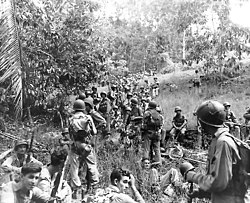
 United States Marines rest in the field during the Guadalcanal campaign. | |||||||
| |||||||
| Belligerents | |||||||
 United States United States Australia Australia United Kingdom United Kingdom•  Solomon Islands[1] Solomon Islands[1]•  Fiji[2] Fiji[2]•  Tonga[3] Tonga[3] New Zealand New Zealand |
 Japan Japan | ||||||
| Commanders and leaders | |||||||
|
U.S. Navy: Robert L. Ghormley William F. Halsey Jr. Richmond K. Turner Frank J. Fletcher U.S. Marine Corps: Alexander A. Vandegrift William H. Rupertus Merritt A. Edson U.S. Army: Alexander M. Patch |
Navy: Isoroku Yamamoto Hiroaki Abe Nobutake Kondō Nishizo Tsukahara Takeo Kurita Jinichi Kusaka Shōji Nishimura Gunichi Mikawa Raizō Tanaka Army: Hitoshi Imamura Harukichi Hyakutake | ||||||
| Units involved | |||||||
| See order of battle | See order of battle | ||||||
| Strength | |||||||
| 60,000+ men (ground forces)[4] | 36,200 men (ground forces)[5] | ||||||
| Casualties and losses | |||||||
|
7,100 killed[6] 7,789+ wounded[7] 4 captured 29 ships lost including 2 fleet carriers, 6 heavy cruisers, 2 light cruisers and 17 destroyers. 615 aircraft lost[8] |
Army: 19,200 dead, of whom 8,500 were killed in combat[9] 1,000 captured38 ships lost including 1 light carrier, 2 battleships, 3 heavy cruisers, 1 light cruiser and 11 destroyers. 683 aircraft lost[10][11] 10,652 evacuated | ||||||
The Guadalcanal campaign, also known as the Battle of Guadalcanal and codenamed Operation Watchtower by the United States, was an Allied offensive against forces of the Empire of Japan in the Solomon Islands during the Pacific Theater of World War II. It was fought between 7 August 1942 and 9 February 1943, and involved major land and naval battles on and surrounding the island of Guadalcanal. It was the first major Allied land offensive against Japan during the war.
In summer 1942, the Allies decided to mount major offensives in New Guinea and the Solomon Islands with the objectives of defending sea lines to Australia and eventually attacking the major Japanese base at Rabaul on New Britain. The Guadalcanal operation was under the command of Robert L. Ghormley, reporting to Chester W. Nimitz, while the Japanese defense consisted of the Combined Fleet under Isoroku Yamamoto and the Seventeenth Army under Harukishi Hyakutake.
On 7 August 1942, Allied forces, predominantly U.S. Marines, landed on Guadalcanal, Tulagi, and Florida Island in the southern Solomon Islands. The Japanese defenders, who had occupied the islands since May 1942, offered little initial resistance, but the capture of Guadalcanal soon turned into a lengthy campaign as both sides added reinforcements. The Allies captured and completed Henderson Field on Guadalcanal and established a defense perimeter. The Japanese made several attempts to retake the airfield, including in mid-September and in late October. The campaign also involved major naval battles, including the Battles of Savo Island, the Eastern Solomons, Cape Esperance, and the Santa Cruz Islands, culminating in a decisive Allied victory at the Naval Battle of Guadalcanal in mid-November. Further engagements took place at the Battle of Tassafaronga and Battle of Rennell Island. In December, the Japanese decided to abandon Guadalcanal to focus on the defense of the other Solomon Islands, and evacuated their last forces by 9 February 1943.
The campaign followed the successful Allied defensive actions at the Battle of the Coral Sea and the Battle of Midway in May and June 1942. Along with the battles at Milne Bay and Buna–Gona on New Guinea, the Guadalcanal campaign marked the Allies' transition from defensive operations to offensive ones, and effectively allowed them to seize the strategic initiative in the Pacific theater from the Japanese. The campaign was followed by other major Allied offensives in the Pacific, most notably: the Solomon Islands campaign, New Guinea campaign, the Gilbert and Marshall Islands campaign, the Mariana and Palau Islands campaign, the Philippines campaign of 1944 to 1945, and the Volcano and Ryukyu Islands campaign prior to the surrender of Japan in August 1945.
Background
[edit]Strategic considerations
[edit]
On 7 December 1941, Japanese forces attacked the United States Pacific Fleet at Pearl Harbor, Hawaii. The attack killed almost 2,500 people and crippled much of the U.S. battleship fleet, precipitating formal declarations of war between the two nations the next day. The initial goals of the Japanese leadership were to neutralize the U.S. Navy, seize territories rich in natural resources, and establish strategic military bases with which to defend Japan's empire in the Pacific Ocean and Asia. Initially, Japanese forces captured the Philippines, Thailand, Malaya, Singapore, Burma, the Dutch East Indies, Wake Island, Gilbert Islands, New Britain and Guam. The U.S. was joined in the war against Japan by several of the Allied powers, including the British Empire and the Dutch government-in-exile, both of which had also been attacked by Japan.[12]
The Japanese made two attempts to continue their offensive and extend their outer defensive perimeter in the south and central Pacific to a point at which they could threaten Australia, Hawaii, and the U.S. west coast. The first offensive was thwarted in the naval Battle of the Coral Sea, which was a tactical stalemate but a strategic Allied victory in retrospect. It was the Allies' first major victory against the Japanese and significantly reduced the offensive capability of Japan's carrier forces. However, the battle did not temper Japan's audacious offensive military posture for several crucial months, with Japanese forces attempting a failed attack on Port Moresby over the Kokoda track. The second major Japanese offensive was stopped at the Battle of Midway. Both sides suffered significant losses in carrier aircraft and aircrew during these engagements. Crucially, while the Americans were able to reconstitute their naval air strength in relatively short order, the Japanese ultimately proved unable to do so.[13] These strategic victories allowed the Allies to transition to a more offensive stance in the Pacific theater, and attempt to seize the strategic initiative from Japan.[14]
The Allies chose the Solomon Islands (a protectorate of the United Kingdom), specifically the southern islands of Guadalcanal, Tulagi and Florida Island, as their first target, designated Task One (codename Pestilence), with the initial objectives of[15][16] occupying the Santa Cruz Islands (codename Huddle), Tulagi (codename Watchtower), and "adjacent positions".[17] Guadalcanal (codename Cactus), which eventually became the focus of the operation, was not even mentioned in the early directive, and only later took on the operation name Watchtower.[15] Tulagi, although small, had a large natural harbor that was ideal for a float-plane base; Florida Island also had to be taken, as it dominated Tulagi. Guadalcanal, much larger than the other two islands and located to the south across the soon-to-be-named Ironbottom Sound, was added when it was discovered the Japanese were constructing an airbase there.[18]
The Imperial Japanese Navy (IJN) had occupied Tulagi in May 1942 and had constructed a seaplane base nearby. Allied concern grew when, in early July, the IJN began constructing a large airfield at Lunga Point on nearby Guadalcanal. From such a base, Japanese long-range bombers could threaten the sea lines of communication and maritime trade & transportation routes from the west coast of the Americas to the populous east coast of Australia. By August, the Japanese had about 900 naval troops on Tulagi and nearby islands, and 2,800 personnel (including 2,200 Korean forced laborers and trustees, as well as Japanese construction specialists) on Guadalcanal. These bases were meant to protect Japan's major naval base at Rabaul, threaten Allied supply and communication lines, and establish a staging area for a planned offensive against Fiji, New Caledonia and Samoa (Operation FS). The Japanese planned to deploy 45 fighters and 60 bombers to Guadalcanal. In the overall strategy for 1942, these aircraft would provide ground-based air cover for Japanese naval forces advancing farther into the South Pacific.[19]
The Allied plan to invade the southern Solomons was conceived by U.S. Admiral Ernest King, Commander in Chief, United States Fleet. He proposed the offensive in order to deny the use of the islands to the Japanese as bases from which the supply routes between the United States and Australia could be threatened, and to use them as starting points for further Allied offensives in the South Pacific. With U.S. President Franklin D. Roosevelt's tacit consent, King also advocated for an invasion of Guadalcanal. Due to the Roosevelt administration's support for Great Britain's proposal that priority be given to defeating Germany before Japan, Allied commanders in Pacific theater had to compete for personnel and resources with the European theater.[20]
An early obstacle was the desire of both the U.S. Army and the Roosevelt administration to initiate offensive action in Europe prior to a large-scale operation in the Pacific.[21] In addition, it was initially unclear who would command the campaign: Tulagi lay in the area under the command of General Douglas MacArthur, whereas the Santa Cruz Islands lay in Admiral Chester W. Nimitz's Pacific Ocean Area, which would also supply almost all Allied offensive forces that would be staged, supplied and covered from that area.[22] Both problems were overcome, and the Chief of Staff of the U.S. Army, General George C. Marshall, gave the operation his full support, despite MacArthur's command being unable to directly assist in the operation and the U.S. Navy taking full operational responsibility.[23][24] As a result, and in order to preserve the unity of command, the boundary between MacArthur's South West Pacific Area and Nimitz's Pacific Ocean Area was shifted 60 miles (97 km) to 360 miles (580 km) to the west, effective from 1 August 1942.[22]
Chief of Staff to the Commander in Chief William D. Leahy established two goals for 1942–1943: first, that Guadalcanal would be taken, in conjunction with an Allied offensive in New Guinea under MacArthur; and second, that the Admiralty Islands and Bismarck Archipelago, including the major Japanese base at Rabaul, would be captured as well. The directive held that the eventual goal was the American reconquest of the Philippines, from which American forces had been evicted in early 1942.[25] The U.S. Joint Chiefs of Staff created the South Pacific theater, with Vice Admiral Robert L. Ghormley taking command on 19 June, to direct the offensive in the Solomons. Nimitz, based at Pearl Harbor, was designated as overall Allied commander-in-chief for Allied forces in the Pacific.[26]
Task force
[edit]
In preparation for the offensive in the Pacific in May 1942, U.S. Marine Major General Alexander Vandegrift was ordered to move his 1st Marine Division from the United States to New Zealand. Other Allied land, naval and air units were sent to establish or reinforce bases in Fiji, Samoa, New Hebrides and New Caledonia.[27]
The island of Espiritu Santo, in the New Hebrides, was selected as the headquarters and primary staging ground for the offensive, codenamed Operation Watchtower, with the commencement date set for 7 August. At first, only the seizure of Tulagi and the Santa Cruz Islands was planned, omitting a landing on Guadalcanal. After Allied reconnaissance discovered Japanese airfield construction efforts on Guadalcanal, its capture was added to the plan, and planned landings on the Santa Cruz islands were (eventually) abandoned.[28] The Japanese were aware, via signals intelligence, of the large-scale movement of Allied forces in the South Pacific Area, but concluded that the Allies were reinforcing either Australia or Port Moresby on the southern coast of New Guinea.[29]
The Watchtower force, numbering 75 warships and transports (including vessels from the U.S. and Australia), assembled near Fiji on 26 July and conducted a single rehearsal landing prior to leaving for Guadalcanal on 31 July.[30] The commander of the Allied expeditionary force was U.S. Vice Admiral Frank Fletcher, Commander of Task Force 16 (whose flag was on the aircraft carrier USS Saratoga). Commanding the amphibious forces was U.S. Rear Admiral Richmond K. Turner. Vandegrift led the 16,000 Allied (primarily U.S. Marine) infantry earmarked for the amphibious landings.[31] The troops sent to Guadalcanal were fresh from military training, armed with legacy bolt-action M1903 Springfield rifles and a meager 10-day supply of ammunition. Because of the need to get the troops into battle quickly, the Allied planners had reduced their supplies from 90 days to only 60. The men of the 1st Marine Division began referring to the coming battle as "Operation Shoestring".[32]
Events
[edit]Landings
[edit]
Bad weather allowed the Allied expeditionary force to arrive unseen by the Japanese on the night of 6 August and morning of 7 August, taking the defenders by surprise. This is occasionally referred to the "Midnight Raid on Guadalcanal".[33] A Japanese patrol aircraft from Tulagi had searched the general area that the Allied invasion fleet was moving through, but was unable to spot the Allied fleet due to severe storms and heavy clouds.[34] The landing force split into two groups, with one group assaulting Guadalcanal and the other Tulagi, Florida, and other nearby islands.[35] Allied warships bombarded the invasion beaches, while U.S. carrier aircraft bombed Japanese positions on the target islands and destroyed 15 Japanese seaplanes at their base near Tulagi.[36]
Tulagi and two nearby small islands, Gavutu and Tanambogo, were assaulted by 3,000 U.S. Marines under the command of Brigadier General William Rupertus.[37] The 886 IJN personnel manning the naval and seaplane bases on the three islands fiercely resisted the Marine landings.[38] With some difficulty, the Marines secured all three islands: Tulagi on 8 August, and Gavutu and Tanambogo by 9 August.[39] The Japanese defenders were killed almost to the last man,[40] and the Marines suffered 248 casualties.[41]
.jpg)
In contrast to Tulagi, Gavutu, and Tanambogo, the landings on Guadalcanal encountered much less resistance. At 09:10 on 7 August, Vandegrift and 11,000 U.S. Marines came ashore on Guadalcanal between Koli Point and Lunga Point. Advancing towards Lunga Point, they encountered scant Japanese resistance and secured the airfield by 16:00 on 8 August. The Japanese naval construction units and combat troops, under the command of Captain Kanae Monzen, had panicked after coming under naval bombardment and aerial bombing, and had abandoned the airfield and fled about 3 miles (5 km) west to the Matanikau River and Point Cruz area. Japanese troops left behind food, supplies, intact construction equipment and vehicles, and 13 dead at the airfield and surrounding area.[42]
During the landing operations on 7 and 8 August, Rabaul-based Japanese naval aircraft under the command of Yamada Sadayoshi attacked the Allied amphibious forces several times, setting on fire the transport USS George F. Elliott, which sank two days later, and heavily damaging the destroyer USS Jarvis.[43] Over the course of two days of air attacks, Japanese air units lost 36 aircraft, while the U.S. lost 19 (including 14 carrier aircraft), both in combat and to accidents.[44]
After these aerial clashes, Fletcher became concerned about the unexpectedly high losses to his carrier fighter aircraft strength, anxious about the threat to his carriers from further Japanese air attacks, and worried about his ships' remaining fuel supply. Fletcher withdrew from the Solomon Islands area with his carrier task force on the evening of 8 August.[45] In response to the loss of carrier-based air cover, Turner decided to withdraw his ships from Guadalcanal, even though less than half of the supplies and heavy equipment needed by the troops ashore had been unloaded.[46] Turner planned to unload as many supplies as possible on Guadalcanal and Tulagi throughout the night of 8 August, and then depart with his ships early on 9 August.[47]
Battle of Savo Island
[edit]As the transports continued to unload on the night of 8–9 August, two groups of screening Allied cruisers and destroyers, under the command of British Rear Admiral Victor Crutchley, were surprised and defeated by a Japanese force of seven cruisers and one destroyer from the 8th Fleet based at Rabaul and Kavieng, commanded by Japanese Vice Admiral Gunichi Mikawa. The 8th fleet had been sighted at least five times over the course of the previous days, both by Allied submarines and aerial reconnaissance, but a combination of misidentification of ships and the Allied leadership's dismissal of Japanese night fighting capability contributed to an air of complacence and ignorance among the Allied surface fleet that proved disastrous. Japanese submarine activity and air attack continued to be the main source of concern to Turner and his staff, not the threat of Japanese surface action.

As a result, during the Battle of Savo Island on the night of 9 August, Mikawa's force was able to surprise and sink one Australian and three American cruisers, as well as damage another American cruiser and two destroyers. The Japanese suffered only moderate damage to one cruiser.[48] Despite this success, Mikawa was unaware that Fletcher was preparing to withdraw with the U.S. aircraft carriers, and immediately retired to Rabaul without attempting to attack the (now defenseless) Allied transports, fearing daytime air attacks on his vessels once the cover of darkness had been lost. Bereft of his carrier air cover and concerned about Japanese submarine and surface attacks against his degraded fleet, Turner withdrew his badly mauled naval forces from the area on the evening of 9 August. This left the Marines ashore understrength (as some transports in the Allied fleet had retreated without disembarking all of their troops), and without much of their heavy equipment and provisions. Mikawa's decision not to attempt to destroy the Allied transport ships when he had the opportunity proved to be a crucial strategic mistake.[49]
Initial ground operations
[edit]

The 11,000 Marines on Guadalcanal initially concentrated on forming a loose defensive perimeter centered around Lunga Point and the airfield, moving what supplies had been brought ashore within the perimeter, and completing the construction of the airfield. Over four days of intense effort, the supplies were moved from the landing beaches to dispersed dumps within the defensive perimeter. Work began on the airfield immediately, mainly using captured Japanese equipment. On 12 August the airfield was named Henderson Field after Lofton R. Henderson, a Marine aviator who was killed during the Battle of Midway. By 18 August the airfield was ready for operation.[50] Five days' worth of food had been landed from the transports, which, along with captured Japanese provisions, gave the Marines a total of 14 days' supply of food.[51] To conserve supplies, the troops were limited to two meals per day.[52]
Allied troops suffered from a severe strain of dysentery soon after the landings, with one in five Marines afflicted by mid-August.[53] Although some of the Korean construction workers surrendered to the Marines, most of the remaining Japanese and Korean personnel gathered just west of the Lunga perimeter on the west bank of the Matanikau River and subsisted mainly on coconuts. A Japanese naval outpost was also located at Taivu Point, about 35 kilometers (22 mi) east of the Lunga perimeter. On 8 August, a Japanese destroyer from Rabaul delivered 113 naval reinforcement troops to the Matanikau position.[54]
Goettge patrol
[edit]On the evening of 12 August, a 25-man U.S. Marine patrol, led by Division D-2 Lieutenant Colonel Frank Goettge and primarily consisting of intelligence personnel, landed by boat west of the U.S. Marine Lunga perimeter, east of Point Cruz and west of the Japanese perimeter at Matanikau River, on a reconnaissance mission with a secondary objective of contacting a group of Japanese troops that U.S. forces believed might be willing to surrender. Soon after the patrol landed, a nearby platoon of Japanese naval troops attacked it and almost completely wiped it out.[55]
In response, on 19 August, Vandegrift sent three companies of the U.S. 5th Marine Regiment to attack the Japanese troop concentration west of the Matanikau. One company attacked across the sandbar at the mouth of the Matanikau River while another crossed the river 1,000 meters (1,100 yd) inland and attacked the Japanese forces located in Matanikau village. The third landed by boat further west and attacked Kokumbuna village. After briefly occupying the two villages, the three Marine companies returned to the Lunga perimeter, having killed about 65 Japanese soldiers while losing four Marines. This action, sometimes referred to as the "First Battle of the Matanikau", was the first of several major actions around the Matanikau River during the campaign.[56]
On 20 August, the escort carrier USS Long Island delivered a squadron of 19 Grumman F4F Wildcats and a squadron of 12 Douglas SBD Dauntlesses to Henderson Field. The airfield's rudimentary nature meant that carrier aircraft, designed for rough landings on flight decks at sea, were more suited for use on Henderson Field than ground-based planes. The aircraft based at Henderson became known as the "Cactus Air Force", after the Allied codename for Guadalcanal, Cactus. The Marine fighters went into action the next day, which also saw the first of what would become almost-daily Japanese bomber air raids on the airfield. On 22 August five U.S. Army Bell P-400 Airacobras and their pilots arrived at Henderson Field.[57]
Battle of the Tenaru
[edit]
In response to the Allied landings, the Japanese Imperial General Headquarters assigned the task of retaking Guadalcanal to the Imperial Japanese Army's (IJA) 17th Army, a corps-sized command based at Rabaul under the command of Lieutenant General Harukichi Hyakutake. The army was to be supported by Japanese naval units, including the Combined Fleet under the command of Isoroku Yamamoto, which was headquartered at Truk. The 17th Army, at that time heavily involved in the Japanese campaign in New Guinea, had only a few units available to allocate to Guadalcanal. Of these, the 35th Infantry Brigade under Major General Kiyotake Kawaguchi was at Palau, the 4th (Aoba) Infantry Regiment under Major General Yumio Nasu was in the Philippines and the 28th (Ichiki) Infantry Regiment, under the command of Colonel Kiyonao Ichiki, was berthed on transport ships near Guam. These units began to move towards Guadalcanal via Truk and Rabaul immediately, but Ichiki's regiment, being the closest, arrived in the area first. A "First Element" of Ichiki's unit, consisting of about 917 soldiers, was landed by IJN destroyers at Taivu Point, east of the Lunga perimeter, after midnight on 19 August, then conducted a 9-mile (14 km) night march west toward the Marine perimeter.[58][59]
Underestimating the strength of Allied forces on Guadalcanal, Ichiki's unit conducted a nighttime frontal assault on Marine positions at Alligator Creek (often called the "Ilu River" on U.S. Marine maps) on the east side of the Lunga perimeter in the early morning hours of 21 August. Jacob Vouza, a Solomon Islands Coastwatcher scout, warned the Americans of the impending attack minutes before it started; the attack was defeated with heavy losses to the Japanese. After daybreak, the Marine units counterattacked Ichiki's surviving troops, killing many more of them. The dead included Ichiki; it has been reported that he died by seppuku after realizing the magnitude of his defeat.[60] In total, 789 of the original 917 members of the Ichiki Regiment's First Element were killed in the battle. About 30 survived the battle and joined Ichiki's rear guard of about 100, and these 128 Japanese returned to Taivu Point, notified 17th Army headquarters of their defeat and awaited further reinforcements and orders from Rabaul.[61]
Battle of the Eastern Solomons
[edit]_under_attack_and_burning_during_the_Battle_of_the_Eastern_Solomons_on_24_August_1942_(NH_97778).jpg)
As the Tenaru battle was ending, more Japanese reinforcements were already on their way to Guadalcanal. Yamamoto had organized an extremely powerful naval expeditionary force, with the goal of destroying any American fleet units in the Solomons and subsequently eliminating Allied ground forces at Henderson Field. This force sortied from Truk on 23 August. Several other IJN units carrying reinforcements and supplies, and ships tasked with naval bombardment of the island, sortied from both Truk and Rabaul.[62] Three slow transport ships departed from Truk on 16 August, carrying the remaining 1,400 soldiers from Ichiki's (28th) Infantry Regiment plus 500 naval marines from the 5th Yokosuka Special Naval Landing Force.[63] The transports were guarded by 13 warships commanded by Japanese Rear Admiral Raizō Tanaka, who planned to land the troops on Guadalcanal on 24 August.[64] To cover the landing of these troops and provide support for the operation to retake Henderson Field from Allied forces, Yamamoto directed Chūichi Nagumo to sortie with a carrier force from Truk on 21 August and sail toward the southern Solomon Islands. Nagumo's force included three carriers and 30 other warships.[65] Yamamoto would send the light carrier Ryūjō ahead of the rest of the Japanese fleet to act as bait to draw the American aircraft into combat. The aircraft from the two fleet carriers would then attack the American fleet while it lacked air cover.[62]
Simultaneously, the U.S. carrier task force under Fletcher approached Guadalcanal to counter the Japanese offensive efforts.[66] On 24 August, the two carrier forces located and launched strikes against each other. The Japanese had two fleet carriers, the Shōkaku and Zuikaku, as well as the light carrier Ryūjō,[62] with a total of 177 carrier-based aircraft. The American forces had two carriers, the Saratoga and Enterprise, and their 176 aircraft. The Japanese light carrier Ryūjō, offered as bait to Allied naval aircraft, was hit by several 1,000-pound (450 kg) bombs and an aerial torpedo; she was abandoned by her crew and sank that night.[62] The two Japanese fleet carriers were not attacked, but Japanese aircraft successfully attacked Enterprise, badly damaging her flight deck. Both fleets subsequently retreated from the area. The Japanese lost the Ryūjō, along with dozens of carrier aircraft and most of their aircrew; the Americans lost a handful of planes and suffered damage to Enterprise requiring two months to repair in Hawaii.[67] Unable to safely land on Enterprise's ruined flight deck, many of her remaining aircraft flew to Guadalcanal and reinforced the beleaguered American air units at Henderson Field.
Concurrently to the carrier air battle, on 25 August, Tanaka's convoy, headed by the flagship Jintsū, was attacked near Taivu Point[62] by Cactus Air Force aircraft based at Henderson Field. After suffering heavy damage during the battle, including the sinking of one of the transports, the convoy was forced to divert to the Shortland Islands in the northern Solomons in order to transfer the surviving troops to destroyers for later delivery to Guadalcanal.[68] A Japanese transport was sunk, and the older destroyer Mutsuki was so badly damaged that she had to be scuttled. Several other Japanese warships were damaged, including Tanaka's flagship Jintsū. At this point, Tanaka withdrew and rescheduled the supply run for the night of 28 August, to be carried out by the remaining destroyers. Japanese air raids against the Allied positions on Guadalcanal continued largely unabated during this time.
On 25 August, the American carrier Wasp, after refueling, positioned herself east of Guadalcanal, expecting Japanese movement to the area. No Japanese forces made any movement towards the area, however, and the Wasp was left idle.[62]
The Americans had won a modest tactical victory with the destruction of the Ryūjō, destroying some 75 Japanese aircraft while losing 25 of their own. The forced withdrawal of Tanaka's troop convoy also bought valuable breathing room for the embattled Allied troops on Guadalcanal. While the Enterprise was taken out of action for repair for several months, she was able to return to sea later in the campaign. The temporary loss of Enterprise was offset by the timely arrival of the carrier Hornet. Additionally, the reinforcement of Henderson Field by Enterprise's orphaned carrier aircraft bolstered ground-based Allied air strength on the island, while ground-based Japanese pilots based at Rabaul were forced to undertake a grueling day-long round-trip flight in order to make their attacks. These factors combined to render daylight supply runs to Guadalcanal impossible for the Japanese. Only weeks before this, the Japanese had total control of the sea in the region; now they were forced to make supply runs only under the cover of darkness.[62] Japanese naval commanders began to recognize the reality that their ships could not safely operate in the Solomons in the daytime without first suppressing Allied airpower at Henderson Field.
Transport Division 12
[edit]For six weeks, from early August to the end of September, the U.S. Navy largely avoided the waters off Tulagi and Guadalcanal, and was ordered not to resupply the Marines or provide escort duty for slow transport ships, as American naval commanders feared a repeat of the disastrous defeat at Savo Island suffered by Australian and American surface vessels on 9 August. Transport Division 12 (Trans Div 12), consisting of six obsolete World War I-era Wickes-class destroyers converted to high-speed transports, were the most heavily armed U.S. surface ships operating in Ironbottom Sound during this time. Their torpedo tubes were retrofitted to hold landing craft boats, enough to carry over 100 extra Marines for rapid transportation. They landed the first Marines onto Tulagi and later on Guadalcanal, conducted special operations missions with Marine Raiders, participated in anti-submarine warfare, and provided covering fire for the Marines on Guadalcanal. They also directly delivered crucial supplies to the Marines that helped to construct Henderson Field and to maintain the aircraft stationed there.[69][70]
On 30 August USS Colhoun (APD-2) was bombed by Japanese high-altitude horizontal bombers and sank with the loss of 51 men. On 4–5 September, USS Little (APD-4) and USS Gregory (APD-3) had finished landing a complement of Marine Raiders back onto Guadalcanal and proceeded to patrol the area for submarines, which had been surfacing and shelling the Marines nightly. Three Japanese destroyers, which did not know that enemy surface ships were patrolling the area, positioned themselves to attack Henderson Field. They were spotted by two American destroyer-transports, and initially identified as a submarine. A U.S. patrol plane also misidentified the destroyers as an enemy submarine at nighttime and dropped flares over the area, inadvertently silhouetting Little and Gregory. The Japanese destroyers immediately fired on and sank the overmatched American ships. 65 men from Little were killed and 24 men from Gregory were killed, including the commanding officer of Transport Division 12 and the commanding officers of both ships.[71][72][73][74]
Air battles over Henderson Field and strengthening of the Lunga defenses
[edit]
Throughout August, small numbers of American aircraft and their crews continued to arrive at Guadalcanal. By the end of August, 64 planes of various types were stationed at Henderson Field.[75] On 3 September, the commander of the 1st Marine Aircraft Wing, U.S. Marine Brigadier General Roy Geiger, arrived with his staff and took command of all air operations at Henderson Field.[76] Air battles between the Allied aircraft at Henderson and Japanese bombers and fighters from Rabaul continued almost daily. Between 26 August and 5 September, the U.S. lost about 15 aircraft to the Japanese's approximately 19. More than half of the U.S. aircrews shot down were rescued; most of the Japanese aircrews were not. The eight-hour round-trip flight from Rabaul to Guadalcanal, about 1,120 miles (1,800 km), seriously hampered Japanese efforts to establish air superiority over Henderson Field. Throughout the campaign, Rabaul-based Japanese aircrew had to fly almost 600 miles before combat with Allied pilots operating in the immediate area of Henderson Field. The Japanese navy also did not systematically rotate their veteran pilots out of combat zones. This steadily exhausted and depleted Japanese air power in the region. From a strategic standpoint, the overall quality of Japanese aviation in the Solomons deteriorated as worn-out veteran pilots were replaced by inexperienced aircrew with minimal combat experience. Australian coastwatchers on Bougainville and New Georgia islands were often able to provide Allied forces on Guadalcanal with advance notice of approaching Japanese air strikes, allowing the U.S. fighters time to take off and position themselves to attack the Japanese aircraft as they approached. The Japanese air forces were slowly losing a war of attrition in the skies above Guadalcanal.[77][78]
During this time, Vandegrift continued to direct efforts to strengthen and improve the defenses of the Lunga perimeter. Between 21 August and 3 September, he relocated three Marine battalions, including the 1st Raider Battalion, under Merritt A. Edson (Edson's Raiders), and the 1st Parachute Battalion from Tulagi and Gavutu to Guadalcanal. These units added about 1,500 troops to Vandegrift's original 11,000 men defending Henderson Field.[79] The 1st Parachute Battalion, which had suffered heavy casualties in the Battle of Tulagi and Gavutu–Tanambogo in August, was placed under Edson's command.[80]
The other relocated battalion, the 1st Battalion, 5th Marine Regiment, was landed by boat west of the Matanikau near Kokumbuna village on 27 August with the mission of attacking Japanese units in the area, much as in the first Matanikau action of 19 August. The Marines were impeded by difficult terrain, hot sun, and well-emplaced Japanese defenses. The next morning, the Marines found that the Japanese defenders had departed during the night, so the Marines returned to the Lunga perimeter by boat.[81] These actions resulted in the loss of 20 Japanese and 3 Marines.[82]
Small Allied naval convoys arrived at Guadalcanal on 23 and 29 August, and 1 and 8 September to provide the Marines at Lunga with more food, ammunition, aircraft fuel, aircraft technicians, and other supplies. The convoy on 1 September also brought 392 Seabees to maintain and improve Henderson Field.[83] In addition, on 3 September, Marine Aircraft Group 25 began airlifting high-priority cargo, including personnel, aviation gasoline, munitions, and other supplies, to Henderson Field.[84]
Tokyo Express
[edit]
By 23 August, Kawaguchi's 35th Infantry Brigade reached Truk and was loaded onto slow transport ships for the rest of the trip to Guadalcanal. The damage done to Tanaka's convoy during the Battle of the Eastern Solomons caused the Japanese to reconsider trying to deliver more troops to Guadalcanal via slow transport. Instead, the ships carrying Kawaguchi's soldiers were rerouted to Rabaul. From there, the Japanese planned to deliver Kawaguchi's unit to Guadalcanal using fast destroyers at night, staging through a Japanese naval base in the Shortland Islands. The Japanese destroyers were usually able to make round trips down "The Slot" (New Georgia Sound) to Guadalcanal and back in a single night throughout the campaign, which minimized their exposure to daytime Allied air attack. These runs became known as the "Tokyo Express" to Allied forces, and were labeled "rat transportation" by the Japanese.[85] While troops could be transported in this manner, most of the heavy equipment such as heavy artillery and vehicles, and supplies such as food and ammunition, could not. In addition, this activity tied up destroyers that the IJN desperately needed to escort convoys elsewhere in the Pacific. The Byzantine nature of the Japanese navy's command setup in the region exacerbated these logistical problems; Tanaka was receiving contradictory orders from the Combined Fleet headquarters and two rival subordinate naval commands at Rabaul, the Eleventh Air Fleet and the Eighth Fleet.[13] Regardless, Tanaka's persistent destroyer operations gradually increased the strength of the forces available to Kawaguchi on the island. A combination of inability and unwillingness prevented Allied naval commanders from frequently challenging Japanese naval forces at night, so the Japanese effectively controlled the seas around the Solomon Islands after sunset. Conversely, the growing Allied airpower at Henderson Field (which was further reinforced on September 11–12 by 24 Wildcats that had been made homeless by the torpedoing of the carrier Saratoga in early September by IJN submarine I-26) meant that any Japanese vessel within range (200 miles or 320 kilometres) of Guadalcanal in daylight was at great risk from air attack. This tactical situation, wherein Japanese naval forces operated freely at night and Allied aircraft enjoyed local air superiority during the day, persisted for the next several months of the campaign.[86]
Between 29 August and 4 September, Japanese light cruisers, destroyers, and patrol boats were able to land almost 5,000 troops at Taivu Point, including most of the 35th Infantry Brigade, much of the Aoba (4th) Regiment, and the rest of Ichiki's regiment. General Kawaguchi, who landed at Taivu Point on 31 August, was placed in command of all Japanese forces on Guadalcanal.[87] A barge convoy took another 1,000 soldiers of Kawaguchi's brigade, under the command of Colonel Akinosuke Oka, to Kamimbo, west of the Lunga perimeter.[88]
Battle of Edson's Ridge
[edit]On 7 September, Kawaguchi issued his attack plan to "rout and annihilate the enemy in the vicinity of the Guadalcanal Island airfield". Kawaguchi's plan called for the forces under his command, split into three divisions, to approach the Lunga perimeter inland, culminating with a surprise night attack. Oka's forces would attack the perimeter from the west, while Ichiki's Second Echelon, renamed the Kuma Battalion, would attack from the east. The main attack would be conducted from the jungle south of the Lunga perimeter by Kawaguchi's "Center Body", numbering 3,000 men in three battalions.[89] By 7 September, most of Kawaguchi's troops had departed Taivu to begin marching towards Lunga Point along the coastline. About 250 Japanese troops remained behind to guard the brigade's supply base at Taivu.[90]

Meanwhile, native scouts under the direction of Martin Clemens, a coastwatcher officer in the British Solomon Islands Protectorate Defence Force and the British district officer for Guadalcanal, brought reports to the U.S. Marines of Japanese troops at Taivu near the village of Tasimboko. Edson subsequently planned a raid on the Japanese troop concentration at Taivu.[91] On 8 September, after being dropped off near Taivu by boat, Edson's men captured Tasimboko and forced the Japanese defenders to retreat into the jungle.[92] In Tasimboko, Edson's troops discovered Kawaguchi's main supply depot, including large stockpiles of food, ammunition, medical supplies, and a powerful shortwave radio. After destroying everything in sight, aside from some documents and equipment that were carried back with them, the Marines returned to the Lunga perimeter. Intelligence gathered from the captured documents indicated that at least 3,000 Japanese troops were on the island, planning to initiate a large-scale ground assault on the airfield in short order.[93]
Edson, along with Colonel Gerald C. Thomas, Vandegrift's operations officer, correctly anticipated that the main Japanese attack would fall upon Lunga Ridge, a narrow, grassy, 1,000-yard-long (900 m) coral ridge that ran parallel to the Lunga River, just south of Henderson Field. The ridge offered a natural avenue of approach to the airfield, commanded the surrounding area, and was almost undefended. On 11 September, the 840 men of Edson's battalion were deployed onto and around the ridge and began digging in.[94]

On the night of 12 September, Kawaguchi's 1st Battalion attacked the Raiders between the Lunga River and ridge, forcing one Marine company to fall back to the ridge before the Japanese halted their attack for the night. The next night Kawaguchi faced Edson's 840 Raiders with 3,000 troops of his brigade, reinforced by an assortment of light artillery. The Japanese began their attack just after nightfall, with Kawaguchi's 1st Battalion assaulting Edson's right flank just to the west of the ridge. After breaking through the Marine lines, the battalion's assault was eventually stopped by Marine units occupying the northern section of the ridge.[95]
Two companies from Kawaguchi's 2nd Battalion charged up the southern edge of the ridge and pushed Edson's troops back to Hill 123, in the center section of the ridge. Throughout the night the Marines at this position, supported by a battery of howitzers brought up from Lunga Point, turned back wave after wave of frontal Japanese infantry attacks, several of which devolved into hand-to-hand combat. The weight of these repeated assaults eventually pressed the Marines back to within a quarter mile of the airfield. At this stage, as the intensity of the battle reached its apex, small groups of Japanese soldiers managed to break through Edson's lines, with some reaching the edge of the airfield itself. Several Japanese soldiers were killed as they attempted to climb onto and destroy parked aircraft, and General Vandegrift's command post even came under direct attack at dawn, with several Japanese infiltrators killed within sight of the general.[13] Nonetheless, Kawaguchi's units were spent, and the main Japanese attack on Edson's positions ground to a halt. The supporting attacks by the Kuma Battalion and Oka's unit at other locations on the Lunga perimeter were likewise defeated. On 14 September, Kawaguchi led the survivors of his shattered brigade on a five-day march west to the Matanikau Valley to join with Oka's unit.[96] In total Kawaguchi's forces lost about 850 killed, with the Marines suffering 104.[97]
On 15 September at Rabaul, Hyakutake learned of Kawaguchi's defeat and forwarded the news to Imperial General Headquarters in Japan. In an emergency meeting, the senior Japanese IJA and IJN command staffs concluded that "Guadalcanal might develop into the decisive battle of the war". The results of the battle now began to exert significant strategic impact on Japanese operations in other areas of the Pacific. Hyakutake realized that he could not send sufficient men and materiel to defeat the Allied forces on Guadalcanal while simultaneously supporting the major ongoing Japanese offensive on the Kokoda Track in New Guinea. Hyakutake, with the concurrence of General Headquarters, ordered his troops on New Guinea, who were within 30 miles (50 km) of their objective of Port Moresby, to withdraw until the "Guadalcanal matter" was resolved. Hyakutake prepared to send more troops to Guadalcanal for another attempt to recapture Henderson Field.[98]
Allied reinforcement
[edit]_burning_on_15_September_1942_(80-G-16331).jpg)
As the Japanese regrouped west of the Matanikau, the U.S. forces concentrated on shoring up and strengthening their Lunga defenses. On 14 September Vandegrift moved another battalion (3rd Battalion, 2nd Marine Regiment) from Tulagi to Guadalcanal. On 18 September, an Allied naval convoy delivered 4,157 men from the 3rd Provisional Marine Brigade (the 7th Marine Regiment plus a battalion from the 11th Marine Regiment and some additional support units), 137 vehicles, tents, aviation fuel, ammunition, rations, and engineering equipment to Guadalcanal. These crucial reinforcements allowed Vandegrift, beginning on 19 September, to establish an unbroken line of defense around the Lunga perimeter. While covering this convoy, the aircraft carrier USS Wasp was scuttled[99] after being struck by torpedoes from the Japanese submarine I-19 southeast of Guadalcanal. This stretched Allied naval airpower thin, with only one aircraft carrier (USS Hornet) remaining in operation in the entire South Pacific Area.[100] Vandegrift also made some changes in the senior leadership of his combat units, transferring several officers who did not meet his performance standards off the island and promoting junior officers who had proven themselves to take their place. One of these was the recently promoted Colonel Merritt Edson, who was placed in command of the 5th Marine Regiment.[101]
A lull occurred in the air war over Guadalcanal, with no Japanese air raids between 14 and 27 September because of bad weather, during which both sides reinforced their respective air units. The Japanese delivered 85 fighters and bombers to their air units at Rabaul, while the U.S. sent a further 23 fighters and attack aircraft to Henderson Field. By 20 September the Japanese had 117 total aircraft at Rabaul, while the Allies tallied 71 aircraft at Henderson Field.[102] The air war resumed with a Japanese air raid on Guadalcanal on 27 September, which was contested by U.S. Navy and Marine fighters from Henderson Field.[103]
The Japanese immediately began to prepare for their next attempt to recapture Henderson Field. The 3rd Battalion, 4th (Aoba) Infantry Regiment had landed at Kamimbo Bay on the western end of Guadalcanal on 11 September - too late to join Kawaguchi's attack, but in time to join Oka's forces near the Matanikau. Tokyo Express runs by IJN destroyers on 14, 20, 21 and 24 September brought food and ammunition as well as 280 men from the 1st Battalion, Aoba Regiment, to Kamimbo Bay. Meanwhile, the Japanese 2nd and 38th Infantry Divisions were transported from the Dutch East Indies to Rabaul, beginning on 13 September. The Japanese planned to transport a total of 17,500 troops from these two divisions to Guadalcanal to take part in the next major attack on the Lunga perimeter by late October.[104]
Actions along the Matanikau
[edit]
Vandegrift and his staff were aware that Kawaguchi's troops had retreated to the area west of the Matanikau, and that numerous groups of Japanese stragglers were scattered throughout the area between the Lunga perimeter and the Matanikau River. Vandegrift therefore decided to conduct another series of small unit operations around the Matanikau Valley. Their purpose was to mop up scattered groups of Japanese troops east of the Matanikau and to keep the main body of Japanese soldiers off-balance, preventing them from consolidating positions so close to the main Marine defenses at Lunga Point.[105]
An attack on Japanese forces west of the Matanikau was conducted between 23 and 27 September by elements of three U.S. Marine battalions. The attack was repulsed by Kawaguchi's troops under Akinosuke Oka's local command. During the action three Marine companies were surrounded by Japanese forces near Point Cruz west of the Matanikau, took heavy losses, and escaped only due to assistance from the destroyer USS Monssen and landing craft crewed by U.S. Coast Guard personnel. One of those was piloted by Douglas Munro, who was killed as he maneuvered his craft to protect the escaping Marines and became the only Coast Guardsman to be awarded the Medal of Honor.[106]
Between 6 and 9 October a larger force of Marines successfully crossed the Matanikau River, attacked newly landed Japanese forces from the 2nd Infantry Division under the command of Generals Masao Maruyama and Yumio Nasu, and inflicted heavy losses on the Japanese 4th Infantry Regiment. This action forced the Japanese to retreat from their positions east of the Matanikau and hindered Japanese preparations for their planned major offensive on the U.S. Lunga defenses.[107] Between 9 and 11 October the U.S. 1st Battalion, 2nd Marines raided two small Japanese outposts about 30 miles (48 km) east of the Lunga perimeter at Gurabusu and Koilotumaria near Aola Bay. These raids killed 35 Japanese at a cost of 17 Marines and 3 U.S. Navy personnel killed.[108]
Battle of Cape Esperance
[edit]Throughout the last week of September and the first week of October, Tokyo Express runs continually delivered troops from the Japanese 2nd Infantry Division to Guadalcanal. The Japanese Navy promised to support the IJA's planned offensive by delivering the necessary troops, equipment, and supplies to the island, and also by stepping up air attacks on Henderson Field and sending warships to bombard the airfield.[109]
_at_a_South_Pacific_base,_circa_in_1943_(NH_95814).jpg)
In the meantime, Millard F. Harmon, commander of U.S. Army forces in the South Pacific, convinced Ghormley that U.S. Marine forces on Guadalcanal needed to be reinforced immediately if the Allies were to successfully defend the island from the next expected Japanese offensive. Thus, on 8 October, the 2,837 men of the 164th Infantry Regiment from the Americal Division boarded ships at New Caledonia for the trip to Guadalcanal with a projected arrival date of 13 October. To protect the transports carrying the 164th to Guadalcanal, Ghormley ordered Task Force 64, consisting of four cruisers and five destroyers under U.S. Rear Admiral Norman Scott, to intercept and combat any Japanese ships that approached Guadalcanal and threatened the arrival of the transport convoy.[110]
Mikawa's 8th Fleet staff scheduled a substantial Express run for the night of 11 October. Two seaplane tenders and six destroyers were ordered to put 728 soldiers, along with artillery and ammunition, ashore on Guadalcanal. At the same time, in a separate operation, three heavy cruisers and two destroyers under the command of Rear Admiral Aritomo Gotō were to bombard Henderson Field with special explosive shells with the objective of destroying the Cactus Air Force and the airfield's facilities. Because U.S. Navy warships had not yet attempted to interdict any Tokyo Express missions to Guadalcanal, the Japanese were not expecting any opposition from Allied naval surface forces that night.[111]
Just before midnight, Scott's warships detected Gotō's force on radar near the entrance to the strait between Savo Island and Guadalcanal. Scott's force was in a position to cross the T on Gotō's unsuspecting formation. Opening fire, Scott's warships sank a cruiser and a destroyer, heavily damaged another cruiser, mortally wounded Gotō, and forced the rest of Gotō's warships to abandon their bombardment mission and retreat. During the exchange of gunfire, one of Scott's destroyers was sunk, and one cruiser and another destroyer were heavily damaged. In the meantime, the Japanese supply convoy successfully completed unloading at Guadalcanal and began its return journey without being discovered by Scott's force.[112]
Later on the morning of 12 October, four Japanese destroyers from the supply convoy turned back to assist Gotō's retreating, damaged warships. Air attacks by CAF aircraft from Henderson Field sank two of these destroyers later that day. Meanwhile, the convoy of U.S. Army troops reached Guadalcanal as scheduled on 13 October, successfully delivering its cargo and passengers to the island.[113]
Henderson Field
[edit]Battleship bombardment
[edit]Despite the U.S. victory off Cape Esperance, the Japanese continued with plans and preparations for their large offensive scheduled for later in October. The Japanese decided to risk a rare departure from their usual practice of only using fast warships to deliver men and materiel to the island. On 13 October, a convoy comprising six cargo ships escorted by eight screening destroyers departed the Shortland Islands for Guadalcanal. The convoy carried 4,500 troops from the 16th and 230th Infantry Regiments, some naval marines, two batteries of heavy artillery, and one company of tanks.[114]

To protect the approaching convoy from attack by CAF aircraft, Yamamoto sent the 3rd Battleship Division from Truk to bombard Henderson Field, under the command of Takeo Kurita. At 01:33 on 14 October, IJN battleships Kongō and Haruna, escorted by one light cruiser and nine destroyers, reached Guadalcanal and opened fire on Henderson Field from a distance of 16,000 meters (17,500 yd). At this range, over ten miles (16 km), Allied shore batteries had no prospect of returning effective fire. Over the next one hour and 23 minutes, the two battleships fired 973 14-inch (356 mm) shells into the Lunga perimeter, most of which fell in and around the 2,200 m2 (24,000 sq ft) area of the airfield. Many of the shells were fragmentation shells, effective against land targets. The bombardment heavily damaged both runways, burned almost all of the available aviation fuel, and destroyed 48 of the CAF's 90 aircraft. 41 men were killed, including six CAF pilots. Few CAF aircraft survived entirely unscathed, and only about a dozen remained in flyable condition the next day. Wrecked and damaged planes were lined up wingtip to wingtip, in the hopes of diverting Japanese attention from the few surviving aircraft. After exhausting their ammunition around 3 a.m., the Japanese battleship force immediately returned to Truk.[115] Allied troops stationed at Henderson Field colloquially referred to this bombardment, the heaviest they had endured thus far in the campaign, as "The Night".[13]
Despite the heavy damage, Henderson personnel were able to restore one of the runways to operational condition within a few hours. Seventeen SBD-3 Dauntless dive bombers and 20 F4F Wildcats at Espiritu Santo were quickly flown to Henderson, and U.S. Army and Marine transport aircraft shuttled aviation gasoline from Espiritu Santo to Guadalcanal. Aware of the approach of the large Japanese reinforcement convoy, the U.S. desperately sought a way to interdict the convoy before it could reach Guadalcanal. Using fuel drained from destroyed aircraft and from a cache in the nearby jungle, the CAF attacked the convoy twice on 14 October but caused no damage.[116]
The Japanese convoy reached Tassafaronga Point at midnight on 14 October and began unloading. Throughout the day of 15 October, a string of CAF aircraft from Henderson bombed and strafed the unloading convoy, destroying three of the cargo ships. The remainder of the convoy departed that night, having unloaded all of the troops and about two-thirds of the supplies and equipment. Several Japanese heavy cruisers also bombarded Henderson on the nights of 14 and 15 October, destroying a few additional CAF aircraft but failing to inflict further significant damage to the airfield.[117]
Battle for Henderson Field
[edit]
Between 1 and 17 October, the Japanese delivered 15,000 troops to Guadalcanal, giving Hyakutake 20,000 total troops to employ for his planned offensive. Because of the loss of their positions on the east side of the Matanikau, the Japanese decided that an attack on the U.S. defenses along the coast would be prohibitively difficult. Therefore, Hyakutake decided that the main thrust of his planned attack would be from south of Henderson Field. His 2nd Division (augmented by troops from the 38th Division), under Maruyama and comprising 7,000 soldiers in three infantry regiments of three battalions each was ordered to march through the jungle and attack the American defenses from the south, near the east bank of the Lunga River.[118] The date of the attack was set for 22 October, then changed to 23 October. To distract the Americans from the planned attack from the south, Hyakutake's heavy artillery plus five battalions of infantry (about 2,900 men) under Major General Tadashi Sumiyoshi were to attack the American defenses from the west along the coastal corridor. The Japanese estimated that there were 10,000 American troops on the island, when in fact there were about 23,000.[119] Despite this, American commanders were pessimistic about their ability to repulse another concerted Japanese attack on the airfield. Units were given orders to fight as guerrillas should they be overrun by the Japanese, and the 1st Marine Division's intelligence staff began burning their classified records. Speaking to reporters in Washington, D.C., Secretary of the Navy Frank Knox refused to publicly guarantee that Guadalcanal could be held.

On 12 October, a company of Japanese engineers began to break a trail, called the "Maruyama Road", from the Matanikau towards the southern portion of the U.S. Lunga perimeter. The 15-mile-long (24 km) trail traversed some of the most difficult terrain on Guadalcanal, including numerous rivers and streams, deep, muddy ravines, steep ridges, and dense jungle. Between 16 and 18 October, the 2nd Division began their march along the Maruyama Road.[120]
By 23 October, Maruyama's forces were still struggling through the jungle to reach the American lines. That evening, after learning that his forces had yet to reach their attack positions, Hyakutake postponed the attack to 19:00 on 24 October. The Americans remained unaware of the approach of Maruyama's forces.[121]

Sumiyoshi was informed by Hyakutake's staff of the postponement of the offensive to 24 October, but he was unable to contact his troops to inform them of the delay. Thus, at dusk on 23 October, two battalions of the 4th Infantry Regiment and the nine tanks of the 1st Independent Tank Company launched attacks on the U.S. Marine defenses at the mouth of the Matanikau. U.S. Marine artillery, cannon, and small arms fire repulsed the attacks, destroying all the tanks and killing many of the Japanese soldiers while suffering only light casualties.[122]
Finally, late on 24 October, Maruyama's forces reached the Lunga perimeter. Over two consecutive nights Maruyama's forces conducted numerous frontal assaults on positions defended by troops of the 1st Battalion, 7th Marines under Lieutenant Colonel Chesty Puller and the U.S. Army's 3rd Battalion, 164th Infantry Regiment, commanded by Lieutenant Colonel Robert Hall. U.S. Marine and Army units armed with rifles, machine guns, mortars, and artillery, including direct canister fire from 37 mm anti-tank guns, "wrought terrible carnage" on the Japanese.[123] A few small groups of Japanese broke through the American defenses, but were hunted down and killed over the next several days. More than 1,500 of Maruyama's troops were killed in the attacks, while the Americans lost about 60 killed. Over the same two days American aircraft from Henderson Field defended against attacks by Japanese aircraft and warships, destroying 14 aircraft and sinking light cruiser Yura.[124]
Further Japanese attacks near the Matanikau on 26 October were also repulsed with heavy losses for the Japanese. As a result, by 08:00 on 26 October, Hyakutake called off any further attacks and ordered his forces to retreat. About half of Maruyama's survivors were ordered to retreat back to the upper Matanikau Valley while the 230th Infantry Regiment under Colonel Toshinari Shōji was told to head for Koli Point, east of the Lunga perimeter. Leading elements of the 2nd Division reached the 17th Army headquarters area at Kokumbona, west of the Matanikau on 4 November. The same day, Shōji's unit reached Koli Point and made camp. Decimated by combat losses, malnutrition, and tropical diseases, the 2nd Division was incapable of further offensive action and fought as a defensive force along the coast for the rest of the campaign. In total, the Japanese lost 2,200–3,000 troops in the battle while the Americans lost around 80 killed.[125]
Battle of the Santa Cruz Islands
[edit]At the same time that Hyakutake's troops were attacking the Lunga perimeter, a large Japanese naval force consisting of two fleet carriers (Shokaku and Zuikaku), two other light carriers, four battleships and various supporting vessels moved into a position near the southern Solomon Islands. Under the overall command of Yamamoto, this fleet was the largest that the Japanese had assembled since the Battle of Midway. Yamamoto's goal was to draw the bulk of Allied naval strength in the region, specifically the American aircraft carriers, into a decisive sea battle at the same time that Japanese troops on Guadalcanal were attacking the airfield in force. Allied naval carrier forces in the area, under the overall command of William Halsey Jr., also hoped to meet the Japanese naval forces in battle. Nimitz had replaced Ghormley with Admiral Halsey on 18 October after concluding that Ghormley had become too pessimistic and myopic to effectively continue leading Allied forces in the South Pacific Area.[126] Due to faulty reports from Hyakutake that his ground forces had seized the airfield over the night of October 25, Yamamoto ordered his task force to sail south and seek out the American fleet.
_on_26_October_1942.jpg)
The two opposing carrier forces confronted each other on the morning of 26 October, in what became known as the Battle of the Santa Cruz Islands, the last carrier battle of the war in the Pacific until the Battle of the Philippine Sea nearly two years later. After an exchange of carrier air attacks, Allied surface ships were forced to retreat from the battle area with the loss of one carrier sunk (Hornet) and another (Enterprise) heavily damaged. The participating Japanese carrier forces, however, also retired because of high aircraft and aircrew losses and significant damage to two carriers. Although the Japanese had apparently secured a tactical victory in terms of ships sunk and damaged, their loss of almost 150 veteran carrier pilots provided a long-term strategic advantage for the Allies, whose aircrew losses in the battle were relatively low. Throughout the Guadalcanal campaign, Allied forces were far more successful in recovering downed pilots (both ground-based and carrier-based) than the Japanese. Japanese carriers would play no further significant role in the campaign.[127]
November land actions
[edit]In order to exploit the victory in the Battle for Henderson Field, Vandegrift sent six Marine battalions, later joined by one Army battalion, on an offensive west of the Matanikau. The operation was commanded by Merritt Edson and its goal was to capture Kokumbona, headquarters of the 17th Army, west of Point Cruz. Defending the Point Cruz area were Japanese army troops from the 4th Infantry Regiment commanded by Nomasu Nakaguma. The 4th Infantry was severely understrength because of battle damage, tropical disease, and malnutrition.[128]

The American offensive began on 1 November and succeeded in destroying Japanese forces defending the Point Cruz area by 3 November, including troops sent to reinforce Nakaguma's battered regiment. The Americans appeared to be on the verge of breaking through the Japanese defenses and capturing Kokumbona. At this time, however, other American forces discovered and engaged newly landed Japanese troops near Koli Point on the eastern side of the Lunga perimeter. To counter this new threat, Vandegrift temporarily halted the Matanikau offensive on 4 November. The Americans suffered 71 killed and the Japanese around 400 killed in the offensive.[129]
At Koli Point early in the morning 3 November, five Japanese destroyers delivered 300 army troops to support Shōji and his troops who were en route to Koli Point after the Battle for Henderson Field. Having learned of the planned landing, Vandegrift sent a battalion of Marines under Herman H. Hanneken to intercept the Japanese at Koli. Soon after landing, the Japanese soldiers encountered and drove Hanneken's battalion back towards the Lunga perimeter. In response, Vandegrift ordered Puller's Marine battalion plus two of the 164th infantry battalions, along with Hanneken's battalion, to move towards Koli Point to attack the Japanese forces there.[130]

As the American troops began to move, Shōji and his soldiers began to arrive at Koli Point. Beginning on 8 November, the American troops attempted to encircle Shōji's forces at Gavaga Creek near Koli Point. Meanwhile, Hyakutake ordered Shōji to abandon his positions at Koli and rejoin Japanese forces at Kokumbona in the Matanikau area. A gap existed by way of a swampy creek in the southern side of the American lines. Between 9 and 11 November, Shōji and between 2,000 and 3,000 of his men escaped into the jungle to the south. On 12 November, the Americans completely overran and killed all the remaining Japanese soldiers left in the pocket. The Americans counted the bodies of 450–475 Japanese dead in the Koli Point area and captured most of Shōji's heavy weapons and provisions. The American forces suffered 40 killed and 120 wounded in the operation.[131]
Meanwhile, on 4 November, two companies from the 2nd Marine Raider Battalion, commanded by Lieutenant Colonel Evans Carlson landed by boat at Aola Bay, 40 miles (64 km) east of Lunga Point. Carlson's raiders, along with troops from the Army's 147th Infantry Regiment, were to provide security for 500 Seabees as they attempted to construct an airfield at that location. Halsey, acting on a recommendation by Turner, had approved the Aola Bay airfield construction effort; however it was abandoned at the end of November because of unsuitable terrain.[132]
On 5 November, Vandegrift ordered Carlson and his raiders to march overland from Aola and attack any of Shōji's forces that had escaped from Koli Point. With the rest of the companies from his battalion, which arrived a few days later, Carlson and his troops set off on a 29-day patrol from Aola to the Lunga perimeter. During the patrol, the raiders fought several battles with Shōji's retreating forces, killing almost 500 of them, while suffering 16 killed. Tropical diseases and a lack of food felled more of Shōji's men. By the time Shōji's forces reached the Lunga River in mid-November, about halfway to the Matanikau, only 1,300 men remained with the main body. When Shōji reached the 17th Army positions west of the Matanikau, only 700 to 800 survivors were still with him. Most of the survivors from Shōji's force joined other Japanese units defending the Mount Austen and upper Matanikau River area.[133]
Tokyo Express runs on 5, 7, and 9 November delivered additional troops from the Japanese 38th Infantry Division, including most of the 228th Infantry Regiment. These fresh troops were quickly placed in the Point Cruz and Matanikau area and helped successfully resist further attacks by American forces on 10 and 18 November. The Americans and Japanese remained facing each other along a line just west of Point Cruz for the next six weeks.[134]
Naval Battle of Guadalcanal
[edit]After the defeat in the Battle for Henderson Field, the IJA planned to try again to retake the airfield in November 1942, but further reinforcements were needed before the operation could proceed. The IJA requested assistance from Yamamoto to deliver the needed reinforcements to the island and to support the next offensive. Yamamoto provided 11 large transport ships to carry the remaining 7,000 troops from the 38th Infantry Division, their ammunition, food, and heavy equipment from Rabaul to Guadalcanal. He also provided a warship support force that included two battleships, Hiei and Kirishima, equipped with special fragmentation shells, which were to bombard Henderson Field on the night of 12–13 November. The goal of the bombardment was to destroy the airfield and the aircraft stationed there, to allow the slow transports to reach Guadalcanal and unload safely the next day.[135] The warship force was commanded from Hiei by recently promoted Vice Admiral Hiroaki Abe.[136]

In early November, Allied intelligence learned that the Japanese were preparing again to try to retake Henderson Field.[137] In response, on 11 November the U.S. sent Turner's Task Force 67 to Guadalcanal, carrying Marine replacements, two U.S. Army infantry battalions, ammunition and food. The supply ships were protected by two task groups, commanded by Rear Admirals Daniel J. Callaghan and Norman Scott, as well as by aircraft from Henderson Field.[138] The ships were attacked several times on 11 and 12 November by Japanese aircraft from Rabaul staging through an air base at Buin, Bougainville, but most unloaded their cargo without serious damage.[139]
U.S. reconnaissance aircraft spotted the approach of Abe's bombardment force and passed a warning to Allied commanders.[140] Thus warned, Turner detached all usable combat ships under Callaghan to protect the troops ashore from the expected Japanese naval attack and troop landing, and ordered the supply ships at Guadalcanal to depart by early evening 12 November.[141] Callaghan's force comprised two heavy cruisers, three light cruisers, and eight destroyers.[142]
Around 01:30 on 13 November, Callaghan's force intercepted Abe's bombardment group between Guadalcanal and Savo Island. In addition to the two battleships, Abe's force included one light cruiser and 11 destroyers. In the pitch darkness[143] the two warship forces became intermingled before opening fire at unusually close range. In the resulting mêlée, Abe's warships sank or severely damaged all but one cruiser and one destroyer in Callaghan's force; both Callaghan and Scott were killed. Two Japanese destroyers were sunk, and another destroyer and the battleship Hiei were heavily damaged. Despite his defeat of Callaghan's force, Abe ordered his warships to retire without bombarding Henderson Field. The Hiei sank later that day after repeated air attacks by aircraft from Henderson Field and the carrier Enterprise. Because of Abe's failure to neutralize Henderson Field, Yamamoto ordered Tanaka's troop transport convoy, located near the Shortland Islands, to wait an additional day before heading towards Guadalcanal. Yamamoto ordered Nobutake Kondō to assemble another bombardment force using warships from Truk and Abe's force to attack Henderson Field on 15 November.[144]
In the meantime, around 02:00 on 14 November, a cruiser and destroyer force under Gunichi Mikawa from Rabaul conducted an unopposed bombardment of Henderson Field. The bombardment caused some damage, but failed to put the airfield or most of its aircraft out of operation. As Mikawa's force retired towards Rabaul, Tanaka's transport convoy, trusting that Henderson Field was destroyed or heavily damaged, began its run down "the Slot" towards Guadalcanal. Throughout the day of 14 November, aircraft from Henderson Field and the Enterprise attacked Mikawa and Tanaka's ships, sinking one heavy cruiser and seven of the transports. Most of the troops were rescued from the transports by Tanaka's escorting destroyers and returned to the Shortlands. After dark, Tanaka and the remaining four transports continued towards Guadalcanal as Kondō's force approached to bombard Henderson Field.[145]
In order to intercept Kondō's force, Halsey, who was low on undamaged ships, detached two battleships, the Washington and South Dakota, and four destroyers from the Enterprise task force. This force, under the command of Willis A. Lee aboard the Washington, reached Guadalcanal and Savo Island just before midnight on 14 November, shortly before Kondō's bombardment force arrived. Kondō's force consisted of the battleship Kirishima, two heavy cruisers, two light cruisers, and nine destroyers. After the two forces made contact, Kondō's force quickly sank three of the U.S. destroyers and heavily damaged the fourth. The Japanese warships then sighted, opened fire, and damaged the South Dakota. As Kondō's warships concentrated on the South Dakota, the Washington approached the Japanese ships unobserved and opened fire on the Kirishima, inflicting severe damage upon the Japanese battleship. After fruitlessly chasing the Washington towards the Russell Islands, Kondō ordered his warships to retire without bombarding Henderson Field. One of Kondō's destroyers was also sunk during the engagement.[146]
.jpg)
As Kondō's ships retired, the four Japanese transports beached near Tassafaronga Point on Guadalcanal at 04:00. At 05:55, U.S. aircraft and artillery began attacking the beached transports, destroying all four, along with most of the supplies that they carried. Only 2,000–3,000 of the IJA troops reached the shore. Because of the failure to deliver most of the troops and supplies, the Japanese were forced to cancel their planned November offensive on Henderson Field, making the battle a significant strategic victory for the Allies and marking the beginning of the end of Japanese attempts to retake Henderson Field.[147]
On 26 November, Japanese Lieutenant General Hitoshi Imamura took command of the newly formed Eighth Area Army at Rabaul. The new command encompassed both Hyakutake's 17th Army and the 18th Army in New Guinea. One of Imamura's first priorities upon assuming command was the continuation of the attempts to retake Henderson Field and Guadalcanal. The Allied offensive at Buna in New Guinea, however, changed Imamura's priorities. Because the Allied attempt to take Buna was considered a more severe threat to Rabaul, Imamura postponed further major reinforcement efforts to Guadalcanal, in order to concentrate on the situation in New Guinea.[148]
Battle of Tassafaronga
[edit]By this stage of the campaign, the Japanese were experiencing severe difficulty delivering sufficient supplies to sustain their troops on Guadalcanal. Attempts to use submarines for resupply runs in the last two weeks in November failed to provide sufficient food for Hyakutake's forces. A separate attempt to establish bases in the central Solomon Islands, which could facilitate barge convoys to Guadalcanal, also failed because of destructive and frequent Allied air attacks. On 26 November, the 17th Army notified Imamura that it faced an acute food crisis. Some front-line units had not been resupplied for six days, and even the rear-area troops were on one-third rations. The situation forced the Japanese to return to delivering supplies with destroyers, which were unable to bring the amounts required by the beleaguered IJA troops on Guadalcanal.[149]

The staff of the IJN Eighth Fleet devised a plan to help reduce the exposure of destroyers delivering supplies to Guadalcanal. Large oil or gas drums were cleaned and filled with medical supplies and food, with enough air space to provide buoyancy, and strung together with rope. When the destroyers arrived at Guadalcanal they would make a sharp turn and the drums would be cut loose. A swimmer or boat from shore was to pick up the buoyed end of a rope attached to the drums and return it to the beach, where teams of soldiers could haul in the supplies.[150]
The Eighth Fleet's Guadalcanal Reinforcement Unit (the Tokyo Express), commanded by Tanaka, was tasked by Mikawa with making the first of five scheduled runs to Tassafaronga using the drum method on the night of 30 November. Tanaka's unit was centered on eight destroyers, with six destroyers assigned to carry between 200 and 240 drums of supplies apiece.[151] Notified by intelligence sources of the Japanese supply attempt, Halsey ordered the newly formed Task Force 67, comprising four cruisers and four destroyers under the command of Rear Admiral Carleton H. Wright, to intercept Tanaka's force off Guadalcanal. Two additional destroyers joined Wright's force en route to Guadalcanal from Espiritu Santo during the day of 30 November.[152]
At 22:40 on 30 November, Tanaka's force arrived off Guadalcanal and prepared to unload the supply barrels. Meanwhile, Wright's warships were approaching through Ironbottom Sound from the opposite direction. Wright's destroyers detected Tanaka's force on radar, and the destroyer commander requested permission to attack with torpedoes. Wright waited four minutes before giving permission, allowing Tanaka's force to escape from an optimum firing setup. All of the American torpedoes missed their targets. At the same time, Wright's cruisers opened fire, hitting and destroying one of the Japanese guard destroyers. The rest of Tanaka's warships abandoned the supply mission, increased speed, turned, and launched a total of 44 torpedoes in the direction of Wright's cruisers.[153] The Japanese torpedoes hit and sank the U.S. cruiser Northampton and heavily damaged the cruisers Minneapolis, New Orleans, and Pensacola. The rest of Tanaka's destroyers escaped without damage but failed to deliver any of the provisions to Guadalcanal.[154]
By 7 December 1942, Hyakutake's forces were losing about 50 men each day from malnutrition, disease, and Allied ground or air attacks.[155] Further attempts by Tanaka's destroyer forces to deliver provisions on 3, 7 and 11 December failed to alleviate the crisis, and one of Tanaka's destroyers was sunk by a U.S. PT boat torpedo.[156] Tanaka privately informed Admiral Mikawa that the Japanese forces on Guadalcanal could no longer be supplied by sea, and advised that they be withdrawn from the island. Tanaka was subsequently transferred to an administrative post in Singapore.
Japanese decision to withdraw
[edit]On 12 December, the Japanese Navy proposed that Guadalcanal be abandoned. At the same time, several army staff officers at the Imperial General Headquarters (IGH) also suggested that further efforts to retake Guadalcanal would be impossible. A delegation led by Colonel Joichiro Sanada, chief of the IGH's operations section, visited Rabaul on 19 December and consulted Imamura and his staff. Upon the delegation's return to Tokyo, Sanada recommended that Guadalcanal be abandoned. The IGH's top leaders agreed with Sanada's recommendation on 26 December and ordered their staffs to begin drafting plans for a withdrawal from Guadalcanal, establishment of a new defense line in the central Solomons, and shifting priorities and resources to the campaign in New Guinea.[157]
On 28 December, General Hajime Sugiyama and Admiral Osami Nagano personally informed Emperor Hirohito of the decision to withdraw from Guadalcanal. On 31 December, Hirohito formally endorsed the decision. The Japanese secretly began to prepare for the evacuation, called Operation Ke, scheduled to begin during the latter part of January 1943.[158] By now, Japanese forces on the island had dwindled to fewer than 15,000 men.
Battle of Mount Austen, the Galloping Horse, and the Sea Horse
[edit]
By December, the weary 1st Marine Division was withdrawn for recuperation, and over the course of the next month the U.S. XIV Corps took over operations on the island. This corps consisted of the 2nd Marine Division and the U.S. Army's 25th Infantry and 23rd "Americal" Divisions. U.S. Army Major General Alexander Patch replaced Vandegrift as commander of Allied forces on Guadalcanal, which by January totaled just over 50,000 men.[159]
On 18 December, Allied (mainly U.S. Army) forces began attacking Japanese positions on Mount Austen. A strong Japanese fortified position, called the Gifu, stymied the attacks and the Americans were forced to temporarily halt their offensive on 4 January.[160] The Allies renewed the offensive on 10 January, attacking the Japanese on Mount Austen as well as on two nearby ridges called the Sea Horse and the Galloping Horse. After some difficulty, the Allies captured all three by 23 January. At the same time, U.S. Marines advanced along the north coast of the island, making significant gains. The Americans lost about 250 killed in the operation while the Japanese suffered around 3,000 killed, about 12 to 1 in the Americans' favor.[161]
Ke evacuation
[edit]On 14 January 1943, a Tokyo Express run delivered a battalion of troops to act as a rear guard for the Ke evacuation. A staff officer from Rabaul accompanied the troops to notify Hyakutake of the decision to withdraw. At the same time, Japanese warships and aircraft moved into position around the Rabaul and Bougainville areas in preparation to execute the withdrawal operation. Allied intelligence detected the Japanese movements but misinterpreted them as preparations for another attempt to retake Henderson Field and Guadalcanal.[162]
_low_in_the_water_on_30_January_1943.jpg)
Patch, wary of what he thought to be an imminent Japanese offensive, committed only a relatively small portion of his troops to continue a slow-moving offensive against Hyakutake's forces. On 29 January, Halsey, acting on the same intelligence, sent a resupply convoy to Guadalcanal screened by a cruiser task force. Sighting the cruisers, Japanese naval torpedo bombers attacked that same evening and heavily damaged the cruiser Chicago. The next day, more torpedo aircraft attacked and sank Chicago. Halsey ordered the remainder of the task force to return to base and directed the rest of his naval forces to take station in the Coral Sea, south of Guadalcanal, to be ready to counter a Japanese offensive.[163]
In the meantime, the Japanese 17th Army withdrew to the west coast of Guadalcanal while rear guard units checked the American offensive. On the night of 1 February, a force of 20 destroyers from Mikawa's 8th Fleet under Shintarō Hashimoto successfully extracted 4,935 soldiers, mainly from the 38th Division, from the island. The Japanese and Americans each lost a destroyer from an air and naval attack related to the evacuation mission.[164]
On the nights of 4 and 7 February, Hashimoto and his destroyers evacuated the remaining Japanese forces from Guadalcanal. Apart from some air attacks, Allied forces were still anticipating a large Japanese offensive and did not attempt to interdict Hashimoto's evacuation runs. In total, the Japanese successfully evacuated 10,652 men from Guadalcanal. Their last troops left the island on the evening of 7 February, six months to the day from when the U.S. forces first landed.[165] Two days later, on 9 February, Patch realized that the Japanese were gone and declared Guadalcanal secure.[166]
Aftermath
[edit]
After the Japanese defeat, Guadalcanal and Tulagi were developed into major bases supporting the Allied advance further up the Solomon Islands chain. Besides Henderson Field, two additional fighter runways were constructed at Lunga Point, and a bomber airfield was built at Koli Point. Extensive naval port and logistics facilities were established at Guadalcanal, Tulagi, and Florida. The anchorage around Tulagi became an important forward base for Allied warships and transport ships supporting the Solomon Islands campaign. Major ground units were staged through large encampments and barracks on Guadalcanal before deployment further up the Solomons.[167]
After Guadalcanal the Japanese were clearly on the defensive in the Pacific. The constant pressure to reinforce Guadalcanal had weakened Japanese efforts in other theaters, contributing to a successful Australian and American counteroffensive in New Guinea which culminated in the capture of the key bases of Buna and Gona in early 1943. The Allies had gained a strategic initiative which they never relinquished. In June, the Allies launched Operation Cartwheel which, after modification in August 1943, formalized the strategy of isolating Rabaul and cutting its sea lines of communication. The subsequent successful neutralization of Rabaul and the forces centered there facilitated the South West Pacific campaign under MacArthur and Central Pacific island-hopping campaign under Nimitz, with both efforts successfully advancing toward Japan. The remaining Japanese defenses in the South Pacific Area were then either destroyed or bypassed by Allied forces as the war progressed.[168]
Medal of Honor recipients
[edit]Marine Corps
- Kenneth D. Bailey, Major – 12–13 September 1942 (posth.)
- Merritt A. Edson, Colonel – 13–14 September 1942
- John Basilone, Sergeant – 24–25 October 1942
- Mitchell Paige, Platoon Sergeant – 26 October 1942
- Joseph J. Foss, Captain (pilot) – 9 October – 19 November 1942, Jan 1943
- Alexander A. Vandegrift, Major General – 7 August – 9 December 1942
Army
- William G. Fournier, Sergeant – 10 January 1943 (posth.)
- Lewis Hall, Technician 5th Grade – 10 January 1943 (posth.)
- Charles W. Davis, Captain – 12 January 1943
Navy
- Daniel J. Callaghan, Rear Admiral – 12–13 September 1942 (posth.)
Coast Guard
- Douglas A. Munro, Signalman First class – 27 September 1942 (posth.)
Significance
[edit]Resources
[edit]

The Battle of Guadalcanal was one of the first prolonged campaigns in the Pacific Ocean theater of World War II. It strained logistical capabilities of the combatant nations. For the U.S., this need prompted the development of effective combat air transport for the first time. A failure to achieve air supremacy forced Japan to rely on reinforcement by barges, destroyers, and submarines, with very uneven results. Early in the campaign, the Americans were hindered by a lack of resources, as they suffered heavy losses in cruisers and carriers, with replacements from ramped-up shipbuilding programs still months away from materializing.[169]
The U.S. Navy suffered such high personnel losses during the campaign that it refused to publicly release total casualty figures for years. However, as the campaign continued, and the American public became more and more aware of the plight and perceived heroism of the American forces on Guadalcanal, more forces were dispatched to the area. This spelled trouble for Japan as its military-industrial complex was unable to match the output of American industry and manpower. Thus, as the campaign wore on the Japanese were losing irreplaceable units while the Americans were rapidly replacing and even augmenting their forces.[170]
The Guadalcanal campaign was costly to Japan strategically and in material losses and manpower. Roughly 30,000 personnel, including 25,000 experienced ground troops, died during the campaign. As many as three-quarters of the deaths were from non-combat causes such as starvation and various tropical diseases.[171] The drain on resources directly contributed to Japan's failure to achieve its objectives in the New Guinea campaign. Japan also lost control of the southern Solomons and the ability to interdict Allied shipping to Australia. Japan's major base at Rabaul became further directly threatened by Allied air power. Most importantly, scarce Japanese land, air, and naval forces had disappeared forever into the Guadalcanal jungle and surrounding sea. The Japanese could not replace the aircraft destroyed and ships sunk in this campaign, as well as their highly trained and veteran crews, especially the naval aircrews, nearly as quickly as the Allies.[172]
Strategy
[edit]While the Battle of Midway is viewed as a turning point in the Pacific War, Japan remained on the offensive, as shown by its advances down the Solomon Islands. Only after the Allied victories in Guadalcanal and New Guinea (at Milne Bay and Buna–Gona)[173] were these large-scale Japanese offensive actions stopped. Strategic initiative passed to the Allies, as it proved, permanently. The Guadalcanal campaign ended all Japanese expansion attempts in the Pacific and placed the Allies in a position of clear supremacy.[174] The Allied victory at Guadalcanal was the first step in a long string of successes that eventually led to the surrender and occupation of Japan.[175][176]
The "Europe first" policy agreed to by the Allies had initially only allowed for defensive actions against Japanese expansion in order to focus resources on defeating Germany. However, Admiral King's argument for the Guadalcanal invasion, as well as its successful implementation, convinced Roosevelt that the Pacific Theater could be pursued offensively as well.[177] By the end of 1942, it was clear Japan had lost the Guadalcanal campaign, a serious blow to Japan's strategic plans for the defense of their empire and an unanticipated defeat at the hands of the Americans.[178]
Perhaps as important as the military victory for the Allies was the psychological victory. On a level playing field, the Allies had beaten Japan's best land, air, and naval forces. After Guadalcanal, Allied personnel regarded the Japanese military with much less fear and awe than previously. In addition, the Allies viewed the eventual outcome of the Pacific War with greatly increased optimism.[179]
Tokyo Express no longer has terminus on Guadalcanal.
- —Major General Alexander Patch, USA, Commander, U.S. Forces on Guadalcanal
Guadalcanal is no longer merely a name of an island in Japanese military history. It is the name of the graveyard of the Japanese army.
- — Major General Kiyotake Kawaguchi, IJA, Commander, 35th Infantry Brigade at Guadalcanal[180]
Beyond Kawaguchi, several Japanese political and military leaders, including Naoki Hoshino, Nagano, and Torashirō Kawabe, stated shortly after the war that Guadalcanal was the decisive turning point in the conflict. Said Kawabe, "As for the turning point [of the war], when the positive action ceased or even became negative, it was, I feel, at Guadalcanal."[181]
Vilu War Museum and Guadalcanal American Memorial
[edit]The Vilu War Museum is on Guadalcanal, about 25 kilometres (16 mi) west of Honiara, the capital of the Solomon Islands. The remains of military equipment and of several aircraft can be seen in the open-air museum. Several memorials for the American, Australian, Fijian, New Zealand and Japanese soldiers who died are erected there.[182]
-
 Entrance of Vilu War Museum
 -
 Memorials in Vilu War Museum
 -
 Aircraft in Vilu War Museum
 -
 Aircraft in Vilu War Museum


To mark the 50th anniversary of the Red Beach landings, the Guadalcanal American Memorial was dedicated in Honiara on 7 August 1992.[183]
Remaining ordnance
[edit]An unknown amount of unexploded bombs from the battle remain on the island, and residents of the island have been killed or severely injured by unexpected explosions from hidden explosives. The threat to people's lives from unexploded bombs remain high.[184] The Solomon Islands police force has disposed most of the discovered bombs; however, clearance work is expensive, and the island does not have sufficient resources to clear the remaining explosives. The Solomon Islands have urged both the U.S. and Japanese governments to clear the remaining bombs from the island.[184] In 2012, 18 years after the U.S. ended its aid program in the South Pacific, the U.S. provided funds to assist efforts to find and remove unexploded bombs. Australia and Norway also established programs to help the Solomon Islands remove unexploded bombs.[184]
News reporting
[edit]The Guadalcanal campaign was the subject of a large amount of high-quality reporting. News agencies sent some of their most talented writers, as it was the first major American offensive combat operation of the war.[185] Richard Tregaskis, who wrote for International News Service, gained fame with the publication of his bestselling Guadalcanal Diary in 1943.[186] Hanson Baldwin, a Navy correspondent, filed stories for The New York Times and won a Pulitzer Prize for his coverage of the early days of World War II.[185] Tom Yarbrough wrote for the Associated Press, Bob Miller for the United Press, John Hersey for Time and Life, Ira Wolfert for the North American Newspaper Alliance (his series of articles about the November 1942 Naval Battle of Guadalcanal won him a Pulitzer Prize), Sergeant James Hurlbut for the Marine Corps, and Mack Morriss for Yank magazine.[185] Commander Vandegrift placed few restrictions on the reporters who were generally allowed to go wherever they wanted and write what they wanted.[185]
Notes
[edit]- ^ Zimmerman documents the participation by native Solomon Islanders in the campaign at pp. 173–175.
- ^ Jersey, pp. 356–358. Assisting the Americans in the latter stages of campaign were Fijian commandos led by officers and non-commissioned officers from the New Zealand Expeditionary Force.
- ^ Garamone, Jim (9 November 2010). "Mullen Thanks Tonga for Steadfast Support". U.S. Navy. Archived from the original on 23 October 2016. Retrieved 9 January 2018.
- ^ Frank, pp. 57, 619–621; Rottman, p. 64. Approximately 20,000 U.S. Marines and 40,000 U.S. Army troops were deployed on Guadalcanal at different times during the campaign. Figures for other the Allies are not included.
- ^ Rottman, p. 65. 31,400 Imperial Japanese Army troops and 4,800 men of the Imperial Japanese Navy were deployed to Guadalcanal during the campaign. Jersey states that 50,000 Japanese army and navy troops were sent to Guadalcanal and that most of the original naval garrison of 1,000–2,000 men was successfully evacuated in November and December 1942 by Tokyo Express warships (Jersey, pp. 348–350).
- ^ Tucker 2014, p. 213
- ^ The USMC History Division states that the US ground forces (Army and Marine Corps) suffered 4,709 total wounded. Marine air units add another 127 to this figure. Frank notes that the Bureau of Personnel, World War II Casualty List, Books 2 and 3, Naval Historical Center, Washington, D.C. lists US Navy wounded over the course of the campaign as 2,953, (Frank, p. 644) but this number appears to be an understatement.
- ^ Frank, pp. 598–618; and Lundstrom, p. 456. 85 Australians were killed in the Battle of Savo Island. Total Solomon Islander deaths are unknown. Most of the rest, if not all, of those killed were American. Numbers include personnel killed by all causes including combat, disease, and accidents. Losses include 1,768 dead (ground), 4,911 dead (naval), and 420 dead (aircrew). Four U.S. aircrew were captured by the Japanese during the Battle of the Santa Cruz Islands and survived their captivity. An unknown number of other U.S. ground, naval, and aircrew personnel were, according to Japanese records, captured by Japanese forces during the campaign but did not survive their captivity and the dates and manners of most of their deaths are unknown (Jersey, pp. 346, 449). Captured Japanese documents revealed that two captured Marine scouts had been tied to trees and then vivisected while still alive and conscious by an army surgeon as a medical demonstration (Clemens, p. 295). Ships sunk includes both warships and "large" auxiliaries. Aircraft destroyed includes both combat and operational losses.
- ^ Cowdrey (1994) p. 71: "Of the 19,200 dead, only 8,500 were 'killed in actual combat,' the majority perishing by malnutrition, malaria, diarrhea, and beriberi." Naval personnel deaths both on land and at sea are not included.
- ^ "Title". www.combinedfleet.com.
- ^ Frank, pp. 598–618; Shaw, p. 52; and Rottman, p. 65. Numbers include personnel killed by all causes including combat, disease, and accidents. Losses include 24,600–25,600 dead (ground), 3,543 dead (naval), and 2,300 dead (aircrew). Most of the captured personnel were Korean slave laborers assigned to Japanese naval construction units. Ships sunk includes warships and "large" auxiliaries. Aircraft destroyed includes both combat and operational losses.
- ^ Murray pp. 169–195
- ^ a b c d Toll, Ian (2015). The Conquering Tide: War in the Pacific Islands, 1942-1944 (1st ed.). United States of America: W. W. Norton & Company. p. 138. ISBN 978-0-393-35320-4.
- ^ Murray p. 196
- ^ a b Dyer v. 1, p. 261
- ^ Loxton, p. 3
- ^ Dyer, v. 1, p. 261
- ^ "Battle of Guadalcanal World War II". Encyclopaedia Britannica Inc. Retrieved 23 August 2007.
- ^ Alexander, p. 72; Frank, pp. 23–31, 129, 628; Smith, p. 5; Bullard, p. 119; Lundstrom, p. 39. The Japanese aircraft assigned to Guadalcanal were to come from the 26th Air Flotilla, then located at bases in the Central Pacific (Bullard, p. 127)
- ^ See Morison, Breaking the Bismarcks Barrier pp. 3–5.
- ^ Dyer v. 1, p. 259
- ^ a b Dyer v. 1, pp. 259–260
- ^ Dyer v. 1, p. 260
- ^ Bowen, James. "Despite Pearl Harbor, America adopts a 'Germany First' strategy". America Fights Back. The Pacific War from Pearl Harbor to Guadalcanal. Pacific War Historical Society. Archived from the original on 27 November 2010. Retrieved 10 January 2018.
- ^ Morison, The Struggle for Guadalcanal p. 12; Frank, pp. 15–16; Miller, Cartwheel, p. 5.
- ^ Murray, pp. 199–200; Jersey, p. 85; and Lundstrom, p. 5.
- ^ Loxton, p. 5; Miller, p. 11.
- ^ Frank pp. 35–37, 53
- ^ Bullard p. 122
- ^ Morison, The Struggle for Guadalcanal p. 15; McGee, pp. 20–21.
- ^ Frank pp. 57, 619–621
- ^ Ken Burns: The War, Episode 1
- ^ McGee, p. 21, Bullard, pp. 125–126
- ^ Bullard; Masaichiro Miyagawa, a Japanese soldier on Tanambogo who was captured by American forces (one of only four of the 3,000 Japanese to survive the battle), wrote that every day four Japanese patrol planes were sent out from Florida Island in fan shape pattern, flying northeast, east, southeast and south of Florida Island to look for enemy activity. Because of poor weather conditions, he said the invading fleet escaped detection, and that if the invasion fleet had been spotted a day or two prior to 7 August, the Allied convoy, with its slow moving transports, probably would have been destroyed. Guadalcanal Echoes, Volume 21, No. 1 Winter 2009/2010 Edition, p. 8 (Publication of the Guadalcanal Campaign Veterans, [American veterans group])
- ^ Frank, p. 60; Jersey, p. 95. The landing force, designated Task Force 62, included six heavy cruisers, two light cruisers, 15 destroyers, 13 transports, six cargo ships, four destroyer transports, and five minesweepers.
- ^ Hammel, Carrier Clash, pp. 46–47; Lundstrom, p. 38.
- ^ Frank p. 51
- ^ Frank, p. 50. The IJN personnel included Japanese and Korean construction specialists as well as trained combat troops.
- ^ Shaw, pp. 8–9; McGee, pp. 32–34.
- ^ Frank, p. 79. Approximately 80 Japanese personnel escaped to Florida Island, where they were found and killed by Marine patrols over the next two months.
- ^ "Combat Narratives Solomon Islands Campaign: I The Landing in the Solomons" (PDF). Naval History and Heritage Command. p. 77. Retrieved 4 March 2023.
- ^ Jersey, pp. 113–115, 190, 350; Morison, The Struggle for Guadalcanal p. 15; and Frank, pp. 61–62, 81.
- ^ Loxton pp. 90–103
- ^ Frank p. 80
- ^ Hammel, Carrier Clash, pp. 99–100; Loxton, pp. 104–105. Loxton, Frank p. 94; and Morison (The Struggle for Guadalcanal p. 28) contend Fletcher's fuel situation was not at all critical, but Fletcher implied it was in order to provide further justification for his withdrawal from the battle area.
- ^ Hammel, Carrier Clash, p. 100
- ^ Morison The Struggle for Guadalcanal p. 31
- ^ Hornfischer pp. 44–92
- ^ Morison The Struggle for Guadalcanal pp. 19–59
- ^ Smith, pp. 14–15. At this time there were exactly 10,819 Marines on Guadalcanal (Frank, pp. 125–127).
- ^ Smith pp. 16–17
- ^ Shaw p. 13
- ^ Smith p. 26
- ^ Smith pp. 20, 35–36
- ^ Zimmerman, pp. 58–60; Smith, p. 35; and Jersey, pp. 196–199. Goettge was one of the first killed. Only three made it back to the Lunga Point perimeter. Seven Japanese were killed in the skirmish. More details of the event are at Clark, Jack, "Goettge Patrol", Pacific Wreck Database and Broderson, Ben, "Franklin native recalls key WWII battle". Archived 14 April 2015 at the Wayback Machine
- ^ Frank, pp. 132–133; Jersey, p. 203; and Smith, pp. 36–42. The 500 Japanese involved were from the 84th Guard Unit, 11th and 13th Construction Units, and the recently arrived 1st Camp Relief Unit. After this engagement the Japanese naval personnel relocated deeper into the hills in the interior of the island.
- ^ Shaw p. 18
- ^ Frank p. 147
- ^ Smith, p. 88; Evans, p. 158; and Frank, pp. 141–143. The Ichiki regiment was named after its commanding officer and was part of the 7th Division from Hokkaido. The Aoba regiment, from the 2nd Division, took its name from Aoba Castle in Sendai, because most of the soldiers in the regiment were from Miyagi Prefecture (Rottman, Japanese Army, p. 52). Ichiki's regiment had been assigned to invade and occupy Midway, but were on their way back to Japan after the invasion was cancelled following the Japanese defeat in the Battle of Midway. Although some histories state that Ichiki's regiment was at Truk, Raizō Tanaka, in Evans' book, states that he dropped off Ichiki's regiment at Guam after the Battle of Midway. Ichiki's regiment was subsequently loaded on ships for transport elsewhere but were rerouted to Truk after the Allied landings on Guadalcanal. Robert Leckie, who was at Guadalcanal, remembers the events of the Battle of the Tenaru in his book Helmet for My Pillow: "Everyone had forgotten the fight and was watching the carnage, when shouting swept up the line. A group of Japanese dashed along the opposite river edge, racing in our direction. Their appearance so surprised everyone that there were no shots." Leckie, pp. 82–83
- ^ Steinberg, Rafael (1978). Island Fighting. Time Life Books. p. 30
- ^ Frank, pp. 156–158, 681; and Smith, p. 43.
- ^ a b c d e f g Chen, C. Peter. "Solomon Islands Campaign: 23 August 1942 – 25 December 1943". World War II Database. Retrieved 10 January 2018.
- ^ Smith pp. 33–34
- ^ Zimmerman, p. 70; Frank, p. 159.
- ^ Hammel, Carrier Clash, pp. 124–125, 157
- ^ Hammel, Carrier Clash, p. 147.
- ^ Frank, pp. 166–174; Lundstrom, p. 106
- ^ Hara, pp. 118–119; and Hough, p. 293. Though the exact number of the 5th Yokosuka troops killed in the sinking of their transport ship is unknown, the losses were considered to be substantial.
- ^ Bernhardt, John W.; Halley, Foster (February 1945). "Saga of the Unsung—The Destroyer Transports". Proceedings. U.S. Naval Institute. Retrieved 21 August 2023.
- ^ Schuck, Eric (November 2019). "Shoestring Logistics Lessons from Guadalcanal". Proceedings. U.S. Naval Institute. Retrieved 21 August 2023.
- ^ "MaritimeQuest - USS Colhoun APD-2 Roll of Honor". www.maritimequest.com. Retrieved 1 October 2023.
- ^ "MaritimeQuest - USS Little APD-4 Roll of Honor". www.maritimequest.com. Retrieved 1 October 2023.
- ^ "MaritimeQuest - USS Gregory APD-3 Roll of Honor". www.maritimequest.com. Retrieved 1 October 2023.
- ^ "H-010-1 Operation Shoestring". NHHC. Retrieved 1 October 2023.
- ^ Zimmerman p. 74
- ^ Hough p. 297
- ^ Frank, pp. 194–213; and Lundstrom, p. 45. In comparison to the 560 miles (900 km) separating Lunga Point from Rabaul, Berlin was about 460 miles (740 km) from Allied air bases in eastern England. Later United States Admiral of the Fleet, William F. Halsey, paid tribute to Australian Coastwatchers: "The Coastwatchers saved Guadalcanal, and Guadalcanal saved the South Pacific."
- ^ "Behind Enemy Lines: An Amateur Radio Operator's Amazing Tale of Bravery". American Radio Relay League.
- ^ Morison, The Struggle for Guadalcanal p. 15; and Hough, p. 298.
- ^ Smith, p. 103; Hough, p. 298.
- ^ Zimmerman, pp. 78–79
- ^ Frank, Guadalcanal, p. 197.
- ^ Smith, pp. 79, 91–92, 94–95.
- ^ Armstrong, Marine Air Group 25 and SCAT, pp. 23–26.
- ^ Griffith, p. 113; Frank, pp. 198–199, 205, 266. The term "rat transportation" was used because, like a rat, the Japanese ships were active only at night. The 35th Infantry Brigade, from the 18th Division, contained 3,880 troops and was centered on the 124th Infantry Regiment with various attached supporting units (Alexander, p. 139).
- ^ Morison The Struggle for Guadalcanal pp. 113–114
- ^ Frank, pp. 201–203; Griffith, pp. 116–124; and Smith, pp. 87–112.
- ^ Frank pp. 218–219
- ^ Frank, pp. 219–220; and Smith, pp. 113–115, 243. Most of the men in Ichiki's second echelon were from Asahikawa, Hokkaidō. "Kuma" refers to the brown bears that lived in that area.
- ^ Frank, p. 220; Smith, p. 121.
- ^ Zimmerman, p. 80; Griffith, p. 125.
- ^ Hough, pp. 298–299; Frank, pp. 221–222; Smith, p. 129; Griffith, pp. 129–130.
- ^ Griffith, pp. 130–132; Frank, pp. 221–222; and Smith, p. 130.
- ^ Frank, pp. 223, 225–226; Griffith, pp. 132, 134–135; and Smith, pp. 130–131, 138.
- ^ Smith, pp. 161–167. The Marine defenders that finally defeated Kokusho's charge were most likely from the 11th Marines with assistance from the 1st Pioneer Battalion (Smith, p. 167; and Frank, p. 235).
- ^ Smith, pp. 162–193; Frank, pp. 237–246; and Griffith, pp. 141–147.
- ^ Griffith, p. 144; and Smith, pp. 184–194.
- ^ Smith pp. 197–198
- ^ Evans, Japanese Navy, pp. 179–180; Hammel, Carrier Strike, pp. 24–41.
- ^ Evans, pp. 179–180; Frank, pp. 247–252; Griffith, p. 156; and Smith, pp. 198–200.
- ^ Frank p. 263
- ^ Frank pp. 264–265
- ^ Frank p. 272
- ^ Griffith, pp. 152; Frank, pp. 224, 251–254, 266; Jersey, pp. 248–249; and Smith, pp. 132, 158.
- ^ Smith, p. 204; and Frank, p. 270.
- ^ Smith, pp. 204–215; Frank, pp. 269–274; Zimmerman, pp. 96–101.
- ^ Griffith, pp. 169–176; Frank, pp. 282–290; and Hough, pp. 318–322.
- ^ Frank, pp. 290–291. 15 of the Marines and the three U.S. Navy sailors were killed when the Higgins boat carrying them from Tulagi to Aola Bay on Guadalcanal was lost. One of the Japanese killed in the raid was "Ishimoto", a Japanese intelligence agent and interpreter who had worked in the Solomon Islands area prior to the war and was alleged to have participated in the murder of two Catholic priests and two nuns at Tasimboko on 3 September 1942. (The Mysterious Mr. Moto on Guadalcanal)
- ^ Rottman, p. 61; Griffith, p. 152; Frank, pp. 224, 251–254, 266–268, 289–290; Dull, pp. 225–226; and Smith, pp. 132, 158.
- ^ Frank, pp. 293–297; Morison, The Struggle for Guadalcanal pp. 147–149; and Dull, p. 225. Since not all of the Task Force 64 warships were available, Scott's force was designated as Task Group 64.2. The U.S. destroyers were from Squadron 12, commanded by Captain Robert G. Tobin in Farenholt.
- ^ Frank, pp. 295–296; Hackett, IJN Aoba: Tabular Record of Movement; Morison, The Struggle for Guadalcanal pp. 149–151; D'Albas, p. 183; and Dull, p. 226.
- ^ Hornfischer, p. 157–188
- ^ Frank, pp. 299–324; Morison, The Struggle for Guadalcanal pp. 154–171; and Dull, pp. 226–230.
- ^ Frank, pp. 313–315. The 16th was from the 2nd Division and the 230th from the 38th Division.
- ^ Evans, pp. 181–182; Frank, pp. 315–320; Morison, The Struggle for Guadalcanal pp. 171–175. Raizo Tanaka commanded Destroyer Squadron 2 which was part of the battleship's screen.
- ^ Frank pp. 319–321
- ^ Frank, pp. 321–326; Hough, pp. 327–328.
- ^ Shaw, p. 34; and Rottman, p. 63.
- ^ Rottman, p. 61; Frank, pp. 289–340; Hough, pp. 322–330; Griffith, pp. 186–187; Dull, pp. 226–230; Morison, The Struggle for Guadalcanal pp. 149–171. The Japanese troops delivered to Guadalcanal during this time comprised the entire 2nd (Sendai) Infantry Division, two battalions from the 38th Infantry Division, and various artillery, tank, engineer, and other support units. Kawaguchi's forces also included what remained of the 3rd Battalion, 124th Infantry Regiment, which was originally part of the 35th Infantry Brigade commanded by Kawaguchi during the Battle of Edson's Ridge.
- ^ Miller, p. 155; Frank, pp. 339–341; Hough, p. 330; Rottman, p. 62; Griffith, pp. 187–188. Hyakutake sent Colonel Masanobu Tsuji, a member of his staff, to monitor the 2nd Division's progress along the trail and to report to him on whether the attack could begin on 22 October as scheduled. Masanobu Tsuji has been identified by some historians as the most likely culprit behind the Bataan death march.
- ^ Griffith, p. 193; Frank, pp. 346–348; Rottman, p. 62.
- ^ Hough, pp. 332–333; Frank, pp. 349–350; Rottman, pp. 62–63; Griffith, pp. 195–196; Miller, pp. 157–158. The Marines lost 2 killed in the action. Japanese infantry losses are not recorded but were, according to Frank, "unquestionably severe." Griffith says that 600 Japanese soldiers were killed. Only 17 of the 44 members of the 1st Independent Tank Company survived the battle.
- ^ Frank pp. 361–362
- ^ Hough, p. 336; Frank, pp. 353–362; Griffith, pp. 197–204; Miller, pp. 147–151, 160–162; Lundstrom, pp. 343–352. The 164th became the first Army unit to engage in combat in the war and was later awarded the Presidential Unit Citation.
- ^ Frank, pp. 63–406, 418, 424, and 553; Zimmerman, pp. 122–123; Griffith, p. 204; Hough, p. 337; Rottman, p. 63. Silver Star medals were awarded to Sgt. Norman Greber of Ohio, Pvt. Don Reno of Texas, Pvt. Jack Bando of Oregon, Pvt. Stan Ralph of New York, and Cpl. Michael Randall of New York for their actions during the battle.
- ^ Morison, The Struggle for Guadalcanal pp. 199–207; Frank, pp. 368–378; Dull, pp. 235–237.
- ^ Dull, pp. 237–244; Frank, pp. 379–403; Morison, The Struggle for Guadalcanal pp. 207–224.
- ^ Hough, p. 343; Hammel, Carrier Clash p. 135; Griffith, pp. 214–215; Frank, p. 411; Anderson; Shaw, pp. 40–41; Zimmerman, pp. 130–131.
- ^ Shaw, pp. 40–41; Griffith, pp. 215–218; Hough, pp. 344–345; Zimmerman, pp. 131–133; Frank, pp. 412–420; Hammel, Carrier Clash pp. 138–139.
- ^ Zimmerman, pp. 133–138; Griffith, pp. 217–219; Hough, pp. 347–348; Frank, pp. 414–418; Miller, pp. 195–197; Hammel, Carrier Clash p. 141; Shaw, pp. 41–42; Jersey, p. 297. Jersey states that the troops landed were from the 2nd Company, 230th Infantry commanded by 1st Lt Tamotsu Shinno plus the 6th Battery, 28th Mountain Artillery Regiment with the two guns.
- ^ Zimmerman, pp. 133–141; Griffith, pp. 217–23; Hough, pp. 347–350; Frank, pp. 414–423; Miller, pp. 195–200; Hammel, Carrier Clash pp. 141–44; Shaw, pp. 41–42; Jersey, pp. 297–305.
- ^ Peatross, pp. 132–133; Frank, pp. 420–421; Hoffman. The two 2nd Raider companies sent to Aola were Companies C and E. The Aola construction units moved to Koli Point where they successfully built an auxiliary airfield beginning on 3 December 1942. (Miller, p. 174.)
- ^ Hough, pp. 348–350; Shaw, pp. 42–43; Frank, pp. 420–424; Griffith, p. 246; Miller, pp. 197–200; Zimmerman, pp. 136–145, Jersey, p. 361.
- ^ Frank, pp. 420–421, 424–25, 493–497; Anderson; Hough, pp. 350–358; Zimmerman, pp. 150–152.
- ^ Hammel, Guadalcanal: Decision at Sea, 41–46
- ^ Hammel, Guadalcanal: Decision at Sea, p. 93
- ^ Hammel, Guadalcanal: Decision at Sea, p. 37
- ^ Hammel, Guadalcanal: Decision at Sea, pp. 38–39; Frank, pp. 429–430. The American reinforcements totaled 5,500 men and included the 1st Marine Aviation Engineer Battalion, replacements for ground and air units, the 4th Marine Replacement Battalion, two battalions of the U.S. Army's 182nd Infantry Regiment, and ammunition and supplies.
- ^ Frank, p. 432; Hammel, Guadalcanal: Decision at Sea, pp. 50–90.
- ^ Hara p. 137
- ^ Hammel, Guadalcanal: Decision at Sea, p. 92
- ^ Hammel, Guadalcanal: Decision at Sea, pp. 99–107
- ^ New moon 8 November 1942 15:19 hours: Fred Espenak, Phases of the Moon: 1901 to 2000
- ^ Frank, pp. 428–461; Hammel, Guadalcanal: Decision at Sea, pp. 103–401; Hara, pp. 137–156.
- ^ Frank, pp. 465–474; Hammel, Guadalcanal: Decision at Sea, pp. 298–345. The American air sorties were possible due to a supply of 488 55-gallon drums of 100-octane gas that was hidden in a secluded area under the jungle canopy by Cub-1 sailor, August Martello.
- ^ Hammel, Guadalcanal: Decision at Sea, pp. 349–395; Frank, pp. 469–486.
- ^ Frank, pp. 484–488, 527; Hammel, Guadalcanal: Decision at Sea, pp. 391–395.
- ^ Dull, p. 261, Frank, pp. 497–499. On 24 December, the 8th Fleet, 11th Air Fleet, and all other Japanese naval units in the New Guinea and Solomon Islands areas were combined under one command, designated the Southeast Area Fleet with Jinichi Kusaka in command.
- ^ Evans, pp. 197–198, Crenshaw, p. 136, Frank, pp. 499–502.
- ^ Hara, pp. 160–161; Roscoe, p. 206; Dull, p. 262; Evans, pp. 197–198; Crenshaw, p. 137; Toland, p. 419; Frank, p. 502; Morison, The Struggle for Guadalcanal p. 295.
- ^ Dull, pp. 262–263; Evans, pp. 198–199; Crenshaw, p. 137; Morison, The Struggle for Guadalcanal p. 297; Frank, pp. 502–504.
- ^ Brown, pp. 124–125; USSBS, p. 139; Roscoe, p. 206; Dull; p. 262; Crenshaw, pp. 26–33; Kilpatrick, pp. 139–142; Morison, The Struggle for Guadalcanal pp. 294–296; Frank, p. 504.
- ^ Hara, pp. 161–164; Dull, p. 265; Evans, pp. 199–202; Crenshaw, pp. 34, 63, 139–151; Morison, The Struggle for Guadalcanal pp. 297–305; Frank, pp. 507–510.
- ^ Dull, p. 265; Crenshaw, pp. 56–66; Morison, The Struggle for Guadalcanal pp. 303–312; Frank, pp. 510–515.
- ^ Frank, Guadalcanal, p. 527.
- ^ Dull, pp. 266–267; Evans, pp. 203–205; Morison, The Struggle for Guadalcanal pp. 318–319; Frank, pp. 518–521.
- ^ Jersey, p. 384; Frank, pp. 536–538; Griffith, p. 268; Hayashi, pp. 62–64; Toland, p. 426.
- ^ Hayashi, pp. 62–64; Griffith, p. 268; Frank, pp. 534–539; Toland, pp. 424–426; Dull, p. 261; Morison, The Struggle for Guadalcanal pp. 318–321. During the conference with Sugiyama and Nagano, the Emperor asked Nagano, "Why was it that it took the Americans just a few days to build an air base and the Japanese more than a month or so?" (The IJN originally occupied Guadalcanal and began constructing the airfield). Nagano apologized and replied that the Americans had used machines while the Japanese had to rely on manpower. (Toland, p. 426).
- ^ Frank, pp. 247–252, 293, 417–420, 430–431, 521–522, 529; Griffith, pp. 156, 257–259, 270; Miller, pp. 143, 173–177, 183, 189, 213–219; Jersey, pp. 304–305, 345–346, 363, 365; Hough, pp. 360–362; Shaw, pp. 46–47; Zimmerman, pp. 156–157, 164. The Americal Division infantry regiments were National Guard units. The 164th was from North Dakota, the 182nd from Massachusetts, and the 132nd from Illinois. The 147th had previously been part of the 37th Infantry Division. During its time on Guadalcanal, the 1st Marine Division suffered 650 killed, 31 missing, 1,278 injured, and 8,580 who contracted some type of disease, mainly malaria. The 2nd Marine Regiment had arrived at Guadalcanal with most of the 1st Marine Division, but remained behind to rejoin its parent unit, the 2nd Marine Division. The U.S. Army's 25th Infantry Division's 35th Regiment arrived at Guadalcanal on 17 December, the 27th Regiment on 1 January, and the 161st Regiment on 4 January. The 2nd Marine Division's headquarters units, the 6th Marine Regiment, and various Marine weapons and support units also arrived on 4 and 6 January. U.S. Major General John Marston, commander of the 2nd Marine Division, remained in New Zealand because he was superior in time in rank to Patch. Instead, Brigadier General Alphonse DeCarre commanded the 2nd Marine Division on Guadalcanal. The total number of Marines on Guadalcanal and Tulagi on 6 January 1943 was 18,383.
- ^ Frank, pp. 529–534; Miller, pp. 231–237, 244, 249–252; Jersey, pp. 350–351; Anderson, Hough, pp. 363–364; Griffith, pp. 263–265.
- ^ Frank, pp. 563–567; Miller, pp. 290–305; Jersey, pp. 367–371.
- ^ Miller, p. 338; Frank, pp. 540–560; Morison, The Struggle for Guadalcanal pp. 333–339; Rottman, p. 64; Griffith, pp. 269–279; Jersey, pp. 384–388; Hayashi, p. 64.
- ^ Hough, pp. 367–368; Frank, pp. 568–576; Miller, pp. 319–342; Morison, The Struggle for Guadalcanal pp. 342–350. After unloading their cargo, the U.S. transports evacuated the 2nd Marine Regiment from the island, which had been on Guadalcanal since the beginning of the campaign.
- ^ Frank, pp. 582–588, 757–758; Jersey, pp. 376–378; Morison, The Struggle for Guadalcanal pp. 364–368; Miller, pp. 343–345; Zimmerman, p. 162; Dull, p. 268.
- ^ Jersey, pp. 397–400.
- ^ Frank, pp. 589–597; Jersey, pp. 378–383, 383, 400–401; Miller pp. 342–348.
- ^ U.S. Navy, Building the Navy's Bases in World War II, pp. 246–256.
- ^ Hough, p. 374; Zimmerman, p. 166.
- ^ Murray, p. 215; Hough, p. 372.
- ^ Murray, p. 215, Hough, p. 372
- ^ Kuwahara, Masatoshi (26 May 2015). "Ex-soldier recalls Guadalcanal as 'island of death'". Japan Times. Archived from the original on 29 May 2015. Retrieved 26 November 2016.
- ^ Hough p. 350
- ^ Dean 2013, p. 236; Keogh 1965, p. 249; James 2012, p. 213.
- ^ Willmott, Barrier and the Javelin, pp. 522–523; Parshall and Tully, Shattered Sword, pp. 416–430.
- ^ Hough, p. 350
- ^ Hough, p. 372; Miller, p. 350; Zimmerman, p. 166.
- ^ Hornfischer, Neptune's Inferno, pp. 11–15
- ^ Willmott, H. P.; Cross, Robin; Messenger, Charles (2006) [2004]. "American Offensives in the Pacific". In Cowe, Dennis (ed.). World War II. London: Dorling Kindersley. p. 208. ISBN 1-4053-1262-9.; Miller, p. 350; Shaw, p. 52; Alexander, p. 81.
- ^ Murray p. 215
- ^ Quoted in Leckie (1999) p. 9 and others
- ^ Zimmerman p. 167
- ^ Michael Brillat: Südsee, p. 40. Munich 2011
- ^ William E. Ryan Jr. (1994). "Prepared statement of Colonel William E. Ryan Jr.". Oversight of H.J. Res. 131, National Cemetery System, American Battle Monuments Commission, and Arlington National Cemetery: Hearing Before the Subcommittee on Housing and Memorial Affairs of the Committee on Veterans' Affairs, House of Representatives, One Hundred Third Congress, Second Session, May 24, 1994. U.S. Government Printing Office. p. 56. ISBN 978-0-16-046398-3.
- ^ a b c Kekea, Gina (18 May 2021). "Long-ago battle in Solomon Islands keeps claiming lives". The Interpreter. Lowy Institute.
- ^ a b c d Toll, Ian W. (2015). "Four". The Conquering Tide. W. W. Norton. pp. 120–121.
- ^ Tregaskis, Richard. Guadalcanal Diary. New York: Modern Library, 2000. ISBN 0-679-64023-1 OCLC 43109810
References
[edit]Books
[edit]- Alexander, Joseph H. Edson's Raiders: The 1st Marine Raider Battalion in World War II. Annapolis, MD: Naval Institute Press, 2000. ISBN 1-55750-020-7 OCLC 44764056
- Armstrong, William M. Marine Air Group 25 and SCAT (Images of Aviation). Charleston, SC: Arcadia, 2017. ISBN 1467127434.
- Bergerud, Eric M. Touched with Fire: The Land War in the South Pacific. New York: Penguin Books, 1997. ISBN 0-14-024696-7 OCLC 37137722
- Clemens, Martin. Alone on Guadalcanal: A Coastwatcher's Story. Annapolis, MD: Naval Institute Press, 2004. ISBN 1-59114-124-9 OCLC 54687505
- Cowdrey, Albert (1994). Fighting for Life: American Military Medicine in World War II. New York: The Free Press. ISBN 0-684-86379-0.
- Crenshaw, Russell Sydnor. South Pacific Destroyer: The Battle for the Solomons from Savo Island to Vella Gulf. Annapolis, MD: Naval Institute Press, 1998. ISBN 1-55750-136-X OCLC 38527912
- D'Albas, Andrieu. Death of a Navy: Japanese Naval Action in World War II. New York: Devin-Adair Co., 1957. OCLC 464407286
- Dean, Peter (2013). "Anzacs and Yanks: US and Australian Operations at the Beachhead Battles". In Dean, Peter (ed.). Australia 1942: In the Shadow of War. Cambridge: Cambridge University Press. pp. 217–239. ISBN 978-1-107-03227-9.
- Dull, Paul S. A Battle History of the Imperial Japanese Navy, 1941–1945. Annapolis, MD: Naval Institute Press, 1978. ISBN 0-87021-097-1 OCLC 3773679
- Evans, David C. The Japanese Navy in World War II: In the Words of Former Japanese Naval Officers. Annapolis, MD: Naval Institute Press, 1986. ISBN 0-87021-316-4 OCLC 13560220
- Dyer, George Carroll (1972). The Amphibians Came to Conquer: The Story of Admiral Richmond Kelly Turner (PDF). Fleet Marine Force Reference Publication (FMFRP 12-109-11). Vol. 1. Washington, DC: Department of the Navy. LCCN 71603853. Retrieved 18 August 2015.
- Frank, Richard. Guadalcanal: The Definitive Account of the Landmark Battle. New York: Random House, 1990. ISBN 0-394-58875-4 OCLC 21229351
- Gilbert, Oscar E. Marine Tank Battles of the Pacific. Conshohocken, PA: Combined Pub., 2001. ISBN 1-58097-050-8 OCLC 45917262
- Griffith, Samuel B. The Battle for Guadalcanal. Champaign, IL: University of Illinois Press, 2000. ISBN 0-252-06891-2 OCLC 43555161
- Hadden, Robert Lee. 2007. "The Geology of Guadalcanal: a Selected Bibliography of the Geology, Natural History, and the History of Guadalcanal." Alexandria, VA: Topographic Engineering Center. 360 pages. Lists sources of information regarding the bodies of the US Marines of the Lt Col. Frank B. Goettge Reconnaissance patrol that was ambushed in August 1942.
- Hammel, Eric. Carrier Clash: The Invasion of Guadalcanal & The Battle of the Eastern Solomons August 1942. St. Paul, MN: Zenith Press, 2004. ISBN 0-7603-2052-7 OCLC 56642994
- Hammel, Eric. Carrier Strike: The Battle of the Santa Cruz Islands, October 1942. Pacifica, CA: Pacifica Press, 2000. ISBN 0-935553-37-1 OCLC 42812897
- Hammel, Eric. Guadalcanal: Decision at Sea: The Naval Battle of Guadalcanal, November 13–15, 1942. New York: Crown, 1988. ISBN 0-517-56952-3.
- Hara, Tameichi. Japanese Destroyer Captain. New York: Ballantine Books, 1961. OCLC 1070440
- Hayashi, Saburo. Kogun: The Japanese Army in the Pacific War. Quantico: Marine Corps Association, 1959. OCLC 464063302
- Hornfischer, James D. Neptune's Inferno: The U.S. Navy at Guadalcanal. New York: Bantam Books, 2011 ISBN 0-553-80670-X OCLC 613432356
- James, Karl (2013). "On Australia's Doorstep: Kokoda and Milne Bay". In Dean, Peter (ed.). Australia 1942: In the Shadow of War. Port Melbourne, Victoria: Cambridge University Press. pp. 199–215. ISBN 978-1-10703-227-9.
- Jersey, Stanley Coleman. Hell's Islands: The Untold Story of Guadalcanal. College Station: Texas A&M University Press, 2008. ISBN 1-58544-616-5 OCLC 122526828
- Keogh, Eustace (1965). South West Pacific 1941–45. Melbourne: Grayflower Publications. OCLC 7185705.
- Kilpatrick, C. W. Naval Night Battles of the Solomons. Pompano Beach, FL: Exposition Press of Florida, 1987. ISBN 0-682-40333-4 OCLC 16874430
- Leckie, Robert. Helmet for my Pillow. [S.l.]: Ibooks, 2006. ISBN 1-59687-092-3 OCLC 173166880
- Loxton, Bruce and Chris Coulthard-Clark. The Shame of Savo: Anatomy of a Naval Disaster. St. Leonards, N.S.W.: Allen & Unwin, 1997. ISBN 1-86448-286-9 OCLC 38759272
- Lundstrom, John B. The First Team and the Guadalcanal Campaign: Naval Fighter Combat from August to November 1942. Annapolis, MD: Naval Institute Press, 2005. ISBN 1-61251-165-1 OCLC 847527705
- Manchester, William. Goodbye, Darkness A Memoir of the Pacific. Boston: Little, Brown and Company, 1980. ISBN 0-316-54501-5 OCLC 6421928
- McGee, William L. The Solomons Campaigns, 1942–1943: From Guadalcanal to Bougainville – Pacific War Turning Point, Volume 2. Santa Barbara, CA: BMC Publications, 2002. ISBN 0-9701678-7-3 OCLC 49317834
- Miller, Thomas G. The Cactus Air Force. Fredericksburg, TX: Admiral Nimitz Foundation, 1969. OCLC 31392623
- Morison, Samuel Eliot The Struggle for Guadalcanal, August 1942 – February 1943, vol. V of History of United States Naval Operations in World War II. Boston: Little, Brown and Company, 1969. OCLC 861242021
- Morison, Samuel Eliot, Breaking the Bismarcks Barrier, 22 July 1942 – 1 May 1944, vol. VI of History of United States Naval Operations in World War II. Boston: Little, Brown and Company 1950. OCLC 459673052
- Murray, Williamson and Allan R. Millett A War To Be Won: Fighting the Second World War. Cambridge, MA: Belknap Press of Harvard University Press, 2000. ISBN 0-674-00680-1 OCLC 43109827
- Peatross, Oscar F. Bless 'em All: The Raider Marines of World War II. Irvine, CA: ReView Publications, 1995. ISBN 0-9652325-0-6 OCLC 35363398
- Rottman, Gordon L. Japanese Army in World War II: The South Pacific and New Guinea, 1942–43. Oxford: Osprey, 2005. ISBN 1-84176-870-7 OCLC 61879308
- Smith, Michael T. Bloody Ridge: The Battle That Saved Guadalcanal. Novato, CA: Pocket Books, 2003. ISBN 0-7434-6321-8 OCLC 51645288
- Toland, John The Rising Sun: The Decline and Fall of the Japanese Empire, 1936–1945. New York: Modern Library, 2003. ISBN 0-8129-6858-1 OCLC 52441692
- Tucker, Spencer C. (2014). Battles That Changed American History: 100 of the Greatest Victories and Defeats. ABC-CLIO. ISBN 9781440828621.
Web
[edit]- Anderson, Charles R. (1993). Guadalcanal. The U.S. Army Campaigns of World War II. United States Army Center of Military History. Archived from the original on 20 December 2007. Retrieved 9 July 2006.
- Bullard, Steven (translator) (2007). Japanese army operations in the South Pacific Area New Britain and Papua campaigns, 1942–43. Senshi Sōshō (translated excerpts). Canberra: Australian War Memorial. ISBN 978-0-9751904-8-7.
- Hough, Frank O.; Ludwig, Verle E.; Shaw, Henry I. Jr. (n.d.). "Pearl Harbor to Guadalcanal". History of U.S. Marine Corps Operations in World War II. Retrieved 16 May 2006.
- Miller, John Jr. (1959). "Cartwheel: The Reduction of Rabaul". United States Army in World War II: The War in the Pacific. Office of the Chief of Military History, U.S. Department of the Army. p. 418. Retrieved 20 October 2006.
- Miller, John Jr. (1995) [1949]. Guadalcanal: The First Offensive. United States Army in World War II. United States Army Center of Military History. ISBN 0-16-001908-7. OCLC 52642465. Archived from the original on 25 December 2007. Retrieved 4 July 2006.
- Parshall, Jon; Bob Hackett; Sander Kingsepp; Allyn Nevitt. "Imperial Japanese Navy Page (Combinedfleet.com)". Retrieved 14 June 2006.
- Shaw, Henry I. (1992). "First Offensive: The Marine Campaign for Guadalcanal". Marines in World War II Commemorative Series. Retrieved 25 July 2006.
- U.S. Navy. "Chapter XXV: Campaign in the Solomons". Building the Navy's Bases in World War II: History of the Bureau of Yards and Docks and the Civil Engineer Corps, 1940–1946. U.S. Department of the Navy, Bureau of Yards and Docks. Retrieved 8 December 2006.
- Zimmerman, John L. (1949). "The Guadalcanal Campaign". Marines in World War II Historical Monograph. Retrieved 4 July 2006.
Further reading
[edit]Books
[edit]- Bartsch, William H. (2014). Victory fever on Guadalcanal: Japan's first land defeat of World War II. Williams-Ford Texas A&M University military history series. College Station, Tex: Texas Univ. Press. ISBN 978-1-62349-184-0.
- Braun, Saul M. (1969). The struggle for Guadalcanal. New York: Putnam. OCLC 27157.
- Christ, James F. (2007). Battalion of the damned: the 1st Marine paratroopers at Gavutu and Bloody Ridge, 1942. Annapolis, Md: Naval Institute Press. ISBN 978-1-59114-114-3. OCLC 71946979.
- Coggins, Jack (1972). The campaign for Guadalcanal: a battle that made history. Garden City, N.Y: Doubleday. ISBN 978-0-385-04354-0. OCLC 483439.
- Crawford, John (1992). New Zealand's Pacific frontline: Guadalcanal-Solomon Islands Campaign, 1942-45. New Zealand: New Zealand Defence Force. ISBN 978-0-473-01537-4. OCLC 27363777.
- DeBlanc, Jefferson J. (2008). The Guadalcanal air war: Col. Jefferson DeBlanc's story. Gretna, La: Pelican. ISBN 978-1-58980-587-3. OCLC 185031258.
- Farrington, Arthur C. (1995). The leatherneck boys: a PFC at the battle for Guadalcanal. Manhattan, Kan., USA: Sunflower University Press. ISBN 978-0-89745-180-2. OCLC 32349291.
- Feldt, Eric Augustus (1991). The Coast Watchers. Ringwood, Vic.: Penguin. ISBN 978-0-140-14926-5. OCLC 27488029.
- Hersey, John (2002) [1943]. Into the valley: Marines at Guadalcanal. Lincoln: University of Nebraska Press. ISBN 978-0-8032-7328-3. OCLC 48941819.
- Hoyt, Edwin Palmer (1988). Guadalcanal. New York: Military Heritage Press. ISBN 978-0-880-29184-2. OCLC 19293942.
- Hubler, Richard Gibson; DeChant, John A. (1944). Flying leathernecks. Garden City, N.Y.: Doubleday, Doran & Co. OCLC 494189806.
- Kwai, Anna Annie (2017). Solomon islanders in World War II: an indigenous perspective. State, society and governance in Melanesia series. Acton, ACT, Australia: ANU Press. ISBN 978-1-76046-165-2.
- Leckie, Robert (1999). Challenge for the Pacific: the bloody six-month Battle of Guadalcanal. New York, NY: Da Capo Press. ISBN 978-0-306-80911-8. OCLC 40126887.
- Letourneau, Roger; Letourneau, Dennis (2012). Operation KE: the Cactus Air Force and the Japanese withdrawal from Guadalcanal. Annapolis, MD: Naval Institute Press. ISBN 978-1-59114-446-5. OCLC 817871003.
- Lord, Walter (2006). Lonely vigil: coastwatchers of the Solomons. Bluejacket books. Annapolis, Md: Naval Institute Press. ISBN 978-1-59114-466-3. OCLC 70045788.
- Lundstrom, John B. (2006). Black shoe carrier admiral: Frank Jack Fletcher at Coral Sea, Midway, and Guadalcanal. Annapolis, Md: Naval Institute Press. ISBN 978-1-59114-475-5. OCLC 62782215.
- Marion, Ore J.; Cuddihy, Thomas; Cuddihy, Edward (2004). On the Canal: the Marines of L-3-5 on Guadalcanal, 1942. Stackpole Military history series. Mechanicsburg, PA: Stackpole Books. ISBN 978-0-8117-3149-2. OCLC 53374983.
- Merillat, H. C. L. (2003). Guadalcanal remembered. Tuscaloosa: University of Alabama Press. ISBN 978-0-8173-1290-9. OCLC 50559909.
- Merillat, H. C. L. (1944). The Island: A History of the First Marine Division on Guadalcanal, August 7-December 9, 1942. Boston: Houghton-Mifflin Company. OCLC 487310466.
- Mueller, Joseph N. (1992). Guadalcanal 1942: the marines strike back. Osprey military Campaign. London: Osprey. ISBN 978-1-85532-253-0. OCLC 28111740.
- Parkin, Robert Sinclair (2001). Blood on the sea: American destroyers lost in World War II. Cambridge, MA: Da Capo Press. ISBN 978-0-306-81069-5. OCLC 48497788.
- Poor, Henry V.; Mustin, Henry A.; Jameson, Colin G. (1994). The battles of Cape Esperance, 11 October 1942 and Santa Cruz Islands, 26 October 1942. Washington: Naval Historical Center. ISBN 978-0-945274-21-6. OCLC 29031302.
- Radike, Floyd W. (2007). Across the Dark Islands: The War in the Pacific. New York: Random House. ISBN 978-0-891-41852-8. OCLC 812906145.
- Richter, Don (1992). Where the sun stood still: the untold story of Sir Jacob Vouza and the Guadalcanal Campaign. Calabasas, Calif. : Agoura, Calif: Toucan Publishing. ISBN 978-0-9611696-3-3. OCLC 27771674.
- Rose, Lisle Abbott (2002). The Ship that Held the Line: The USS Hornet and the First Year of the Pacific War. Annapolis, Md.: Naval Institute Press. ISBN 978-1-557-50008-3. OCLC 48507810.
- Rottman, Gordon; Anderson, Duncan (2004). U.S. Marine Corps Pacific theater of operations. Vol. 1: 1941-43. Oxford: Osprey. ISBN 978-1-841-76518-1. OCLC 53459823.
- Smith, George W. (2003). The do-or-die men: the 1st Marine Raider Battalion at Guadalcanal. New York: Pocket Books. ISBN 978-0-7434-7005-6. OCLC 53009145.
- Stafford, Edward Peary (2002). The Big E: the story of the USS Enterprise. Classics of naval literature. Annapolis, Md: Naval Institute Press. ISBN 978-1-55750-998-7. OCLC 48493709.
- Toll, Ian W. (2016). The conquering tide: war in the Pacific Islands, 1942-1944. New York, NY: W. W. Norton & Company. ISBN 978-0-393-08064-3. OCLC 1031380189.
- Twining, Merrill B. (1996). Carey, Neil G. (ed.). No bended knee: the battle for Guadalcanal. Novato, Calif: Presidio Press. ISBN 978-0-89141-549-7. OCLC 503599358.
- Ulbrich, David J.; Neimeyer, Charles P. (2011). Preparing for Victory: Thomas Holcomb and the Making of the Modern Marine Corps, 1936-1943. Annapolis, Md: Naval Institute Press. ISBN 978-1-59114-903-3. OCLC 670481778.
- Walker, Charles H. (2004). Combat officer: a memoir of the war in the South Pacific. New York, NY: Presidio Press. ISBN 978-0-345-46385-2. OCLC 56656650.
- Werstein, Irving (1963). Guadalcanal. New York: Crowell. OCLC 1370693.
Web
[edit]- Australian War Memorial (n.d.). "Secondary Bibliography by Author" (bibliography of Japanese-language sources). Australia-Japan Research Project. Retrieved 6 November 2008.
- Burbeck, James (2008). "The Guadalcanal Campaign". Flash animated combat map series at The War Times Journal.
- Cagney, James. "An Animated Map History of the Battle for Guadalcanal". HistoryAnimated.com. Archived from the original on 19 March 2009. Retrieved 4 September 2008.
- Craven, Wesley Frank; James Lea Cate. "Vol. IV, The Pacific: Guadalcanal to Saipan, August 1942 to July 1944". The Army Air Forces in World War II. U.S. Office of Air Force History. Retrieved 20 October 2006.
- Donahue, PFC James A. "Guadalcanal Journal". GuadalcanalJournal.com.
- Dillard, Nancy R. (20 May 1997). "Operational Leadership: A Case Study of Two Extremes during Operation Watchtower" (Academic report). Joint Military Operations Department, Naval War College. Archived (PDF) from the original on 4 June 2011. Retrieved 4 August 2009.
- Dyer, George Carroll. "The Amphibians Came to Conquer: The Story of Admiral Richmond Kelly Turner". United States Government Printing Office. Retrieved 20 October 2006.
- Emberton, Keith D. (1 May 1996). "Operational Leadership Once Beyond the Culminating Point: Perspectives on Calculated Tactical Risk to Achieve Operational Success" (Academic report). Joint Military Operations Department, Naval War College. Archived (PDF) from the original on 3 September 2009. Retrieved 4 August 2009.
- Garrett, James R. "James R. 'Rube' Garrett A Marine Diary: My Experiences on Guadalcanal". An Eyewitness Account of the Battle of Guadalcanal. Archived from the original on 11 February 2007.
- Gillespie, Oliver A. (1952). "'The Official History of New Zealand in the Second World War, 1939–1945'; The Battle for the Solomons (Chapter 7)". New Zealand Electronic Text Center. Retrieved 11 July 2006.
- Hoffman, Jon T. (1995). "'From Makin to Bougainville: Marine Raiders in the Pacific War'" (brochure). World War II Commemorative Series. Marine Corps Historical Center. Retrieved 29 August 2006.
- Hoffman, Jon T. "Silk Chutes and Hard Fighting: U.S. Marine Corps Parachute Units in World War II" (PDF). Commemorative series. Marine Corps History and Museums Division. p. 1. Retrieved 26 December 2006.
- Mersky, Peter B. (1993). "Time of the Aces: Marine Pilots in the Solomons, 1942–1944". Marines in World War II Commemorative Series. History and Museums Division, Headquarters, U.S. Marine Corps. Retrieved 20 October 2006.
- Newell, Clayton R. (2003). "Central Pacific". The U.S. Army Campaigns of World War II. United States Army Center of Military History. Archived from the original on 2 February 2012. Retrieved 6 August 2008.
- Japanese Operations in the Southwest Pacific Area, Volume II – Part I. Reports of General MacArthur. United States Army Center of Military History. Archived from the original on 25 January 2008. Retrieved 8 December 2006. – Translation of the official record by the Japanese Demobilization Bureaux detailing the Imperial Japanese Army and Navy's participation in the Southwest Pacific area of the Pacific War.
- U.S. Army Air Forces (1992). "Pacific Counterblow: The 11th Bombardment Group and the 67th Fighter Squadron in the Battle for Guadalcanal". Wings at War (Reissue ed.). Office of Assistant Chief of Air Staff, Intelligence. Retrieved 8 December 2006.
- "Fighting On Guadalcanal" (PDF). Fighting On Guadalcanal with short commentary and stories by individual participants including Merritt Edson. United States of America War Office. 1943. Archived from the original (PDF) on 12 February 2023. Retrieved 21 July 2020.
Audio/visual
[edit]- Adams, M. Clay (Director) (1952). Victory at Sea – Episode 6: Guadalcanal (Video documentary). National Broadcasting Company (NBC) Film. One episode from a 26-episode series about naval combat during World War II.
- Montgomery, Robert (Director) (1960). The Gallant Hours (Feature-length film). United Artists. Biographical film about Admiral Halsey during the Guadalcanal campaign.
- Van Patten, Tim (Director) (2010). The Pacific (TV miniseries). HBO, Seven Network, DreamWorks. "Part One" and "Part Two" deal with the Guadalcanal campaign.
- Video including historical footage of the Battle for Guadalcanal
External links
[edit]

| International | |
|---|---|
| National | |
| Other | |

Guadalcanal campaign
View on GrokipediaBackground
Strategic Context
The Pacific War began with Japan's surprise attack on Pearl Harbor on December 7, 1941, which propelled rapid Japanese expansion across the Pacific and Southeast Asia. By early 1942, Japanese forces had captured key positions including Rabaul on New Britain on January 23, providing a major base for further operations, and occupied Tulagi in the Solomon Islands on May 3–4 to establish a seaplane reconnaissance and refueling base. This advance threatened Allied supply lines to Australia and New Zealand, as Japan aimed to consolidate control over the region to support invasions of New Guinea and potential assaults on Australia itself. However, Allied counteroffensives shifted the momentum: the Battle of the Coral Sea in May 1942 thwarted a Japanese landing at Port Moresby, and the decisive Battle of Midway from June 4–7, 1942, resulted in the loss of four Japanese aircraft carriers, marking a turning point that halted Japan's offensive drive and allowed the Allies to consider limited counteroperations. The Solomon Islands held critical strategic value in mid-1942, straddling vital sea lanes between the United States and Australia while positioning Allied forces to isolate the major Japanese stronghold at Rabaul. Control of the Solomons would safeguard Allied communication lines essential for sustaining Australia as a base for future offensives, while denying Japan the ability to use the islands as staging points for air and naval strikes against Allied shipping and positions in the South Pacific. Japanese planners, leveraging their Tulagi seaplane base, initiated construction of an airfield on Guadalcanal on July 6, 1942, landing troops and laborers to build a facility near Lunga Point that could support long-range bombers threatening Allied interests. This move was part of broader Imperial Japanese Navy efforts to extend defensive perimeters and disrupt Allied logistics following Midway.[1] Allied intelligence in early July 1942, derived from aerial reconnaissance, confirmed the Japanese airfield construction on Guadalcanal, prompting a swift decision for a limited offensive to test U.S. amphibious capabilities and disrupt Japanese advances. Operation Watchtower, targeting Guadalcanal and Tulagi, was approved by the Joint Chiefs of Staff on July 2, 1942, with Admiral Chester Nimitz issuing execution orders to Vice Admiral Robert Ghormley on July 10, setting the stage for the first major Allied land offensive in the Pacific. This operation aimed not at total conquest but at seizing key islands to establish air superiority and force Japan into a defensive posture, thereby protecting Allied supply routes while building experience for larger campaigns against Rabaul.Allied Planning and Forces
The Allied planning for Operation Watchtower, the codenamed invasion of Guadalcanal and nearby islands, originated from U.S. Navy advocacy led by Admiral Ernest J. King, Commander in Chief of the United States Fleet, who pushed for an offensive to counter Japanese expansion in the South Pacific following the Battle of Midway. General Douglas MacArthur, Supreme Commander of Allied forces in the Southwest Pacific Area, contributed to the strategic discussions, though the operation fell under the Pacific Ocean Areas command structure established by the Joint Chiefs of Staff on July 23, 1942. Vice Admiral Robert L. Ghormley, as Commander South Pacific Area (ComSoPac), held overall responsibility for coordinating the effort, while Major General Alexander A. Vandegrift commanded the ground component as leader of the 1st Marine Division. The planning emphasized a rapid amphibious assault to seize the partially constructed airfield at Lunga Point on Guadalcanal, with supporting operations against Tulagi, but was constrained by the need to shift forces from defensive postures across the Pacific.[2][7][8] The primary ground force consisted of the 1st Marine Division, totaling approximately 11,000 troops organized into infantry regiments (1st, 5th, and elements of the 7th Marines), along with attached raider and parachute battalions for specialized assaults. Supporting naval elements formed Task Force 62 under Rear Admiral Richmond K. Turner, comprising 13 attack transports, 6 attack cargo ships, 4 destroyer transports, 6 heavy cruisers, 2 light cruisers, 15 destroyers, and associated auxiliaries for the amphibious lift and fire support. Air cover was provided by Task Force 61, which included the aircraft carriers USS Enterprise and USS Saratoga (along with USS Wasp), delivering around 250 aircraft to neutralize Japanese threats during the initial phase. Australian cruisers also contributed to the bombardment force, reflecting early multinational integration.[9][8][2] Logistics planning focused on sustaining the invasion with self-contained resources, including an initial estimate of 30 days' supplies for combat operations, divided into assault echelons with ammunition, food, and medical items palletized for rapid unloading. Amphibious tactics involved wave-based landings using Higgins boats and LVTs, with combat loading conducted in Wellington, New Zealand, to prioritize essential gear over heavy equipment, anticipating a quick seizure and airfield activation for resupply. However, key challenges included limited rehearsal time, with only a four-day exercise (Operation Dovetail) from July 28 to 31 off Koro Island, Fiji, hampered by coral reefs, mechanical failures, and incomplete unit training. Intelligence gaps persisted due to scanty aerial reconnaissance, crude maps, and underestimation of Japanese strength on Guadalcanal, while inter-service coordination suffered from communication mismatches between Army-Navy radio systems and personality-driven tensions among senior leaders.[10][11] The invasion force departed staging areas on July 31, 1942, with elements from Fiji and New Caledonia converging after refueling south of Fiji, marking the end of rehearsals and the start of the transit. By August 6, 1942, the armada approached the Solomon Islands undetected, positioning for landings the following day under cover of pre-dawn bombardment. These timelines reflected the compressed schedule, originally targeting an August 1 D-Day but delayed for loading and training adjustments.[8][2]Japanese Positions and Preparations
In early July 1942, Japanese forces initiated construction of an airfield at Lunga Point on Guadalcanal, utilizing the 11th and 13th Construction Units under the oversight of elements from the Ichiki Detachment to support operations against Allied positions in the South Pacific.[12][13] These units, comprising primarily Korean laborers and engineering personnel, cleared jungle terrain and laid a 3,600-foot runway, along with supporting infrastructure such as hangars, power plants, and radio stations, aiming for completion by late August to enable bomber deployments from Rabaul.[8][13] The initial Japanese garrison across Guadalcanal and nearby islands totaled approximately 3,500 personnel, drawn from the 4th Fleet and including elements of the South Seas Detachment, with around 970 concentrated on Tulagi, Gavutu, and Tanambogo for seaplane base operations.[14] On Guadalcanal itself, the force numbered about 2,600, mostly non-combat construction workers and a small infantry contingent of around 350 from the Yokosuka 5th Special Naval Landing Force, equipped with light weapons and minimal fortifications such as rudimentary bunkers and machine-gun posts along the northern coast.[13] Defensive preparations emphasized rapid airfield development over robust land defenses, relying on the island's dense jungle for concealment and limited air cover from fighters based at Rabaul, about 550 miles away.[8][12] Command of Japanese forces in the region fell to Vice Admiral Gunichi Mikawa, who directed naval operations as commander of the 8th Fleet from Rabaul, coordinating cruiser squadrons and transport convoys for the Solomons area.[13] Ground troop leadership was assigned to Major General Kiyotake Kawaguchi of the 35th Infantry Brigade, tasked with overseeing reinforcements and potential counteroffensives from the South Seas Detachment.[14][13] Japanese intelligence suffered significant failures, underestimating Allied interest in the Solomons until late July 1942, when reconnaissance flights first detected unusual U.S. naval activity near the islands.[8] Prior assessments dismissed Guadalcanal as a low-priority outpost, focusing instead on Port Moresby, leading to inadequate scouting and a failure to anticipate the scale of an amphibious assault, with commanders believing any Allied force would number no more than 2,000 troops.[13][14] This misjudgment left preparations fragmented, with communication reliant on fragile radio networks vulnerable to disruption.[12]Initial Operations
Allied Landings on Guadalcanal and Tulagi
The Allied amphibious assault on Guadalcanal and the nearby islands of Tulagi, Gavutu, and Tanambogo commenced on August 7, 1942, marking the first major U.S. offensive operation in the Pacific Theater. Task Force 62, under Rear Admiral Richmond K. Turner, transported elements of the 1st Marine Division and supporting units aboard 23 transports and cargo ships, escorted by cruisers and destroyers. The landings targeted Lunga Point on Guadalcanal's north coast for the main force, while smaller Marine units assaulted the Florida Islands group to secure Tulagi as an advanced base. Preceding the landings, carrier-based aircraft from Task Force 16—comprising the carriers USS Enterprise, USS Saratoga, and USS Wasp—struck Japanese airfields at Lunga and Tulagi, destroying 18 seaplanes on the water and suppressing potential air opposition.[15][16] On Guadalcanal, naval bombardment from cruisers USS Quincy, USS Vincennes, and USS Astoria, along with destroyers USS Dewey, USS Hull, USS Ellet, and USS Wilson, began at 0903 and lasted six minutes, targeting the unfinished airfield and surrounding areas. At 0913, Combat Group A of the 5th Marines, commanded by Colonel Leon G. Carr, landed unopposed on Beach Red near Lunga Point, followed shortly by Combat Group B of the 1st Marines under Colonel Clifton B. Cates. Advancing inland with minimal resistance from approximately 2,200 Japanese construction workers and a small garrison—who fled into the jungle—the Marines reached the airfield by 1600 hours and secured it by the following day. By evening, over 11,000 Marines had established a beachhead along the north coast, renaming the airfield Henderson Field in honor of Major Lofton R. Henderson, killed earlier at Midway.[15][16][17] Simultaneously, the assault on Tulagi began with a 20-minute bombardment at 0740 from the light cruiser USS San Juan and destroyers USS Monssen and USS Buchanan. At 0800, Companies B and D of the 1st Raider Battalion, led by Lieutenant Colonel Merritt A. Edson, landed on Beach Blue and quickly secured the southeastern shore, including Sasapi village. However, Companies A and C encountered fierce resistance from about 900 entrenched Japanese naval troops on the central ridge (Hill 208), fighting house-to-house and repelling night counterattacks. Reinforcements from the 2nd Battalion, 5th Marines, arrived on August 8, securing Tulagi by afternoon. Parallel landings on Gavutu at noon involved the 1st Parachute Battalion, which faced heavy machine-gun fire from caves, suffering 32 killed before the island fell on August 8; Tanambogo was cleared in a subsequent assault by the 3rd Battalion, 2d Marines, after intense close-quarters combat.[15][16][17] The Japanese, caught by surprise at the scale of the operation—having anticipated only a minor raid—mounted limited initial responses, with Rabaul-based aircraft launching ineffective attacks that damaged several transports but inflicted no sinkings. Defenders on Tulagi and the smaller islands fought tenaciously from prepared positions but were largely annihilated, with around 900 killed and only 23 captured; surviving elements attempted evacuation to Florida Island but were pursued and mostly eliminated. U.S. casualties totaled 144 Marines killed and 194 wounded across the operations, concentrated on Tulagi, Gavutu, and Tanambogo. By August 8, the Allies controlled Guadalcanal's north coast and the Tulagi group, establishing a vital foothold, though the unloading of supplies was incomplete—leaving troops with just 17 days of rations and four days of ammunition—exposing tenuous supply lines as transports withdrew on August 9.[15][16][17]Battle of Savo Island
The Battle of Savo Island occurred on the night of August 8–9, 1942, immediately following the Allied amphibious landings on Guadalcanal and Tulagi, when a Japanese naval force ambushed unsuspecting Allied screening ships in the waters north of Guadalcanal.[18] Vice Admiral Gunichi Mikawa, commanding the Japanese Eighth Fleet from Rabaul, planned a rapid night attack to disrupt the invasion support, assembling a force of seven cruisers—Chōkai (flagship), Aoba, Furutaka, Kako, Kinugasa, Tenryū, and Yūbari—and one destroyer, Yunagi.[18] Departing Rabaul on August 7, Mikawa's task force exploited Allied intelligence gaps and the cover of darkness to approach the invasion area undetected, aiming to strike the Allied cruisers guarding the transport anchorage off Savo Island before withdrawing to avoid anticipated daylight air attacks.[19] Allied naval dispositions were fragmented and vulnerable, divided into a covering force under Vice Admiral Frank J. Fletcher, whose aircraft carriers had withdrawn southward early on August 8 due to aircraft losses from prior strikes and fuel concerns, leaving limited air cover.[18] The screening force, tasked with protecting the transports in "Ironbottom Sound," fell under British Rear Admiral Victor Crutchley, who detached several ships—including his flagship HMAS Australia—for a conference with the amphibious commander, further weakening the patrol line around Savo Island.[19] The remaining Allied cruisers were split into northern and southern groups: the northern group included three U.S. heavy cruisers—USS Vincennes, Quincy, and Astoria—with destroyers Helm and Wilson; destroyer Ralph Talbot was on radar picket duty to the north; the southern group comprised the Australian heavy cruiser HMAS Canberra and U.S. heavy cruiser USS Chicago, supported by destroyers Bagley and Patterson.[18] Lacking effective radar coordination and night-fighting doctrine, the Allies failed to detect the approaching Japanese via patrolling destroyers or floatplanes, compounded by a false sense of security after repelling an earlier Japanese air raid.[19] The battle unfolded in a devastating surprise assault beginning around 01:31 on August 9, as Mikawa's force, steaming at high speed in two columns, launched Type 93 "Long Lance" torpedoes—renowned for their 5,500-yard range and oxygen-fueled propulsion—before opening fire with gunfire.[18] The southern group bore the initial brunt: a torpedo struck Chicago's bow at 01:45, disabling it, while Canberra took multiple torpedo and shell hits, rendering it dead in the water within minutes; Quincy and Vincennes in the northern group were similarly overwhelmed by torpedoes and rapid 8-inch gunfire from Chōkai and Aoba, with Quincy sinking after a chaotic internal explosion and Vincennes going down with heavy list after absorbing over 70 shells.[19] Astoria, initially spared, succumbed to accumulated damage and fires by mid-morning, scuttled by its crew; the engagement concluded in under an hour as Mikawa, fearing air retaliation, opted not to press attacks on the transports or shell the newly captured airfield at Lunga Point.[18] Allied losses were catastrophic, with 1,077 personnel killed—including 389 on Quincy, 342 on Vincennes, 235 on Astoria, and 85 on Canberra—alongside the sinking of the four heavy cruisers and damage to Chicago and destroyer Ralph Talbot.[19] Japanese casualties were minimal, with light damage to several cruisers from sporadic return fire but no ships lost, highlighting their superior night tactics and torpedo effectiveness.[18] Strategically, the victory granted Japan temporary dominance over Ironbottom Sound, forcing the Allied amphibious force to withdraw prematurely and leaving the Marine landing force on Guadalcanal critically short of supplies and reinforcements for several days.[19] However, Mikawa's decision to retire without exploiting the rout—particularly by shelling Henderson Field—allowed the Allies to retain their tenuous foothold, preserving the campaign's momentum despite the naval disaster.[18]Ground Campaign
Initial Ground Operations and Seizure of Henderson Field
Following the amphibious landings on August 7, 1942, the 1st Marine Division, commanded by Major General Alexander A. Vandegrift, rapidly advanced inland from Beach Red on Guadalcanal's north coast, encountering no significant Japanese resistance.[13] The 5th Marines secured the beachhead east of the Lunga River, while the 1st Marines pushed westward, crossing the Ilu River via an engineer-constructed bridge and reaching the unfinished airfield by August 8.[14] By August 8–12, Vandegrift established a defensive perimeter around Lunga Point, centered on the airfield and anchored on higher ground west of the Lunga River, with outposts extending up to 1,500 yards inland to counter potential threats from the dense jungle terrain.[13] The airfield, captured intact after Japanese construction laborers fled, was swiftly renamed Henderson Field in honor of Major Lofton R. Henderson, killed earlier at Midway.[14] Marine engineers and Seabees, utilizing captured Japanese equipment such as bulldozers and graders, worked tirelessly to complete the runway, filling craters and smoothing the coral surface despite shortages of tools and fuel.[13] By August 12, the field was operational, with the first aircraft—a Navy PBY-5A Catalina—landing to evacuate two wounded Marines, followed shortly by C-47 Skytrain transports delivering essential supplies from Espiritu Santo.[13] On August 20, 1942, Marine Fighter Squadron 223 (VMF-223) became the first air unit operational at Henderson Field, as 19 F4F-4 Wildcat fighters arrived via the escort carrier USS Long Island.[13] This marked the activation of the "Cactus Air Force," a provisional unit under Major General Roy S. Geiger that integrated Marine, Navy, and later Army aircraft to defend the airfield and support ground operations.[13] That same day, VMF-223 conducted the first Allied combat mission from the field, patrolling beaches east of the Tenaru River to interdict potential Japanese movements.[13] Japanese reconnaissance efforts began soon after the landings, with scouts from Colonel Kiyonao Ichiki's detachment—landing near Taivu Point on August 18—probing Allied positions in small groups to assess defenses around Lunga Point.[13] Marine patrols, including those from the 1st Raider Battalion, encountered and engaged these isolated units in the jungle fringes, confirming enemy presence but avoiding larger confrontations during the initial consolidation phase.[13] Logistical challenges compounded the Marines' efforts, as the U.S. Navy's defeat at the Battle of Savo Island on August 8–9 forced the withdrawal of transport ships, with approximately 60-70% of planned cargo unloaded but in disorganized fashion from vessels like the USS Fomalhaut, leaving only about 4-5 days of supplies instead of the planned 14-21 days.[13][20] This resulted in acute shortages of food, ammunition, and medical supplies, reducing rations to two meals per day by August 12 and compelling reliance on disorganized beach unloading operations under sporadic Japanese air attacks.[14] Marines supplemented stocks by scavenging abandoned Japanese rice and equipment, but the perimeter's vulnerability to naval interdiction underscored the precarious supply lines supporting the seizure of Henderson Field.[13]Goettge Patrol and Early Reconnaissance
Following the successful seizure of Henderson Field by U.S. Marine forces on August 7-8, 1942, early reconnaissance efforts sought to assess Japanese strength west of the airfield along the Matanikau River.[21] On August 18, Lieutenant Colonel Frank B. Goettge, the 1st Marine Division's intelligence officer, led a patrol of 25 personnel, comprising three officers—including Goettge—and 21 enlisted Marines, supplemented by Navy Lieutenant Commander Malcolm G. Pratt, a surgeon.[21] The mission's purpose was to probe approximately three miles west of the Lunga perimeter to contact and encourage the surrender of an estimated 2,000-3,000 Japanese construction troops reportedly demoralized and willing to defect, based on intercepted signals and prisoner interrogations suggesting white flags of surrender near the Matanikau River.[21] The patrol departed from the Lunga perimeter around dusk aboard two Higgins boats, landing undetected near the mouth of the Matanikau River under cover of darkness.[21] However, upon advancing inland, the group was ambushed shortly after midnight by a well-entrenched Japanese naval landing force under Captain Shusaku Kanae, consisting of about 100 troops equipped with machine guns and rifles.[21] The attack caught the Marines in open terrain, leading to near-total annihilation; Goettge was killed instantly by machine-gun fire, and 21 perished in total, with three survivors—Sergeant Charles C. Arndt, Sergeant Frank Few, and Corporal Joseph Spaulding—who escaped by swimming eastward along the coast and reached friendly lines by dawn.[21] Contributing factors included overconfidence stemming from the lightly opposed initial landings on Guadalcanal, which fostered underestimation of Japanese resolve, as well as operational lapses such as the failure to carry portable TBY radios for secure communication, forcing reliance on the boats' radios that inadvertently alerted nearby Japanese positions through chatter about extraction plans.[21] The disaster prompted a relief patrol the following day, which recovered no bodies or equipment, confirming the ambush's severity and leading to the group being initially listed as missing in action.[21] This event reinforced Allied caution, curtailing aggressive reconnaissance and emphasizing fortified perimeters, while depriving the division of its top intelligence expertise at a critical juncture.[21] For the Japanese, the victory provided a significant morale boost amid their setbacks, along with captured U.S. documents, weapons, and maps that yielded valuable tactical intelligence on Marine dispositions and intentions.[21] In September 1942, a subsequent Marine patrol revisited the ambush site and discovered the decayed remains of the fallen, alongside evidence of extensive Japanese defensive preparations, including fortified positions and supply caches, underscoring the enemy's growing entrenchment west of the Matanikau.[21]Battle of the Tenaru
The Battle of the Tenaru, fought on the night of August 20–21, 1942, marked the first major ground engagement of the Guadalcanal campaign, pitting elements of the U.S. 1st Marine Division against an advance force of the Imperial Japanese Army. Intelligence from earlier failed reconnaissance patrols, including the ill-fated Goettge Patrol, had alerted Marine commanders to potential Japanese movements along the eastern flank of the Lunga perimeter, though the scale of the impending assault remained underestimated. Colonel Kiyonao Ichiki's detachment, comprising approximately 917 men from the 28th Infantry Regiment of the Japanese 7th Division, launched a frontal assault across the sandbar at the mouth of Alligator Creek (the eastern branch of the Tenaru River) around 1:30 a.m. on August 21. This elite but understrength force, transported via destroyers in a hasty reinforcement effort, aimed to overrun the Marine positions and seize the captured airfield, now dubbed Henderson Field. Lacking adequate heavy weapons and intelligence on Marine defenses, the Japanese advanced in a series of banzai charges, expecting a swift victory based on prior successes in China.[22] The Marine defense, centered on the 1st Battalion, 1st Marines under the overall command of Lieutenant Colonel Lewis B. "Chesty" Puller, held a fortified line along the creek's west bank, reinforced with barbed wire, machine-gun emplacements, and artillery positions. Puller's battalion, numbering about 400 men, was supported by mortars, 37mm anti-tank guns loaded with canister shot, and 75mm pack howitzers from the 11th Marines. As the Japanese penetrated the initial wire obstacles and reached the creek mouth, concentrated fire from .30- and .50-caliber machine guns, along with mortar barrages, halted the first wave, turning the sandbar into a killing zone illuminated by flares. Subsequent banzai charges were met with devastating enfilade fire, preventing any significant breach of the perimeter.[22] By dawn, with the Japanese assault faltering amid heavy losses, Puller organized a counterattack, flanking the enemy from the right bank with two companies while light tanks and additional 37mm guns advanced along the beach to envelop the survivors. Marine aircraft from VMF-223 provided strafing support, further disrupting Japanese cohesion. The engagement concluded by late afternoon, with the remnants of Ichiki's force annihilated or scattered into the jungle. Colonel Ichiki himself perished in the final stages, reportedly by suicide.[22] Casualties were starkly lopsided: 789 Japanese soldiers killed, including most of Ichiki's officers, with only 15 taken prisoner. Marine losses totaled 44 dead and 75 wounded, reflecting the effectiveness of prepared defenses against uncoordinated night attacks. The destruction of the Ichiki Detachment not only secured the eastern flank of the Lunga perimeter but also boosted Allied morale, demonstrating that Japanese infantry could be decisively defeated in direct assault on fortified positions. This outcome forced Tokyo to reassess its strategy for retaking Guadalcanal, paving the way for larger reinforcements.[22]Battle of Edson's Ridge
The Battle of Edson's Ridge, also known as Bloody Ridge, was a critical defensive action fought from September 12 to 14, 1942, during the Guadalcanal campaign, in which U.S. Marine Corps forces under Colonel Merritt A. Edson repelled a major Japanese ground offensive aimed at capturing Henderson Field. The ridge, a long, narrow elevation about 1,000 yards southeast of the airfield, dominated the southern approaches to the Marine perimeter and became the focal point of intense close-quarters combat. Edson's troops, numbering around 850 men from elite units, held against repeated assaults by a larger Japanese force, preventing the loss of the airfield and preserving Allied air superiority in the Solomon Islands.[23][8] Major General Kiyotake Kawaguchi devised the Japanese offensive as part of a broader effort to retake Guadalcanal, deploying elements of his 35th Infantry Brigade, primarily the Aoba Regiment (124th Infantry) with over 3,000 troops, to infiltrate from the south through dense jungle terrain. Kawaguchi's plan called for a nighttime envelopment to exploit perceived weaknesses in the Marine southern defenses, with the main assault force of about 2,500 men advancing in columns to seize the airfield after a diversionary feint near the Tenaru River; however, logistical challenges, including leaving artillery behind due to the rugged landscape, limited their firepower support. Japanese scouts had detected the ridge's importance by early September, but poor coordination and delays from the jungle allowed Edson to anticipate and fortify the position.[23][8] Edson positioned the 1st Marine Raider Battalion and 1st Parachute Battalion along the ridge, with the Raiders' Companies B and C anchoring the center on open grassy slopes protected by limited barbed wire and machine-gun emplacements, while parachute companies covered the flanks—the right secured by the Lunga River and the left by thick jungle. Reserves from the 2nd Battalion, 5th Marines were held nearby at Hill 120, though the defenders suffered from prior attrition, illness, and scant fortifications like sandbags. On September 12, Japanese probes began with artillery bombardment around 2200 hours, isolating elements of Company C near a coastal lagoon and forcing a withdrawal; Edson responded with a counterattack but soon repositioned to a tighter defensive line midway along the ridge.[23] The fiercest fighting erupted on the night of September 13, as Kawaguchi's forces launched multi-wave assaults starting around 2200 hours, penetrating Marine lines in the center and triggering desperate hand-to-hand combat around Hill 120, where Edson personally rallied his men amid banzai charges and grenade duels. Japanese troops, wielding bayonets and light machine guns, overran forward positions, but Marine mortars, .50-caliber machine guns, and close-range artillery from the 11th Marines—fired as near as 200 yards—halted the advances, with reinforcements from the 5th Marines arriving by 0400 on September 14 to stabilize the line. By dawn on September 14, U.S. Army Air Forces P-40 Warhawks strafed the disorganized Japanese remnants, ending the organized attacks; Kawaguchi, realizing the failure, ordered a withdrawal into the jungle.[23][8] Marine casualties totaled 104 killed and approximately 280 wounded, representing heavy losses for Edson's understrength units and straining the 1st Marine Division's reserves. Japanese losses were far greater, with ~500 dead counted on and around the ridge and estimates of 800-1,000 total killed from Kawaguchi's brigade, many succumbing to wounds or exhaustion during the retreat. For his "conspicuous gallantry and intrepidity" in exposing himself to direct fire while directing the defense, Edson was awarded the Medal of Honor; Major Kenneth D. Bailey received a posthumous Medal of Honor for his actions in leading counterattacks. The victory at Edson's Ridge thwarted the Japanese bid to recapture Henderson Field, forcing Kawaguchi's forces onto the defensive and buying critical time for Allied reinforcements, though it came at a high cost to Marine combat effectiveness.[23][8][24]Actions Along the Matanikau River
The actions along the Matanikau River represented a series of probing patrols and offensives by U.S. Marines to secure the western flank of their defensive perimeter around Henderson Field and disrupt Japanese reinforcements landing west of the Lunga River from late August through October 1942.[25] These engagements contrasted with the static defense at Edson's Ridge by involving fluid maneuvers across difficult jungle terrain and river crossings, aiming to prevent Japanese forces from consolidating artillery positions that could threaten the airfield.[26] The Marines faced elements of the Japanese 2d (Sendai) Division, particularly the 4th Infantry Regiment, which employed delaying tactics to cover orderly retreats while inflicting casualties through ambushes and defensive fires.[14] Initial Marine patrols in late August sought to scout Japanese positions west of the Matanikau. On August 19–21, 1942, a patrol from Company A, 1st Battalion, 1st Marines was ambushed by Japanese troops near the river's mouth, suffering losses that highlighted the enemy's growing presence in the area.[14] These early probes confirmed intelligence of Japanese reinforcements, including artillery, assembling near Point Cruz, prompting Major General Alexander Vandegrift to plan more aggressive operations to clear the threat.[25] By early September, patrols from the 1st Battalion, 7th Marines under Lieutenant Colonel Lewis B. Puller clashed with Japanese outposts on the slopes of Mount Austen, losing seven killed and 25 wounded in skirmishes that revealed strong enemy defenses.[26] The first major offensive occurred on September 27, 1942, when the 1st Battalion, 7th Marines, supported by the 2d Battalion, 5th Marines and the 1st Raider Battalion, targeted an estimated 500 Japanese troops of the 4th Regiment entrenched along the Matanikau's east bank.[25] Puller's battalion executed an amphibious envelopment, landing by Higgins boats near Point Cruz behind enemy lines, but the Marines were quickly ambushed and isolated by intense rifle and machine-gun fire from concealed positions.[26] The Raiders' inland flanking attempt stalled in dense jungle, and supporting destroyer gunfire and dive-bomber strikes from Henderson Field were called in to extract the pinned-down force, which withdrew after heavy fighting.[14] Marine casualties totaled 65 killed and 125 wounded, while Japanese losses were lighter, allowing the enemy to maintain their bridgehead despite the repulse.[25] Renewed efforts culminated in a larger-scale advance from October 7–9, 1942, involving five Marine battalions—the 1st and 2d Battalions, 7th Marines; 2d and 3d Battalions, 5th Marines; and 3d Battalion, 2d Marines—along with a special scouting group under Colonel William S. Whaling, aimed at encircling and destroying the Japanese 4th Regiment (sometimes referred to in context as elements of the Sumiyoshi Brigade within the Sendai Division).[27] On October 7, Whaling's group advanced upstream to flank the river positions, while Puller's 7th Marines prepared a crossing and the 5th Marines pushed forward from the east bank, encountering fierce resistance 400 yards from the water amid heavy rains that hampered movement.[25] Japanese forces, positioned in fortified ridges and using the river as a natural barrier, conducted delaying actions with mortars and small arms to cover their retreat, but Marine artillery from the 11th Marines and close air support pounded their lines.[14] By October 8, hand-to-hand combat erupted as the Raiders reinforced the 5th Marines, forcing the Japanese to fall back across the river, though some units escaped northward.[27] On October 9, the Marines completed the envelopment, crossing the Matanikau in force and clearing remaining pockets along ridge lines to the coast, establishing an outpost that secured the western approach.[25] The operation inflicted approximately 700 Japanese killed, disrupting their artillery buildup and reinforcement efforts, but Marine advances were limited by rugged terrain, supply shortages, and monsoon conditions that prevented deeper pursuit.[14] U.S. losses stood at 65 killed and 125 wounded, reflecting the high cost of these riverine operations in achieving partial tactical success.[27]November Land Actions
In early November 1942, the arrival of the 164th Infantry Regiment from the Americal Division significantly bolstered the exhausted U.S. Marines on Guadalcanal, providing fresh troops numbering around 2,852 men to support ongoing operations west of the Matanikau River.[28] This reinforcement, part of broader Allied logistics efforts to sustain the campaign, allowed Major General Alexander Vandegrift's 1st Marine Division to launch coordinated offensives against Japanese positions.[28] The Japanese, meanwhile, had entrenched remnants of their 2nd (Sendai) Division, including elements of the 4th and 16th Infantry Regiments under Lieutenant General Masao Maruyama, later reinforced by detachments under Major General Takeo Sumiyoshi, featuring extensive bunkers, pillboxes, and machine-gun nests along the western perimeter.[29][30] Heavy rainfall throughout the month turned trails into mud and flooded rivers, severely hindering troop movements and supply lines for both sides.[28] From November 1 to 4, U.S. forces initiated a major push along the Matanikau River, with the 5th Marines, 2d Marines, and Colonel Lewis B. Puller's Whaling Group advancing westward toward Kokumbona in an attempt to envelop Japanese strongpoints at Point Cruz.[28] Supported by close air strikes from P-39 Airacobras and SBD Dauntless dive bombers, as well as naval gunfire, the assault gained approximately 1,000 yards on the first day and reduced a Japanese pocket near Point Cruz, killing over 350 defenders.[29] However, the offensive stalled about 4,000 yards short of its objective due to determined resistance and the need to divert forces eastward against a new Japanese landing at Koli Point, preventing full encirclement of the main enemy forces.[28] The assault resumed on November 10 with renewed vigor, as the newly arrived 8th Marines—landing on November 11—joined the 164th Infantry and 2d Marines in attacks on key Japanese-held features, including the Coconut Grove and Sea Beetle ridge.[29] Intense close-quarters fighting in the dense jungle saw U.S. troops employing flamethrowers for the first time in the Pacific theater to clear bunkers, complemented by close air support that targeted entrenched positions.[28] By November 15, the 2d Battalion, 8th Marines, had captured the Coconut Grove at heavy cost, but the overall advance bogged down by November 23 along the Hill 66-80-81-Point Cruz line amid relentless Japanese counterfire.[29] These actions resulted in approximately 225 U.S. casualties compared to over 450 Japanese killed, yielding partial territorial gains but failing to destroy or encircle the bulk of the Sendai Division's forces, which remained a threat into December.[28]Battle of Mount Austen, the Galloping Horse, and the Sea Horse
Following the stalemates along the Matanikau River in November 1942, Allied forces under Major General Alexander M. Patch's XIV Corps launched a major offensive in mid-December to clear Japanese strongholds in Guadalcanal's southern interior and secure Henderson Field from artillery threats.[31] The operation targeted remnants of Lieutenant General Harukichi Hyakutake's 17th Army, primarily elements of the 2nd (Sendai) Division, including the 124th and 228th Infantry Regiments under Colonel Jiro Oka, entrenched in fortified positions.[32] Involved U.S. units included the 2nd Marine Division, the 25th Infantry Division, and the Americal Division's 132nd Infantry Regiment, supported by artillery from four battalions and air strikes from Henderson Field.[33] The primary objective was Mount Austen, a 1,514-foot peak six miles southwest of Henderson Field, flanked by the Galloping Horse and Sea Horse ridgelines—rugged, jungle-covered hill masses west of the Matanikau River characterized by steep cliffs, deep ravines, thick vegetation limiting visibility to under 10 feet, and dry stream beds that hindered movement.[34] Japanese defenses featured over 40 interconnected bunkers and caves at the Gifu strongpoint on Mount Austen's western slopes, reinforced with artillery from the 10th Mountain Artillery Regiment and designed for mutual protection against frontal assaults.[31] Fighting commenced on December 18, 1942, with the 132nd Infantry Regiment advancing in brutal jungle combat against heavy machine-gun fire and night infiltrations from the entrenched Japanese, who numbered around 500 at Gifu.[34] Initial assaults from December 18 to 25 met fierce resistance, with bunkers shrugging off mortar and 105mm howitzer fire; a flanking maneuver by the regiment's 2nd Battalion on January 1–3, 1943, achieved surprise and captured key heights like Hill 27, but counterattacks persisted until January 17.[33] On January 10, the 25th Infantry Division joined, with the 35th Infantry seizing Sea Horse after overcoming an ambush and repelling defenses using "time-on-target" artillery barrages, while the 27th Infantry captured Galloping Horse amid close-quarters fighting against bunkers, earning Captain Charles W. Davis the Medal of Honor for leading a charge.[32] Tanks from the 10th Marines provided crucial support on January 22, their 37mm guns destroying bunkers at Gifu, complemented by direct-fire artillery that finally breached the strongpoint after a final Japanese suicide charge on January 23.[34] The operation concluded with the capture of Mount Austen on January 14, 1943, after 22 days of grueling combat that inflicted severe attrition on both sides due to terrain, disease like malaria, and supply shortages.[33] Allied casualties totaled approximately 300-400 killed across the operation, with the 132nd Infantry suffering 112-115 killed at Mount Austen alone, alongside hundreds wounded.[32] Japanese losses exceeded 500 killed in the immediate actions, with estimates of 1,100–1,500 overall from the offensive, including 431 at Gifu, 558 around Sea Horse, and 400 at Galloping Horse, many from starvation and illness among the remnants.[34] This key victory eliminated major ground resistance in the interior, denying the Japanese observation and artillery positions, and paved the way for their decision to evacuate the island.[31]Air and Naval Engagements
Battle of the Eastern Solomons
The Battle of the Eastern Solomons, fought from August 23 to 25, 1942, was the first major carrier versus carrier engagement of the Guadalcanal campaign, pitting U.S. naval air power against a Japanese effort to reinforce their ground forces on the island and neutralize the Allied airfield at Henderson Field.[35] As part of Operation Ka, the Japanese counteroffensive, Vice Admiral Chūichi Nagumo commanded a carrier striking force including the fleet carriers Shōkaku and Zuikaku along with the light carrier Ryūjō, supported by battleships, cruisers, and destroyers from the Combined Fleet under Admiral Isoroku Yamamoto.[36] The Japanese aimed to escort a convoy of three transports carrying approximately 1,500 troops under Rear Admiral Raizō Tanaka to Guadalcanal while launching air strikes to bomb Henderson Field and disrupt U.S. operations.[36] In response, Vice Admiral Frank Jack Fletcher's Task Force 61, comprising the carriers USS Saratoga (Task Group 11) and USS Enterprise (Task Group 16), the battleship USS North Carolina, and screening cruisers and destroyers, positioned east of the Solomons to intercept the Japanese advance after intelligence from reconnaissance flights and codebreaking alerted them to the threat.[37] On August 23, U.S. PBY Catalina flying boats sighted Tanaka's convoy—consisting of the cruiser Jintsu and eight destroyers escorting the transports—but a 37-plane strike from Saratoga failed to locate it due to poor weather and evasive maneuvers.[36] The following day, August 24, marked the height of the battle as Ryūjō launched a 24-plane strike against Henderson Field, causing minimal damage before being intercepted by U.S. fighters.[36] Fletcher ordered a coordinated counterstrike from Saratoga and Enterprise, sending 31 dive bombers and torpedo planes that located and sank Ryūjō with multiple bomb and torpedo hits, while also damaging the seaplane tender Chitose.[37] In retaliation, Nagumo launched 27 Aichi D3A "Val" dive bombers from Shōkaku and Zuikaku, which penetrated U.S. defenses and struck Enterprise with three 550-pound bombs at 4:14 p.m., igniting fires and explosions that killed 74 sailors and wounded 95, forcing the carrier to withdraw for repairs.[36] U.S. fighters and anti-aircraft fire downed several Japanese aircraft during the exchange.[36] Fighting continued into August 25, when U.S. aircraft from Henderson Field, including Marine Corps SBD Dauntless dive bombers, along with Navy planes and Army Air Forces B-17 Flying Fortresses, attacked Tanaka's convoy, sinking the destroyer Mutsuki and heavily damaging the transport Kinryū Maru, which later foundered, while also striking Jintsu.[36] These losses compelled Tanaka to abandon the reinforcement attempt and withdraw, though some troops were later landed via destroyer runs.[35] The U.S. Navy lost 20 aircraft in the battle, with Enterprise sidelined for two months of repairs, reducing carrier availability to one in the South Pacific.[37] Japanese losses were heavier, including 91 aircraft destroyed (many with experienced pilots), the sinking of Ryūjō and Mutsuki, and approximately 335 personnel killed, including around 90 sailors from shipboard actions.[37] Tactically, the battle represented a U.S. victory by thwarting the immediate Japanese reinforcement and supply effort, thereby preserving the operational integrity of the "Cactus Air Force" at Henderson Field and buying time for Allied ground forces to consolidate their positions.[35] Strategically, it highlighted the vulnerability of carriers to coordinated air attacks and the importance of air superiority in supporting amphibious operations, though the damage to Enterprise strained U.S. naval resources in the theater.[36]Battle of Cape Esperance
The Battle of Cape Esperance, fought on the night of 11–12 October 1942 off the northwestern coast of Guadalcanal near Savo Island, marked the first major surface engagement of the Guadalcanal campaign in which U.S. forces achieved a tactical victory over the Imperial Japanese Navy during nighttime operations. This clash arose from Japanese efforts to reinforce their troops on the island via the "Tokyo Express" runs, which involved fast destroyers ferrying soldiers and supplies under cover of darkness to evade Allied air attacks from Henderson Field. On this occasion, Rear Admiral Aritomo Gotō commanded a bombardment force intended to shell the airfield, consisting of three heavy cruisers—Aoba (Gotō's flagship), Furutaka, and Kinugasa—and two destroyers, Fubuki and Hatsuyuki—while a separate reinforcement convoy, including the seaplane tenders Chitose and Nisshin carrying approximately 728 troops, artillery, and supplies, was escorted by six destroyers including Asagumo, Natsugumo, and Yamagumo. The Japanese plan aimed to land the reinforcements at Cape Esperance and then bombard Henderson Field to support ground operations, but U.S. intelligence from reconnaissance flights and coastwatchers alerted Allied commanders to the impending threat.[38][39][40] Opposing Gotō's force was Task Force 64 under Rear Admiral Norman Scott, comprising two heavy cruisers (San Francisco as flagship and Salt Lake City), two light cruisers (Boise and Helena), and five destroyers (Farenholt leading the van, followed by Buchanan, Laffey, and Duncan in the rear). Scott positioned his column northwest of Savo Island to intercept any Japanese approach from the north, emphasizing radar-directed gunnery and coordinated destroyer torpedo attacks learned from the earlier defeat at the Battle of Savo Island. At approximately 23:32, Helena's advanced SG radar detected the Japanese column at 27,700 yards, allowing Scott to maneuver his force into a favorable position; he ordered a simultaneous 180-degree turn to port at 23:35, inadvertently executing a "criss-cross" or "crossing the T" tactic that aligned his broadsides against the enemy while exposing only their bows. The engagement erupted at 23:46 when Helena opened fire on Aoba with radar-controlled 6-inch guns, followed rapidly by Salt Lake City and San Francisco targeting Furutaka and Fubuki; the initial surprise volley inflicted severe damage, with Furutaka absorbing over 90 hits and catching fire, while Fubuki was pummeled by San Francisco's 8-inch shells. Chaos ensued due to communication breakdowns and friendly fire—Duncan was mistakenly shelled by San Francisco—but the Allies maintained fire superiority for about seven minutes before Japanese return fire from Aoba and Kinugasa began scoring hits.[41][39][38] By 00:20 on 12 October, Furutaka had sunk with over 240 crewmen lost, including most of her officers, and Fubuki followed soon after with around 120 fatalities; Aoba, though heavily damaged with more than 40 hits and fires aboard, managed to withdraw under cover from Kinugasa and Hatsuyuki, which escaped undamaged. Rear Admiral Gotō was mortally wounded by shrapnel on Aoba's bridge during the opening salvos and died shortly after the ship reached safety. On the Allied side, destroyer Duncan was critically damaged by Japanese shells and later sank, while Boise suffered severe flooding and fires from Aoba's gunfire, San Francisco was struck by over 40 shells (some possibly friendly), and Farenholt took torpedo and shell damage to her bridge. U.S. casualties totaled 163 killed and 163 wounded, primarily from Duncan (48 dead) and Boise (107 dead), with no ships lost beyond Duncan. Japanese losses exceeded 200 killed, though estimates vary up to 440 based on ship reports.[39][40][38] The battle's outcome was a tactical success for the Allies, disrupting the planned bombardment of Henderson Field and demonstrating the effectiveness of radar in night fighting, which provided early detection and accurate fire control despite Japanese optical advantages. However, the reinforcement convoy evaded detection and successfully landed its troops near Cape Esperance, bolstering Japanese ground forces on Guadalcanal. This victory boosted U.S. Navy morale after prior defeats and influenced subsequent tactics, though it did not halt ongoing Japanese resupply efforts through the Tokyo Express. Scott's force retired to New Caledonia for repairs, with Boise requiring stateside overhaul, underscoring the high cost of even a "win" in the attritional slot of the Solomons.[41][39][38]Battleship Bombardment and Defense of Henderson Field
In mid-October 1942, Japanese naval forces launched a series of heavy bombardments against Henderson Field on Guadalcanal, aiming to neutralize the airfield's aircraft and support an impending ground offensive to recapture it. On the night of October 13-14, battleships Kongō and Haruna, escorted by cruisers and destroyers, approached within 17,000 yards of the island and unleashed nearly 1,000 14-inch shells over 80 minutes, devastating the airfield's infrastructure.[42] This attack destroyed or damaged 48 of approximately 90 aircraft, including most of the Marine dive bombers and fighters, and obliterated the bulk of the stored aviation fuel, leaving only a handful of planes operational.[43] The shelling killed 41 U.S. Marines, primarily aviation ground crew and maintenance personnel, and temporarily silenced the Cactus Air Force, the Allied aviation unit based at Henderson Field.[42] Follow-up cruiser bombardments exacerbated the damage: on October 14-15, heavy cruiser Chōkai fired 752 eight-inch shells, while on October 15-16, heavy cruisers Myōkō and Maya delivered around 1,500 more, further cratering runways and scattering equipment but failing to fully disable the field due to rapid U.S. repairs.[43] These naval strikes were intended to soften defenses ahead of a major Japanese ground assault by the 17th Army's 2nd (Sendai) Division, comprising about 4,500-5,600 troops in eight to nine infantry battalions under Major General Kiyotake Maruyama.[30] The attack commenced on October 23, with Maruyama's forces advancing along the difficult Maruyama Trail through dense jungle, steep ridges, and ravines south of the airfield, delayed by logistical issues, poor maps, and exhaustion from carrying supplies manually without vehicles.[30] U.S. forces, commanded by Major General Alexander Vandegrift of the 1st Marine Division (totaling around 23,000 troops, reinforced by the Army's 164th Infantry Regiment), maintained a tight defensive perimeter around Henderson Field, with key positions on the extension of Bloody Ridge (also known as the Alligator Creek line from earlier fighting).[30] The Cactus Air Force, despite its depleted state, provided critical intercepts and close air support, downing Japanese aircraft and harassing enemy columns when weather permitted, while Marine artillery and machine guns covered the ridges.[44] The ground fighting intensified from October 24 to 26, as Maruyama's troops launched frontal assaults on the ridge lines but were repulsed by determined U.S. fire, with the 164th Infantry alone burying over 975 Japanese dead in their sector.[30] Japanese coordination faltered due to communication breakdowns and the terrain's obstacles, preventing the assault from reaching the airfield; by October 26, Maruyama ordered a withdrawal, and his forces dispersed into the jungle by October 29.[30] Overall casualties reflected the lopsided outcome: more than 80 Allied killed (primarily Marines), compared to over 1,000 Japanese fatalities, underscoring the failure of the offensive to breach the integrated U.S. air-ground defenses that centered on protecting Henderson Field's vital role in Allied operations.[30] This defense highlighted the airfield's strategic centrality, as its continued operation allowed Cactus Air Force remnants to contest Japanese naval movements and support ground troops despite the bombardments' toll.[43]Battle of the Santa Cruz Islands
The Battle of the Santa Cruz Islands, fought on 26 October 1942 approximately 200 miles northeast of Guadalcanal, was a major carrier-versus-carrier engagement in the Guadalcanal campaign, aimed at supporting Japanese ground operations on the island while contesting Allied control of the surrounding waters.[45] The U.S. Navy's Task Force 61, under Rear Admiral Thomas C. Kinkaid, comprised two aircraft carriers—USS Enterprise (Captain Osborne B. Hardison) and USS Hornet (Captain Charles P. Mason)—along with the battleship USS South Dakota, six cruisers (including USS Portland, Northampton, Pensacola, San Juan, San Diego, and Juneau), and 14 destroyers.[46] These forces carried 136 aircraft, including 63 Grumman F4F Wildcat fighters, 47 Douglas SBD Dauntless dive bombers, and 26 Grumman TBF Avenger torpedo bombers.[45] Opposing them was the Imperial Japanese Navy's Third Fleet, commanded by Vice Admiral Chuichi Nagumo for the carrier striking force and Vice Admiral Nobutake Kondō overall, featuring four carriers—Shōkaku, Zuikaku (with its air group embarked elsewhere due to prior damage), light carrier Zuihō, and Jun'yō—supported by four battleships, eight heavy cruisers (such as Chikuma, Tone, Myōkō, Atago, and Takao), two light cruisers, 25 destroyers, and approximately 200 carrier-based aircraft (Mitsubishi A6M Zero fighters, Aichi D3A Val dive bombers, and Nakajima B5N Kate torpedo bombers), plus 158 land-based planes from Rabaul.[46][45] The battle unfolded through a series of coordinated air strikes initiated after U.S. PBY Catalina flying boats located the Japanese fleet early on 26 October. At 0740, a U.S. search group from Hornet damaged Zuihō with two 500-pound bombs, temporarily sidelining the light carrier.[45] By 0912, Japanese aircraft from Shōkaku and Zuihō struck Hornet, scoring multiple bomb and torpedo hits that left the carrier dead in the water and engulfed in flames; subsequent attacks worsened the damage, forcing its abandonment by 1727.[45] U.S. counterstrikes proved effective: Hornet's first wave at 0927 hit Shōkaku with four or five 1,000-pound bombs, crippling the carrier and forcing its withdrawal.[46] A second U.S. wave damaged heavy cruiser Chikuma with at least three bombs, though Enterprise itself suffered three bomb hits at 1105–1109, along with near-misses that damaged South Dakota and light cruiser San Juan.[45] Later Japanese strikes inflicted additional harm, but Enterprise remained operational; Hornet was scuttled by U.S. destroyers USS Mustin and Anderson with torpedoes and gunfire between 1840 and 2140 after failed salvage attempts, while destroyer USS Porter was sunk by a submarine torpedo (possibly Japanese I-21) and friendly fire.[45] Losses were heavy on both sides, underscoring the battle's ferocity. The U.S. Navy lost 81 aircraft (25 shot down, 28 in combat operations, 28 ditched), the carrier Hornet, destroyer Porter, and sustained damage to Enterprise, South Dakota, San Juan, and several destroyers, with 240 personnel killed or missing and 24 pilots or aircrew lost (including four prisoners of war).[45] Japan fared worse in aviation terms, losing 97 carrier aircraft (65 shot down, 29 ditched, three operational losses) out of about 200 committed, plus significant aircrew casualties totaling 148, alongside damage to Shōkaku (out of action for months), Zuihō, Chikuma, Myōkō, and other vessels, though no ships were sunk.[45][47] Tactically, the Japanese claimed a victory by sinking Hornet and forcing the U.S. fleet to withdraw, temporarily easing pressure on their Guadalcanal transports.[48] However, the irreplaceable loss of experienced pilots critically weakened Japanese naval aviation, delaying reinforcements to Guadalcanal and contributing to the ground stalemate by preserving U.S. air superiority from Henderson Field despite its ongoing vulnerabilities to bombardment.[45][47] The engagement highlighted the U.S. Navy's growing proficiency in radar-directed anti-aircraft fire and damage control, setting the stage for future carrier operations.[45]Naval Battle of Guadalcanal
The Naval Battle of Guadalcanal, fought from November 12 to 15, 1942, represented a critical escalation in the Guadalcanal campaign, as Imperial Japanese Navy forces sought to bombard Henderson Field and deliver approximately 7,000 troops via a convoy of 11 transports escorted by destroyers, under the overall command of Vice Admiral Nobutake Kondō.[49] This operation aimed to neutralize Allied airpower and reinforce Japanese ground forces on the island, following earlier carrier losses that had depleted both sides' naval aviation capabilities.[50] In response, U.S. forces, including Rear Admiral Richmond K. Turner's Task Force 67 with the reinforcement convoy code-named "Sugar Loaf" carrying the 8th Marine Regiment and elements of the 182nd Infantry Regiment, positioned to intercept the Japanese advance through "the Slot."[51] The battle commenced on November 12 with intense aerial engagements, as Japanese aircraft from Rabaul attacked U.S. ships near Guadalcanal, damaging the destroyer USS Aaron Ward; Barton was later sunk during the night action, while U.S. Marine and Army Air Forces from Henderson Field struck the approaching Japanese bombardment force, damaging the battleship Hiei and light cruiser Nagara.[49] The following night, November 12–13, Rear Admiral Daniel J. Callaghan's Task Group 67.4—comprising two heavy cruisers (San Francisco and Portland), three light cruisers (Helena, Atlanta, and Juneau), and eight destroyers—intercepted Vice Admiral Hiroaki Abe's bombardment group of two battleships (Hiei and Kirishima), one light cruiser, and 11 destroyers in Ironbottom Sound.[52] In a chaotic close-quarters melee fought largely without effective radar coordination, U.S. ships crossed the Japanese "T" formation, inflicting severe damage on Hiei with gunfire and torpedoes, but suffering heavy losses including the sinking of the light cruiser Atlanta (with Rear Admiral Norman Scott aboard), destroyers Cushing, Laffey, Barton, and Monssen, and the light cruiser Juneau, which carried the five Sullivan brothers—all killed in the sinking.[52][53] The Japanese lost the destroyers Akatsuki and Yudachi, with Hiei crippled and withdrawing; Callaghan and Scott became the only U.S. flag officers killed in a surface action during World War II.[5] U.S. casualties in this phase exceeded 1,400 killed.[52] On November 13, U.S. aircraft from Henderson Field pursued and sank the damaged Hiei off Savo Island after multiple bombing and torpedo attacks, while a brief Japanese bombardment of the airfield caused minimal damage.[49] The next day, November 14, intensified air strikes sank four Japanese transports and the heavy cruiser Kinugasa, with several others damaged, stranding most of the troop convoy; only about 2,500 soldiers reached shore in the ensuing chaos.[49] That night, Rear Admiral Willis A. Lee's Task Force 64, featuring the battleships Washington and South Dakota screened by four destroyers, clashed with Kondō's force—including Kirishima, heavy cruisers Atago and Takao, and supporting destroyers—in a radar-directed gunnery duel.[54] Washington inflicted devastating 16-inch gunfire on Kirishima, sinking the battleship shortly after midnight on November 15, while South Dakota was temporarily blinded by electrical failures and damaged but survived; U.S. destroyers Walke, Benham, and Preston were lost to torpedoes and gunfire.[54] Japanese destroyer actions and U.S. submarine attacks further sank seven transports overall, preventing effective reinforcement.[50] The battle concluded on November 15 with surviving Japanese elements withdrawing, having failed to neutralize Henderson Field or land the full invasion force.[49] U.S. losses included two light cruisers, seven destroyers (with three more damaged), and 35 aircraft, with total personnel casualties exceeding 1,700 killed and wounded.[52][54][50] Japanese losses were far heavier: two battleships (Hiei and Kirishima), one heavy cruiser (Kinugasa), three destroyers, 11 transports, and 64 aircraft, with over 1,900 personnel killed, including troops aboard the sunk vessels.[50][54] This decisive U.S. victory secured Allied control of the surrounding seas, preserved Henderson Field's operational status, and marked a strategic turning point, forcing Japan to abandon offensive operations in the Solomons and shift to defense.[5][54]Battle of Tassafaronga
The Battle of Tassafaronga, fought on the night of 30–31 November 1942 off Tassafaronga Point on Guadalcanal, represented the final major surface naval engagement of the Guadalcanal campaign and underscored the persistent challenges in interdicting Japanese resupply efforts.[55] As part of the "Tokyo Express," Rear Admiral Raizō Tanaka's Imperial Japanese Navy force consisted of eight destroyers—Naganami (flagship), Takanami, Oyashio, Kuroshio, Kagero, Makinami, Suzukaze, and Kawakaze—departing from Shortland Harbor to deliver vital supplies to Japanese troops on Guadalcanal using the "Shortland Express" drum method, where each destroyer carried approximately 200–240 buoyant drums filled with food, ammunition, and fuel to be floated ashore.[56] To counter this run, the U.S. Navy's Task Force 67, under Rear Admiral Carleton H. Wright, comprised five cruisers—three heavy cruisers (Northampton, Minneapolis, New Orleans, Pensacola) and one light cruiser (Honolulu)—escorted by six destroyers (Fletcher, Maury, Drayton, Perkins, Lamson, and Lardner), positioned in Ironbottom Sound with the advantage of SG surface-search radar to detect and engage the approaching Japanese force.[55][57] The engagement began around 23:06 when the Minneapolis detected the Japanese column at 23,000 yards via radar, prompting Wright to order his destroyers forward for a torpedo attack while the cruisers prepared to follow with gunfire.[55] At approximately 23:20, the U.S. destroyers launched 21 Mark 15 torpedoes, but delays in firing, combined with Japanese evasive maneuvers, resulted in no hits; the cruisers then opened fire at 12,000 yards, scoring hits on the trailing Japanese destroyer Takanami and setting her ablaze.[55][57] Tanaka's force, benefiting from superior night-fighting doctrine and the long-range Type 93 "Long Lance" oxygen torpedoes (armed with eight to ten per destroyer, except for the fully loaded Naganami and Takanami), counterattacked decisively between 23:23 and 23:33, launching about 44 torpedoes that struck four U.S. cruisers: the Northampton was fatally hit aft and exploded, while the Minneapolis, New Orleans, and Pensacola suffered severe bow and engine damage from multiple impacts.[56][55] Coordination issues plagued the U.S. force, including radar identification errors and premature cruiser gunfire that silhouetted their own destroyers, preventing effective pursuit as the damaged ships withdrew southward.[57] U.S. casualties totaled 395 personnel—37 killed and 26 wounded on Minneapolis, 183 killed and 20 wounded on New Orleans, 125 killed and 72 wounded on Pensacola, and 50 killed and 35 wounded on Northampton—while material losses included the sinking of Northampton and heavy damage to the three other cruisers, all requiring months of repairs.[55] Japanese losses were lighter, with Takanami sunk by gunfire (211 of 244 crew killed, only 33 survivors) and minor damage to other destroyers, but the resupply mission failed that night, with the drums jettisoned and only about 200 barrels of fuel recovered ashore in subsequent efforts.[55][56] Despite the tactical defeat for the Allies, the battle highlighted Japanese torpedo superiority and ongoing logistical vulnerabilities, contributing to the Imperial high command's eventual decision to withdraw from Guadalcanal in early 1943, marking it as the campaign's last significant naval clash following the more intense November actions.[58][57]Logistics and Reinforcements
Development and Role of Henderson Field
Following the Allied landings on Guadalcanal on August 7, 1942, U.S. Marine engineers from the 1st Engineer Battalion rapidly completed the partially constructed Japanese airfield at Lunga Point, renaming it Henderson Field and enabling the first aircraft landings by late August. The initial 2,600-foot coral-surfaced runway was extended and improved under harsh conditions, with Seabees from the 6th Naval Construction Battalion arriving in September 1942 to lengthen it to over 6,000 feet and add dispersal areas for aircraft protection. By October, the base had evolved into a major hub with the addition of Fighter Strip No. 1—a 4,000-foot grassy emergency runway southeast of the main field for light aircraft—and the near-completion of the Bomber Strip (later Carney Field) east of Henderson, allowing simultaneous operations for fighters and heavier bombers despite ongoing enemy threats.[30] The airfield served as the base for the Cactus Air Force, a composite unit of U.S. Marine Corps, Navy, and Army Air Forces squadrons that peaked at over 100 aircraft by mid-October 1942, including F4F Wildcat fighters, SBD Dauntless dive bombers, and P-39/P-400 Airacobra fighters.[30] These aircraft conducted daily combat air patrols over the island, intercepted incoming Japanese raids, and launched strikes against enemy shipping in the surrounding waters, significantly disrupting Japanese resupply efforts known as the Tokyo Express.[59] The force's operations were supported by more than 2,000 personnel, encompassing pilots, maintainers from Marine Air Group 23 and associated squadrons, and ground crews including the 6th Construction Battalion's engineers who repaired bomb damage and managed logistics.[30] Notably, Henderson Field hosted the first radar-directed night fighter operations in the Pacific theater, with F4F Wildcats using early warning from Coastwatchers and SCR-268 radar to engage Japanese bombers after dark, enhancing the base's all-weather defensive capability.[8] Operations at Henderson faced severe challenges, including repeated Japanese aerial bombardments and naval shellings that cratered runways and destroyed aircraft on the ground, necessitating constant repairs by Seabees using coral fill and manual labor under fire.[30] Fuel shortages were particularly acute, with high-octane aviation gasoline severely rationed in late 1942, with supplies often limited to support only essential sorties; supplies were airlifted in 55-gallon drums via C-47 transports from Espiritu Santo due to limited shipping capacity and submarine threats.[59] Despite these constraints, the Cactus Air Force's strikes sank or damaged more than 15 Japanese warships and transports over the campaign, including key contributions to denying enemy naval superiority during critical engagements like the Battle of the Eastern Solomons.[8] Henderson Field's role as an unsinkable aircraft carrier proved pivotal, enabling Allied air dominance that isolated Japanese ground forces and forced their eventual withdrawal in February 1943.Tokyo Express Runs
The Tokyo Express was the Japanese Imperial Navy's improvised resupply system during the Guadalcanal campaign, relying on fast destroyer flotillas to ferry troops and vital supplies to Japanese forces on the island under cover of darkness.[60] These operations, which began in earnest in October 1942 and continued until February 1943, were essential for sustaining the beleaguered 17th Army amid Allied control of the surrounding airspace.[30] Commanded primarily by Rear Admiral Raizo Tanaka, the runs exploited the element of surprise and superior night-fighting tactics to counter the threat posed by U.S. aircraft operating from Henderson Field.[36] The method involved high-speed nocturnal transits from bases at Shortland Island in the northern Solomons, through the inter-island waterway known as "The Slot," to unloading points along Guadalcanal's northern coast, typically west of the Matanikau River.[61] Destroyers carried troops directly or towed barges for larger groups, while supplies—often rice, ammunition, and fuel—were packaged in buoyant steel drums to facilitate rapid discharge.[60] Unloading occurred at designated beaches, such as those near Taivu Point, where drums were pushed overboard or transferred to small boats for beaching; the entire process was designed to take 20 to 30 minutes before the flotilla withdrew at high speed to evade dawn patrols.[62] This "rat transportation" approach, as the Japanese termed it, prioritized speed over volume, allowing runs roughly every few nights during favorable moon phases.[55] Over the course of the campaign, the Tokyo Express conducted more than 70 such missions, successfully delivering approximately 20,000 troops and around 4,000 tons of supplies despite mounting opposition.[62] These efforts peaked in November 1942, when Tanaka's forces landed about 13,000 reinforcements, including elements of the 38th Infantry Division, even as intense naval engagements raged nearby.[63] However, the system's efficiency was severely hampered, with only 10 to 20 percent of drummed supplies often reaching Japanese hands due to Allied interdiction; for instance, recovery rates as low as 18 percent were common after offshore dumps.[61] Allied forces mounted aggressive countermeasures to disrupt the Express, including surface fleet interceptions such as those at Cape Esperance and Tassafaronga, submarine ambushes in The Slot, and relentless air strikes from Henderson Field that strafed floating drums at dawn.[42] U.S. motor torpedo boats (PT boats) also patrolled coastal approaches, engaging destroyers in close-quarters actions and further reducing delivery success.[61] These efforts exacted a heavy toll, with the Japanese losing at least 12 destroyers sunk during the runs, alongside damage to many more vessels from gunfire, torpedoes, and bombs.[64] Despite these setbacks, the Tokyo Express prolonged Japanese resistance on Guadalcanal until the decision to withdraw in early 1943.[63]Allied Reinforcements and Supply Efforts
The Allied effort to reinforce and supply Guadalcanal involved a gradual buildup of ground forces amid severe logistical constraints, transforming an initial Marine landing force into a robust Army-dominated garrison. The first major reinforcement arrived on 13 October 1942, when the 164th Infantry Regiment of the Americal Division, numbering approximately 2,852 men, landed at Lunga Point from transports McCawley and Zeilin, bringing 70 days' rations, 60 days' other supplies, and significant equipment including 44 jeeps, 20 half-ton trucks, and 12 37-mm guns. This infusion allowed Marine commander Major General Alexander Vandegrift to extend the defensive perimeter and stockpile a one-month subsistence reserve. Subsequent rotations included the 8th Marines of the 2nd Marine Division, which arrived on 4 November 1942 as part of a reinforcement convoy, providing fresh combat power just before intense fighting at Henderson Field. By mid-December, elements of the 25th Infantry Division began landing near the Tenaru River on 17 December, with the full division committed by early January 1943, enabling the relief of exhausted Marine units. These reinforcements swelled Allied strength on Guadalcanal to over 50,000 troops by early 1943, including the Americal Division (about 16,000 men) and the 25th Division. Supply operations relied on a combination of sea convoys, small craft, and unconventional methods to counter Japanese interdiction, with the 11 November 1942 reinforcement convoy—escorted through the Naval Battle of Guadalcanal—delivering critical troops and materiel despite heavy losses to the escorting warships. PT boats, such as those of Motor Torpedo Boat Squadron 2 based at Tulagi, facilitated short-haul transfers of ammunition and fuel from nearby islands, while U.S. submarines like USS Nautilus and USS Argonaut conducted blockade-running missions, with Argonaut delivering over 3,500 rounds of 5-inch ammunition and other essentials in late December. These efforts were supported by rear-area staging from Espiritu Santo in the New Hebrides, which served as the primary base for assembling convoys and aviation gasoline drums, with CUB-1 units providing ground facilities for loading. Innovations included the construction of prefabricated fuel storage tanks at Henderson Field by Navy Seabees, enabling a standing reserve of aviation fuel despite bombardments, and airdrops via C-47 transports starting 15 October 1942, which delivered gasoline and munitions under fire to sustain air operations. Overall, these methods ensured the delivery of thousands of tons of supplies by air and sea, bolstering the garrison's endurance. Logistical challenges were formidable, including persistent Japanese air and naval threats that sank transports and disrupted unloading, as seen in the October bombardments that damaged fuel depots and limited heavy bomber support. Severe weather, such as the tropical cyclone in late October 1942, further hampered operations by flooding beaches and delaying reinforcements. Malaria and malnutrition compounded these issues, hospitalizing nearly 2,000 troops in October alone and necessitating rear bases like Espiritu Santo for medical evacuation and resupply staging. The culmination of these efforts occurred on 9 December 1942, when command passed to U.S. Army Major General Alexander M. Patch, marking the full takeover by Army forces and the relief of the 1st Marine Division, which began embarking for Australia amid ongoing operations. Under Patch's XIV Corps, which organized the Americal and 25th Divisions, the reinforced Allied position enabled the final push that ended organized Japanese resistance by February 1943.Japanese Transport Division 12 and Supply Challenges
In early November 1942, the Japanese Imperial Army organized Transport Division 12, comprising 11 transports loaded with approximately 7,000 troops—including remnants of Major General Kiyotake Kawaguchi's forces and other units—to mount a major reinforcement effort aimed at recapturing Henderson Field on Guadalcanal.[65] The convoy departed from the Shortland Islands on November 13, escorted by a screen of destroyers, while the convoy was escorted by Rear Admiral Shōji Nishimura's close support force, consisting of heavy cruisers Suzuya and Maya, light cruiser Tenryū, and eight destroyers. On November 14, this force came under heavy air attack from Henderson Field aircraft but withdrew without bombarding the airfield or engaging Allied surface units.[66] This operation represented Japan's most ambitious attempt to reverse the tide on the island through large-scale surface resupply, as smaller destroyer-based runs had proven inadequate for sustaining prolonged combat.[5] As the convoy approached Guadalcanal on November 14, U.S. aircraft from Henderson Field launched repeated attacks, sinking seven transports and damaging the remaining four, which beached on Guadalcanal's northern shore near Tassafaronga, disembarking around 4,000 troops and minimal supplies, including just 260 cases of ammunition and 1,500 bags of rice.[65] The operation resulted in the loss of approximately 3,000 troops.[5] These setbacks exacerbated Japan's chronic supply challenges on Guadalcanal, where troops increasingly relied on air-dropped provisions that proved ineffective due to the limited range of aircraft from bases like Rabaul and the dense jungle terrain, which allowed recovery of only about 40% of the airdropped materiel.[65] By late November, following the inconclusive Battle of the Santa Cruz Islands in October, Japanese high command had shifted priorities from offensive recapture to defensive consolidation, acknowledging the logistical strain.[66] Starvation gripped the garrison through December, with daily rations plummeting to less than 100 grams of rice per soldier for the 38th Division, far below subsistence levels and contributing to widespread disease and combat ineffectiveness.[65] Overall, the campaign's supply shortfalls—totaling insufficient food, fuel, and munitions for sustained fighting—left Japanese forces on Guadalcanal critically weakened, setting the stage for their eventual evacuation.[5]Japanese Withdrawal
Decision to Evacuate
By late 1942, the Imperial Japanese high command faced mounting pressures that rendered continued operations on Guadalcanal untenable. The campaign had inflicted heavy losses, with over 25,000 Japanese troops killed or incapacitated by combat, disease, and starvation, alongside severe depletion of carrier pilots and aircraft due to repeated engagements with Allied forces. Reports from the 17th Army, including a desperate dispatch from Lieutenant General Harukichi Hyakutake on December 23, highlighted widespread starvation, with troops surviving on minimal rations amid failed supply efforts like the Tokyo Express runs that delivered only a fraction of needed provisions. Allied momentum, bolstered by control of Henderson Field and naval superiority, further eroded Japanese positions, prompting a reevaluation of the island's strategic value.[67][68] Key deliberations within the high command crystallized the decision to withdraw. On December 12, 1942, Combined Fleet staff at Truk convened to assess the dire situation, with Admiral Isoroku Yamamoto supporting withdrawal due to the unsustainable attrition. The Imperial General Headquarters formalized the shift on December 31, 1942, through a coded order initiating "Operation Ke," with Emperor Hirohito granting final approval during an audience that day, following presentations by Army Chief of Staff General Hajime Sugiyama and Navy Chief Admiral Osami Nagano, marking a rare direct imperial intervention in operational matters.[67][69][6] This decision represented a profound strategic pivot for Japan, transitioning from an expansive offensive perimeter to a defensive posture in the South Pacific. Resources previously committed to Guadalcanal— including ships, aircraft, and personnel—were redirected to bolster defenses in New Guinea and the central Solomons, aiming to stabilize the broader empire against advancing Allied forces. Planning for the evacuation commenced in late December 1942, with execution slated for early 1943, ultimately succeeding in extracting over 10,000 survivors by February 7 without major Allied interference.[67][68]Ke Operation Evacuation
Following the high-level decision to withdraw Japanese forces from Guadalcanal, Operation Ke commenced in early February 1943 as a series of clandestine destroyer lifts to evacuate the remaining troops.[70] The plan, overseen by Rear Admiral Kiyohide Shima as commander of the Eighth Fleet at Rabaul, relied on fast destroyers for "rat transportation" (nezumi yusō), a nocturnal resupply and evacuation tactic pioneered earlier in the campaign. Rear Admiral Raizo Tanaka, leading Destroyer Squadron 2, coordinated the core evacuation groups, while Rear Admiral Shintaro Hashimoto commanded the final destroyer flotillas from bases like Shortland Harbor. These vessels staged at Russell Island before making high-speed night runs to Guadalcanal's western beaches, embarking troops in small boats under darkness to avoid detection.[71][72] Execution proceeded with remarkable efficiency over three principal nights—February 1, 4, and 7—despite the inherent risks of navigating The Slot amid Allied patrols. Japanese deception measures, including false radio traffic simulating reinforcements and diversions by larger surface units, minimized encounters with U.S. forces, whose ships and aircraft were dispersed across the Solomons and focused on anticipated offensives rather than withdrawals. Only sporadic interference from PT boats and land-based bombers occurred, inflicting light damage on a few destroyers without halting the operation.[70][71] The evacuees faced severe physical challenges from months of malnutrition on what Japanese troops dubbed "Starvation Island," weakened by malaria and dysentery. To deny valuable assets to the Allies, withdrawing units systematically destroyed artillery, ammunition dumps, vehicles, and engineering equipment, including bridges and coastal defenses, before boarding.[72][73] The operation culminated in the successful removal of 10,652 troops across the three main lifts, contributing to a total evacuation of 11,706 men with no sinkings or major losses in the final runs. U.S. forces, conducting routine sweeps, did not confirm the scale of the withdrawal until February 8, when forward patrols encountered no resistance.[71] Operation Ke stood as a rare Japanese tactical triumph amid mounting defeats, preserving a seasoned cadre of survivors who bolstered defenses in subsequent battles across the Solomons and New Guinea.[70]Aftermath
Casualties and Material Losses
The Guadalcanal campaign exacted a heavy toll on both Allied and Japanese forces, with total human losses exceeding 38,000 and significant material destruction across land, sea, and air domains. Allied casualties totaled approximately 7,100 killed and 7,789 wounded, encompassing ground, naval, and air personnel.[17] Of these, U.S. ground forces—primarily Marines and Army troops—suffered around 1,600 killed (about 1,100 Marines and 500 from Army and Navy shore parties) and 4,200 wounded.[74] Japanese losses were far more devastating, with an estimated 31,000 dead and 9,000 wounded overall, including both ground and naval elements.[17] On the island itself, over 25,000 Japanese troops perished, predominantly from disease and starvation rather than direct combat.[6]| Side | Killed | Wounded | Ships Sunk | Aircraft Lost |
|---|---|---|---|---|
| Allies (primarily U.S.) | ~7,100 | ~7,789 | 29 (including 2 carriers, 8 cruisers, 17 destroyers) | 615 |
| Japanese | ~31,000 | ~9,000 | 38 | 683 |
Medal of Honor Recipients
The Guadalcanal campaign produced 14 recipients of the Medal of Honor, the largest number awarded for any single battle or operation in the Pacific Theater of World War II, recognizing acts of valor across ground, air, and sea domains that contributed decisively to the Allied success. These awards, presented to members of the U.S. Marine Corps, Navy, Coast Guard, and Army, underscored the intense and desperate nature of the fighting, with six bestowed posthumously to honor those who gave their lives in service. The recipients exemplified leadership, sacrifice, and individual heroism amid the campaign's grueling conditions, from ridge-top defenses to naval night actions and evacuation efforts.[1] The following table lists all 14 recipients, including their branch, the date of their qualifying action, a brief summary of their heroism, and posthumous status where applicable. Descriptions are drawn from official citations.| Recipient | Branch | Action Date | Brief Description of Heroism | Posthumous |
|---|---|---|---|---|
| Kenneth D. Bailey | USMC | September 12–13, 1942 | As commanding officer of Company C, 1st Marine Raider Battalion, led the repulse of a Japanese attack on the right flank of Henderson Field near Edson's Ridge, fighting hand-to-hand for 10 hours despite severe wounds to inspire his men and hold the line. | Yes |
| John Basilone | USMC | October 24–25, 1942 | Single-handedly operated and repaired multiple machine guns under intense enemy fire during the defense of Henderson Field, killing at least 38 Japanese soldiers and holding off a regiment-sized assault until reinforcements arrived.[78] | No |
| Harold W. Bauer | USMC | September–October 1942 | As a Marine aviator and commander of Marine Aircraft Group 12, led daring low-level attacks on Japanese forces and shipping despite being wounded, downing multiple enemy aircraft and providing vital air support over Guadalcanal. | Yes |
| Lewis K. Bausell | USMC | September 15, 1942 | During a patrol near the Matanikau River, threw himself on a Japanese grenade to protect his comrades after being wounded, shielding three Marines from the blast in an act of ultimate sacrifice. | Yes |
| Anthony Casamento | USMC | November 1, 1942 | After his machine-gun section was destroyed near Henderson Field, fought alone with grenades and his rifle for three hours, killing 16 Japanese and wounding many more to prevent a breakthrough.[79] | No |
| Daniel J. Callaghan | USN | November 12–13, 1942 | Commanded Task Force 67 during the First Naval Battle of Guadalcanal, closing with superior Japanese forces at point-blank range despite heavy losses, sinking enemy cruisers and preventing bombardment of Henderson Field, though mortally wounded. | Yes |
| Charles W. Davis | USA | January 12, 1943 | Volunteered to carry messages across exposed terrain under heavy fire to three isolated companies near Mount Austen, directing artillery fire and rescuing wounded while exposed to enemy observation.[80] | No |
| Merritt A. Edson | USMC | September 12–14, 1942 | Commanded the defense of "Bloody Ridge" near Henderson Field, reorganizing his Raiders and paratroopers under relentless Japanese assaults, personally manning weapons to repel waves of attackers and preserve the airfield. | No |
| William G. Fournier | USA | January 10, 1943 | In the Mount Austen area, single-handedly held a forward position with his machine gun against a Japanese counterattack, firing until killed and preventing the enemy from overrunning his company.[81] | Yes |
| Joseph J. Foss | USMC | October 9–November 19, 1942 | As a fighter pilot with VMF-121, downed 23 Japanese aircraft over Guadalcanal in 55 days of intense aerial combat, often leading missions despite mechanical issues and enemy superiority. | No |
| Lewis R. Hall | USA | January 10, 1943 | During the same Mount Austen engagement as Fournier, manned a machine gun alone after his crew was killed, holding off Japanese forces for four hours until he succumbed to wounds, allowing his unit to regroup.[82] | Yes |
| Douglas A. Munro | USCG | September 27, 1942 | Led a small boat flotilla to evacuate 500 Marines under fire at Point Cruz, positioning his craft to draw enemy attention and shield the withdrawal, before being mortally wounded while ensuring all were saved. | Yes |
| Mitchell Paige | USMC | October 26, 1942 | On a ridge south of Henderson Field, operated a machine gun single-handedly after his platoon was casualties, firing continuously to repel a Japanese battalion assault and holding the line until dawn.[83] | No |
| Norman Scott | USN | October 11–12, 1942 | As commander of Task Force 64 in the Battle of Cape Esperance, executed a daring night maneuver to cross the Japanese T, sinking multiple enemy ships and disrupting their reinforcement efforts despite taking hits. | Yes |