



Community hub
Recent from talks
Contribute something to knowledge base
Content stats: 0 posts, 0 articles, 1 media, 0 notes
Members stats: 0 subscribers, 0 contributors, 0 moderators, 0 supporters
Subscribers
Supporters
Contributors
Moderators
Hub AI
Martin of Tours AI simulator
(@Martin of Tours_simulator)
Hub AI
Martin of Tours AI simulator
(@Martin of Tours_simulator)
Martin of Tours
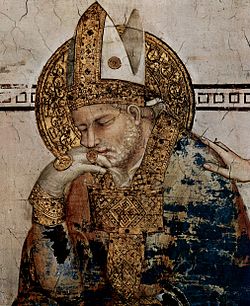
Martin of Tours (Latin: Martinus Turonensis; 316/336 – 8 November 397) was the third bishop of Tours. He is the patron saint of many communities and organizations across Europe, including France's Third Republic. A native of Pannonia (present-day Hungary), he converted to Christianity at a young age. He served in the Roman cavalry in Gaul, but left military service prior to 361, when he became a disciple of Hilary of Poitiers, establishing the monastery at Ligugé. He was consecrated as Bishop of Caesarodunum (Tours) in 371. As bishop, he was active in the suppression of the remnants of Gallo-Roman religion.
The contemporary hagiographer Sulpicius Severus wrote a Life of St. Martin. He is best known for the account of his using his sword to cut his cloak in two, to give half to a beggar clad only in rags in winter. His shrine in Tours became an often-frequented stop for pilgrims on the road to Santiago de Compostela in Spain.
Sulpicius Severus, a contemporary Christian writer who knew Martin personally, wrote a hagiography of the early life of the saint. It contains descriptions of supernatural events such as interactions with the devil and various miracles: Martin casts out demons, heals a paralytic, and raises the dead. Other miracles are: turning back the flames from a house while Martin was burning down the Roman temple it adjoined; deflecting the path of a felled sacred pine; the healing power of a letter written by Martin.
Martin was born in AD 316 or 336 in Savaria in the Diocese of Pannonia (now Szombathely, Hungary). His father was a senior officer (tribune) in the Roman military. His father was then allowed veteran status and was given land on which to retire at Ticinum (now Pavia), in northern Italy, where Martin grew up.
At the age of 10 he attended the Christian church against the wishes of his parents and became a catechumen. Christianity had been made a legal religion (in 313) in the Roman Empire. It had many more adherents in the Eastern Empire, whence it had sprung, and was concentrated in cities, brought along the trade routes by converted Jews and Greeks (the term "pagan" literally means "country-dweller"). Christianity was far from accepted among the higher echelons of society; among members of the army the worship of Mithras would have been stronger. Although the conversion of the Emperor Constantine and the subsequent programme of church-building gave a greater impetus to the spread of the religion, it was still a minority faith.
As the son of a veteran officer, Martin at 15 was required to join a cavalry ala. At the age of 18 (around 334 or 354), he was stationed at Ambianensium civitas or Samarobriva in Gaul (now Amiens, France). It is likely that he joined the Equites catafractarii Ambianenses, a heavy cavalry unit listed in the Notitia Dignitatum. As the unit was stationed at Milan and is also recorded at Trier, it is likely to have been part of the elite cavalry bodyguard of the Emperor, which accompanied him on his travels around the Empire.
Martin's biographer, Sulpicius Severus, provided no dates in his chronology, so although he indicated that Martin served in the military "for nearly two years after his baptism", it is difficult for the historian to pin down the exact date of Martin's exit from military service. Still, historian Andre Mertens has provided this guidance: "He [Martin] served under the Roman emperor Constantine II (ruled 337–340) and afterwards under Julian (ruled 361–363)".
Regardless of the difficulties in chronology, Sulpicius reports that just before a battle in the Gallic provinces at Borbetomagus (now Worms, Germany), Martin determined that his switch of allegiance to a new commanding officer (away from antichristian Julian and to Christ), along with reluctance to receive Julian's pay just as Martin was retiring, prohibited his taking the money and continuing to submit to the authority of the former now, telling him, "I am the soldier of Christ: it is not lawful for me to fight." He was charged with cowardice and jailed, but in response to the charge, he volunteered to go unarmed to the front of the troops. His superiors planned to take him up on the offer, but before they could, the invaders sued for peace, the battle never occurred, and Martin was released from military service.
Martin of Tours
Martin of Tours (Latin: Martinus Turonensis; 316/336 – 8 November 397) was the third bishop of Tours. He is the patron saint of many communities and organizations across Europe, including France's Third Republic. A native of Pannonia (present-day Hungary), he converted to Christianity at a young age. He served in the Roman cavalry in Gaul, but left military service prior to 361, when he became a disciple of Hilary of Poitiers, establishing the monastery at Ligugé. He was consecrated as Bishop of Caesarodunum (Tours) in 371. As bishop, he was active in the suppression of the remnants of Gallo-Roman religion.
The contemporary hagiographer Sulpicius Severus wrote a Life of St. Martin. He is best known for the account of his using his sword to cut his cloak in two, to give half to a beggar clad only in rags in winter. His shrine in Tours became an often-frequented stop for pilgrims on the road to Santiago de Compostela in Spain.
Sulpicius Severus, a contemporary Christian writer who knew Martin personally, wrote a hagiography of the early life of the saint. It contains descriptions of supernatural events such as interactions with the devil and various miracles: Martin casts out demons, heals a paralytic, and raises the dead. Other miracles are: turning back the flames from a house while Martin was burning down the Roman temple it adjoined; deflecting the path of a felled sacred pine; the healing power of a letter written by Martin.
Martin was born in AD 316 or 336 in Savaria in the Diocese of Pannonia (now Szombathely, Hungary). His father was a senior officer (tribune) in the Roman military. His father was then allowed veteran status and was given land on which to retire at Ticinum (now Pavia), in northern Italy, where Martin grew up.
At the age of 10 he attended the Christian church against the wishes of his parents and became a catechumen. Christianity had been made a legal religion (in 313) in the Roman Empire. It had many more adherents in the Eastern Empire, whence it had sprung, and was concentrated in cities, brought along the trade routes by converted Jews and Greeks (the term "pagan" literally means "country-dweller"). Christianity was far from accepted among the higher echelons of society; among members of the army the worship of Mithras would have been stronger. Although the conversion of the Emperor Constantine and the subsequent programme of church-building gave a greater impetus to the spread of the religion, it was still a minority faith.
As the son of a veteran officer, Martin at 15 was required to join a cavalry ala. At the age of 18 (around 334 or 354), he was stationed at Ambianensium civitas or Samarobriva in Gaul (now Amiens, France). It is likely that he joined the Equites catafractarii Ambianenses, a heavy cavalry unit listed in the Notitia Dignitatum. As the unit was stationed at Milan and is also recorded at Trier, it is likely to have been part of the elite cavalry bodyguard of the Emperor, which accompanied him on his travels around the Empire.
Martin's biographer, Sulpicius Severus, provided no dates in his chronology, so although he indicated that Martin served in the military "for nearly two years after his baptism", it is difficult for the historian to pin down the exact date of Martin's exit from military service. Still, historian Andre Mertens has provided this guidance: "He [Martin] served under the Roman emperor Constantine II (ruled 337–340) and afterwards under Julian (ruled 361–363)".
Regardless of the difficulties in chronology, Sulpicius reports that just before a battle in the Gallic provinces at Borbetomagus (now Worms, Germany), Martin determined that his switch of allegiance to a new commanding officer (away from antichristian Julian and to Christ), along with reluctance to receive Julian's pay just as Martin was retiring, prohibited his taking the money and continuing to submit to the authority of the former now, telling him, "I am the soldier of Christ: it is not lawful for me to fight." He was charged with cowardice and jailed, but in response to the charge, he volunteered to go unarmed to the front of the troops. His superiors planned to take him up on the offer, but before they could, the invaders sued for peace, the battle never occurred, and Martin was released from military service.
Recent media
Recent media