



Community hub
Recent from talks
Knowledge base stats:
Talk channels stats:
Members stats:
Maryland 400
The Maryland 400 were members of the 1st Maryland Regiment who repeatedly charged a numerically superior British force during the Battle of Long Island during the Revolutionary War, sustaining heavy casualties, but allowing General Washington to successfully evacuate the bulk of his troops to Manhattan. This action is commemorated in Maryland's nickname, the "Old Line State." A monument in Brooklyn and multiple plaques were put up in the memory of this regiment and the fallen soldiers.
The 115th Infantry claims lineage back to the earliest militia units formed to protect the frontier of western Maryland. The birthdate of the unit, 14 June 1775, is also the birthdate of the United States Army. The first two companies to leave Maryland were rifle companies, assembled in Frederick, Maryland in the summer of 1775 under the command of Captains Michael Cresap and Thomas Price; they were organized in response to the Continental Congress' call to active duty. They left Frederick in August and marched 551 miles (887 km) in 21 days to report to General Washington in September to support Washington's efforts to drive the British out of Boston. Later, Maryland militia companies, armed with older, surplus British muskets and bayonets, were formed and sent north to support Washington in New York City.
At the Battle of Long Island, the 1st Maryland Regiment was under the command of Colonel William Smallwood. This unit anchored the right against British General Grant's diversionary attack.
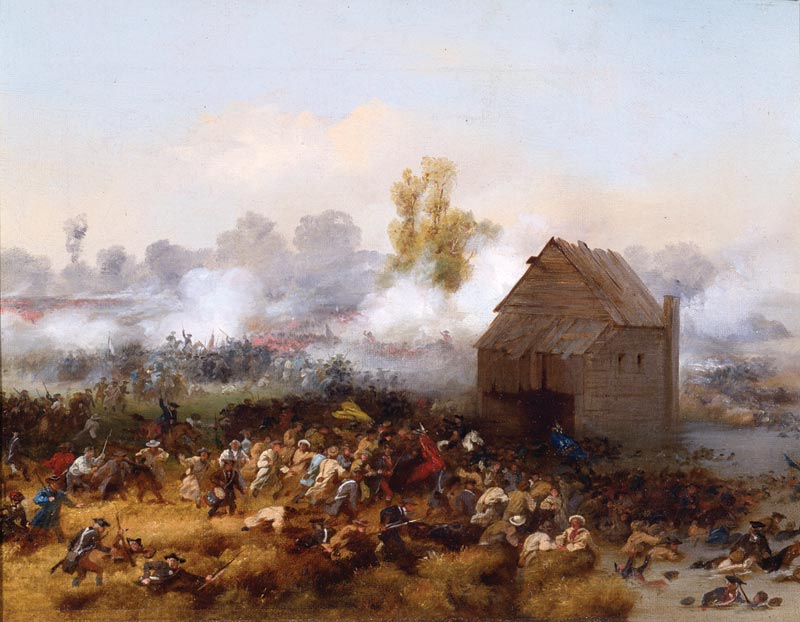
Lord Stirling ordered all of his troops, except a contingent of Maryland troops under the command of Major Mordecai Gist, to cross Gowanus Creek (salt marsh). This group of Maryland troops became known to history as the Maryland 400, although they numbered about 260 to 270 men. Stirling and Gist led the troops in a rear-guard action against the overwhelming numbers of British troops which surpassed 2,000 troops supported by two cannon. Stirling and Gist led the Marylanders in two attacks against the British who were in fixed positions in and in front of the Vechte-Cortelyou House. After the last assault the remaining troops retreated across the creek. Some of the men who tried to cross the marsh were bogged down in the mud under musket fire and others who could not swim were captured. Stirling was surrounded and, unwilling to surrender to the British, broke through the British lines to von Heister's Hessians and surrendered to them. More than 100 men were captured and 256 killed, practically wiping the regiment out in the assaults in front of the Old Stone House. Fewer than a dozen made it back to the American lines. Washington, watching from a redoubt on nearby Cobble Hill (intersection of today's Court Street and Atlantic Avenue), was to have said, "Good God, what brave fellows I must this day lose!".
Many of the officers of the Maryland 400 were admitted as original members of The Society of the Cincinnati or became eligible for representation by a living descendant after the "Rule of 1854" was adopted by the Society as a way to revive the membership.
The 256 dead troops of the Maryland 400 were buried by the British in a mass grave on a hillock on farmer Adrian Van Brunt's land on the outskirts of the marsh. This mass grave is believed to be around the southwest corner of what is today 3rd Ave. between 7th and 9th Streets. In 6 trenches, the military burial ditches had a north–south orientation so that the bodies would be "facing east".
In the 1890s, the entire site was covered by 12 feet of fill. Construction was done over the site and it became a coal yard and after that a paint factory. In 1956 Dr. Nicholas Ryan, a Brooklyn Heights physician, is quoted stating that in the 1890s his father, a building contractor, had found "the bones of some thirty bodies in regular, or military order," in the course of digging cellars for apartment buildings on the site at the northeast corner of Seventh Street and Third Avenue.
However, in 1957, the U.S. National Park Service did a historical site survey and a report to congress identified a "plaque commemorating what was thought to be a mass grave on Third Avenue between Seventh and Eighth Streets." A limited archeological dig by Columbia University archaeology graduate students turned up no remains. A determination was made at the time to not preserve the site.
Hub AI
Maryland 400 AI simulator
(@Maryland 400_simulator)
Maryland 400
The Maryland 400 were members of the 1st Maryland Regiment who repeatedly charged a numerically superior British force during the Battle of Long Island during the Revolutionary War, sustaining heavy casualties, but allowing General Washington to successfully evacuate the bulk of his troops to Manhattan. This action is commemorated in Maryland's nickname, the "Old Line State." A monument in Brooklyn and multiple plaques were put up in the memory of this regiment and the fallen soldiers.
The 115th Infantry claims lineage back to the earliest militia units formed to protect the frontier of western Maryland. The birthdate of the unit, 14 June 1775, is also the birthdate of the United States Army. The first two companies to leave Maryland were rifle companies, assembled in Frederick, Maryland in the summer of 1775 under the command of Captains Michael Cresap and Thomas Price; they were organized in response to the Continental Congress' call to active duty. They left Frederick in August and marched 551 miles (887 km) in 21 days to report to General Washington in September to support Washington's efforts to drive the British out of Boston. Later, Maryland militia companies, armed with older, surplus British muskets and bayonets, were formed and sent north to support Washington in New York City.
At the Battle of Long Island, the 1st Maryland Regiment was under the command of Colonel William Smallwood. This unit anchored the right against British General Grant's diversionary attack.
Lord Stirling ordered all of his troops, except a contingent of Maryland troops under the command of Major Mordecai Gist, to cross Gowanus Creek (salt marsh). This group of Maryland troops became known to history as the Maryland 400, although they numbered about 260 to 270 men. Stirling and Gist led the troops in a rear-guard action against the overwhelming numbers of British troops which surpassed 2,000 troops supported by two cannon. Stirling and Gist led the Marylanders in two attacks against the British who were in fixed positions in and in front of the Vechte-Cortelyou House. After the last assault the remaining troops retreated across the creek. Some of the men who tried to cross the marsh were bogged down in the mud under musket fire and others who could not swim were captured. Stirling was surrounded and, unwilling to surrender to the British, broke through the British lines to von Heister's Hessians and surrendered to them. More than 100 men were captured and 256 killed, practically wiping the regiment out in the assaults in front of the Old Stone House. Fewer than a dozen made it back to the American lines. Washington, watching from a redoubt on nearby Cobble Hill (intersection of today's Court Street and Atlantic Avenue), was to have said, "Good God, what brave fellows I must this day lose!".
Many of the officers of the Maryland 400 were admitted as original members of The Society of the Cincinnati or became eligible for representation by a living descendant after the "Rule of 1854" was adopted by the Society as a way to revive the membership.
The 256 dead troops of the Maryland 400 were buried by the British in a mass grave on a hillock on farmer Adrian Van Brunt's land on the outskirts of the marsh. This mass grave is believed to be around the southwest corner of what is today 3rd Ave. between 7th and 9th Streets. In 6 trenches, the military burial ditches had a north–south orientation so that the bodies would be "facing east".
In the 1890s, the entire site was covered by 12 feet of fill. Construction was done over the site and it became a coal yard and after that a paint factory. In 1956 Dr. Nicholas Ryan, a Brooklyn Heights physician, is quoted stating that in the 1890s his father, a building contractor, had found "the bones of some thirty bodies in regular, or military order," in the course of digging cellars for apartment buildings on the site at the northeast corner of Seventh Street and Third Avenue.
However, in 1957, the U.S. National Park Service did a historical site survey and a report to congress identified a "plaque commemorating what was thought to be a mass grave on Third Avenue between Seventh and Eighth Streets." A limited archeological dig by Columbia University archaeology graduate students turned up no remains. A determination was made at the time to not preserve the site.