


Community hub
Recent from talks
Contribute something
Nothing was collected or created yet.
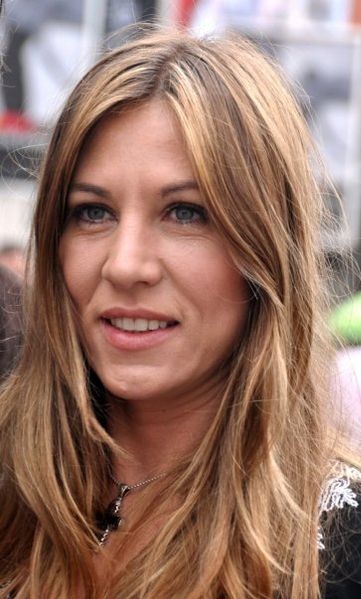
Mathilde Seigner
View on Wikipedia
Mathilde Seigner (born 17 January 1968) is a French actress.
Key Information


Early life
[edit]Seigner was born in Paris. She is the granddaughter of actor Louis Seigner (1903–1991). She is the sister of Emmanuelle Seigner and a niece of Françoise Seigner.
Career
[edit]Seigner's acting performances have been confined to French-language films, but she has appeared in a number of productions. She won Best Actress at the Montreal World Film Festival in 2001 for her role in Betty Fisher and Other Stories and has been nominated for a César Award three times.
Seigner studied comedy at Florent (famous French school of theater), before making her first appearance in theaters in 1994, alongside her sister Emmanuelle in Le Sourire (Smile) directed by Claude Miller.[2] She received the Prix Michel Simon in 1995 for her role in Rosine. Two years later, she won a Cesar Award for Best Supporting Actress for her role in Nettoyage à sec.
Seigner won the Romy Schneider Prize in 1999. Mathilde Seigner is appreciated for her spontaneity and strong character, she quickly gained favor with the public, thanks to the nostalgic Une hirondelle a fait le printemps (2001) as a city dweller who discovers the joys of the countryside. She appeared in Le passager de l'été, Zone libre, and Dance avec lui. With 3 amis, she returned to comedy, in such films as Tout pour plaire and Détrompez-vous.
She returned in 2009 with three dramatic comedies about family (Quelque chose à te dire, Trésor and Une semaine sur deux (et la moitié des vacances scolaires)). After Fini les vacances (2010), she appeared in Camping 2 and the remake of La guerre des boutons (2011).
In 2012, Seigner appeared in Dans la tourmente and Max. In September 2013, she appeared onstage. Two years after L'amour, la mort les fringues, she appeared in Nina, a comedy in which she is the heroine alongside François Berléand and François Vincentelli, as her husband and lover, respectively.
Personal life
[edit] | This section of a biography of a living person does not include any references or sources. (February 2018) |
From 1998 to 2001 she had an affair with the comedian Laurent Gerra.
From 2002 to 2005, she was a couple with the actor Antoine Duléry.
Since October 2006, Seigner has lived with Mathieu Petit, a cameraman; they have a son.[citation needed]
She is the sister-in-law of film director Roman Polanski, who married her sister Emmanuelle in 1989.
Controversies
[edit]In 2009, Seigner signed a petition in support of her brother-in-law Roman Polanski, calling for his release after Polanski was arrested in Switzerland in relation to his 1977 charge for drugging and raping a 13-year-old girl.[3]
On 24 February 2012, during the César Award ceremony, she interrupted the telecast when Michel Blanc won, stating she would have preferred that Joey Starr won.[4]
Theater
[edit]| Year | Title | Author | Director | Notes |
|---|---|---|---|---|
| 1988 | The Moods of Marianne | Alfred de Musset | Françoise Seigner | |
| Les Chevaliers de la Table ronde | Jean Cocteau | Françoise Seigner (2) | ||
| 1989 | Les Fourberies de Scapin | Molière | Françoise Seigner (3) | |
| 1990 | Le Médecin malgré lui | Molière | Michel Galabru | |
| The Miser | Molière | Françoise Seigner (4) | ||
| 1991 | L'Étourdi | Molière | Françoise Seigner (5) | Théâtre des Célestins |
| 1992 | Et s'il n'en restait qu'un | Françoise Dorin | Françoise Seigner (6) | |
| 1997 | Uncle Vanya | Anton Chekhov | Patrice Kerbrat | Théâtre Hébertot |
| 2001-03 | Educating Rita | Willy Russell | Michel Fagadau | Théâtre des Champs-Élysées |
| 2011 | Love, Loss, and What I Wore | Nora & Delia Ephron | Danièle Thompson | Théâtre Marigny |
| 2013–15 | Nina | André Roussin | Bernard Murat | Théâtre Édouard VII |
Filmography
[edit]| Year | Title | Role | Director | Notes |
|---|---|---|---|---|
| 1989 | Salut les musclés | Jacques Samyn | TV series (1 episode) | |
| 1991 | Cas de divorce | Pascale Seguin | Gérard Espinasse | TV series (1 episode) |
| 1994 | Rosine | Marie | Christine Carrière | Acteurs à l'Écran – Best Actress |
| Le sourire | Tututt | Claude Miller | ||
| Boulevard Mac Donald | Melvil Poupaud | Short | ||
| 3000 scénarios contre un virus | Daniel Vigne | TV series (1 episode) | ||
| 1995 | J'aime beaucoup ce que vous faites | Laurence | Xavier Giannoli | Short |
| 1996 | Mémoires d'un jeune con | Nathalie | Patrick Aurignac | |
| Portraits chinois | Fanny | Martine Dugowson | ||
| Vacances bougeoises | Mélanie | Jean-Claude Brialy | TV movie | |
| Pêcheur d'Islande | Gaud | Daniel Vigne (2) | TV movie | |
| Combats de femme | Nadine | Pascale Bailly | TV series (1 episode) | |
| 1997 | Dry Cleaning | Marylin | Anne Fontaine | Nominated – César Award for Best Supporting Actress |
| Vive la république | Corinne | Éric Rochant | ||
| Francorusse | Sophie | Alexis Miansarow | ||
| The Man I Love | Lise | Stéphane Giusti | TV movie | |
| Si je t'oublie Sarajevo | Leila | Arnaud Sélignac | TV movie | |
| Georges Dandin | Angélique | Jean-Claude Brialy (2) | TV movie | |
| 1998 | Noël en famille | Fabienne Berthaud & Aruna Villiers | Short | |
| Marc Eliot | Isabelle Germain | Josée Dayan | TV series (1 episode) | |
| Commandant Nerval | Nathalie Joste | Arnaud Sélignac (2) | TV series (1 episode) | |
| 1999 | Venus Beauty Institute | Samantha | Tonie Marshall | Nominated – César Award for Best Supporting Actress |
| Time Regained | Céleste | Raúl Ruiz | ||
| Belle maman | Séverine | Gabriel Aghion | ||
| Le bleu des villes | Mylène | Stéphane Brizé | ||
| 2000 | Harry, He's Here to Help | Claire | Dominik Moll | Nominated – César Award for Best Supporting Actress |
| Le coeur à l'ouvrage | Chloë | Laurent Dussaux | ||
| Le mal des femmes | Daniel Vigne (3) | |||
| La chambre des magiciennes | Odette | Claude Miller (2) | TV movie | |
| 2001 | The Girl from Paris | Sandrine Dumez | Christian Carion | Cabourg Film Festival – Best Actress |
| Inch'Allah Dimanche | Nicole Briat | Yamina Benguigui | ||
| The Milk of Human Kindness | Josiane | Dominique Cabrera | Locarno International Film Festival – Special Mention | |
| Alias Betty | Carole Novacki | Claude Miller (3) | Montreal World Film Festival – Best Actress | |
| 2002 | Madame Sans-Gêne | Catherine Hübscher | Philippe de Broca | TV movie |
| Les enquêtes d'Éloïse Rome | Irène | Edwin Baily | TV series (1 episode) | |
| 2003 | Tristan | Emmanuelle Barsac | Philippe Harel | |
| 2004 | Les parisiens | Clémentine / Anne | Claude Lelouch | |
| Mariages ! | Valentine | Valérie Guignabodet | ||
| 2005 | Le courage d'aimer | Clémentine / Anne | Claude Lelouch (2) | |
| Palais royal! | Laurence | Valérie Lemercier | ||
| Tout pour plaire | Juliette Fischer | Cécile Telerman | ||
| 2006 | Camping | Sophie Gatineau | Fabien Onteniente | |
| Le passager de l'été | Angèle | Florence Moncorgé-Gabin | ||
| 2007 | Game of Four | Lisa | Bruno Dega | |
| 3 amis | Claire | Michel Boujenah | ||
| Zone libre | Daughter-in-law | Christophe Malavoy | ||
| Danse avec lui | Alexandra | Valérie Guignabodet (2) | ||
| 2009 | Trésor | Nathalie | Claude Berri & François Dupeyron | |
| Une semaine sur deux (et la moitié des vacances scolaires) |
Marjorie | Ivan Calbérac | ||
| Quelque chose à te dire | Alice Celliers | Cécile Telerman (2) | ||
| 2010 | Camping 2 | Sophie Gatineau | Fabien Onteniente (2) | |
| 2011 | La guerre des boutons | Lebrac's mother | Yann Samuell | |
| Dans la tourmente | Hélène | Christophe Ruggia | ||
| 2012 | Maman | Sandrine | Alexandra Leclère | |
| Bowling | Mathilde | Marie-Castille Mention-Schaar | ||
| Max | Rose | Stéphanie Murat | ||
| Médecin-chef à la Santé | Séverine Vincent | Yves Rénier | TV movie | |
| 2014 | La liste de mes envies | Jocelyne Guerbette | Didier Le Pêcheur | |
| 2015 | Come What May | Mado | Christian Carion (2) | |
| Une mère | Marie | Christine Carrière (2) | ||
| Flic, tout simplement | Martine Monteil | Yves Rénier (2) | TV movie | |
| 2016 | Back to Mom's | Carole Mazerin | Éric Lavaine | |
| Sam | Sam | Valérie Guignabodet (3) | TV series (6 episodes) – Replaced by Natacha Lindinger for Season 2.[1] | |
| 2016 | Chacun sa vie et son intime conviction | Mathilde | Claude Lelouch (3) | |
| Coexister | Sophie Demanche | Fabrice Eboué | ||
| 2018 | Edmond | Maria Legault | Alexis Michalik |
References
[edit]- ^ "Mathilde Seigner has appeared in the following films:Boulevard Mac Donald (1994)..." Retrieved 22 September 2012.
{{cite news}}: CS1 maint: deprecated archival service (link) - ^ "Seigner Bio". Notre Cinema. Retrieved 29 October 2025.
- ^ "Polanski : la pétition". La Règle du Jeu (in French). 7 June 2010. Retrieved 29 August 2021.
{{cite web}}: CS1 maint: deprecated archival service (link) - ^ Profile Archived 25 February 2013 at the Wayback Machine, closermag.fr; accessed 22 June 2015.(in French)
External links
[edit]

Mathilde Seigner
View on GrokipediaEarly life
Family background and upbringing
Mathilde Seigner was born on January 17, 1968, in Paris, France, into a family with deep roots in the French performing arts.[6] Her father, Jean-Louis Seigner (1941–2020), and mother, Aline Ponelle, raised her alongside her sisters, Emmanuelle Seigner and Marie-Amélie Seigner.[1][7] Seigner is the granddaughter of Louis Seigner (1903–1991), a prominent French stage actor known for his long tenure at the Comédie-Française, and the niece of actress Françoise Seigner.[8] This lineage positioned her within an acting dynasty, where familial connections to theater and cinema provided an environment steeped in performance culture from an early age.[9] Her upbringing in Paris exposed her to the artistic milieu surrounding her relatives' careers, fostering an innate familiarity with the demands and dynamics of acting without formal training until later adolescence.[9] This immersion, as described by her sister Emmanuelle, normalized the profession as a household norm, shaping Seigner's early worldview toward creative expression amid the city's vibrant cultural scene.[9]Professional career
Debut and early roles
Mathilde Seigner trained at the prestigious Cours Florent drama school in Paris during the early 1990s, where she honed her acting skills amid a family legacy in the performing arts.[10] Her professional debut occurred on television in 1991, appearing in the sitcom Cas de divorce produced by AB Productions.[11] Transitioning to film, she secured minor roles in 1994, marking her cinematic entry with three projects: the anthology short 3 000 scénarios contre un virus directed by Jean Achache, Le Sourire by Claude Miller, and Rosine by Christine Carrière.[12] These initial appearances, often uncredited or supporting, provided on-set experience that developed her versatility in dramatic and comedic contexts.[8] In Le Sourire, Seigner played Tututt, a stripper in a narrative exploring an aging psychiatrist's infatuation, performing a notable nude dance sequence alongside other performers.[13] Her role in Rosine, portraying the titular character in a story of generational family tensions, garnered critical attention and earned her the Prix Michel Simon for most promising actress in 1995, signaling early empirical validation of her talent through peer recognition.[14] These formative roles, secured independently despite familial connections—such as sharing screen time with sister Emmanuelle in Le Sourire—demonstrated a progression from training to practical proficiency without reliance on nepotism for casting.[8] [15] Throughout the late 1990s, Seigner continued with supporting parts in French productions, including L'homme que j'aime (1997) as Lise, Vive la république! (1997) as Corinne, and Francorusse (1997) as a serial killer named Sophie, accumulating credits that refined her range across genres like thriller and period drama.[3] This phase emphasized skill-building through diverse, low-profile work, culminating in the Prix Romy Schneider in 1999 for her emerging body of performances, which positioned her for lead opportunities entering the 2000s.[14] Limited early theater engagements followed her Florent studies, though specific productions from this period remain sparsely documented, with her focus shifting toward screen roles by mid-decade.[16]Film work
Seigner's breakthrough role in cinema arrived with her portrayal of Claire, the beleaguered wife of a struggling writer in the psychological thriller With a Friend Like Harry... (Harry, un ami qui vous veut du bien), directed by Dominik Moll and released in 2000.[17] The film, centered on an obsessive reunion with a former classmate, drew 1,862,499 admissions in France, marking a commercial hit.[18] Her performance in the tense domestic dynamics earned a César nomination for Best Supporting Actress in 2001.[19] In 2001, Seigner appeared as Carole Novacki, a mother entangled in a web of abduction and grief, in Claude Miller's dramatic adaptation Alias Betty (Betty Fisher et autres histoires), based on Ruth Rendell's novel.[20] The film's intricate narrative of intertwined family tragedies attracted 143,809 viewers in France, reflecting more modest box-office returns despite critical praise for its plotting.[21] That same year, she led as Sandrine, a disillusioned Parisian IT professional pursuing a rural farming dream, in Christian Carion's dramedy The Girl from Paris (Une hirondelle a fait le printemps).[22] The story of urban-to-rural adaptation resonated widely, achieving 2,250,137 admissions in France and underscoring her appeal in character-driven tales of personal reinvention.[23] Seigner's subsequent film work diversified across genres, incorporating family comedies and lighter fare. In Arnaud Lemort's 2019 comedy Ibiza, she played Carole, the girlfriend navigating chaotic island holidays with a podiatrist and stepchildren, which garnered 629,425 admissions in France.[24] This evolution highlighted her range, transitioning from suspenseful supporting parts to comedic leads in ensemble-driven narratives.[25]Theater engagements
Seigner's initial theater appearances occurred in the early 1990s, coinciding with her film debut, including a role in Molière's L'Étourdi, directed by her mother Françoise Seigner at Théâtre Mouffetard and later Théâtre des Célestins in 1991.[26] She followed with performances in Françoise Dorin's Et s'il n'en restait qu'un in 1992 and Anton Chekhov's Oncle Vania in 1997, establishing a foundation in classical and contemporary French repertoire.[26] Her return to the stage in major Parisian productions began with André Roussin's Nina in 2013, where she portrayed the titular character—a whimsical, defiant, and passionate woman—in a comedy directed by Bernard Murat at Théâtre Édouard VII, running from September 6, 2013, to January 12, 2014, alongside François Berléand and François Vincentelli.[27] [28] The production toured in 2015, extending its reach beyond Paris.[29] In 2017, Seigner starred as Mado in Éric Assous's La Nouvelle, a comedy directed by and co-starring Richard Berry at Théâtre de Paris, from September 15, 2017, to January 7, 2018, depicting a father's introduction of his younger companion to his sons.[30] [28] More recently, she appeared in Éric-Emmanuel Schmitt's Bungalow 21 at Théâtre de la Madeleine from September 14, 2023, to January 7, 2024, embodying Simone Signoret in a depiction of 1960s encounters at the Beverly Hills Hotel alongside her sister Emmanuelle Seigner as Marilyn Monroe.[29] [28] These engagements, totaling three principal productions with over 300 representations, primarily in boulevard comedy genres, underscore her selective involvement in live theater amid a film-heavy career.[28]Television and recent projects
Seigner portrayed Séverine Vincent in the 2012 television film Médecin-chef à la Santé, a drama centered on challenges within France's prison healthcare system.[31] She also played Hélène in the 2011 television production Dans la tourmente, depicting personal and familial struggles amid adversity.[31] In 2024, Seigner featured in the film Bungalow 21, contributing to her ongoing cinematic output.[3] The following year, she joined the cast of the eight-episode TF1 series Montmartre, a historical drama exploring Paris's cabaret culture, with production commencing in late 2024.[3][32] Her 2006 comedy Camping, in which she starred as Vanessa alongside Gérard Lanvin and Franck Dubosc, gained renewed visibility through its streaming debut on Netflix on July 15, 2025.[33] This release underscores the enduring appeal of her roles in accessible, character-driven narratives within French popular entertainment.[34]Personal life
Relationships and family
Mathilde Seigner was in a relationship with comedian Laurent Gerra from 1998 to 2001.[35][36] She subsequently dated actor Anthony Delon in 2001.[37][38] Since October 2006, Seigner has maintained a long-term partnership with cameraman Mathieu Petit, with whom she has one child.[39][40] Their son, Louis, was born on August 10, 2007.[41][40] Seigner has not married.[40]Health and personal choices
In July 2025, Mathilde Seigner admitted to undergoing cosmetic surgery specifically to address a persistent "recalcitrant" frown line between her eyebrows.[42] She described the decision as yielding to targeted intervention after other methods proved insufficient, while emphasizing her overall acceptance of aging, stating "Vieillir, je m’en fous."[42] Seigner has also utilized non-surgical aesthetic treatments, including injections for the same frown lines and laser therapy to enhance skin tonicity.[43] In a 2023 interview, she disclosed consulting an aesthetic physician for these procedures, following professional advice to avoid enhancements around the mouth, and advocated for such options as a means to feel confident in one's appearance without denying natural maturation.[43] For weight management, Seigner reported losing 10 kilograms through the Shelton diet, a food dissociation method devised in the 1950s by Herbert Shelton that separates intake into alkaline (vegetables, fruits) and acidic (meats, fish, cereals) groups to support biochemical balance.[44] This followed a 10-kilogram gain during menopause, with the approach guided by a specialist and implemented post a May 2024 consultation; she qualified its suitability as personal, noting "C'est un régime qui me convient, mais ce n'est pas forcément valable pour tout le monde."[44]Political and social views
Influences and self-identification
Mathilde Seigner has self-identified as an anarchiste de droite, or right-wing anarchist, emphasizing a blend of individual liberty and conservative values that rejects rigid ideological conformity.[45][46] In a January 2022 interview, she elaborated that her father, Jean-Louis Seigner, a photographer and Gaullist, instilled in her a "généreuse et paternaliste" form of right-wing thought, prioritizing national sovereignty and personal responsibility over collectivist norms.[45] This paternal influence, rooted in the Gaullist tradition of post-World War II France—which combined economic interventionism with anti-communist individualism—shaped Seigner's aversion to prevailing left-leaning cultural and political orthodoxies in artistic circles.[47] She has contrasted her upbringing with the progressive environments of contemporary media, crediting family discussions that favored empirical skepticism toward state overreach and emphasized self-reliance.[47] Seigner's self-description aligns with observed family non-conformism, evident in the Seigners' artistic pursuits that defied mainstream expectations, such as her grandfather Louis Seigner's versatile career spanning avant-garde and commercial theater.[45]Public expressions and positions
Mathilde Seigner has infrequently discussed her political views in public, emphasizing in a 2022 interview that she identifies as an "anarchiste de droite," drawing from her father Jean-Louis Seigner's Gaullist heritage, which she described as a "droite généreuse et modérée."[46] She elaborated on this self-description during a December 2022 appearance on Europe 1, affirming her right-leaning orientation while distancing it from familial influences, stating it stems from personal values of tradition and classicism rather than ideology.[48] [49] In the same period, Seigner critiqued aspects of contemporary French governance, expressing opposition to what she termed a "politique de la peur" in relation to potential electricity and heating cuts amid energy crises, arguing it unfairly targeted lower-income populations.[50] During a December 2022 episode of Sept à huit, she positioned herself as aligned with "la France profonde"—rural and working-class communities—claiming, "Ce que j'ai de communiste, c'est que je suis proche de la France profonde," while directly questioning President Emmanuel Macron and Prime Minister Élisabeth Borne on these policy risks.[51] Seigner has voiced frustration with constraints on personal freedoms in France, stating in a July 2024 social media post amid legislative elections that "on est en permanence brimés," reflecting a broader sense of national decline and individual restriction.[52] [53] Earlier, in a 2013 Paris Match interview, she contrasted her candid style with industry norms, noting that peers often adopt "politiquement correct" approaches to appease professional circles, whereas she avoids such accommodations.[54] In response to media reports alleging proximity to right-wing figures like National Rally leader Jordan Bardella, including claims of hosting dinners with celebrities, Seigner issued a June 2024 Instagram statement denying any political affiliations or endorsements: "Je n'appartiens et ne soutiens aucun courant politique," and announced plans to file defamation complaints against outlets like Glitz and Le Monde for the assertions.[55] [56] This rebuttal underscores her insistence on independence from organized political movements, consistent with her self-professed anarchist leanings.Reception and impact
Awards and nominations
Seigner received three nominations for the César Award for Best Supporting Actress, France's highest film honor voted by the Académie des Arts et Techniques du Cinéma, without securing a win; these nods, amid fields of over 4,000 eligible films annually, underscore her sustained peer recognition in competitive categories emphasizing nuanced ensemble contributions.[57] The nominations correlated with roles in commercially and critically successful films, amplifying her visibility: Dry Cleaning (1997) grossed over 1.5 million admissions in France, while With a Friend Like Harry... (2000) exceeded 1.2 million, per box office data, thereby bolstering her trajectory toward lead opportunities. She won the Prix Michel Simon for Best Actress in 1995 for Rosine (1994), a jury-selected accolade from the Syndicat de la Critique de Films honoring emerging dramatic talent. In 1999, Seigner was awarded the Prix Romy Schneider, annually bestowed by journalists on a promising actress under 30 for overall promise rather than a single role. Additionally, in 2001, she shared the Best Actress prize at the Montreal World Film Festival for Betty Fisher and Other Stories (2001), selected by an international jury for lead performance impact.| Year | Award | Category | Nominated work | Result |
|---|---|---|---|---|
| 1995 | Prix Michel Simon | Best Actress | Rosine | Won[57] |
| 1998 | César Award | Best Supporting Actress | Dry Cleaning (Nettoyage à sec) | Nominated[57] |
| 1999 | Prix Romy Schneider | — | — | Won |
| 2000 | César Award | Best Supporting Actress | Venus Beauty Institute (Vénus beauté institut) | Nominated[57] |
| 2001 | César Award | Best Supporting Actress | With a Friend Like Harry... (Harry, un ami qui vous veut du bien) | Nominated[19] |
| 2001 | Montreal World Film Festival | Best Actress | Betty Fisher and Other Stories (Betty Fisher et autres histoires) | Won (joint) |