



Community hub
Recent from talks
Contribute something
Nothing was collected or created yet.
Matrix analytic method
View on WikipediaIn probability theory, the matrix analytic method is a technique to compute the stationary probability distribution of a Markov chain which has a repeating structure (after some point) and a state space which grows unboundedly in no more than one dimension.[1][2] Such models are often described as M/G/1 type Markov chains because they can describe transitions in an M/G/1 queue.[3][4] The method is a more complicated version of the matrix geometric method and is the classical solution method for M/G/1 chains.[5]
Method description
[edit]An M/G/1-type stochastic matrix is one of the form[3]
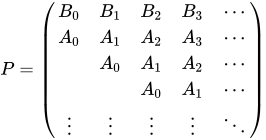
where Bi and Ai are k × k matrices. (Note that unmarked matrix entries represent zeroes.) Such a matrix describes the embedded Markov chain in an M/G/1 queue.[6][7] If P is irreducible and positive recurrent then the stationary distribution is given by the solution to the equations[3]

where e represents a vector of suitable dimension with all values equal to 1. Matching the structure of P, π is partitioned to π1, π2, π3, …. To compute these probabilities the column stochastic matrix G is computed such that[3]
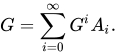
G is called the auxiliary matrix.[8] Matrices are defined[3]
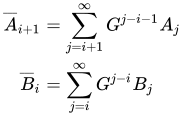
then π0 is found by solving[3]
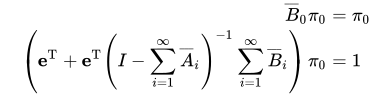
and the πi are given by Ramaswami's formula,[3] a numerically stable relationship first published by Vaidyanathan Ramaswami in 1988.[9]
![{\displaystyle \pi _{i}=(I-{\overline {A}}_{1})^{-1}\left[{\overline {B}}_{i+1}\pi _{0}+\sum _{j=1}^{i-1}{\overline {A}}_{i+1-j}\pi _{j}\right],i\geq 1.}](https://wikimedia.org/api/rest_v1/media/math/render/svg/0991a5676c9a24717aacd3ebc56c35add63d201b)
Computation of G
[edit]There are two popular iterative methods for computing G,[10][11]
- functional iterations
- cyclic reduction.
Tools
[edit]References
[edit]- ^ Harchol-Balter, M. (2012). "Phase-Type Distributions and Matrix-Analytic Methods". Performance Modeling and Design of Computer Systems. pp. 359–379. doi:10.1017/CBO9781139226424.028. ISBN 9781139226424.
- ^ Neuts, M. F. (1984). "Matrix-analytic methods in queuing theory". European Journal of Operational Research. 15: 2–12. doi:10.1016/0377-2217(84)90034-1.
- ^ a b c d e f g Meini, B. (1997). "An improved FFT-based version of Ramaswami's formula". Communications in Statistics. Stochastic Models. 13 (2): 223–238. doi:10.1080/15326349708807423.
- ^ Stathopoulos, A.; Riska, A.; Hua, Z.; Smirni, E. (2005). "Bridging ETAQA and Ramaswami's formula for the solution of M/G/1-type processes". Performance Evaluation. 62 (1–4): 331–348. CiteSeerX 10.1.1.80.9473. doi:10.1016/j.peva.2005.07.003.
- ^ Riska, A.; Smirni, E. (2002). "M/G/1-Type Markov Processes: A Tutorial" (PDF). Performance Evaluation of Complex Systems: Techniques and Tools. Lecture Notes in Computer Science. Vol. 2459. pp. 36. doi:10.1007/3-540-45798-4_3. ISBN 978-3-540-44252-3.
- ^ Bolch, Gunter; Greiner, Stefan; de Meer, Hermann; Shridharbhai Trivedi, Kishor (2006). Queueing Networks and Markov Chains: Modeling and Performance Evaluation with Computer Science Applications (2 ed.). John Wiley & Sons, Inc. p. 250. ISBN 978-0471565253.
- ^ Artalejo, Jesús R.; Gómez-Corral, Antonio (2008). "The Matrix-Analytic Formalism". Retrial Queueing Systems. pp. 187–205. doi:10.1007/978-3-540-78725-9_7. ISBN 978-3-540-78724-2.
- ^ Riska, A.; Smirni, E. (2002). "Exact aggregate solutions for M/G/1-type Markov processes". ACM SIGMETRICS Performance Evaluation Review. 30: 86. CiteSeerX 10.1.1.109.2225. doi:10.1145/511399.511346.
- ^ Ramaswami, V. (1988). "A stable recursion for the steady state vector in markov chains of m/g/1 type". Communications in Statistics. Stochastic Models. 4: 183–188. doi:10.1080/15326348808807077.
- ^ Bini, D. A.; Latouche, G.; Meini, B. (2005). Numerical Methods for Structured Markov Chains. doi:10.1093/acprof:oso/9780198527688.001.0001. ISBN 9780198527688.
- ^ Meini, B. (1998). "Solving m/g/l type markov chains: Recent advances and applications". Communications in Statistics. Stochastic Models. 14 (1–2): 479–496. doi:10.1080/15326349808807483.
- ^ Riska, A.; Smirni, E. (2002). "MAMSolver: A Matrix Analytic Methods Tool". Computer Performance Evaluation: Modelling Techniques and Tools. Lecture Notes in Computer Science. Vol. 2324. p. 205. CiteSeerX 10.1.1.146.2080. doi:10.1007/3-540-46029-2_14. ISBN 978-3-540-43539-6.
| Single queueing nodes | |
|---|---|
| Arrival processes | |
| Queueing networks | |
| Service policies | |
| Key concepts | |
| Limit theorems | |
| Extensions | |
| Information systems | |
