



Community hub
Recent from talks
Contribute something
Nothing was collected or created yet.
Maximal information coefficient
View on Wikipedia |
In statistics, the maximal information coefficient (MIC) is a measure of the strength of the linear or non-linear association between two variables X and Y.
The MIC belongs to the maximal information-based nonparametric exploration (MINE) class of statistics.[1] In a simulation study, MIC outperformed some selected low power tests,[1] however concerns have been raised regarding reduced statistical power in detecting some associations in settings with low sample size when compared to powerful methods such as distance correlation and Heller–Heller–Gorfine (HHG).[2] Comparisons with these methods, in which MIC was outperformed, were made in Simon and Tibshirani[3] and in Gorfine, Heller, and Heller.[4] It is claimed[1] that MIC approximately satisfies a property called equitability which is illustrated by selected simulation studies.[1] It was later proved that no non-trivial coefficient can exactly satisfy the equitability property as defined by Reshef et al.,[1][5] although this result has been challenged.[6] Some criticisms of MIC are addressed by Reshef et al. in further studies published on arXiv.[7]
Overview
[edit]The maximal information coefficient uses binning as a means to apply mutual information on continuous random variables. Binning has been used for some time as a way of applying mutual information to continuous distributions; what MIC contributes in addition is a methodology for selecting the number of bins and picking a maximum over many possible grids.
The rationale is that the bins for both variables should be chosen in such a way that the mutual information between the variables be maximal. That is achieved whenever .[Note 1] Thus, when the mutual information is maximal over a binning of the data, we should expect that the following two properties hold, as much as made possible by the own nature of the data. First, the bins would have roughly the same size, because the entropies and are maximized by equal-sized binning. And second, each bin of X will roughly correspond to a bin in Y.



Because the variables X and Y are real numbers, it is almost always possible to create exactly one bin for each (x,y) datapoint, and that would yield a very high value of the MI. To avoid forming this kind of trivial partitioning, the authors of the paper propose taking a number of bins for X and whose product is relatively small compared with the size N of the data sample. Concretely, they propose:


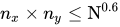
In some cases it is possible to achieve a good correspondence between and with numbers as low as and , while in other cases the number of bins required may be higher. The maximum for is determined by H(X), which is in turn determined by the number of bins in each axis, therefore, the mutual information value will be dependent on the number of bins selected for each variable. In order to compare mutual information values obtained with partitions of different sizes, the mutual information value is normalized by dividing by the maximum achievable value for the given partition size. It is worth noting that a similar adaptive binning procedure for estimating mutual information had been proposed previously.[8] Entropy is maximized by uniform probability distributions, or in this case, bins with the same number of elements. Also, joint entropy is minimized by having a one-to-one correspondence between bins. If we substitute such values in the formula , we can see that the maximum value achievable by the MI for a given pair of bin counts is . Thus, this value is used as a normalizing divisor for each pair of bin counts.





Last, the normalized maximal mutual information value for different combinations of and is tabulated, and the maximum value in the table selected as the value of the statistic.
It is important to note that trying all possible binning schemes that satisfy is computationally unfeasible even for small n. Therefore, in practice the authors apply a heuristic which may or may not find the true maximum.
Notes
[edit]- ^ The "b" subscripts have been used to emphasize that the mutual information is calculated using the bins
References
[edit]- ^ a b c d e Reshef, D. N.; Reshef, Y. A.; Finucane, H. K.; Grossman, S. R.; McVean, G.; Turnbaugh, P. J.; Lander, E. S.; Mitzenmacher, M.; Sabeti, P. C. (2011). "Detecting novel associations in large data sets". Science. 334 (6062): 1518–1524. Bibcode:2011Sci...334.1518R. doi:10.1126/science.1205438. PMC 3325791. PMID 22174245.
- ^ Heller, R.; Heller, Y.; Gorfine, M. (2012). "A consistent multivariate test of association based on ranks of distances". Biometrika. 100 (2): 503–510. arXiv:1201.3522. doi:10.1093/biomet/ass070.
- ^ Noah Simon and Robert Tibshirani, Comment on “Detecting Novel Associations in Large Data Sets” by Reshef et al., Science Dec. 16, 2011
- ^ "Comment on "Detecting Novel Associations in Large Data Sets"" (PDF). Archived from the original (PDF) on 2017-08-08.
- ^ Equitability, mutual information, and the maximal information coefficient by Justin B. Kinney, Gurinder S. Atwal, arXiv Jan. 31, 2013
- ^ Murrell, Ben; Murrell, Daniel; Murrell, Hugh (2014). "R2-equitability is satisfiable". Proceedings of the National Academy of Sciences. 111 (21): E2160. Bibcode:2014PNAS..111E2160M. doi:10.1073/pnas.1403623111. PMC 4040619. PMID 24782547.
- ^ Equitability Analysis of the Maximal Information Coefficient, with Comparisons by David Reshef, Yakir Reshef, Michael Mitzenmacher, Pardis Sabeti, arXiv Jan. 27, 2013
- ^ Fraser, Andrew M.; Swinney, Harry L. (1986-02-01). "Independent coordinates for strange attractors from mutual information". Physical Review A. 33 (2): 1134–1140. Bibcode:1986PhRvA..33.1134F. doi:10.1103/PhysRevA.33.1134. PMID 9896728.
Maximal information coefficient
View on GrokipediaIntroduction
Definition and purpose
The Maximal Information Coefficient (MIC) is a pairwise statistic designed to measure the strength of dependence between two continuous random variables, and , encompassing both linear and non-linear associations. Unlike traditional correlation measures, MIC provides a normalized score ranging from 0, which signifies statistical independence between the variables, to 1, which indicates noiseless functional dependence where one variable is a deterministic function of the other. This normalization allows for direct comparability across different types of relationships and datasets.[5] The primary purpose of MIC is to facilitate the discovery of meaningful pairwise relationships in large, high-dimensional datasets without requiring assumptions about the specific functional form of the dependence, such as linearity. It addresses key shortcomings of metrics like the Pearson correlation coefficient, which excels at detecting linear patterns but often fails to identify non-linear ones, such as curves or periodic structures, leading to overlooked associations in exploratory data analysis. By prioritizing equitability—treating different functional forms with comparable scores when they explain similar proportions of variance—MIC enables researchers to scan vast numbers of variable pairs efficiently and highlight potentially interesting interactions for further investigation.[5] At its core, the "maximal information" principle underpinning MIC involves selecting the grid partition of the scatterplot that maximizes the normalized mutual information between and , thereby capturing the richest informational structure in the data plane. Mutual information, an information-theoretic measure of shared information between variables, forms the foundational basis for this approach. For example, in a scatter plot of global health data showing the relationship between the number of physicians per 100,000 people and deaths due to HIV/AIDS, the points form a curved pattern; while Pearson correlation yields a low score due to the non-linearity, MIC assigns a high value of approximately 0.85, successfully detecting the underlying association. Similarly, for clustered or periodic patterns where points form non-linear clusters, MIC approaches 1 if the dependence is strong, whereas it nears 0 for random scatter with no discernible structure.[5]Historical development
The maximal information coefficient (MIC) was introduced in 2011 by David N. Reshef and colleagues in a landmark paper published in Science, presenting it as a measure for detecting diverse associations in large datasets as part of an "any-to-all" framework for exploratory data analysis.[5] The work, involving key contributors such as Yakir A. Reshef, Hilary K. Finucane, Sharon R. Grossman, and others affiliated with Harvard University and the Broad Institute, emphasized MIC's ability to capture both linear and nonlinear relationships equitably across varying functional forms.[5] Accompanying the publication, the authors released the MINE software suite, an open-source toolset for computing MIC and related nonparametric exploration statistics, enabling practical application to high-throughput data.[2] Following the initial proposal, refinements emerged between 2013 and 2015 to address critiques and enhance performance. Early criticisms, notably from Simon and Tibshirani, questioned MIC's claimed equitability property relative to mutual information, prompting a detailed analysis by Reshef et al. that introduced MICe, an adjusted equitable variant designed to better handle noisy relationships while maintaining the original's strengths.[3] This period also saw algorithmic improvements focused on computational efficiency, including optimizations to the grid-partitioning approximation process to reduce runtime for larger sample sizes.[6] In the 2020s, MIC has seen extensions tailored to high-dimensional data and integration with machine learning paradigms. Notable advancements include model-free feature screening methods leveraging MIC for ultra-high-dimensional settings, such as multi-omics analysis.[7] By 2023, MIC variants appeared in causal inference pipelines, exemplified by hybrid approaches like MICFuzzy for inferring gene regulatory networks from noisy biological data.[8] In 2024 and 2025, further advancements include the ChiMIC algorithm for efficient MIC computation and applications in highly imbalanced learning and coalbed methane reservoir evaluation.[9][10][11] As of November 2025, MIC enjoys broad adoption in bioinformatics toolkits, such as MICtools for scalable association discovery, alongside ongoing research into approximations that further mitigate computational bottlenecks for big data applications.[12][4]Mathematical formulation
Grid partitioning and characteristic matrix
The grid partitioning central to the maximal information coefficient (MIC) involves discretizing the scatterplot of paired observations from variables and in a dataset of size by dividing the ordered -values into bins and the -values into bins, forming an -by- rectangular grid that may include empty bins. This process is repeated across varying bin counts and to probe associations at different resolutions, with the constraint applied to limit complexity and mitigate overfitting by focusing on partitions that balance under- and over-fitting risks. The value for was selected empirically to effectively detect both linear and nonlinear relationships while maintaining computational tractability.[13] The characteristic matrix (often denoted when restricted to grids satisfying the bound) is then constructed as a matrix indexed by these bin counts, where each entry quantifies the strength of the best association resolvable at that grid resolution. For a given -by- grid , the mutual information is computed as , using the entropies derived from the joint and marginal bin probabilities , , and , where is the number of points in bin . The optimal mutual information for the dimension is , taken over all possible -by- grids . The matrix entry is then which normalizes by an upper bound on to yield values in , as upper-bounds under uniform binning assumptions. This construction equivalently represents as the normalized mutual information using the actual binned entropies when emphasizing the uncertainty coefficient form, though the logarithmic bound simplifies computation and ensures consistency properties.[13] Selection of grids proceeds via exhaustive enumeration over all feasible pairs with , though finding the optimal bin edges for each pair requires approximating the full search space; a dynamic programming approach efficiently identifies near-optimal partitions by sequentially building cumulative distributions and scoring sub-grids to avoid enumerating all possible edge combinations. This limitation by sample size prevents grids from becoming too fine-grained, which could capture noise rather than true structure.[13] To address ties in discrete or repeated values, which could distort binning in continuous approximations, the data undergoes preprocessing by adding uniform random jitter drawn from to each point, rendering values distinct with negligible impact on the overall partitioning. Ranking the data prior to gridding serves as an alternative for managing discreteness, preserving order while treating ties consistently. Mutual information provides the foundational scoring mechanism for evaluating these grid-based discretizations.[13]Mutual information calculation
The mutual information (MI) between two continuous random variables and , denoted , quantifies the amount of information shared between them, measuring their statistical dependence in bits. It is defined as the difference between the joint entropy and the conditional entroppies, or equivalently, , where denotes entropy.[3] Entropy for a discrete random variable with probability mass function is computed as , representing the average uncertainty in bits. In the context of MIC, and are discretized into a grid with bins for and bins for , transforming them into discrete variables whose entropies and joint entropy are estimated empirically from the sample data. The joint entropy is , where is the joint probability of the -th bin of and -th bin of . Similarly, the marginal entropies are with , and with . Thus, the MI for the grid is This formula arises from expanding the entropy difference and summing only over non-zero probabilities, as terms with contribute zero.[3] Bin probabilities are estimated using observed frequencies from the finite sample of data points: , where is the number of points falling into the -th grid cell, and similarly for marginals and . This empirical estimation adapts MI to finite samples by discretizing the continuous variables via the grid, avoiding direct density estimation issues in high dimensions.[3] In the MIC framework, for a specific grid with rows and columns, the mutual information is normalized as . This division by the logarithm of the minimum number of bins approximates the maximum possible MI under a uniform distribution over the bins, which is , thereby scaling the measure to the interval [0, 1] and promoting equitability. The base-2 logarithm aligns with the bits unit of the unnormalized MI. The maximum over all such grids for fixed is then .[3] This grid-based MI differs from standard continuous MI in two key ways: it relies on discretization induced by the grid to make computation feasible for finite samples, introducing a form of minimal smoothing that reduces sensitivity to noise while potentially underestimating true dependence for very fine grids; and it incorporates sample-specific binning, which adapts to the data distribution unlike kernel or histogram methods in traditional MI estimation that use fixed bandwidths or bin counts. These adaptations enable MIC to detect diverse functional relationships but can lead to biased estimates for small due to the coarse graining.[3][14]MIC computation algorithm
The computation of the maximal information coefficient (MIC) for a dataset of paired observations involves constructing a characteristic matrix from mutual information values across possible grid partitions of the scatterplot and selecting the maximum normalized entry within a bounded complexity regime. This process ensures the measure captures diverse associations while maintaining computational tractability. The algorithm, originally detailed in dynamic programming approximations, generates grids up to a complexity limit of , computes the characteristic matrix entries, and defines MIC as the maximum value therein.[5] The sample MIC is given by where is the mutual information maximized over all -by- grids. Admissible grids are those with row count and column count satisfying , ensuring balanced dimensions by restricting highly elongated partitions that could overfit noise while allowing sufficient resolution for functional relationships.[15] The core computational steps proceed as follows: (1) Rank the observations by their and values to facilitate equipartitioning and handle ties in continuous data; (2) For each pair of dimensions with , approximate the maximum mutual information over -by- grids using dynamic programming—typically by fixing an equipartition on one axis and optimizing the other via recursive column merges; (3) Normalize each by to form the characteristic matrix entry , then select the global maximum across the matrix (considering both axis orientations for robustness). These steps yield the sample MIC while approximating the ideal exhaustive search over all possible grids.[16] For large , the original dynamic programming approach scales approximately as , but post-2011 implementations introduce further optimizations such as parallelization across grid computations and variable pairs using multi-threading, achieving up to 7-fold speedups on datasets with thousands of variables. Subsampling techniques have also been proposed to reduce effective sample size for initial screening in massive datasets, preserving dependence detection accuracy when combined with bootstrapping for significance.[17] A high-level pseudocode outline for the approximate MIC computation is:function ApproxMIC(D, n, alpha = 0.6):
B = n^alpha
M = empty matrix // Characteristic matrix
for x in 1 to floor(sqrt(B)):
for y in 1 to floor(B / x):
// Compute in both orientations
I_xy = ApproxMaxMI(D, x rows, y columns)
I_yx = ApproxMaxMI(D, y rows, x columns)
score = max(I_xy, I_yx) / log(min(x, y))
M[x, y] = score
return max(M) // MIC value
function ApproxMaxMI(D, rows, cols):
// Equipartition one axis (e.g., columns)
fixed_part = EquipPartition(D, cols)
// Optimize the other axis via dynamic programming
opt_part = OptimizeAxis(D, fixed_part, rows)
G = grid from opt_part and fixed_part
return MutualInfo(D, G)
function ApproxMIC(D, n, alpha = 0.6):
    B = n^alpha
    M = empty matrix  // Characteristic matrix
    for x in 1 to floor(sqrt(B)):
        for y in 1 to floor(B / x):
            // Compute in both orientations
            I_xy = ApproxMaxMI(D, x rows, y columns)
            I_yx = ApproxMaxMI(D, y rows, x columns)
            score = max(I_xy, I_yx) / log(min(x, y))
            M[x, y] = score
    return max(M)  // MIC value

function ApproxMaxMI(D, rows, cols):
    // Equipartition one axis (e.g., columns)
    fixed_part = EquipPartition(D, cols)
    // Optimize the other axis via dynamic programming
    opt_part = OptimizeAxis(D, fixed_part, rows)
    G = grid from opt_part and fixed_part
    return MutualInfo(D, G)
Properties and characteristics
Equitability and functional form invariance
The maximal information coefficient (MIC) is designed to exhibit equitability, a property that enables it to assign comparable scores to relationships between variables that have similar levels of noise, irrespective of their underlying functional form.[13] This contrasts with traditional measures like Pearson's correlation, which may undervalue non-linear associations even when noise levels are equivalent.[13] Equitability ensures that MIC provides a fair assessment of dependence strength, approximating the coefficient of determination for functional relationships under comparable stochastic conditions.[13] A core aspect of MIC's equitability is its functional form invariance, whereby the measure yields high scores for any noiseless functional relationship , approaching 1 as the sample size increases.[13] In the absence of noise, MIC normalizes mutual information across possible grid partitions to capture the maximal possible dependence, making it agnostic to whether the relationship is linear, exponential, periodic, or otherwise smooth.[13] For independent variables, scores approach 0, providing a bounded scale from non-association to perfect functional dependence.[13] This invariance is illustrated through synthetic data examples, where relationships like (linear) and (sinusoidal), each with added noise yielding , receive nearly identical MIC values around 0.8 for sample sizes of several hundred points—unlike Pearson's correlation, which scores the sinusoidal case much lower.[13] Such examples highlight how MIC avoids bias toward specific shapes, treating diverse functional forms on equal footing when noise is controlled.[13] The mathematical foundation for this behavior lies in MIC's normalization process, defined as where is the mutual information under grid with and bins, and the maximum is taken over admissible grids with total bins bounded by .[13] This normalization by the logarithm of the minimum dimension ensures that scores reflect the intrinsic strength of the association rather than the particular partitioning or functional shape, promoting equitability across relationship types.[13] Simulations in the original formulation demonstrate equitability across more than 10 functional families, including polynomials, exponentials, and periodic functions, where MIC scores closely track values for varying noise levels and sample sizes up to 1,000 points.[13] For instance, noiseless cases uniformly score 1.0, while increasing noise proportionally reduces scores in a manner independent of the functional form.[13] These results underscore MIC's robustness to shape variations, establishing it as a versatile tool for detecting associations in heterogeneous datasets.[13]Noise resilience and equidistribution
The maximal information coefficient (MIC) exhibits notable resilience to noise, particularly Gaussian noise added to data points. When Gaussian noise is introduced to functional relationships, MIC scores decrease gradually and intuitively with increasing noise levels, rather than dropping abruptly. This behavior allows MIC to maintain detectability of associations as long as the signal-to-noise ratio (SNR) exceeds 1, where the underlying dependence remains sufficiently strong relative to perturbations. For instance, in simulations of linear and nonlinear functions with added noise corresponding to R² values around 0.8, MIC preserves comparable scores across relationship types, reflecting its ability to capture genuine structure amid moderate perturbations.[1] Qualitatively, noise impacts the computation of MIC by reducing the normalized mutual information in the characteristic matrix, specifically lowering the maximum value of D(B) over possible bin partitions B. As noise disperses data points across grid cells, the mutual information I(X^B; Y^B) diminishes due to increased entropy in the conditional distributions, leading to a smaller D(B) = I(X^B; Y^B) / log(min(|X^B|, |Y^B|)) for each B, and thus a reduced overall MIC = max_B D(B). This gradual degradation ensures that MIC scores align roughly with the coefficient of determination R² in noisy functional settings, providing a bounded lower estimate of dependence strength.[1] The equidistribution property of MIC refers to its tendency to spread scores evenly across the [0, 1] range as dependence strengths vary, enabling fair ranking of associations without bias toward specific functional forms. This uniformity arises from MIC's equitability, which ensures that relationships of comparable strength but different shapes receive similar scores, even under varying noise conditions—a feature that facilitates equitable comparisons in noisy environments. In contrast to measures like mutual information, which often produce skewed distributions clustered near extremes, MIC's scores distribute more broadly, better reflecting a continuum of dependence levels from independence (score ≈ 0) to perfect functional association (score = 1).[1] Empirical benchmarks validate MIC's robustness in noisy simulations, where it outperforms mutual information by sustaining equitable and detectable scores for diverse relationships, such as sinusoids and parabolas, across noise levels that degrade MI performance. However, in extreme noise scenarios—where SNR falls well below 1—MIC scores approach 0, though they may occasionally overestimate very weak signals due to residual grid partitioning artifacts. These findings underscore MIC's practical utility for exploratory analysis in noisy datasets, while highlighting the need for sufficient sample sizes to mitigate overestimation risks.[1]Computational complexity
The computation of the maximal information coefficient (MIC) for a dataset of size requires enumerating a large number of grid partitions to maximize mutual information, resulting in a time complexity of per variable pair when using the default maximum grid resolution . This arises from considering approximately grid configurations via a heuristic dynamic programming approach, with each mutual information evaluation costing time. For all-pairs analysis across variables, the overall time becomes , limiting its feasibility for high-dimensional or large-sample datasets without specialized hardware or approximations. Space complexity is dominated by the characteristic matrix, which stores mutual information values across grid resolutions up to , requiring memory. This storage need can constrain implementation on standard hardware for , particularly in all-pairs scenarios where multiple matrices may be maintained. The MICe estimator, developed as an efficient alternative, restricts the grid search to equipartitions and leverages optimized dynamic programming (e.g., the EquicharClump algorithm), reducing time complexity to , or approximately under typical parameter choices. Parallel implementations in libraries like minepy (for Python and R) distribute pair-wise computations across CPU cores, achieving speedups of 5–10× on multi-core systems for datasets up to . Scalability remains a challenge, with exact computations becoming impractical beyond samples due to escalating runtime and memory demands, often necessitating subsampling or approximations in real-world applications. Heuristics such as limited grid enumeration or chi-square-based early termination offer trade-offs, reducing time to near-linear in while introducing minor bias in dependence estimates, thus enabling broader use in exploratory data analysis.[18][12]Applications
Biological and genomic data analysis
The maximal information coefficient (MIC) has been instrumental in genomic applications, particularly for detecting non-linear gene-gene interactions in genome-wide association studies (GWAS) and constructing co-expression networks. In GWAS, MIC-based methods like EpiMIC enable the identification of epistatic interactions by quantifying dependencies between single-nucleotide polymorphisms (SNPs) that traditional linear models overlook, demonstrating superior performance in simulations and real datasets for traits with varying heritability degrees.[19] Early applications highlighted MIC's utility in co-expression analysis, where it was evaluated alongside mutual information and Pearson correlation in capturing diverse associations across empirical gene expression datasets, facilitating the discovery of biologically relevant networks.[20] For instance, a 2013 study integrated MIC into a novel co-expression algorithm to reveal non-linear relationships in large-scale transcriptomic data, enhancing the detection of regulatory modules in complex biological systems.[21] In microbiome analysis, MIC has proven effective for uncovering dependencies in compositional 16S rRNA sequencing data, where zero-inflation and sparsity challenge standard correlation metrics. A 2015 study applied MIC to 16S rRNA data from aquatic microbial communities, identifying robust co-occurrence patterns resistant to compositional biases and revealing functional interactions among taxa that linear methods missed.[22] Reshef et al. demonstrated MIC's application to human microbiome datasets from the Human Microbiome Project, detecting novel non-linear associations between microbial taxa and host factors—such as age and geography—that were overlooked by Pearson correlations, thereby highlighting previously unknown ecological links in gut communities.[1] These findings underscore MIC's ability to handle high-dimensional, heterogeneous microbiome data without assuming normality or linearity. For protein structure prediction, MIC supports the analysis of pairwise residue associations by quantifying non-linear couplings in evolutionary or predicted structural data. This approach leverages MIC's equidistribution property to integrate diverse data types, such as sequence covariation and structural metrics, enhancing accuracy in modeling protein interactions. A key advantage of MIC in biological and genomic data analysis lies in its capacity to process heterogeneous data types, such as continuous gene expression paired with categorical metadata (e.g., disease states or environmental factors), without parametric assumptions, thus enabling equitable detection of associations in noisy, high-dimensional datasets typical of life sciences.Other scientific domains
In physics and engineering, the maximal information coefficient (MIC) has been applied to detect nonlinear dynamics in time series data, such as identifying complex dependencies in chaotic systems and physical processes.[23] For instance, in analyzing time series from physical experiments, MIC quantifies associations that traditional linear measures overlook, aiding in the reconstruction of nonlinear models from observational data. In climate science, MIC facilitates feature selection for machine learning models forecasting precipitation, revealing correlations between meteorological variables like temperature and humidity that exhibit nonlinear patterns. In economics and finance, MIC measures variable associations in market data, capturing stock-price relationships that remain invariant to functional forms, including non-monotonic trends.[24] This property enables robust detection of dependencies between assets, such as between crude oil futures and stock indices, supporting improved risk assessment and portfolio analysis.[25] In social sciences, MIC supports network analysis of behavioral data, quantifying interaction patterns in large-scale datasets to uncover hidden associations. For example, in sociology, it has been used to explore spatial and temporal relationships between crime rates and property values, highlighting nonlinear influences across urban areas.[26] In environmental science, MIC identifies linkages between pollutants and climate factors, emphasizing non-monotonic trends in air quality dynamics. Applications include modeling the impact of environmental variables on PM2.5 concentrations, where MIC selects relevant features like wind speed and humidity to predict pollution levels more accurately than linear methods.[27] As of 2025, emerging uses of MIC integrate it into AI pipelines for feature selection in tabular data, enhancing machine learning performance by prioritizing nonlinear dependencies in high-dimensional datasets for tasks like classification and prediction.[28] This versatility stems from MIC's equitability, which ensures fair comparison of associations across diverse data types.Criticisms and comparisons
Key limitations and responses
One major critique of the Maximal Information Coefficient (MIC) emerged in 2013–2014, highlighting its tendency to produce excessive false positives in large-scale exploratory analyses due to low statistical power in detecting true associations under noise. Simulations demonstrated that MIC underperforms distance correlation and Pearson's correlation in power across various functional relationships, such as linear, quadratic, and sinusoidal forms, particularly at moderate noise levels.[29] Regarding equitability, MIC was found not to satisfy the original definition of R²-equitability for all noise models, as it remains invariant only to strictly monotonic transformations and fails to decrease proportionally with added noise in non-grid-like patterns.[30] Instead, MIC tends to favor grid-like structures in partitioning, achieving near-maximal scores even with substantial noise, which biases it toward certain artificial associations.[30] In response, the MICe variant was introduced with stricter normalization via a column-maximum approach to better balance power and equitability, addressing overestimation in noisy data while preserving generality.[31] Empirical defenses in subsequent analyses, including simulations on real datasets with sample sizes up to 5,000, affirmed MIC's practical utility for equitability across diverse noise distributions, outperforming mutual information estimators in finite-sample settings.[32] Additional limitations include MIC's sensitivity to sample size, leading to reduced power and necessitating larger samples for reliable detection.[29] In all-pairs scans across high-dimensional data, MIC is prone to multiple testing errors without stringent corrections, exacerbating false discoveries in exploratory settings.[33] Recent advancements from 2022 onward include hybrid variants like KM-MIC, which integrates K-Medoids clustering for optimized partitioning, enhancing specificity by reducing bias toward suboptimal grids and improving detection accuracy in nonlinear, noisy relationships without sacrificing equitability.[34]Comparisons to other dependence measures
The maximal information coefficient (MIC) offers distinct advantages over traditional linear dependence measures like Pearson's correlation coefficient, particularly in capturing nonlinear relationships. Pearson's coefficient, which quantifies linear associations and ranges from -1 to 1, often underperforms on curved or non-monotonic patterns; for example, in synthetic parabolic data (y = x² with x uniform on [-1, 1]), Pearson's value approaches 0 due to symmetry, while MIC scores near 1 for low-noise cases, demonstrating its ability to detect functional dependencies regardless of form.[13] This makes MIC suitable for exploratory analysis where relationship types are unknown, though Pearson remains preferable for confirmed linear scenarios due to its simplicity and established inferential properties.[13] Compared to Spearman's rank correlation, which handles monotonic nonlinearities but ignores non-monotonic ones, MIC provides broader equidistribution across association types. In benchmarks on synthetic functional relationships (e.g., linear, sinusoidal, parabolic), Spearman's rho scores vary significantly by form—high for monotonic but low for oscillating patterns—while MIC yields more consistent values approximating the noise-adjusted R².[13] Hoeffding's D, a nonparametric measure sensitive to all dependence types including non-monotonic, shares MIC's generality but lacks normalization (ranging beyond [-1, 1]) and can be computationally intensive for large datasets; MIC's bounded 0-1 scale offers more intuitive interpretation for ranking associations. A comparison on synthetic data illustrates these differences:| Relationship Type | Pearson | Spearman | Hoeffding's D | MIC |
|---|---|---|---|---|
| Linear (low noise) | ~0.99 | ~0.99 | ~0.99 | ~1.0 |
| Parabolic (low noise) | ~0.00 | ~0.87 | ~0.95 | ~1.0 |
| Sinusoidal (low noise) | ~0.00 | ~0.00 | ~0.85 | ~1.0 |
| Noisy uniform (no association) | ~0.00 | ~0.00 | ~0.00 | ~0.0 |