



Community hub
Recent from talks
Contribute something
Nothing was collected or created yet.
Maximum Force
View on Wikipedia| Maximum Force | |
|---|---|
 North American arcade flyer | |
| Developer | Mesa Logic
|
| Publishers |
|
| Producer | Rob Rowe |
| Designer | Robert Weatherby |
| Programmers | Charlie Grisafi David G. Mahaffey |
| Artists | Guy Fumagalli, James Webb |
| Composer | John Paul |
| Platforms | Arcade, PlayStation, Sega Saturn, Windows |
| Release | |
| Genre | Light gun shooter |
| Modes | Single-player, multiplayer |
| Arcade system | COJAG |
Maximum Force is a light gun shooter arcade game developed by Mesa Logic for Atari Games in 1997. In 1998, Atari Games re-released the game as part of one machine called Area 51/Maximum Force Duo that also included Area 51,[2] and later ported the game to the PlayStation and Sega Saturn.
Like its predecessor Area 51, Maximum Force uses digitized video stored on an on-board hard disk, and red gibs into which every enemy blows apart when shot, in exactly the same way. While enemies, innocents, and explosions are 2D digitized video sprites, the levels and vehicles are pre-rendered in 3D.[3]
Released into markets increasingly dominated by games with polygon graphics, Maximum Force was a critical failure, with many citing generic and dated gameplay, unrealistic death animations, and short length, but a commercial success.
Gameplay
[edit]The player(s) play the role of an unnamed counter-terrorist agent who engages in three major combat zones: a cargo ship at a dock, a large bank, and a jungle. The first two zones can be played in any order. These areas are under siege by terrorists and the player must kill the terrorists before they take aim and fire at the player character. Shooting hostages or getting shot by terrorists causes the player to lose lives. After four hits are taken, the player must refill their credits or the game is over. Players can have a maximum of seven lives in the home versions.
There are several power-ups in the game, such as rapid-fire mode (which is indicated by a spinning assault rifle bullet) for the player's gun or a powerful single-shot mode (which is indicated by a spinning shotgun shell). Shooting windows, barrels, cars, and other objects increases the player's score. Like in Area 51, shooting certain objects in an area will transport the player to a secret bonus zone, most often a shooting exercise, for extra points.[4]
Development
[edit]![[icon]](https://en.wikipedia.org/wiki/File:Wiki_letter_w_cropped.svg) | This section needs expansion. You can help by adding missing information. (November 2021) |
The game made its world debut on January 21, 1997 at the Amusement Trades Exhibition International show in London.[5]
Reception
[edit]| Aggregator | Score |
|---|---|
| GameRankings | 45% (PS1)[6] |
| Publication | Score |
|---|---|
| CNET Gamecenter | 4/10 (SAT)[7] |
| Electronic Gaming Monthly | 4/10, 4/10, 6/10, 5/10 (PS)[9] |
| Game Informer | 7/10 (PS1, SAT)[10] |
| GameSpot | 4.7/10 (PS)[11] 4.4/10 (SAT)[12] |
| IGN | 5/10 (PS)[13] |
| Next Generation | 2/5 (ARC)[14] |
| Official U.S. PlayStation Magazine | 1.5/5 (PS1)[15] |
| PC Gamer (UK) | 21% (PC)[16] |
| PC Zone | 30% (PC)[17] |
| Sega Saturn Magazine | 71% (SAT)[18] |
Maximum Force was a moderate success in arcades.[19]
Reviewing the arcade version, Next Generation said that the game "puts a new face on the same old game, and while it's tempting to say that it gets away with it, in the end, it really just doesn't."[14]
The home console versions also met with mediocre reviews. Critics overwhelmingly remarked that digitized light gun shooting was overfamiliar or even outdated,[9][11][12][13][20] though some added that Maximum Force was superior to most games in that style, including Area 51.[9][13][18] In particular, they praised the sound effects[11][12][18][20] and the smoothly animated video with natural-feeling transitions between locations.[9][11][13][18] Sega Saturn Magazine elaborated, "The video backgrounds move very smoothly, and the baddies actually seem to fit in with the rest of the graphics, rather than looking as if they've been stuck in as an afterthought. The only problem with having this graphics system is the way the enemies are killed - the big splodge of red cartoon blood ..."[18]
However, many critics also remarked that the 30-minute length, while decent by arcade standards, was unacceptably short for a home console game,[9][18] and that the lack of alternate routes to choose from leaves Maximum Force with little replay value.[11][12][18][20] Most reviews assessed the game as overall bland compared to the alternatives, with IGN stating that "Maximum Force isn't as bad as Revolution X or some of the other ones floating around, but it's no Time Crisis either."[13] Game Informer was more positive, describing it as a fun and replayable game which had been converted faithfully to both the PlayStation and the Saturn, but likewise concluded that it was outshone by competitors like Time Crisis.[10] Jeff Gerstmann commented in GameSpot that it "simply falls short. Gamers will be better served by picking up Virtua Cop 2 or even Die Hard Trilogy."[11][12] Shawn Smith of Electronic Gaming Monthly summarized, "I suppose if you take this game for what it is (a standard B-movie type gun game), then it's not half bad. But if you're looking for something more serious, along the lines of a Virtua Cop 2, then you shouldn't even consider it."[9] GamePro concluded, "Gamers who enjoyed all those gun games of the past will find familiar ground in Maximum Force. However, if you're looking for a real evolutionary step in this genre, you'll have to keep looking."[20][a]
See also
[edit]


Notes
[edit]References
[edit]- ^ GameSpot staff (9 October 1997). "VideoGameSpot Game Calendar [date mislabeled as "April 26, 2000"]". GameSpot. Red Ventures. Archived from the original on 21 April 1999. Retrieved 30 October 2021.
- ^ "Area 51/Maximum Force Duo". Killer List of Videogames. Retrieved October 30, 2021.
- ^ Webb, Marcus (May 1997). "Arcadia". Next Generation. No. 29. Imagine Media. p. 28.
- ^ "Preview: Maximum Force". Sega Saturn Magazine. No. 26. Emap International Limited. December 1997. pp. 26–27.
- ^ "ATEI London Show" (PDF). Electronic Gaming Monthly. No. 92. Ziff Davis. March 1997. p. 94.
- ^ "Maximum Force for PlayStation". GameRankings. CBS Interactive. Archived from the original on 27 May 2019.
- ^ Ham, Tom (12 December 1997). "Maximum Force". Gamecenter. CNET. Archived from the original on 16 August 2000. Retrieved 31 October 2021.
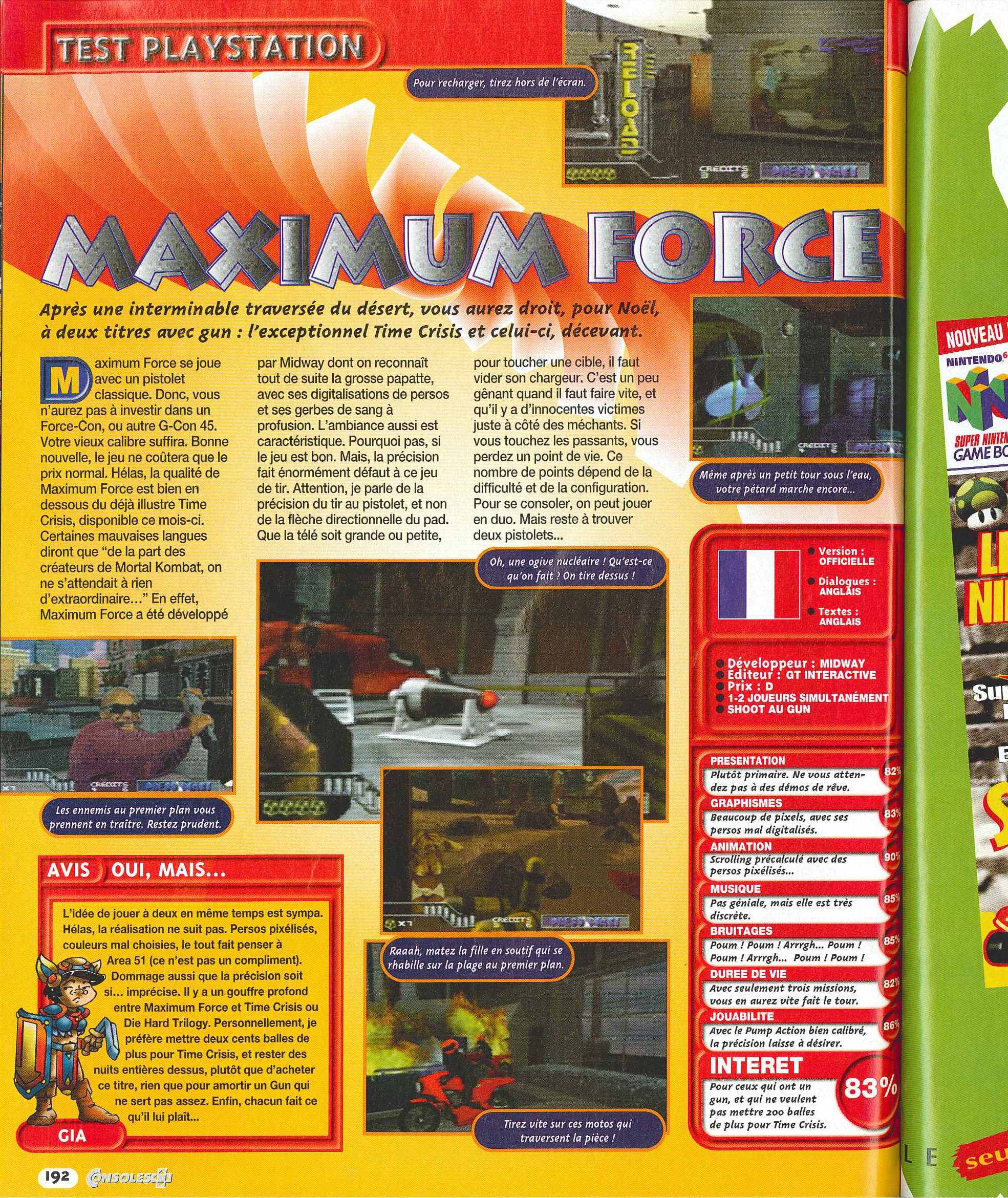
- ^ Gia (December 1997). "Maximum Force (PS)". Consoles + (in French). No. 71. p. 192. Retrieved 31 October 2021.
- ^ a b c d e f Smith, Shawn; Craig; Boyer, Crispin; Sushi-X (November 1997). "Review Crew". Electronic Gaming Monthly. Vol. 10, no. 11. Ziff-Davis Publications. p. 198. Retrieved October 13, 2025 – via Video Game History Foundation.
- ^ a b "Maximum Force (PS, Saturn)". Game Informer. No. 54. FuncoLand. October 1997. p. 68. Archived from the original on 21 September 1999. Retrieved 31 October 2021.
- ^ a b c d e f Gerstmann, Jeff. "Maximum Force Review". GameSpot. CBS Interactive. Retrieved February 6, 2020.
- ^ a b c d e Gerstmann, Jeff. "Maximum Force Review". GameSpot. CBS Interactive. Retrieved February 6, 2020.
- ^ a b c d e "Maximum Force Review". IGN. September 25, 1997. Retrieved 6 February 2020.
- ^ a b "Maximum Force". Next Generation. No. 32. Imagine Media. August 1997. p. 126. Retrieved 30 October 2021.
- ^ Mollohan, Gary (November 1997). "Maximum Force". Official U.S. PlayStation Magazine. Vol. 1, no. 2. Ziff Davis. p. 92. Retrieved 30 October 2021.
- ^ Bickham, Jes (July 1998). "Maximum Force". PC Gamer UK. No. 58. Future Publishing. Archived from the original on 4 May 2001. Retrieved 31 October 2021.
- ^ Harris, Ian (June 1998). "Maximum Force". PC Zone. No. 64. Dennis Publishing. p. 100. Retrieved 31 October 2021.
- ^ a b c d e f g Cutlack, Gary (January 1998). "Review: Maximum Force". Sega Saturn Magazine. No. 27. EMAP. pp. 70–71. Retrieved 30 October 2021.
- ^ "NG Alphas: Atari Comes Alive". Next Generation. No. 35. Imagine Media. November 1997. p. 78.
- ^ a b c d Full-On Ferret (November 1997). "Maximum Force (PS)". GamePro. No. 110. IDG. p. 150.
External links
[edit]

Maximum Force
View on GrokipediaDevelopment and Production
Concept and Design
Maximum Force was conceived as a spiritual successor to the 1995 light gun shooter Area 51, developed by the same studio, Mesa Logic, but pivoting from a science fiction alien invasion narrative to a realistic counter-terrorism theme involving elite agents combating global threats. This shift aimed to capitalize on Area 51's commercial success while introducing a more grounded, high-stakes action framework suited for cooperative arcade play.[1][7] The project's key personnel included Atari Games producer Rob Rowe, who oversaw overall production; Mesa Logic game designer Robert Weatherby, responsible for core concept and structure; art director James Webb; 3D animators Guy Fumagalli and James Webb; and composer John Paul, who handled audio design. These contributors drew on their experience from prior light gun titles to emphasize intense, accessible gameplay.[8] Central design choices focused on on-rails shooting mechanics to deliver relentless forward momentum through fixed paths, enhancing the arcade thrill without complex navigation. To build tension, the game incorporated hostage mechanics, where players must carefully identify and avoid shooting civilians amid chaotic firefights, with penalties for mistakes adding risk-reward depth. Variety was achieved through three distinct environments: a hijacked cargo ship at a dock for close-quarters naval combat, an urban bank robbery scenario emphasizing precision in crowded interiors, and a dense jungle outpost introducing environmental hazards and ambushes.[9][10] The game debuted as a prototype showcase at the Amusement Trades Exhibition International (ATEI) in London in January 1997, allowing industry attendees to experience its innovative force-feedback light gun integration early in development.[11]Technical Aspects
Maximum Force was developed by Mesa Logic for Atari Games, utilizing the COJAG arcade system board, an adaptation of the Atari Jaguar hardware designed for light gun shooters.[1][12] The COJAG employs a MIPS R3000 CPU running at 33 MHz, paired with the "Tom" graphics chip at 26 MHz for handling object processing, including scaled sprites and bitmapped graphics, and the "Jerry" chip for I/O and sound processing.[12] This setup enabled the game's rail-shooter mechanics on a single-board configuration with an integrated hard drive for storing video assets, supporting resolutions up to 320x240 in a JAMMA-compatible format.[12] Key programming contributions came from Charlie Grisafi of Atari Games and David G. Mahaffey of Mesa Logic, who handled the core software implementation.[13] They integrated digitized video graphics, where enemies and bystanders were captured as full-motion video sprites overlaid on prerendered 3D environments, creating a hybrid visual style that emphasized realistic actor performances for immersive combat sequences.[1][3] Sprite-based enemies were rendered efficiently through the "Tom" chip's blitter capabilities, allowing for dynamic scaling and Z-buffering without compromising frame rates during intense shooting action. Light gun calibration was a critical software feature, ensuring accurate targeting by mapping optical sensor inputs to on-screen crosshairs, with built-in test modes for operator adjustments to maintain precision across various cabinet setups.[13][12] The audio system featured custom sound design by composer John Paul, incorporating explosive effects, weapon fire, and voice samples to heighten immersion in the game's terrorist-themed missions.[14][3] Paul's work utilized the "Jerry" chip's 16-bit DACs and DSP for processing layered soundscapes, including sampled dialogue from actors to simulate radio communications and enemy reactions, all synchronized with the digitized visuals for seamless playback.[15][12] Development challenges centered on optimizing performance for dual-gun cabinets, where simultaneous player inputs demanded low-latency hit detection to prevent desynchronization in cooperative modes. The team addressed this by leveraging the COJAG's dedicated I/O processing to handle optical gun signals in real-time, minimizing lag through efficient sprite collision algorithms tied to the light gun's photon detection.[12] This technical foundation built directly on the prior Area 51, refining hardware utilization for enhanced multiplayer responsiveness.[1]Release History
Arcade Versions
Maximum Force was initially released in arcades in February 1997 by Atari Games.[16] The game made its debut appearance at the Amusement Trades Exhibition International (ATEI) in London in January 1997, providing early international exposure ahead of its full rollout.[17] Distribution focused primarily on North American arcades as a wide release from the U.S.-based Atari Games, with approximately 97 known units preserved among collectors, including 75 original dedicated cabinets.[2] The original arcade cabinets featured an upright standard design equipped with optical light guns, supporting simultaneous play for up to two players in a dual-gun configuration while also accommodating single-player mode.[2] This setup emphasized the game's cooperative light gun shooting mechanics, adapted for the arcade hardware's Jaguar-based system. In 1998, Atari Games re-released Maximum Force bundled with Area 51 in a combo titled Area 51 / Maximum Force Duo, utilizing a shared upright cabinet to leverage the popularity of both titles.[18] The Duo version operated as a conversion kit, running both games from a single hard drive with swappable EPROMs, and included enhancements such as a new tournament mode for Maximum Force and additional secret areas.[18] This configuration maintained the dual optical gun setup for two players and was available as a kit for existing Area 51 or Maximum Force cabinets, with around 161 known instances documented.[18]Home Ports
The PlayStation port of Maximum Force was released on September 30, 1997 by Midway Home Entertainment, with development handled by Tantalus Interactive.[5] This adaptation supported the Namco GunCon light gun peripheral for precise aiming, alongside standard controllers, and introduced a configurable life system allowing up to seven lives per player, contrasting the arcade original's stricter four-hit tolerance before requiring additional credits.[9] The port retained the core rail-shooter mechanics but added home-friendly features like adjustable difficulty and bonus content to accommodate single-player sessions on television screens. The Sega Saturn version followed on October 13, 1997, also published by Midway Home Entertainment and ported by Tantalus Interactive, optimizing the game for the console's analog controller and dedicated light gun accessory.[19][20] Graphical adjustments were made for standard TV output, including a border that reduces the effective playfield size and resolution of full-motion video sequences and assets, while preserving the core animations.[1] Like the PlayStation release, it incorporated the seven-life system for extended play without constant restarts.[9] A Windows PC port arrived in 1997, published by GT Interactive Software, with porting by Perfect Entertainment.[21][20] It supported mouse input as a primary control method to emulate light gun functionality, along with compatibility for early PC light gun peripherals, and included options for fullscreen mode and variable difficulty settings to suit desktop hardware variations.[3] The seven-life system was retained here as well.[9] Porting Maximum Force to home platforms required adapting the arcade's full-motion video and pre-rendered 3D elements to consumer hardware. Developers also integrated new menu interfaces for save states and options, absent in the coin-operated original, while ensuring seamless integration with diverse peripherals like light guns to maintain the intuitive shooting experience.Gameplay Mechanics
Core Features
Maximum Force utilizes a point-and-shoot light gun interface, allowing players to aim directly at on-screen targets to fire upon enemies in a first-person perspective. The controls support simultaneous gameplay for one or two players, enabling cooperative action without alternating turns.[2][3] Gameplay occurs in scenes with a 90-second time limit; failure to eliminate all threats within the time results in damage to the player.[1] Shooting mechanics provide unlimited ammunition overall, though players must reload by pointing the light gun off-screen after a clip of shots, simulating realistic firearm handling. Rapid-fire power-ups, obtained by shooting specific icons, temporarily upgrade the weapon to a machine gun for increased firing rate. A key penalty mechanic deducts a life for accidentally hitting civilians, who are visually distinguished by lighter clothing from dark-clad terrorists, emphasizing precise aiming. Additionally, destroying environmental objects like explosive barrels or crates yields bonus points, adding strategic depth to target selection beyond enemies.[22][1][9] The health system operates on a lives-based structure, with players starting with 4 lives in the arcade version (adjustable via operator settings; up to 7 in console ports). Each hit from enemy fire or shooting a civilian deducts one life, leading to a game over when all lives are lost unless continues are inserted via credits.[9][1][23] Power-ups extend beyond rapid fire to include temporary weapon variants, such as a shotgun for area-effect shots in close quarters, enhancing precision or crowd control as needed. Hidden items scattered across levels, like those in secret rooms accessed by shooting specific objects, grant score multipliers to boost overall performance and encourage exploration within the rail-shooter format.[1][3]Levels and Progression
Maximum Force features three distinct missions that form the core of its gameplay progression, with players initially choosing between the first two before unlocking the third as the climactic finale.[24] The game's structure emphasizes on-rails advancement through enemy-infested environments, where counter-terrorist agents must eliminate threats while protecting civilians and hostages to advance.[1] The Cargo Ship mission, selectable as the starting point, involves infiltrating a hijacked vessel docked at a port, where players navigate deck and interior sections to neutralize armed terrorists and rescue crew members amid hazards like explosive barrels and civilian bystanders.[24] Key segments include boarding the boat, an underwater approach with scuba divers, and a staircase assault leading to missile silos, requiring precise shooting to avoid friendly fire that could end lives prematurely.[24] Alternatively, players can begin with the Bank mission, an urban heist scenario set in a high-rise financial institution under siege by robbers and guards, focusing on rooftop entry, vault penetration, and elevator defense while steering clear of panicked civilians in teller areas and secure rooms.[24] This level progresses from exterior truck and gazebo skirmishes to interior counter battles, culminating in a helicopter boss encounter that demands rapid target acquisition to prevent mission failure.[24] Upon completing the initial two missions in any order, the Jungle mission unlocks as the finale, depicting a desperate escape through dense enemy territory filled with pursuing forces, booby traps, and heavy weaponry in a wilderness setting.[24] It encompasses wilderness chases on four-wheelers, a plane crash site, laboratory infiltrations, and sewer escapes leading to tanker truck confrontations, emphasizing survival against escalating boss-like threats to conclude the narrative arc.[24] Overall progression is linear within each mission's scenes, with the early branching choice between Cargo Ship and Bank adding replayability, though the total experience typically lasts 20-30 minutes per full playthrough due to the concise, action-packed design.[25]Reception and Impact
Critical Reviews
Upon its 1997 arcade release, Maximum Force received mixed reviews that highlighted its energetic shooting action while critiquing its lack of originality as a follow-up to Area 51. Critics appreciated the fast-paced gameplay and immersive audio design, particularly the explosive sound effects that enhanced the intensity of firefights against terrorists. However, it was frequently described as derivative, with a confusing storyline and fewer stages than its predecessor, leading to moderate scores in contemporary assessments.[26][27] The PlayStation port, released later that year, fared similarly in critical reception, earning a 4.7/10 from GameSpot, which praised the decent graphics, effective full-motion video sequences, and above-average sound effects and music but lambasted its brevity—limited to just three short levels—and absence of replay value or deeper mechanics. IGN awarded the same version a 5/10, noting the smooth camera tracking and standard light-gun mechanics that built tension through avoiding hostage shots amid digitized video backdrops, yet faulted its repetitive structure and low replayability when stacked against more innovative titles like Time Crisis or Virtua Cop 2. The PlayStation version holds a Metacritic score of 57/100.[28][29][6] Reviews of the PC port echoed these sentiments, with GameSpot assigning a 4.4/10 and emphasizing the faithful arcade translation but underscoring the same issues of limited depth and innovation in a market shifting toward polygonal graphics.[30] Overall, while the game's use of pre-rendered video for immersive environments and the challenge of precise shooting to spare civilians were commended across platforms, detractors consistently pointed to monotonous level design, dated live-action aesthetics by late 1997, and scant deviations from established light-gun formulas as key shortcomings.[29][28]Commercial Performance and Legacy
The arcade version of Maximum Force achieved moderate commercial success.[31] Home ports for the PlayStation, Sega Saturn, and PC followed in 1997, though these versions saw modest sales without achieving the arcade's scale.[31] Re-releases have kept the game accessible, including the 1998 Area 51/Maximum Force Duo arcade cabinet that integrated both titles for player selection.[32] In the 2020s, emulation has enabled its inclusion in modern arcade setups, such as customized Arcade1Up cabinets running the original via community software.[33] Maximum Force influenced the light gun shooter genre by building on Area 51's on-rails format, emphasizing fast-paced terrorist takedowns and realistic gun handling that became staples in arcade shooters.[31] As a hallmark of 1990s arcade nostalgia, it appears in retro gaming analyses and playthrough videos, evoking memories of cooperative light gun play.[34] Fan-driven preservation efforts, including 2025 community projects converting original cabinets to emulation rigs with authentic light guns, have sustained its playability.[35][36] Lacking major sequels, Maximum Force nonetheless bolstered Atari Games' shooter lineup, contributing to the enduring appeal of light gun mechanics in arcade history.[31]References
- https://strategywiki.org/wiki/Maximum_Force